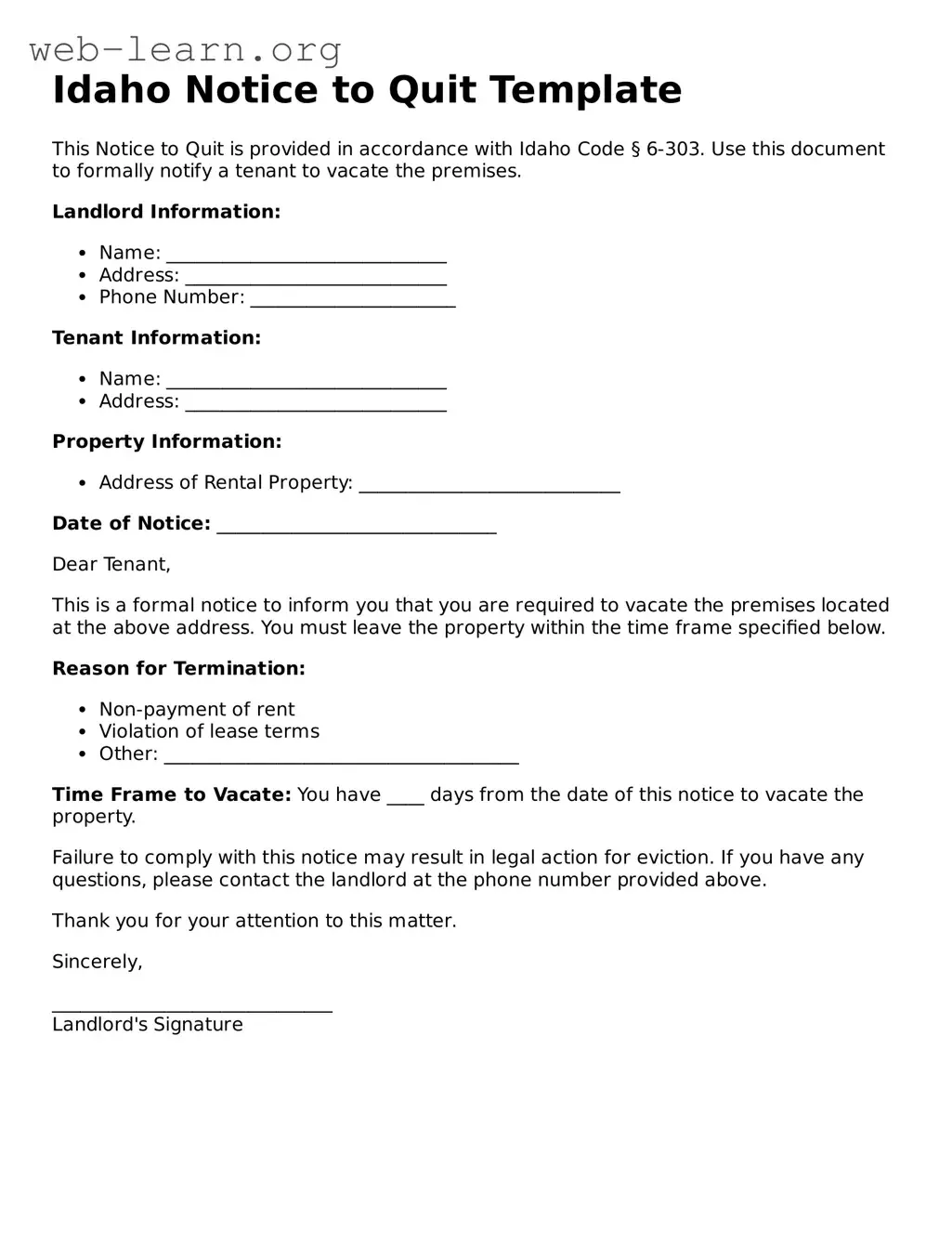
The Idaho Notice to Quit form serves as a critical tool for landlords and tenants navigating the complexities of rental agreements. This document is primarily used when a landlord wishes to terminate a lease due to specific reasons, such as non-payment of rent or lease violations. It outlines essential details, including the tenant's name, the property address, and the reason for termination. The form also specifies a timeframe within which the tenant must vacate the premises, ensuring that both parties understand their rights and obligations. By providing clear instructions and legal guidelines, the Notice to Quit helps facilitate a smoother transition for all involved, aiming to minimize disputes and misunderstandings. Understanding the nuances of this form can empower both landlords and tenants to make informed decisions regarding their rental relationships.
Idaho Notice to Quit Template
This Notice to Quit is provided in accordance with Idaho Code § 6-303. Use this document to formally notify a tenant to vacate the premises.
Landlord Information:
Tenant Information:
Property Information:
Date of Notice: ______________________________
Dear Tenant,
This is a formal notice to inform you that you are required to vacate the premises located at the above address. You must leave the property within the time frame specified below.
Reason for Termination:
Time Frame to Vacate: You have ____ days from the date of this notice to vacate the property.
Failure to comply with this notice may result in legal action for eviction. If you have any questions, please contact the landlord at the phone number provided above.
Thank you for your attention to this matter.
Sincerely,
______________________________
Landlord's Signature
| Fact Name | Description |
|---|---|
| Purpose | The Idaho Notice to Quit form is used by landlords to inform tenants of the need to vacate the rental property. |
| Governing Law | This form is governed by Idaho Code § 6-303 and § 55-208. |
| Notice Period | Landlords typically must provide a 3-day notice for non-payment of rent. |
| Delivery Methods | The notice can be delivered in person, by mail, or by posting on the property. |
| Tenant's Rights | Tenants have the right to contest the notice in court if they believe it is unjust. |
| Form Requirements | The form must include specific details such as the tenant's name, address, and reason for eviction. |
| Signature Requirement | The landlord must sign the notice to validate it. |
| Response Time | Tenants typically have a limited time to respond or vacate, depending on the reason for the notice. |
| Legal Consequences | Failure to comply with the notice may lead to eviction proceedings in court. |
After obtaining the Idaho Notice to Quit form, it is essential to complete it accurately to ensure proper communication with the tenant. Follow the steps below to fill out the form correctly.
What is a Notice to Quit in Idaho?
A Notice to Quit is a formal document that a landlord provides to a tenant to request that they vacate the rental property. In Idaho, this notice serves as a precursor to eviction proceedings. It outlines the reasons for the eviction and gives the tenant a specified period to leave the premises. The notice is crucial for ensuring that the landlord follows the legal process when seeking to reclaim their property.
How long does a tenant have to respond to a Notice to Quit?
The response time varies based on the reason for the eviction. Generally, Idaho law stipulates the following timeframes:
It is essential for tenants to read the Notice to Quit carefully to understand their obligations and timeline.
What should a Notice to Quit include?
A properly drafted Notice to Quit should contain several key elements to ensure its effectiveness:
Including these elements helps to provide clarity and reduces the likelihood of disputes later on.
Can a tenant contest a Notice to Quit?
Yes, a tenant has the right to contest a Notice to Quit. If the tenant believes the notice is unjust or that they have rectified the issue, they may choose to respond in writing or seek legal counsel. If the situation escalates to court, the tenant can present their case, and the court will ultimately decide whether the eviction is warranted.
What happens if a tenant does not comply with a Notice to Quit?
If a tenant does not comply with the Notice to Quit within the specified timeframe, the landlord may proceed with eviction proceedings. This often involves filing an unlawful detainer action in court. The court will then schedule a hearing, where both parties can present their arguments. If the court rules in favor of the landlord, a judgment will be issued, allowing the landlord to regain possession of the property.
Filling out the Idaho Notice to Quit form can be a straightforward process, but many people make common mistakes that can lead to complications. One frequent error is failing to include the correct date. The notice must specify when the tenant is expected to vacate the property. Without a clear date, the notice may be considered invalid, leaving landlords without a proper legal basis to proceed with eviction.
Another mistake involves not providing adequate details about the reason for the eviction. Whether it’s for non-payment of rent or lease violations, the grounds for eviction must be clearly stated. Vague language or insufficient explanation can confuse the tenant and weaken the landlord's position if the matter escalates to court.
People also often overlook the importance of proper delivery. The Idaho Notice to Quit must be served in accordance with state law. Whether it’s through personal delivery, certified mail, or another method, failing to follow the correct procedure can render the notice ineffective. This means that even if the form is filled out correctly, the landlord may not have the legal standing to evict.
Additionally, many individuals neglect to keep a copy of the completed form for their records. This is essential for any future legal proceedings. Having a copy can provide proof that the notice was issued and can help establish a timeline of events, which is crucial in case of disputes.
Finally, some people mistakenly assume that a Notice to Quit is a final eviction order. It is not. It is simply a formal request for the tenant to vacate the premises. Misunderstanding this can lead to frustration and confusion about the eviction process. It’s vital to remember that further legal action may be necessary if the tenant does not comply with the notice.
The Idaho Notice to Quit form is an important document used in the process of terminating a rental agreement. However, it is often accompanied by other forms and documents that help clarify the situation or provide additional information. Below is a list of commonly used documents that may accompany the Notice to Quit in Idaho.
Understanding these documents can help both landlords and tenants navigate the complexities of rental agreements and ensure that their rights are respected throughout the process.
The Notice to Quit form is similar to several other documents used in landlord-tenant relationships. Each serves a specific purpose related to tenancy termination or eviction processes. Below are six documents that share similarities with the Notice to Quit form:
When filling out the Idaho Notice to Quit form, it is important to approach the task with care and attention to detail. This form serves as a formal notification to a tenant regarding the termination of their lease. Here are some essential dos and don'ts to keep in mind:
By following these guidelines, you can ensure that the Notice to Quit is completed accurately and serves its intended purpose effectively.
Understanding the Idaho Notice to Quit form is essential for both landlords and tenants. However, several misconceptions can lead to confusion and missteps. Here are six common misconceptions:
Many people believe that a Notice to Quit is an eviction notice. In reality, it is a preliminary step that informs a tenant that they must vacate the property. An eviction notice follows if the tenant does not comply.
Some think that all tenants are entitled to the same notice period. In Idaho, the notice period can vary based on the reason for termination and the type of tenancy. For example, a month-to-month tenant may receive a different notice than a tenant with a fixed lease.
It is a common belief that the notice must be delivered directly to the tenant. However, Idaho law allows for alternative methods of delivery, such as posting the notice on the property and sending it via certified mail.
Some landlords think they can issue a Notice to Quit at any time and for any reason. In Idaho, there are specific legal grounds that must be met, such as non-payment of rent or lease violations.
Many tenants believe that they must vacate the premises immediately upon receiving a Notice to Quit. In reality, they typically have a set period to respond or remedy the situation before eviction proceedings can begin.
Some tenants assume that if their lease has expired, they can remain in the property without a Notice to Quit. However, landlords are still required to provide notice before initiating eviction procedures, even after a lease ends.
Understanding these misconceptions can help both landlords and tenants navigate the rental process more effectively, ensuring that rights and responsibilities are clear.
When using the Idaho Notice to Quit form, consider the following key points:
Understanding these points can help ensure that the process is handled correctly and efficiently.
Printable Indiana Eviction Notice Form - It may also include instructions for the tenant to remedy the situation.
Three Day Notice to Quit - Landlords should avoid any form of harassment when delivering the notice.
Michigan Eviction - Landlords should keep a copy of the Notice to Quit for their records.