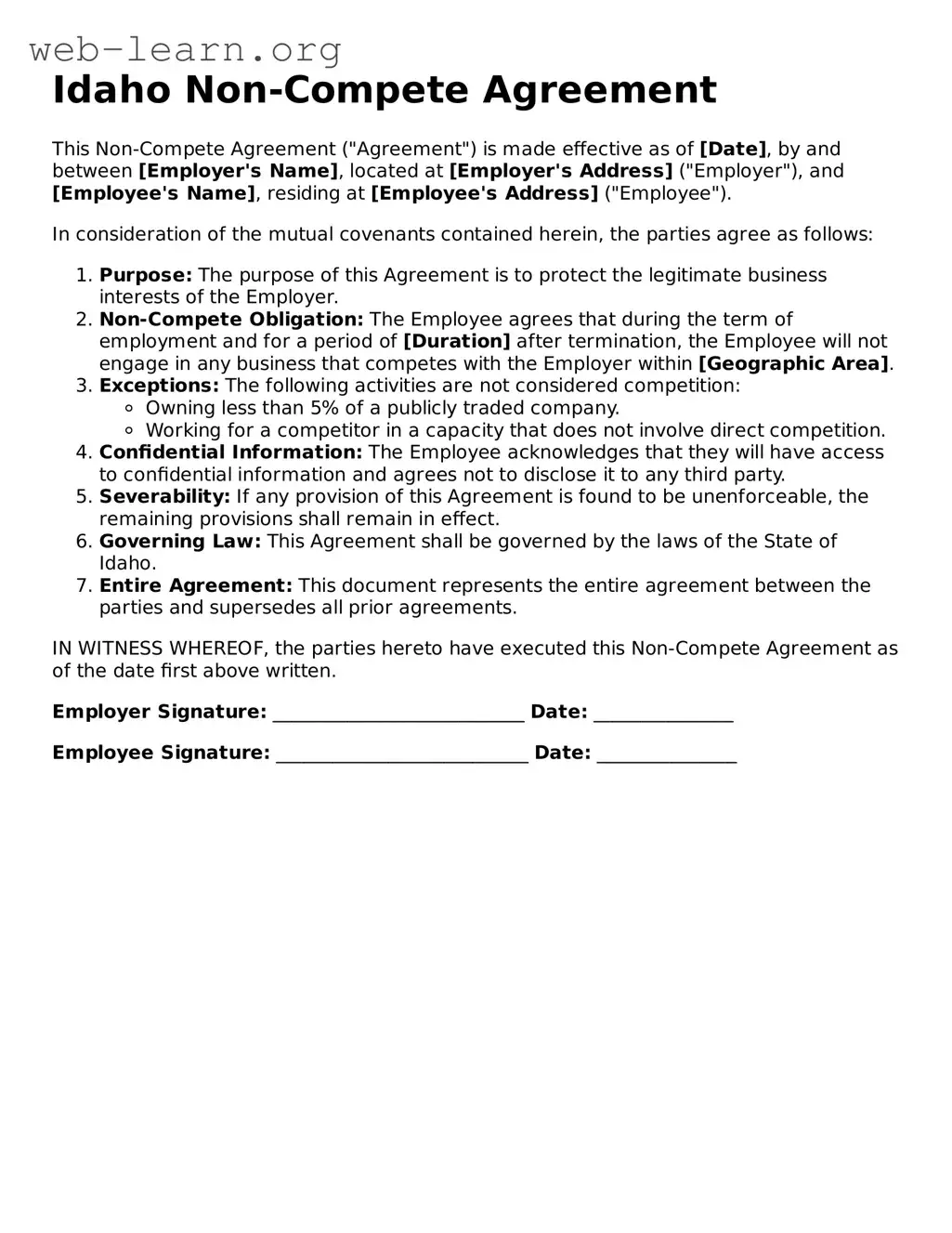
The Idaho Non-compete Agreement form serves as a crucial tool for employers seeking to protect their business interests while also outlining the expectations for employees. This form typically includes essential elements such as the duration of the non-compete period, the geographic scope of the restrictions, and the specific activities that are prohibited after employment ends. It is designed to prevent former employees from sharing confidential information or competing directly with their previous employer within a defined timeframe and area. Clarity is vital; both parties must understand their rights and obligations. Employers must ensure that the terms are reasonable and enforceable under Idaho law to avoid potential disputes. Employees, on the other hand, should carefully review the agreement before signing to comprehend the limitations it imposes on their future job opportunities. Understanding these components is essential for both parties to navigate the complexities of employment relationships in Idaho effectively.
Idaho Non-Compete Agreement
This Non-Compete Agreement ("Agreement") is made effective as of [Date], by and between [Employer's Name], located at [Employer's Address] ("Employer"), and [Employee's Name], residing at [Employee's Address] ("Employee").
In consideration of the mutual covenants contained herein, the parties agree as follows:
IN WITNESS WHEREOF, the parties hereto have executed this Non-Compete Agreement as of the date first above written.
Employer Signature: ___________________________ Date: _______________
Employee Signature: ___________________________ Date: _______________
| Fact Name | Details |
|---|---|
| Governing Law | Idaho Code § 44-1801 et seq. |
| Definition | A non-compete agreement restricts an employee's ability to work in a similar field after leaving a job. |
| Enforceability | Non-compete agreements are enforceable in Idaho if they are reasonable in duration and geographic scope. |
| Duration | Typically, a duration of one to two years is considered reasonable in Idaho. |
| Geographic Scope | The geographic area must be limited to where the employer operates or has a legitimate business interest. |
| Consideration | For a non-compete agreement to be valid, the employee must receive something of value, such as a job offer or training. |
After obtaining the Idaho Non-compete Agreement form, you will need to complete it accurately to ensure its validity. Follow the steps below to fill out the form correctly.
Once the form is filled out, make sure to keep a copy for your records and provide a copy to the other party involved. This ensures both parties have access to the terms agreed upon.
What is a Non-compete Agreement in Idaho?
A Non-compete Agreement is a legal contract between an employer and an employee. It restricts the employee from engaging in certain activities that could compete with the employer’s business after leaving the job. In Idaho, these agreements are enforceable under specific conditions, ensuring that they protect legitimate business interests without imposing unreasonable restrictions on the employee's ability to work.
What are the key elements of a valid Non-compete Agreement in Idaho?
For a Non-compete Agreement to be valid in Idaho, it must meet several criteria:
How long can a Non-compete Agreement last in Idaho?
The duration of a Non-compete Agreement in Idaho should be reasonable. Typically, courts may enforce agreements lasting up to two years, depending on the specific circumstances of the employment and the industry. However, longer durations may be scrutinized for fairness and reasonableness.
Are there any restrictions on the geographic area covered by a Non-compete Agreement?
Yes, the geographic scope of a Non-compete Agreement must be reasonable and related to the area where the employer conducts business. A broad or overly expansive geographic restriction may lead to the agreement being deemed unenforceable. The goal is to ensure that the employee is not unfairly limited in their ability to find work.
Can an employee negotiate the terms of a Non-compete Agreement?
Employees have the right to negotiate the terms of a Non-compete Agreement before signing. This includes discussing the duration, geographic scope, and specific activities that are restricted. It is advisable for employees to seek legal advice during this process to ensure their rights and interests are protected.
What happens if an employee violates a Non-compete Agreement?
If an employee violates the terms of a Non-compete Agreement, the employer may seek legal remedies. This could include injunctive relief to prevent the employee from continuing the competing activities, as well as monetary damages for any losses incurred due to the violation. The specific consequences depend on the terms of the agreement and the nature of the violation.
Are there any exceptions to enforceability of Non-compete Agreements in Idaho?
Yes, there are exceptions. Non-compete Agreements may not be enforceable if they are deemed overly restrictive or if they do not protect a legitimate business interest. Additionally, Idaho law prohibits the enforcement of Non-compete Agreements against employees who are terminated without cause or who resign due to a significant change in their employment conditions.
When filling out the Idaho Non-compete Agreement form, individuals often make several common mistakes that can affect the enforceability of the agreement. Understanding these pitfalls is essential for anyone entering into such an agreement, whether they are employers or employees.
One frequent error is failing to clearly define the scope of the agreement. A non-compete should specify the activities that are restricted. Vague language can lead to confusion and may render the agreement unenforceable. For instance, if the form states that an employee cannot work in "any similar business," it may be too broad. Instead, it should detail the specific industry or types of roles that are off-limits.
Another mistake is neglecting to include a reasonable duration for the non-compete. Courts often look for a time frame that is fair and justifiable. If the duration is excessively long, it may be viewed as unreasonable. Typically, a period of six months to two years is considered acceptable, depending on the industry and position.
Many individuals also overlook the importance of geographic limitations. A non-compete agreement should outline the specific areas where the restrictions apply. Failing to do so can lead to enforceability issues. For example, if an employee is restricted from working in a state where the employer has no presence, the agreement could be deemed invalid.
Additionally, some people forget to consider the consideration aspect of the agreement. In legal terms, consideration refers to what each party receives in return for their obligations. If an employee signs a non-compete without receiving something of value—like a promotion, training, or a signing bonus—the agreement may lack the necessary legal foundation.
Finally, many individuals fail to review the agreement with legal counsel before signing. This oversight can lead to misunderstandings about the implications of the non-compete. Consulting with a legal expert can provide clarity and ensure that the agreement is fair and enforceable. Taking the time to understand the terms can save significant trouble down the road.
When entering into a Non-compete Agreement in Idaho, several other forms and documents may be necessary to ensure clarity and compliance. Each of these documents serves a specific purpose and can help protect both parties involved. Below is a list of commonly used forms that accompany a Non-compete Agreement.
These documents play a crucial role in establishing clear expectations and protecting the interests of both employers and employees. Ensuring that all relevant forms are properly executed can help avoid misunderstandings and legal disputes in the future.
When filling out the Idaho Non-compete Agreement form, it is essential to approach the task with care. Here are five important things to keep in mind:
By following these guidelines, you can navigate the Non-compete Agreement form more effectively and protect your interests.
Non-compete agreements can be a bit confusing, especially in Idaho. Here are some common misconceptions that people often have about these agreements:
Understanding these misconceptions can help you navigate the complexities of non-compete agreements in Idaho more effectively. Always consider seeking legal advice if you have questions about your specific situation.
When filling out and using the Idaho Non-compete Agreement form, it is important to consider several key points. Below are essential takeaways that can guide individuals and businesses in effectively utilizing this form.
How to Get Out of a Non Compete Agreement - It is important for both employers and employees to understand their rights and obligations under this agreement.
Are Non Competes Enforceable in Kentucky - Non-compete agreements can be a double-edged sword; while they protect businesses, they can limit employees’ career options.
How to Beat a Non Compete in New Jersey - This form ensures that employees understand the limitations placed on them regarding future employment opportunities.