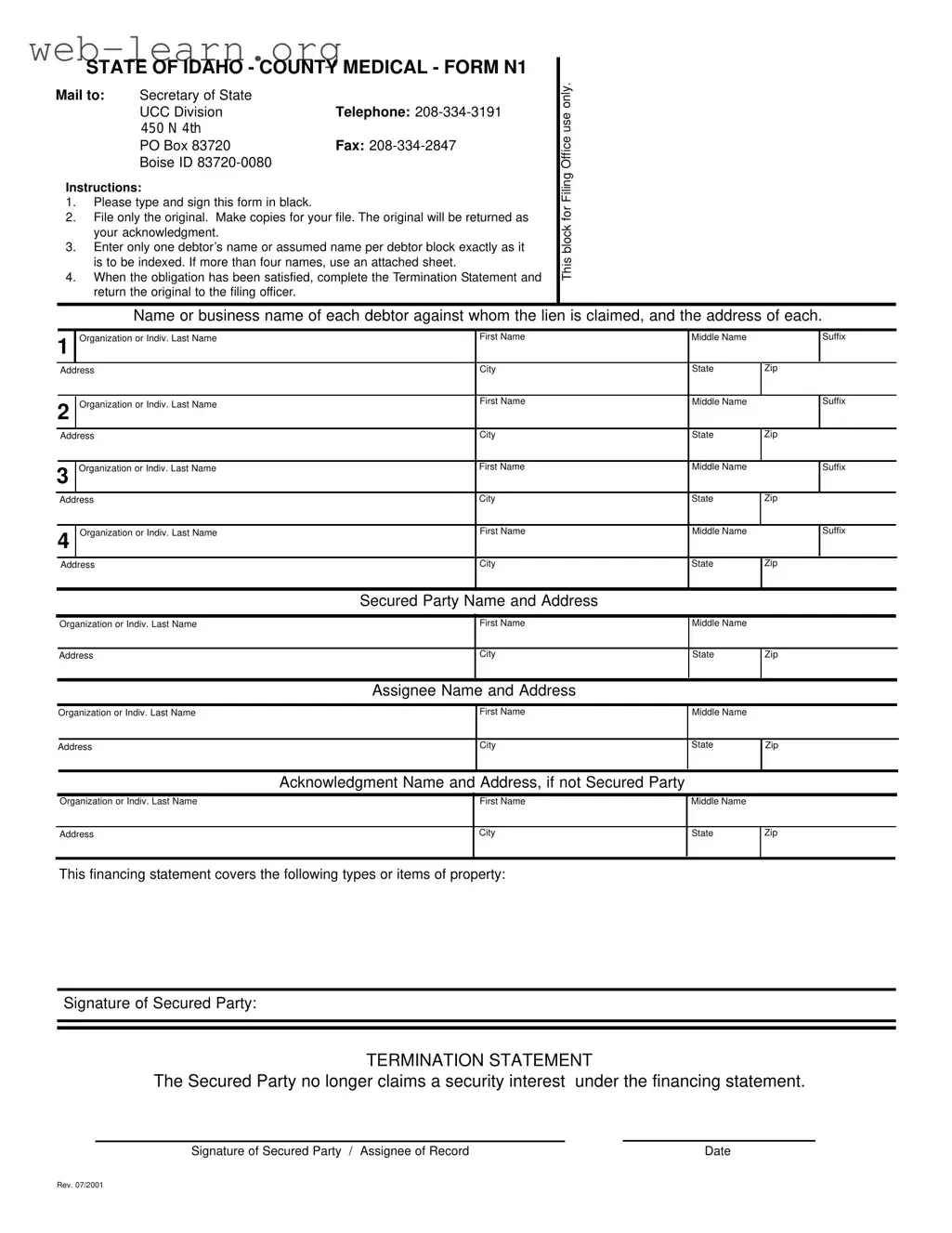
The Idaho N1 form is an essential document for anyone involved in secured transactions in the state of Idaho. This form is used to file a financing statement, which establishes a legal claim against specific assets or property in the event of a default. It requires detailed information, including the names and addresses of the debtors and the secured party, ensuring clarity and accuracy in the filing process. Each debtor's name must be entered precisely as it is intended to be indexed, and if there are more than four names, an additional sheet is necessary. The form also includes a termination statement, which must be completed when the obligation is satisfied, allowing the secured party to formally release their claim. By following the provided instructions, such as typing and signing the form in black ink and filing only the original, individuals can ensure that their filings are processed correctly. This document plays a crucial role in protecting the rights of creditors and providing transparency in financial transactions.
STATE OF IDAHO - COUNTY MEDICAL - FORM N1
Mail to: |
Secretary of State |
|
|
|
UCC Division |
Telephone: |
|
|
70045 WN 4thJefferson |
|
|
|
PO Box 83720 |
Fax: |
|
|
Boise ID |
|
|
Instructions:
1.Please type and sign this form in black.
2.File only the original. Make copies for your file. The original will be returned as your acknowledgment.
3.Enter only one debtor’s name or assumed name per debtor block exactly as it is to be indexed. If more than four names, use an attached sheet.
4.When the obligation has been satisfied, complete the Termination Statement and return the original to the filing officer.
blockThis Filingfor useOffice .only
Name or business name of each debtor against whom the lien is claimed, and the address of each.
1 |
Organization or Indiv. Last Name |
|
First Name |
Middle Name |
|
Suffix |
|
|
|
|
|||
|
|
|
|
|
|
|
Address |
|
City |
State |
Zip |
||
|
|
|
|
|
|
|
2 |
Organization or Indiv. Last Name |
|
First Name |
Middle Name |
|
Suffix |
|
|
|
|
|
||
|
|
|
|
|
|
|
Address |
|
City |
State |
Zip |
||
|
|
|
|
|
|
|
3 |
Organization or Indiv. Last Name |
|
First Name |
Middle Name |
|
Suffix |
|
|
|
|
|
|
|
Address |
|
City |
State |
Zip |
||
|
|
|
|
|
|
|
4 |
Organization or Indiv. Last Name |
|
First Name |
Middle Name |
|
Suffix |
|
|
|
|
|
||
|
|
|
|
|
|
|
Address |
|
City |
State |
Zip |
||
|
|
|
|
|
|
|
|
|
Secured Party Name and Address |
|
|
|
|
Organization or Indiv. Last Name
Address
First Name |
Middle Name |
|
|
City |
State |
|
Zip |
|
|||
|
|
|
|
|
|
|
|
Assignee Name and Address
Organization or Indiv. Last Name
First Name
Middle Name
Address
City
State
Zip
Acknowledgment Name and Address, if not Secured Party
Organization or Indiv. Last Name
First Name
Middle Name
Address
City
State
Zip
This financing statement covers the following types or items of property:
Signature of Secured Party:
TERMINATION STATEMENT
The Secured Party no longer claims a security interest under the financing statement.
Signature of Secured Party / Assignee of Record |
Date |
Rev. 07/2001
| Fact Name | Details |
|---|---|
| Purpose of Form | The Idaho N1 form is used to file a financing statement, which establishes a secured party's interest in a debtor's property. |
| Filing Authority | This form must be mailed to the Secretary of State's UCC Division in Idaho. |
| Governing Law | The Idaho Uniform Commercial Code (UCC) governs the use and filing of the N1 form. |
| Filing Instructions | Only the original form should be filed. Copies should be made for personal records, as the original will be returned as acknowledgment. |
| Debtor Information | Each debtor's name must be entered exactly as it is to be indexed. If there are more than four names, an attached sheet is required. |
Filling out the Idaho N1 form requires careful attention to detail. This form is essential for ensuring that the necessary information is accurately recorded. After completing the form, you will need to file it with the appropriate office and keep a copy for your records. Here’s how to fill it out step by step.
What is the Idaho N1 form?
The Idaho N1 form is a legal document used to file a financing statement in Idaho. This form is essential for securing a creditor's interest in a debtor's property. By filing this form, a secured party can establish their claim against the debtor's assets, which can include personal property or other collateral.
Who needs to file the Idaho N1 form?
Any individual or organization that is lending money or extending credit may need to file the Idaho N1 form. This includes businesses that want to secure a loan with collateral, as well as individuals who are providing personal loans. The form must be filed whenever a secured party wishes to protect their interest in the debtor's property.
What information is required on the form?
The Idaho N1 form requires specific details, including:
It is crucial to enter the debtor's name exactly as it should be indexed. If there are more than four names, an additional sheet should be attached.
How do I file the Idaho N1 form?
To file the Idaho N1 form, follow these steps:
Once filed, the original will be returned to you as acknowledgment of your submission.
What happens if the obligation is satisfied?
When the obligation secured by the financing statement is satisfied, the secured party must complete a Termination Statement. This statement indicates that the secured party no longer claims an interest under the original financing statement. The original Termination Statement should then be returned to the filing officer.
What is the purpose of the acknowledgment section?
The acknowledgment section of the Idaho N1 form is designed for the secured party or assignee to provide their name and address, if different from the secured party. This section helps ensure proper communication regarding the financing statement and any related matters.
Is there a fee associated with filing the Idaho N1 form?
While the specific fee can vary, it is important to check with the Idaho Secretary of State's office for the most current fee schedule. Generally, there may be a nominal fee for filing the form, which can be paid by check or money order.
Filling out the Idaho N1 form can seem straightforward, but there are several common mistakes that people often make. Being aware of these pitfalls can help ensure that your filing is successful and that you avoid unnecessary delays.
One frequent error is not following the instruction to type and sign the form in black ink. Submitting the form in any color other than black can lead to rejection, as it may not be legible when scanned or copied. Always check that your signature is clear and in the specified color to avoid complications.
Another common mistake is failing to file only the original document. Some individuals mistakenly send copies instead of the original form. Remember, the original is what gets processed, and you'll receive it back as acknowledgment. Always keep copies for your records, but ensure the filing is the original document.
People also often overlook the requirement to enter only one debtor’s name or assumed name per debtor block. If you have more than four names to include, you must attach an additional sheet. Neglecting this detail can result in incomplete filings, leading to delays in processing.
Additionally, many individuals forget to include complete and accurate addresses for each debtor. The form requires the full address, including city, state, and zip code. Incomplete information can create confusion and may affect the validity of the lien.
Another mistake involves not properly identifying the secured party. Ensure that the name and address of the secured party are clearly filled out. This information is crucial as it identifies who holds the security interest and must be accurate to avoid complications.
Some filers also neglect to sign the form. A signature is essential, as it validates the document. Without a signature, the form is considered incomplete and will not be processed. Double-check that you have signed in the designated area before submitting.
Lastly, individuals sometimes forget to complete the Termination Statement when the obligation has been satisfied. This step is critical to formally release the lien. Failing to do so can lead to confusion about the status of the lien and may affect future transactions.
By being mindful of these common mistakes, you can streamline the process of filing the Idaho N1 form and ensure that your paperwork is processed efficiently. Taking the time to carefully review each section will save you from potential headaches down the line.
The Idaho N1 form is an essential document for filing a financing statement, which establishes a security interest in personal property. Alongside the N1 form, there are several other important forms and documents that may be used in conjunction with it. Below is a brief overview of four such documents.
Understanding these accompanying documents can help streamline the process of securing interests and managing obligations. Being informed about each form's purpose ensures that all necessary steps are taken to maintain accurate and up-to-date records.
The Idaho N1 form serves a specific purpose in the realm of secured transactions, primarily related to filing a financing statement. Several other documents share similar characteristics or functions within the context of secured interests. Here is a list of nine documents that are comparable to the Idaho N1 form:
When filling out the Idaho N1 form, there are important guidelines to follow. Here’s a list of what you should and shouldn’t do:
When it comes to the Idaho N1 form, there are several misconceptions that can lead to confusion. Understanding the truth behind these misconceptions can help ensure that you complete the form correctly and efficiently. Here are seven common misconceptions:
By dispelling these misconceptions, you can navigate the process of filing the Idaho N1 form with greater confidence and clarity.
When filling out the Idaho N1 form, it is essential to follow specific guidelines to ensure accuracy and compliance. Here are some key takeaways to keep in mind: