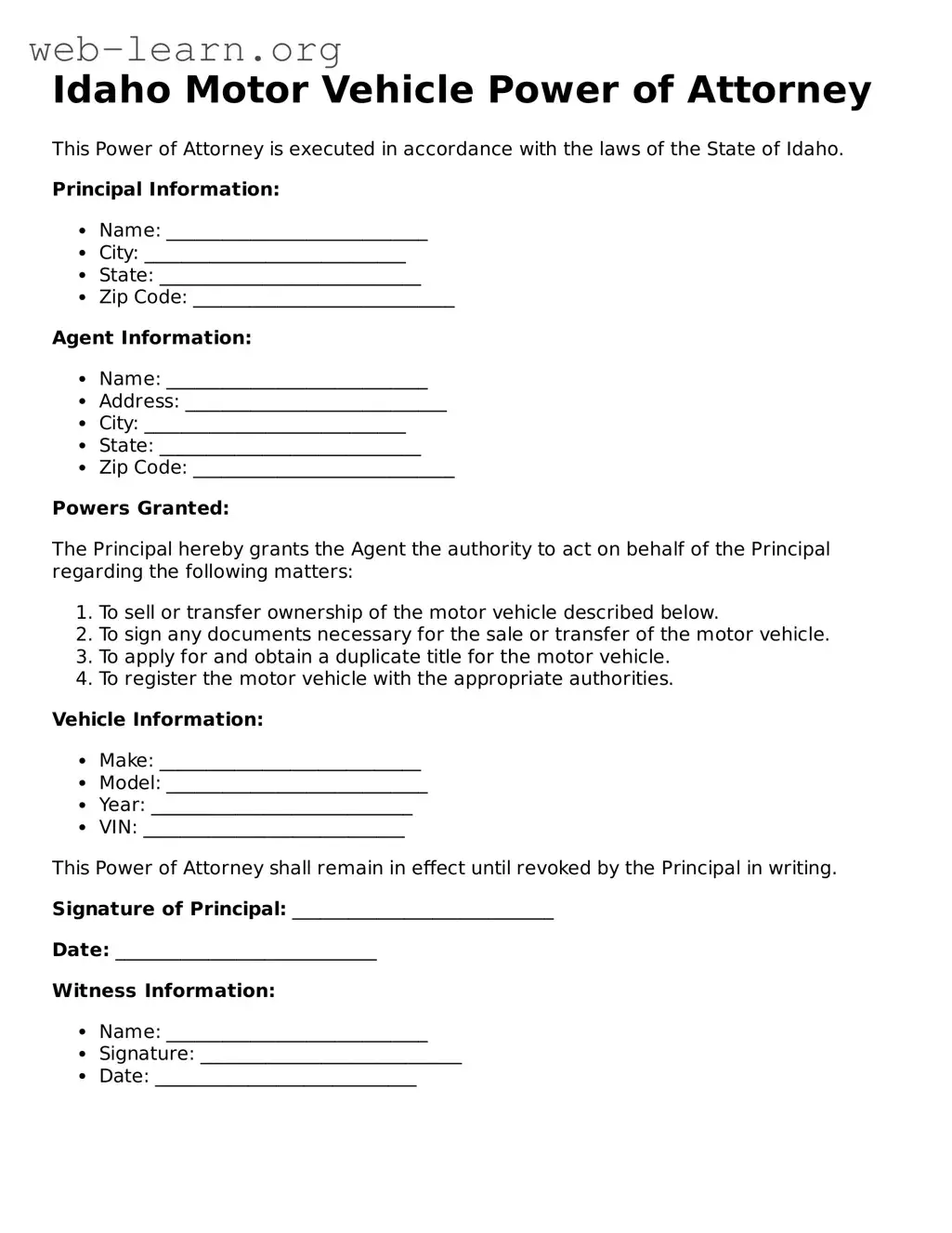
The Idaho Motor Vehicle Power of Attorney form is a crucial document for anyone needing to delegate authority related to motor vehicle transactions. This form allows an individual, known as the principal, to appoint another person, referred to as the agent, to act on their behalf. This can include tasks such as signing documents for vehicle registration, title transfers, and other essential transactions involving motor vehicles. The form is particularly useful when the principal cannot be present to complete these tasks due to time constraints or physical limitations. It is important to ensure that the agent is trustworthy, as they will have the power to make decisions regarding the principal's vehicle. Proper completion of the form includes providing necessary information about both the principal and the agent, as well as detailing the specific powers granted. Understanding the implications of this document is vital for anyone considering its use, as it can significantly streamline the process of managing motor vehicle affairs in Idaho.
Idaho Motor Vehicle Power of Attorney
This Power of Attorney is executed in accordance with the laws of the State of Idaho.
Principal Information:
Agent Information:
Powers Granted:
The Principal hereby grants the Agent the authority to act on behalf of the Principal regarding the following matters:
Vehicle Information:
This Power of Attorney shall remain in effect until revoked by the Principal in writing.
Signature of Principal: ____________________________
Date: ____________________________
Witness Information:
| Fact Name | Details |
|---|---|
| Purpose | The Idaho Motor Vehicle Power of Attorney form allows an individual to designate another person to act on their behalf regarding motor vehicle transactions. |
| Governing Law | This form is governed by Idaho Code § 49-201 and § 49-202, which outline the powers and limitations of a power of attorney in motor vehicle matters. |
| Signature Requirement | The form must be signed by the principal (the person granting authority) in the presence of a notary public to be valid. |
| Revocation | The power of attorney can be revoked at any time by the principal, provided the revocation is documented and communicated to the agent. |
| Agent's Authority | The agent can perform tasks such as signing documents, transferring titles, and handling registration on behalf of the principal. |
| Form Availability | The Idaho Motor Vehicle Power of Attorney form is available through the Idaho Department of Transportation and can often be found online. |
| Use Cases | This form is commonly used when the vehicle owner cannot be present for transactions, such as selling or transferring a vehicle. |
Once you have the Idaho Motor Vehicle Power of Attorney form in hand, you are ready to begin the process of filling it out. This form allows you to designate someone to act on your behalf regarding motor vehicle matters. Follow these steps to ensure that you complete the form correctly.
After completing the form, keep a copy for your records. You may need to provide the original to your attorney-in-fact for them to carry out the designated tasks. Ensure that both you and your attorney-in-fact understand the powers granted in this document.
What is a Motor Vehicle Power of Attorney in Idaho?
A Motor Vehicle Power of Attorney (POA) in Idaho is a legal document that allows one person, known as the principal, to authorize another person, known as the agent, to act on their behalf regarding motor vehicle transactions. This can include signing titles, registering vehicles, and handling other related tasks.
Who can be designated as an agent?
Any competent adult can be designated as an agent. This includes family members, friends, or professionals such as attorneys or financial advisors. It is crucial that the principal trusts the agent, as they will have the authority to make decisions related to the vehicle.
What types of transactions can the agent perform?
The agent can perform various transactions, including:
How long is the Motor Vehicle Power of Attorney valid?
The validity of a Motor Vehicle Power of Attorney in Idaho typically lasts until the principal revokes it or until the specific task is completed. It is advisable for the principal to clearly state the duration in the document if they have a specific timeframe in mind.
How do I revoke a Motor Vehicle Power of Attorney?
To revoke a Motor Vehicle Power of Attorney, the principal must create a written document stating the revocation. This document should be signed and dated. It is also recommended to notify the agent and any relevant parties, such as the DMV, to prevent unauthorized actions.
Is the Motor Vehicle Power of Attorney form available online?
Yes, the Motor Vehicle Power of Attorney form can typically be found on the Idaho Department of Motor Vehicles website or other legal document websites. Ensure that you are using the most current version to comply with state laws.
Do I need a notary for the Motor Vehicle Power of Attorney?
While notarization is not always required, it is highly recommended. Having the document notarized can provide an additional layer of authenticity and may be required by certain institutions when processing vehicle transactions.
Filling out the Idaho Motor Vehicle Power of Attorney form can be straightforward, but several common mistakes can lead to complications. One frequent error is failing to provide complete information. This includes not filling out all required fields, such as the names and addresses of both the principal and the agent. Omitting any details can result in delays or even the rejection of the form.
Another mistake is not signing the form correctly. The principal must sign the document, and if the signature does not match the name as it appears on the form, it may raise questions about the validity of the authorization. Additionally, the form may require a witness or notarization, depending on the specific requirements. Neglecting these steps can lead to further issues.
People sometimes overlook the importance of specifying the powers granted to the agent. The form should clearly outline what the agent is authorized to do. If the powers are too vague or broad, it could create confusion or lead to misuse of authority. Being specific helps to prevent misunderstandings later on.
Another common error involves not dating the form. A date is crucial as it indicates when the powers take effect. Without a date, there could be disputes regarding the timing of the authority granted. This can complicate matters if the principal becomes incapacitated or if there are changes in circumstances.
Some individuals forget to keep a copy of the completed form. It’s essential to retain a copy for personal records and to provide a copy to the agent. Without this, the agent may face difficulties proving their authority when dealing with third parties, such as banks or the Department of Motor Vehicles.
Failing to review the form for accuracy is another mistake. Errors in names, addresses, or other details can lead to problems. It is advisable to double-check all information before submission. A thorough review can help catch any mistakes that might otherwise go unnoticed.
Lastly, people sometimes fail to understand the implications of granting power of attorney. It is important to recognize that this document gives significant authority to the agent. If there are concerns about trust or the potential for misuse, it may be wise to reconsider or consult with a legal professional before proceeding.
When dealing with motor vehicle transactions in Idaho, several forms may accompany the Motor Vehicle Power of Attorney form. Each of these documents serves a specific purpose and can help streamline the process. Below is a list of commonly used forms that may be relevant.
Using the appropriate forms alongside the Idaho Motor Vehicle Power of Attorney can simplify the process of managing vehicle transactions. Each document plays a vital role in ensuring that everything is handled correctly and legally.
When filling out the Idaho Motor Vehicle Power of Attorney form, it's essential to approach the task with care and attention to detail. Here are five important do's and don'ts to keep in mind:
By following these guidelines, you can ensure that the process goes smoothly and that your intentions are clearly communicated. Taking the time to fill out the form correctly will help avoid potential issues in the future.
Understanding the Idaho Motor Vehicle Power of Attorney form is crucial for anyone looking to delegate authority regarding vehicle transactions. However, several misconceptions exist that can lead to confusion. Here are five common misconceptions:
Clarifying these misconceptions can help ensure that the Idaho Motor Vehicle Power of Attorney is used effectively and appropriately.
When it comes to managing your vehicle's legal matters in Idaho, the Motor Vehicle Power of Attorney (POA) form is a useful tool. Here are some key takeaways to keep in mind when filling out and using this form:
Understanding these key points will help you navigate the process smoothly and ensure that your vehicle matters are handled appropriately.
How to Get Power of Attorney in Arizona - This form can be especially beneficial for elderly individuals who may need assistance with their vehicle matters.
Poa Dmv - This document can be essential for individuals with busy schedules who need help managing their vehicles.
Louisiana Dmv Power of Attorney - It can help prevent potential disputes by clearly outlining the authority granted to your agent.