The Idaho Last Will and Testament form serves as a crucial legal document that allows individuals to outline their wishes regarding the distribution of their assets after death. This form provides a structured way for a person, known as the testator, to specify beneficiaries who will inherit property, designate guardians for minor children, and appoint an executor to manage the estate. Additionally, it offers the opportunity to include specific bequests, such as personal items or monetary gifts, ensuring that the testator's intentions are clear. The document must be signed and witnessed according to Idaho law to be valid, emphasizing the importance of adhering to proper legal procedures. By utilizing this form, individuals can gain peace of mind, knowing their affairs will be handled according to their preferences, ultimately providing clarity and reducing potential disputes among surviving family members.
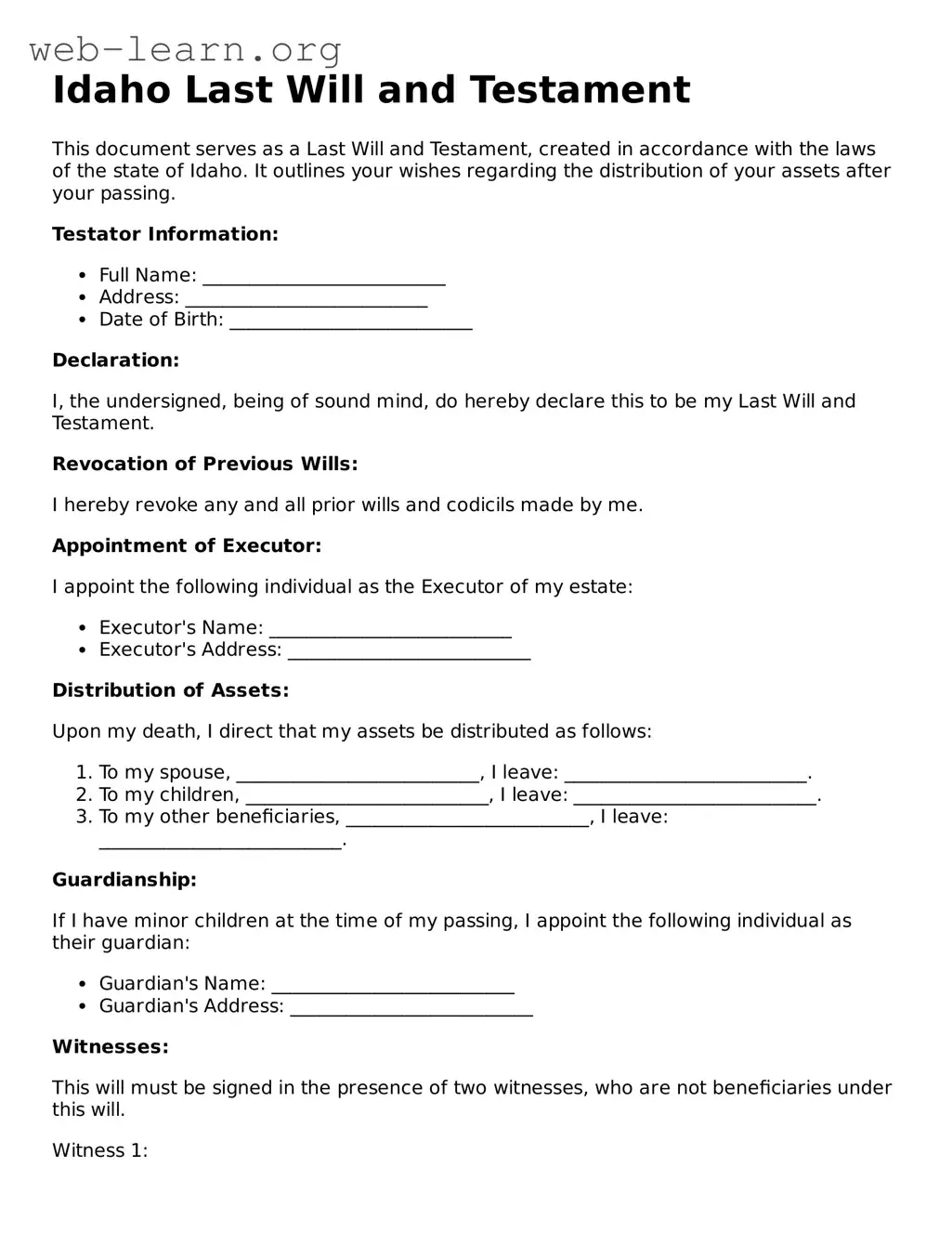
Idaho Last Will and Testament
This document serves as a Last Will and Testament, created in accordance with the laws of the state of Idaho. It outlines your wishes regarding the distribution of your assets after your passing.
Testator Information:
Declaration:
I, the undersigned, being of sound mind, do hereby declare this to be my Last Will and Testament.
Revocation of Previous Wills:
I hereby revoke any and all prior wills and codicils made by me.
Appointment of Executor:
I appoint the following individual as the Executor of my estate:
Distribution of Assets:
Upon my death, I direct that my assets be distributed as follows:
Guardianship:
If I have minor children at the time of my passing, I appoint the following individual as their guardian:
Witnesses:
This will must be signed in the presence of two witnesses, who are not beneficiaries under this will.
Witness 1:
Witness 2:
Signature:
In witness whereof, I have hereunto set my hand this ____ day of __________, 20__.
______________________________
(Testator's Signature)
This document is intended to serve as a template and should be reviewed by a legal professional to ensure compliance with Idaho state laws.
| Fact Name | Description |
|---|---|
| Governing Law | The Idaho Last Will and Testament is governed by Idaho Code Title 15, Chapter 2. |
| Legal Age | In Idaho, individuals must be at least 18 years old to create a valid will. |
| Witness Requirement | A will must be signed by at least two witnesses who are present at the same time. |
| Signature Requirement | The testator must sign the will or direct someone else to sign it in their presence. |
| Holographic Wills | Idaho recognizes holographic wills, which are handwritten and signed by the testator. |
| Revocation | A will can be revoked by a subsequent will or by physically destroying the original document. |
| Self-Proving Wills | Idaho allows for self-proving wills, which simplify the probate process. |
| Residency Requirement | There is no residency requirement for creating a will in Idaho; it can be made by non-residents. |
| Distribution of Assets | The will outlines how the testator’s assets will be distributed after their death. |
| Executor Appointment | The testator can appoint an executor in the will to manage the estate and ensure the will is executed. |
After obtaining the Idaho Last Will and Testament form, it is essential to fill it out accurately to ensure that your wishes are clearly articulated. This document will serve as a legal declaration of how your assets should be distributed upon your passing, as well as appointing guardians for any minor children. Completing the form correctly is crucial for its validity.
Once the form is completed, ensure it is stored in a safe place and inform your executor and family members of its location. This will help facilitate the process when the time comes to execute your wishes.
What is a Last Will and Testament in Idaho?
A Last Will and Testament is a legal document that allows an individual, known as the testator, to outline how their assets and property should be distributed after their death. In Idaho, this document can also name guardians for minor children and specify funeral arrangements. It serves as a crucial tool for ensuring that your wishes are honored and can help prevent disputes among surviving family members.
Do I need a lawyer to create a Last Will and Testament in Idaho?
No, you do not necessarily need a lawyer to create a Last Will and Testament in Idaho. While legal counsel can provide valuable guidance, many individuals choose to prepare their own wills using templates or forms. However, it is essential to ensure that the will meets Idaho’s legal requirements to be considered valid. This includes being signed by the testator and witnessed by at least two individuals who are not beneficiaries.
What are the requirements for a valid will in Idaho?
In Idaho, several requirements must be met for a will to be deemed valid:
Meeting these requirements ensures that the will is legally enforceable and that your wishes regarding asset distribution are respected.
Can I change my Last Will and Testament after it is created?
Yes, you can change your Last Will and Testament at any time while you are still alive. This process is known as making a codicil, which is an amendment to your existing will. Alternatively, you may choose to create an entirely new will that revokes the previous one. It is important to follow the same legal formalities when making changes to ensure that the updated document is valid.
What happens if I die without a will in Idaho?
If you die without a will, also known as dying intestate, Idaho law will determine how your assets are distributed. This distribution follows a specific hierarchy, typically favoring spouses and children first. However, without a will, you lose the ability to specify your wishes, which can lead to potential conflicts among family members. Therefore, having a will is highly recommended to ensure your preferences are honored.
Filling out a Last Will and Testament form can be a daunting task, and many individuals make mistakes that can lead to complications later on. One common error is failing to properly identify beneficiaries. It is crucial to provide full names and, if possible, their relationship to you. Omitting this information can create confusion and disputes among family members after your passing.
Another mistake involves the lack of a witness signature. In Idaho, a will must be signed by at least two witnesses who are not beneficiaries. Not adhering to this requirement can render the will invalid. It is essential to ensure that witnesses are present at the time of signing and that they understand their role in the process.
Some individuals neglect to date their will. A date is vital as it establishes the timeline of your wishes. Without a date, there may be ambiguity regarding which document reflects your most current intentions, especially if multiple versions exist.
Additionally, many people forget to include a residuary clause. This clause addresses any assets not specifically mentioned in the will. Without it, any assets not explicitly outlined may be subject to state laws regarding intestacy, which may not align with your wishes.
Another common oversight is failing to update the will after significant life changes. Events such as marriage, divorce, or the birth of a child can affect your beneficiaries and asset distribution. Regularly reviewing and updating your will ensures that it accurately reflects your current circumstances.
In some cases, individuals may attempt to create a will without legal guidance. While it is possible to fill out a form independently, the nuances of state laws can be complex. Seeking professional advice can help avoid pitfalls that may arise from misunderstandings or misinterpretations of legal requirements.
Finally, people often overlook the importance of storing the will in a secure yet accessible location. A will that cannot be found after a person's death can lead to delays and disputes. It is advisable to inform trusted family members or friends about the location of the will to ensure that it can be easily retrieved when needed.
When creating a Last Will and Testament in Idaho, several additional forms and documents can help ensure that your wishes are clearly communicated and legally recognized. Each of these documents serves a specific purpose in the estate planning process.
Incorporating these documents into your estate planning can provide clarity and peace of mind. Each one plays a vital role in ensuring that your wishes are respected and your loved ones are taken care of in the future.
The Last Will and Testament is an important legal document that outlines how a person's assets and responsibilities will be handled after their death. Several other documents serve similar purposes or have related functions. Here’s a list of eight documents that share similarities with a Last Will and Testament:
Understanding these documents can enhance estate planning efforts, ensuring that individuals’ wishes are respected and followed. Each document serves a unique purpose but can work together to create a comprehensive estate plan.
When filling out the Idaho Last Will and Testament form, it’s important to approach the process thoughtfully. Here are some key dos and don’ts to keep in mind:
Being mindful of these guidelines can help ensure your wishes are clearly communicated and legally binding.
Many people have misunderstandings about the Idaho Last Will and Testament form. Here are some common misconceptions:
Filling out and using the Idaho Last Will and Testament form is an important step in ensuring your wishes are honored after your passing. Here are some key takeaways to keep in mind:
Taking these steps can provide peace of mind for you and your loved ones.
Connecticut Will - A Last Will can help you leave behind a clear and organized plan for your estate.
Free Ny Will Template - May specify the timing of distributions to beneficiaries.
Online Wills Oregon - May require notarization in some jurisdictions to enhance its legal validity.