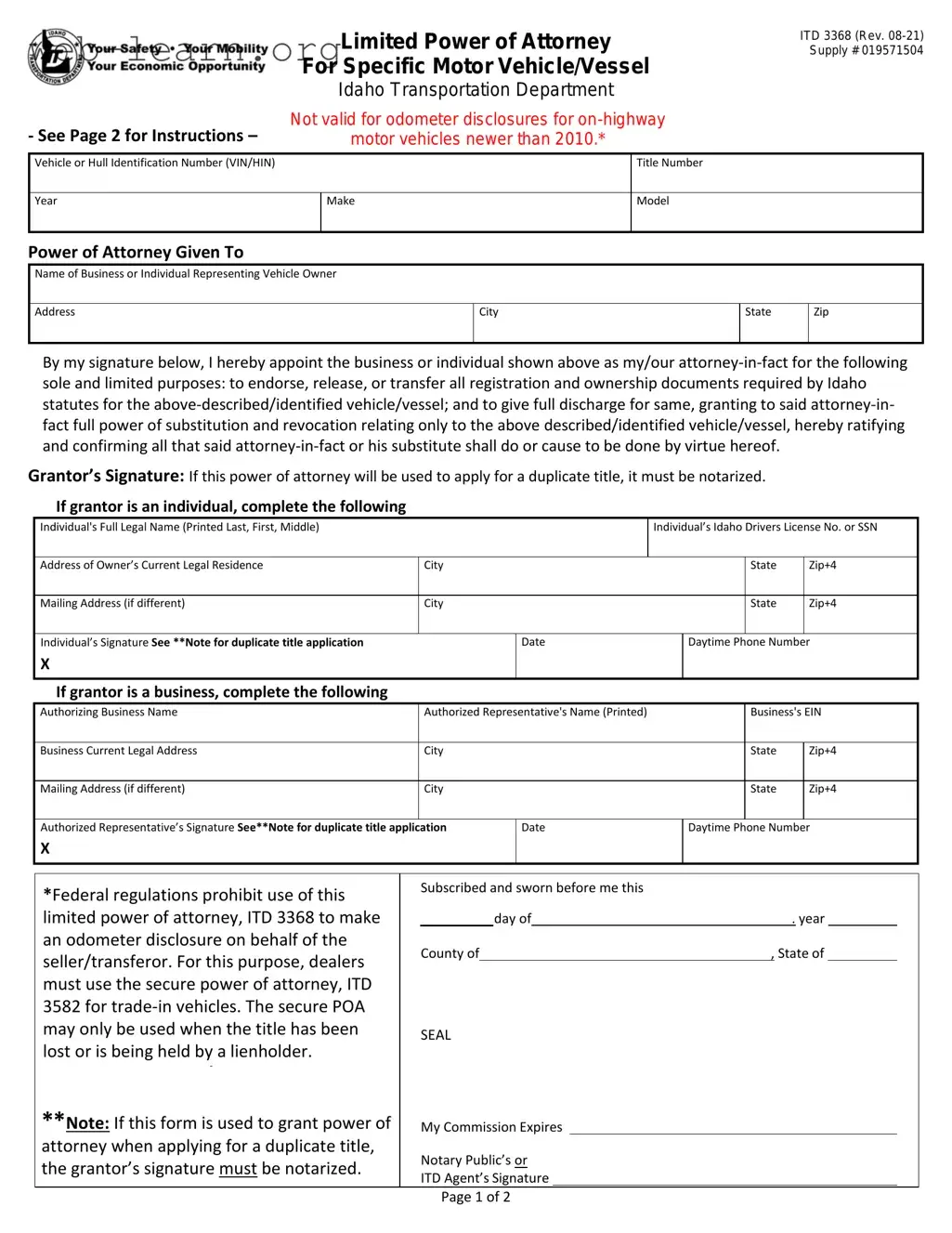
The Idaho ITD form, specifically the Limited Power of Attorney for Specific Motor Vehicle/Vessel (ITD 3368), serves a crucial role in the management of vehicle and vessel ownership documentation in the state. This form allows an individual or business to appoint a representative, known as an attorney-in-fact, to handle specific tasks related to the registration and ownership transfer of a vehicle or vessel. Key details required on the form include the Vehicle or Hull Identification Number (VIN/HIN), title number, year, make, and model of the vehicle or vessel. The appointed representative is granted authority to endorse, release, or transfer all necessary documents in accordance with Idaho statutes. It is important to note that this power of attorney is limited in scope and does not apply to odometer disclosures for on-highway motor vehicles manufactured after 2010. The form also requires the signatures of the grantor, which may need to be notarized if the power of attorney is used to apply for a duplicate title. Additionally, specific instructions outline how the power of attorney should be executed, ensuring that both individuals and businesses can effectively utilize this document for their vehicle or vessel transactions.
Limited Power of Attorney
For Specific Motor Vehicle/Vessel
Idaho Transportation Department
ITD 3368 (Rev.
- See Page 2 for Instructions – |
Not valid for odometer disclosures for |
motor vehicles newer than 2010.* |
Vehicle or Hull Identification Number (VIN/HIN)
Title Number
Year
Make
Model
Power of Attorney Given To
Name of Business or Individual Representing Vehicle Owner
Address
City
State
Zip
By my signature below, I hereby appoint the business or individual shown above as my/our attorney‐in‐fact for the following sole and limited purposes: to endorse, release, or transfer all registration and ownership documents required by Idaho statutes for the above‐described/identified vehicle/vessel; and to give full discharge for same, granting to said attorney‐in‐ fact full power of substitution and revocation relating only to the above described/identified vehicle/vessel, hereby ratifying and confirming all that said attorney‐in‐fact or his substitute shall do or cause to be done by virtue hereof.
Grantor’s Signature: If this power of attorney will be used to apply for a duplicate title, it must be notarized.
If grantor is an individual, complete the following
Individual's Full Legal Name (Printed Last, First, Middle) |
|
|
|
|
|
|
|
Individual’s Idaho Drivers License No. or SSN |
||||||||
|
|
|
|
|
|
|
|
|
|
|
|
|
|
|
|
|
Address of Owner’s Current Legal Residence |
City |
|
|
|
|
|
|
|
State |
|
Zip+4 |
|||||
|
|
|
|
|
|
|
|
|
|
|
|
|
|
|
|
|
Mailing Address (if different) |
City |
|
|
|
|
|
|
|
State |
|
Zip+4 |
|||||
|
|
|
|
|
|
|
|
|
|
|
|
|
|
|
|
|
Individual’s Signature See **Note for duplicate title application |
|
|
|
Date |
|
Daytime Phone Number |
||||||||||
X |
|
|
|
|
|
|
|
|
|
|
|
|
|
|
|
|
|
|
|
|
|
|
|
|
|
|
|
|
|
|
|
|
|
If grantor is a business, complete the following |
|
|
|
|
|
|
|
|
|
|
|
|
|
|
|
|
Authorizing Business Name |
Authorized Representative's Name (Printed) |
|
|
Business's EIN |
||||||||||||
|
|
|
|
|
|
|
|
|
|
|
|
|
|
|
|
|
Business Current Legal Address |
City |
|
|
|
|
|
|
|
State |
|
Zip+4 |
|||||
|
|
|
|
|
|
|
|
|
|
|
|
|
|
|
|
|
Mailing Address (if different) |
City |
|
|
|
|
|
|
|
State |
|
Zip+4 |
|||||
|
|
|
|
|
|
|
|
|
|
|
|
|
|
|
|
|
Authorized Representative’s Signature See**Note for duplicate title application |
|
Date |
|
Daytime Phone Number |
||||||||||||
X |
|
|
|
|
|
|
|
|
|
|
|
|
|
|
|
|
|
|
|
|
|
|
|
|
|
|
|
|
|
|
|
|
|
|
|
|
|
|
|
|
|
|
|
|
|
|
|
|
||
*Federal regulations prohibit use of this |
|
Subscribed and sworn before me this |
|
|
|
|
|
|
|
|
||||||
|
|
|
|
|
|
|
|
|
|
|
|
|
|
|
|
|
limited power of attorney, ITD 3368 to make |
|
|
|
day of |
|
|
|
|
|
. year |
||||||
an odometer disclosure on behalf of the |
|
|
|
|
|
|
|
|
|
|
|
|
|
|
|
|
|
County of |
|
|
|
|
|
|
|
, State of |
|||||||
seller/transferor. For this purpose, dealers |
|
|
|
|
|
|
|
|
||||||||
|
|
|
|
|
|
|
|
|
|
|
|
|
|
|
|
|
must use the secure power of attorney, ITD |
|
|
|
|
|
|
|
|
|
|
|
|
|
|
|
|
3582 for |
|
|
|
|
|
|
|
|
|
|
|
|
|
|
|
|
may only be used when the title has been |
|
SEAL |
|
|
|
|
|
|
|
|
|
|
|
|
|
|
lost or is being held by a lienholder. |
|
|
|
|
|
|
|
|
|
|
|
|
|
|
||
|
|
|
|
|
|
|
|
|
|
|
|
|
|
|
|
|
**Note: If this form is used to grant power of |
|
My Commission Expires |
|
|
|
|
|
|
|
|
|
|||||
attorney when applying for a duplicate title, |
|
Notary Public’s or |
|
|
|
|
|
|
|
|
||||||
the grantor’s signature must be notarized. |
|
|
|
|
|
|
|
|
|
|||||||
|
ITD Agent’s Signature |
|
|
|
|
|
|
|
|
|||||||
|
|
|
|
|
|
|
|
|
|
|||||||
|
|
|
|
|
|
|
|
|
|
|
|
|
|
|
|
|
Page 1 of 2

Instructions for Using This Limited Power of Attorney on
Vehicle Title and/or Registration Documents
This limited power of attorney may only be used by the person or firm named as representative on this form. To properly exercise the power of attorney, write the name of the owner followed by the representative’s signature.
Example: Sharon Smith by |
Jane Doe, POA |
|
Sharon Smith is the owner and Jane Doe is the person named as representative on the power of attorney.
If the named representative is a company, an authorized individual of that company must sign the document.
Example: Sharon Smith by |
Morrison’s Garage |
|
George Morrison, POA |
Note: The power of attorney must be exercised on the title or document for which the authority was granted. This Power of Attorney must be notarized if given for application of a duplicate title.
Page 2 of 2
| Fact Name | Details |
|---|---|
| Form Title | Limited Power of Attorney For Specific Motor Vehicle/Vessel |
| Form Number | ITD 3368 (Rev. 08-21) |
| Governing Law | Idaho Statutes related to vehicle registration and ownership transfers |
| Notarization Requirement | The form must be notarized if used to apply for a duplicate title. |
| VIN/HIN Requirement | Vehicle or Hull Identification Number must be provided on the form. |
| Odometer Disclosure Limitation | Not valid for odometer disclosures for on-highway motor vehicles newer than 2010. |
| Signature Requirement | The grantor must sign to appoint the attorney-in-fact. |
| Power of Substitution | The attorney-in-fact has full power of substitution and revocation for the specified vehicle/vessel. |
Filling out the Idaho ITD form requires careful attention to detail to ensure that all necessary information is accurately provided. Once the form is completed, it will serve as a limited power of attorney for a specific motor vehicle or vessel. Below are the steps to successfully fill out the form.
What is the Idaho ITD form?
The Idaho ITD form, specifically the ITD 3368, is a Limited Power of Attorney designed for specific motor vehicle or vessel transactions. It allows an individual or business to appoint someone else as their attorney-in-fact. This representative can then handle tasks such as endorsing, releasing, or transferring ownership and registration documents for the specified vehicle or vessel. It's important to note that this form is not valid for odometer disclosures for on-highway motor vehicles manufactured after 2010.
When is notarization required?
If the Idaho ITD form is being used to apply for a duplicate title, it must be notarized. This means that the signature of the grantor—whether an individual or a business—needs to be witnessed by a notary public. Notarization adds an extra layer of verification, ensuring that the person granting the power of attorney is indeed who they say they are.
How do I properly use the Idaho ITD form?
To use the Idaho ITD form correctly, you must fill in the details of the vehicle or vessel, including the Vehicle or Hull Identification Number (VIN/HIN), title number, year, make, and model. Then, specify the individual or business you are appointing as your representative. When signing, the owner’s name should be followed by the representative’s signature. For instance, if Sharon Smith is the owner and Jane Doe is the representative, it should read: “Sharon Smith by Jane Doe, POA.” If the representative is a business, an authorized individual from that business must sign the document.
What happens if I need to revoke the power of attorney?
You have the right to revoke the power of attorney at any time. To do this, you should provide a written notice to the representative you appointed. It’s also advisable to notify any relevant parties, such as the Idaho Transportation Department, to ensure that your revocation is acknowledged. Keep in mind that once revoked, the representative can no longer act on your behalf regarding the vehicle or vessel specified in the form.
Filling out the Idaho ITD form can be a straightforward process, but many people make common mistakes that can delay their application or even invalidate it. Understanding these pitfalls can save you time and hassle. Here are seven mistakes to watch out for when completing the Limited Power of Attorney for Specific Motor Vehicle/Vessel.
One frequent error occurs with the Vehicle or Hull Identification Number (VIN/HIN). Many individuals either leave this field blank or enter incorrect information. This number is crucial for identifying the vehicle or vessel in question. Double-checking this detail ensures that your application aligns with state records.
Another common mistake is failing to provide the correct signature. If you are the grantor, your signature must match the name printed on the form. If the power of attorney is being executed by a business, an authorized representative must sign, which can lead to confusion if not done correctly. Always ensure that the signatures are clear and properly placed.
People often neglect to include the notarization when required. If you are using this power of attorney to apply for a duplicate title, it must be notarized. Skipping this step can result in your application being rejected. Make sure you arrange for a notary to witness your signature before submitting the form.
Another mistake is not providing complete contact information. The form requires your daytime phone number, and many forget to fill this in. This information is essential for any follow-up or clarification needed by the Idaho Transportation Department. Always provide accurate and up-to-date contact details.
Sometimes, individuals fail to specify whether they are completing the form as an individual or a business. Each option has different requirements, including what information must be provided. Be clear about your status to avoid confusion and ensure the correct sections are completed.
In addition, people may overlook the mailing address section. If your mailing address differs from your current legal residence, it's important to indicate that. This ensures that any correspondence from the Idaho Transportation Department reaches you without delay.
Finally, many forget to read the instructions on the form thoroughly. Each section has specific requirements, and missing a single detail can lead to complications. Taking the time to read the instructions can help you avoid unnecessary mistakes and streamline the process.
By being aware of these common mistakes, you can fill out the Idaho ITD form accurately and efficiently. Attention to detail is key, and ensuring all sections are completed correctly will help you avoid delays in processing your application.
The Idaho ITD Limited Power of Attorney form is often used in conjunction with several other documents related to vehicle and vessel ownership and registration. Understanding these forms can help streamline the process of transferring ownership or managing vehicle-related matters. Below is a list of related forms commonly utilized in Idaho.
These documents work together to facilitate the legal transfer of vehicle ownership and ensure compliance with Idaho state laws. Familiarity with these forms can make the process smoother for both buyers and sellers.
When filling out the Idaho ITD form, it's important to be careful and thorough. Here’s a list of things you should and shouldn’t do to ensure your form is completed correctly.
By following these guidelines, you can help ensure that your Idaho ITD form is filled out correctly and processed without unnecessary delays.
Here are eight common misconceptions about the Idaho ITD form, specifically the Limited Power of Attorney for Specific Motor Vehicle/Vessel (ITD 3368):
Filling out the Idaho ITD form can seem daunting, but understanding its key aspects can simplify the process. Here are some important takeaways:
By keeping these points in mind, you can navigate the Idaho ITD form with confidence and ensure that you fulfill all necessary requirements.