For families in Idaho considering homeschooling, understanding the necessary paperwork is crucial for a smooth transition. One of the first steps in this journey is completing the Homeschool Letter of Intent form. This document serves as a formal notification to the local school district of your intent to homeschool your child. It requires essential information, including the names and ages of the children being homeschooled, as well as the educational approach you plan to take. Submitting this form is not just a formality; it establishes your commitment to providing a quality education outside the traditional school setting. Additionally, the form helps ensure that you remain compliant with Idaho's homeschooling laws, which can vary from state to state. By taking this important step, you are laying the groundwork for a successful homeschooling experience, allowing you to focus on fostering a rich and engaging learning environment for your children.
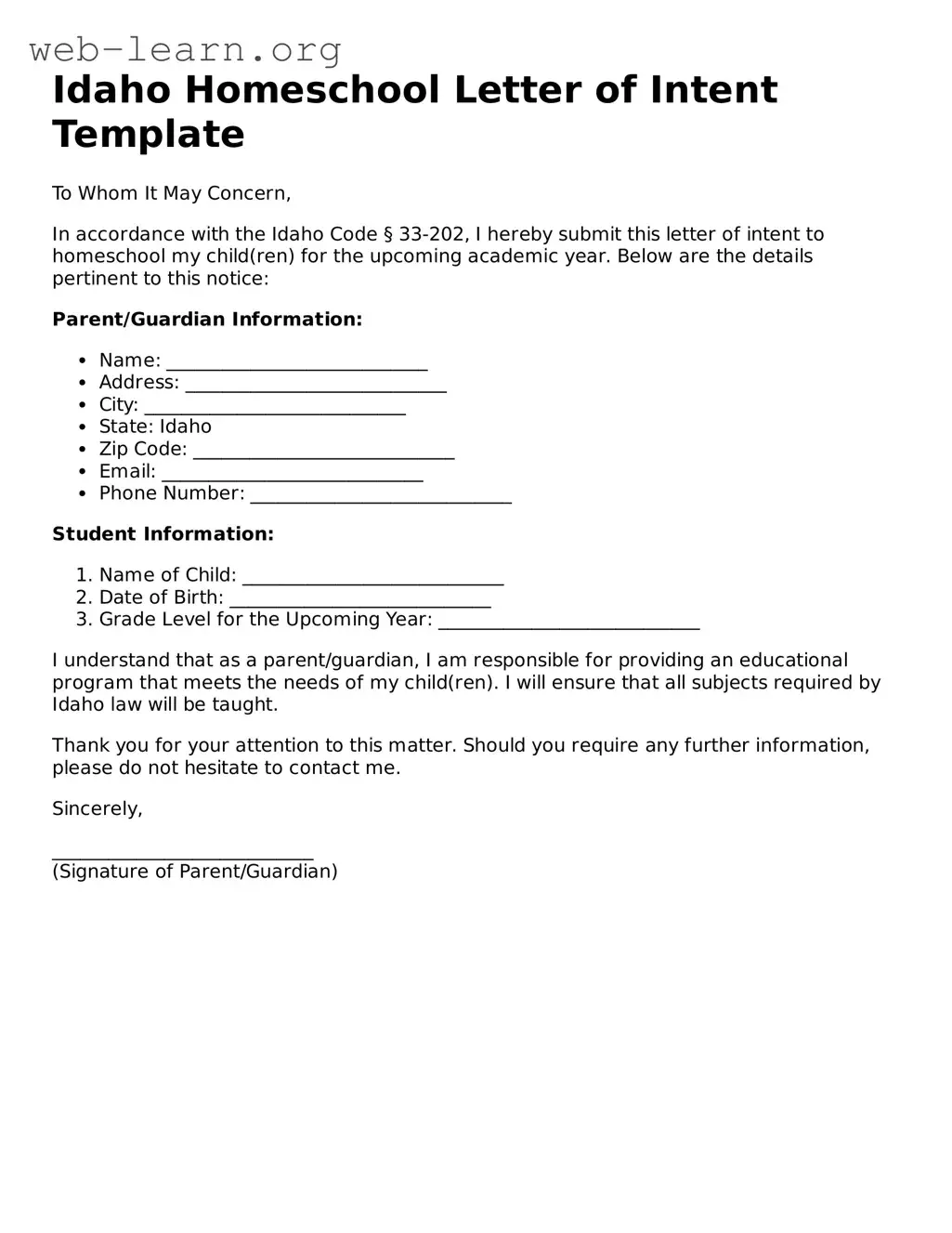
Idaho Homeschool Letter of Intent Template
To Whom It May Concern,
In accordance with the Idaho Code § 33-202, I hereby submit this letter of intent to homeschool my child(ren) for the upcoming academic year. Below are the details pertinent to this notice:
Parent/Guardian Information:
Student Information:
I understand that as a parent/guardian, I am responsible for providing an educational program that meets the needs of my child(ren). I will ensure that all subjects required by Idaho law will be taught.
Thank you for your attention to this matter. Should you require any further information, please do not hesitate to contact me.
Sincerely,
____________________________
(Signature of Parent/Guardian)
| Fact Name | Description |
|---|---|
| Governing Law | The Idaho Homeschool Letter of Intent is governed by Idaho Code § 33-202. |
| Filing Requirement | Parents must submit the Letter of Intent to the local school district annually. |
| Submission Deadline | The form must be filed by September 1st of each school year. |
| Content of the Form | The form requires the names and ages of the children being homeschooled. |
| Notification | Once submitted, parents do not need to notify the school district again unless there are changes. |
| Record Keeping | Parents must maintain educational records, though they are not submitted with the form. |
Once you have the Idaho Homeschool Letter of Intent form, you can begin filling it out. This form is a necessary step for parents who wish to homeschool their children in Idaho. After completing the form, you will submit it to the appropriate school district.
What is the Idaho Homeschool Letter of Intent?
The Idaho Homeschool Letter of Intent is a formal document that parents or guardians must submit to the local school district to notify them of their intention to homeschool their child. This letter serves as a declaration of the family's decision to educate their child outside of the traditional public school system.
Who needs to submit the Letter of Intent?
Any parent or guardian who wishes to homeschool a child between the ages of 6 and 16 in Idaho must submit this letter. It is essential for ensuring compliance with state laws regarding homeschooling.
When should the Letter of Intent be submitted?
The Letter of Intent should be submitted at the beginning of the homeschooling year. However, if you are starting homeschooling mid-year, it is advisable to submit the letter as soon as you decide to withdraw your child from public school.
What information is required in the Letter of Intent?
The letter must include:
Is there a specific format for the Letter of Intent?
No specific format is mandated by the state. However, it is important that the letter is clear and includes all required information. Many parents choose to use a template for convenience.
What happens after submitting the Letter of Intent?
Once the Letter of Intent is submitted, the local school district will acknowledge receipt. You are not required to wait for approval before beginning your homeschooling journey. However, keep a copy of the letter for your records.
Are there any consequences for not submitting the Letter of Intent?
Failing to submit the Letter of Intent can result in legal complications. The state requires this notification to ensure that children are receiving an education. If you do not submit the letter, your child may be considered truant, which can lead to penalties for the parents or guardians.
When filling out the Idaho Homeschool Letter of Intent form, many families make common mistakes that can lead to delays or complications. One of the most frequent errors is failing to include all required information. The form asks for specific details about the child, such as their name, age, and the address of the homeschooling location. Omitting even one piece of this information can result in the form being rejected.
Another mistake is not signing the form. It may seem like a small detail, but without a signature, the intent to homeschool is not officially recognized. Parents should ensure that they sign and date the form before submitting it to the local school district.
Some individuals also overlook the importance of timely submission. The Idaho law requires that the Letter of Intent be submitted within a certain timeframe, typically by September 1st for the upcoming school year. Missing this deadline can lead to unnecessary complications or even legal issues.
Another common error is misunderstanding the definition of "homeschooling" as it pertains to the form. Some parents might think that they can simply teach their children at home without following the state's guidelines. However, Idaho law has specific requirements that must be met, including maintaining a curriculum and keeping records of educational progress.
Additionally, failing to provide a valid reason for homeschooling can be a pitfall. While Idaho does not require a specific justification for choosing to homeschool, it is still advisable to include a brief statement of intent. This can help clarify the family's commitment to education and may prevent questions from the school district.
Finally, many families neglect to keep a copy of the submitted form. It is crucial to retain a copy for personal records. This ensures that parents have proof of their intent to homeschool should any questions arise in the future. Keeping organized records can save time and stress down the line.
When families decide to homeschool in Idaho, submitting the Homeschool Letter of Intent is just the beginning. Several other forms and documents can help ensure a smooth homeschooling experience. Here’s a list of some key documents that may be used alongside the Homeschool Letter of Intent.
Having these documents ready can help streamline the homeschooling process and provide clarity for parents and students alike. Each form plays a role in tracking educational progress and maintaining compliance with state regulations.
When filling out the Idaho Homeschool Letter of Intent form, it's important to follow certain guidelines to ensure your submission is correct. Here are five things you should and shouldn't do:
Homeschooling in Idaho offers families a unique opportunity to tailor education to their children's needs. However, several misconceptions surround the Idaho Homeschool Letter of Intent form. Understanding these misconceptions can help families navigate the process more effectively.
In reality, the form is straightforward and requires minimal information. Parents need only provide basic details about their children and their educational plans.
While it is required for those who wish to homeschool in Idaho, families who are already homeschooling and have not submitted a letter may still do so without penalty.
Parents can submit the form at any time. There is flexibility in when the letter is filed, allowing families to start homeschooling mid-year if they choose.
This is not true. The form does not require parents to outline their entire curriculum. A simple statement of intent to homeschool is sufficient.
Idaho law does not require ongoing oversight of homeschoolers. Once the form is submitted, families enjoy the freedom to educate without state interference.
There is no cost to submit the Letter of Intent. Parents can complete this process without any financial burden.
Homeschooling allows families to create their own schedules. Flexibility is one of the key benefits of homeschooling, enabling families to learn at their own pace.
While it is an important first step, families should also familiarize themselves with other regulations and best practices for homeschooling in the state.
By dispelling these misconceptions, families can better prepare for their homeschooling journey in Idaho. Understanding the requirements and freedoms associated with homeschooling can lead to a more fulfilling educational experience for both parents and children.
Filling out the Idaho Homeschool Letter of Intent form is an important step for families choosing to educate their children at home. Here are some key takeaways to keep in mind:
By keeping these points in mind, you can ensure a smoother transition into the homeschooling journey in Idaho.
Letter of Intent to Homeschool Florida - Communicate your educational intentions effectively with this letter.
Colorado Homeschool Testing Requirements - Parents often find this letter to be a motivating step in their homeschooling journey.
Arkansas Intent to Homeschool - Document your intent to create a home learning environment.
Oregon Home-schooling - In some jurisdictions, the Letter of Intent must be renewed periodically.