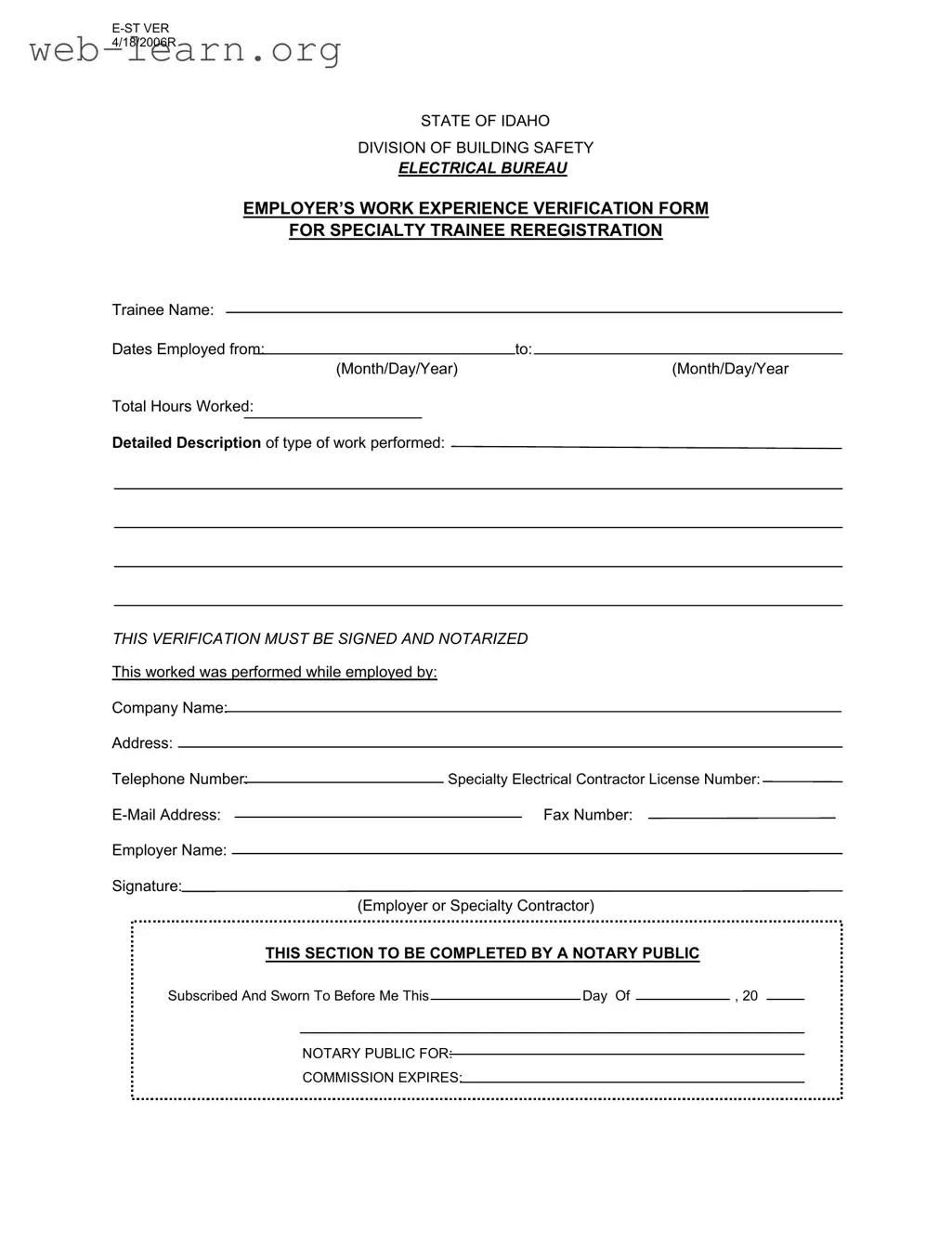
The Idaho Employer’s Work Experience Verification Form, commonly referred to as the E St Ver form, plays a crucial role in the process of specialty trainee reregistration within the electrical field. This form is designed to document the work experience of trainees seeking to advance their careers in electrical specialties. It captures essential details, such as the trainee's name, employment dates, and total hours worked, ensuring that all relevant information is readily available for review. Employers are required to provide a detailed description of the type of work performed, which helps to assess the trainee's qualifications and experience accurately. Furthermore, the form mandates a signature from the employer or specialty contractor, along with notarization, to validate the information presented. This adds an important layer of authenticity and accountability to the process. By requiring the employer’s contact information and license number, the form facilitates communication and verification, ensuring that all parties involved can confirm the trainee's work history and qualifications.
STATE OF IDAHO
DIVISION OF BUILDING SAFETY
ELECTRICAL BUREAU
EMPLOYER’S WORK EXPERIENCE VERIFICATION FORM
FOR SPECIALTY TRAINEE REREGISTRATION
Trainee Name: |
|
Dates Employed from: |
to: |
(Month/Day/Year) |
(Month/Day/Year |
Total Hours Worked: |
|
Detailed Description of type of work performed: |
|
THIS VERIFICATION MUST BE SIGNED AND NOTARIZED
This worked was performed while employed by:
Company Name:
Address:
Telephone Number: |
Specialty Electrical Contractor License Number: |
|
Fax Number: |
|
|
Employer Name: |
|
|
Signature: |
|
|
(Employer or Specialty Contractor) |
|
|
THIS SECTION TO BE COMPLETED BY A NOTARY PUBLIC |
|
|
Subscribed And Sworn To Before Me This |
Day Of |
, 20 |
NOTARY PUBLIC FOR: |
|
|
COMMISSION EXPIRES: |
|
|
| Fact Name | Description |
|---|---|
| Purpose | The Idaho E St Ver form is used to verify the work experience of specialty trainees seeking re-registration. |
| Governing Law | This form is governed by the Idaho Code Title 54, Chapter 10, which regulates electrical licensing and training. |
| Notarization Requirement | The completed form must be signed by the employer and notarized to be valid. |
| Information Required | Employers must provide details such as the trainee's employment dates, total hours worked, and a description of the work performed. |
| Contact Information | The form requires the employer's contact information, including the company name, address, and phone number. |
Completing the Idaho E St Ver form is a straightforward process that requires attention to detail. This form is essential for verifying the work experience of specialty trainees seeking re-registration. Once you have gathered the necessary information, you can follow these steps to fill out the form accurately.
What is the Idaho E St Ver form?
The Idaho E St Ver form, officially known as the Employer’s Work Experience Verification Form for Specialty Trainee Reregistration, is a document used to verify the work experience of individuals seeking to renew their specialty electrical trainee registration. This form is essential for ensuring that trainees have gained the necessary practical experience under a licensed electrical contractor.
Who needs to fill out this form?
This form must be completed by the employer of the specialty trainee. If you are a trainee looking to renew your registration, your employer will need to provide details about your employment and the work you performed.
What information is required on the form?
The form requires several key pieces of information, including:
Is notarization required for the Idaho E St Ver form?
Yes, the form must be signed and notarized. This step adds an extra layer of verification, ensuring that the information provided is accurate and has been confirmed by a notary public.
How does a trainee benefit from submitting this form?
Submitting the Idaho E St Ver form allows trainees to demonstrate their work experience, which is a critical component of maintaining their specialty electrical trainee registration. This verification can help them advance in their careers and pursue further certifications.
What happens if the form is not completed correctly?
If the form is incomplete or contains inaccuracies, it may delay the reregistration process. It’s crucial to ensure that all information is filled out correctly and that the notarization is completed to avoid any issues.
Where can I obtain the Idaho E St Ver form?
The Idaho E St Ver form can typically be obtained from the Idaho Division of Building Safety’s website or by contacting the Electrical Bureau directly. It’s important to use the most current version of the form to ensure compliance with state regulations.
Completing the Idaho E St Ver form can seem straightforward, but many individuals make common mistakes that can delay the re-registration process for specialty trainees. One frequent error is failing to provide accurate dates of employment. The form requires specific start and end dates, and any discrepancies can lead to confusion or rejection of the application.
Another mistake involves the total hours worked. Applicants often underestimate or overestimate their hours, which can affect their eligibility. It is crucial to ensure that the total hours accurately reflect the actual time spent working in the specialty area.
Some individuals neglect to include a detailed description of the type of work performed. This section is vital for verifying the trainee's experience and skills. A vague or incomplete description may not satisfy the requirements of the Electrical Bureau.
Not obtaining the necessary signatures is another common pitfall. The form must be signed by both the employer and the specialty contractor. Omitting either signature can render the form invalid, causing unnecessary delays.
Additionally, applicants sometimes forget to have the form notarized. The notarization process is essential for confirming the authenticity of the signatures. Without it, the form cannot be processed.
Providing incorrect contact information for the employer is also a mistake that can complicate matters. The form asks for the company name, address, and telephone number. If any of this information is inaccurate, it may hinder communication and verification efforts.
Finally, individuals may overlook the importance of double-checking the entire form for completeness and accuracy before submission. Taking the time to review each section can prevent errors that could delay the re-registration process.
The Idaho E St Ver form is an important document used for specialty trainee reregistration in the electrical field. Along with this form, several other documents are often required to ensure a complete application. Below is a list of these forms and a brief description of each.
Having these documents prepared and organized can streamline the reregistration process for specialty trainees. Ensuring that all required forms are completed accurately will help avoid delays and facilitate a smoother application experience.
When filling out the Idaho Employer’s Work Experience Verification Form for Specialty Trainee Reregistration, there are important guidelines to follow. Here are seven things you should and shouldn’t do:
Following these guidelines will help ensure that your application is processed smoothly and efficiently.
Misconceptions about the Idaho E St Ver form can lead to confusion for both trainees and employers. Here are some common misunderstandings:
Understanding these misconceptions can help streamline the process for everyone involved in the re-registration of specialty trainees in Idaho.
When filling out and using the Idaho E St Ver form, consider the following key takeaways:
Following these guidelines will help ensure a smooth process for filling out and using the Idaho E St Ver form.