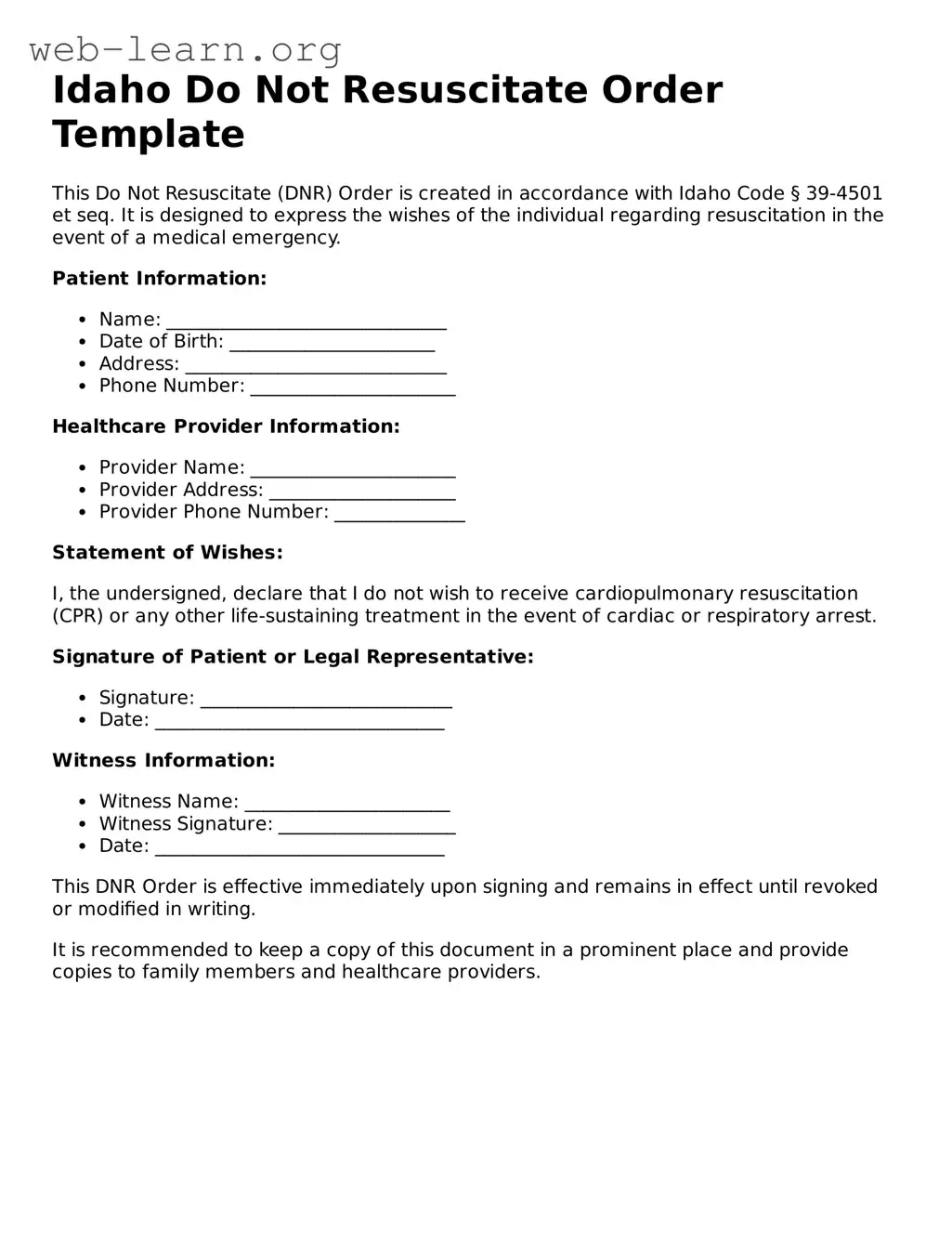
The Idaho Do Not Resuscitate Order (DNR) form serves as an important legal document for individuals who wish to express their preferences regarding medical treatment in emergency situations. This form is particularly relevant for those with serious health conditions or terminal illnesses, allowing them to communicate their desire not to receive cardiopulmonary resuscitation (CPR) if their heart stops or they stop breathing. It is designed to be clear and straightforward, ensuring that medical personnel understand the patient's wishes. The DNR form must be completed and signed by the patient or their legal representative and should include specific information such as the patient's name, date of birth, and the signatures of witnesses. Additionally, healthcare providers are required to honor this document, ensuring that the patient's choices are respected in critical moments. Understanding the DNR process can empower individuals to make informed decisions about their end-of-life care, providing peace of mind for both patients and their loved ones.
Idaho Do Not Resuscitate Order Template
This Do Not Resuscitate (DNR) Order is created in accordance with Idaho Code § 39-4501 et seq. It is designed to express the wishes of the individual regarding resuscitation in the event of a medical emergency.
Patient Information:
Healthcare Provider Information:
Statement of Wishes:
I, the undersigned, declare that I do not wish to receive cardiopulmonary resuscitation (CPR) or any other life-sustaining treatment in the event of cardiac or respiratory arrest.
Signature of Patient or Legal Representative:
Witness Information:
This DNR Order is effective immediately upon signing and remains in effect until revoked or modified in writing.
It is recommended to keep a copy of this document in a prominent place and provide copies to family members and healthcare providers.
| Fact Name | Details |
|---|---|
| Definition | The Idaho Do Not Resuscitate (DNR) Order form allows individuals to refuse cardiopulmonary resuscitation (CPR) in the event of a medical emergency. |
| Governing Law | The Idaho DNR Order is governed by Idaho Code § 39-4501 through § 39-4504. |
| Eligibility | Any adult who is capable of making their own healthcare decisions can complete a DNR Order in Idaho. |
| Signature Requirement | The form must be signed by the individual or their legal representative and a physician to be valid. |
| Emergency Medical Services | Emergency medical personnel are required to honor a valid DNR Order when presented in an emergency situation. |
Filling out the Idaho Do Not Resuscitate Order form is an important step in expressing your healthcare wishes. After completing the form, ensure it is signed and dated appropriately. Keep a copy for your records and provide copies to your healthcare provider and family members.
What is a Do Not Resuscitate (DNR) Order?
A Do Not Resuscitate Order is a legal document that allows a person to refuse resuscitation in the event of a medical emergency where their heart stops beating or they stop breathing. It instructs healthcare providers not to perform life-saving measures such as CPR (cardiopulmonary resuscitation) or advanced cardiac life support.
Who can complete a DNR Order in Idaho?
In Idaho, a DNR Order can be completed by a patient who is at least 18 years old and has the capacity to make healthcare decisions. If the patient is unable to make decisions, a legal guardian or an authorized healthcare representative may complete the order on their behalf.
How is a DNR Order implemented in Idaho?
To implement a DNR Order, the patient or their representative must fill out the official Idaho DNR form. This form must be signed by the patient or their representative and a physician. Once completed, the form should be kept in a place where it is easily accessible, such as with medical records or at home, and a copy should be provided to healthcare providers.
Can a DNR Order be revoked?
Yes, a DNR Order can be revoked at any time. The patient or their representative can verbally inform healthcare providers of the decision to revoke the order, or they can destroy the physical document. It is important to communicate this change clearly to ensure that healthcare providers are aware of the current wishes.
What should I do if I have questions about a DNR Order?
If you have questions about a DNR Order, consider discussing them with your healthcare provider or an attorney who specializes in healthcare law. They can provide guidance tailored to your specific situation and help ensure that your wishes are properly documented and understood.
Completing a Do Not Resuscitate (DNR) Order form can be a deeply personal and significant decision for individuals and their families. However, mistakes can easily occur during this process, leading to confusion and potential complications in medical situations. Understanding common errors can help ensure that the form accurately reflects one’s wishes.
One common mistake is not discussing the decision with family members or loved ones. Engaging in conversations about end-of-life preferences can foster understanding and support. Without these discussions, family members may be unaware of the individual’s wishes, leading to conflict during critical moments.
Another frequent error is failing to consult with a healthcare provider. Medical professionals can provide valuable insights into the implications of a DNR order. They can help clarify the medical conditions under which resuscitation might be necessary and guide individuals in making informed decisions.
People sometimes overlook the importance of signing the form properly. A DNR order must be signed by the individual or their authorized representative. If the signature is missing or improperly completed, the order may not be honored by medical personnel, which can lead to unwanted interventions.
Inaccurate completion of personal information is another mistake. Individuals must ensure that their name, date of birth, and other identifying details are correct. Errors in this section can lead to confusion and may result in the wrong person’s wishes being followed.
Additionally, failing to date the form can create complications. A DNR order should be current to reflect the individual’s most recent wishes. An undated form may be questioned by healthcare providers, potentially leading to unnecessary resuscitation efforts.
Some individuals may neglect to provide clear instructions regarding their wishes. The DNR order should explicitly state the individual’s preferences. Vague language can lead to misinterpretation and may not accurately convey the individual’s intent.
Another mistake involves not keeping copies of the completed DNR form. It is essential to distribute copies to family members, healthcare providers, and anyone involved in the individual’s care. Without proper distribution, the order may not be accessible when needed most.
People often forget to review and update their DNR orders regularly. Life circumstances can change, and so can an individual’s preferences. Regularly revisiting the order ensures that it remains aligned with current wishes and medical conditions.
Lastly, individuals sometimes underestimate the importance of understanding the legal implications of a DNR order. Each state has specific laws governing these documents. Being informed about the legal framework in Idaho can help individuals navigate the process more effectively.
By being aware of these common mistakes, individuals can take proactive steps to ensure that their DNR orders reflect their true wishes. This can provide peace of mind, knowing that their preferences will be respected in critical medical situations.
When considering the Idaho Do Not Resuscitate Order form, it is important to understand that several other documents may complement or support this directive. Each of these documents serves a unique purpose in ensuring that an individual's healthcare preferences are respected. Below is a list of forms commonly used alongside the Do Not Resuscitate Order.
Understanding these documents can help individuals and their families navigate healthcare decisions more effectively. Each form plays a vital role in ensuring that a person's healthcare preferences are respected and upheld, providing peace of mind during challenging times.
A Do Not Resuscitate (DNR) Order form is an important document that outlines a person's wishes regarding medical treatment in the event of a cardiac arrest or respiratory failure. Several other documents serve similar purposes in healthcare decision-making. Here are four documents that share similarities with a DNR Order:
When filling out the Idaho Do Not Resuscitate (DNR) Order form, it is crucial to approach the process with care and consideration. Below are some important dos and don'ts to keep in mind.
By following these guidelines, you can ensure that your DNR order reflects your wishes and is respected by medical professionals. It is a vital step in planning for your healthcare preferences.
Understanding the Idaho Do Not Resuscitate (DNR) Order form is crucial for both patients and healthcare providers. However, several misconceptions can lead to confusion. Here are eight common misconceptions about the Idaho DNR Order form, along with clarifications.
This is incorrect. A DNR order specifically addresses resuscitation efforts in the event of cardiac or respiratory arrest. Other medical treatments and interventions can still be provided.
This misconception overlooks the fact that anyone can request a DNR order, regardless of their overall health status. It is a personal choice based on individual preferences about end-of-life care.
In reality, a DNR order can be revoked or modified at any time. Patients or their authorized representatives can communicate changes to their healthcare providers.
While most providers will respect a valid DNR order, there may be circumstances where certain providers or facilities have policies that affect its enforcement. It is essential to discuss these policies with your healthcare team.
While a written DNR order is preferred, verbal orders can sometimes be accepted in emergencies, depending on the situation and the provider's discretion.
This belief can be misleading. A DNR order reflects a person's wishes about how they want to approach the end of life, often focusing on comfort and quality of life rather than aggressive interventions.
People of all ages can have a DNR order. It is a personal decision based on individual values and health circumstances, not strictly age-related.
DNR orders can be applicable in various settings, including at home or in long-term care facilities. It is important to ensure that all relevant parties are aware of the order.
By addressing these misconceptions, individuals can make informed decisions about their healthcare preferences and ensure that their wishes are respected in critical situations.
Filling out and using the Idaho Do Not Resuscitate (DNR) Order form is an important process for individuals who wish to communicate their medical preferences. Here are key takeaways to keep in mind:
Understanding these key points can help ensure that the DNR Order accurately reflects a person's wishes and is properly utilized in medical situations.
Can You Get a Dnr at Any Age - A DNR order is a legal means of communicating a patient's wishes regarding resuscitation.
Dnr Hospital - Understanding the implications of a DNR order can help individuals make informed decisions about their healthcare.
Is a Dnr an Advance Directive - Patients can discuss their DNR wishes with their healthcare providers to ensure clarity and understanding.
Do Not Resuscitate Form Indiana - In some cases, a DNR order may be accompanied by a discussion about hospice or palliative care options.