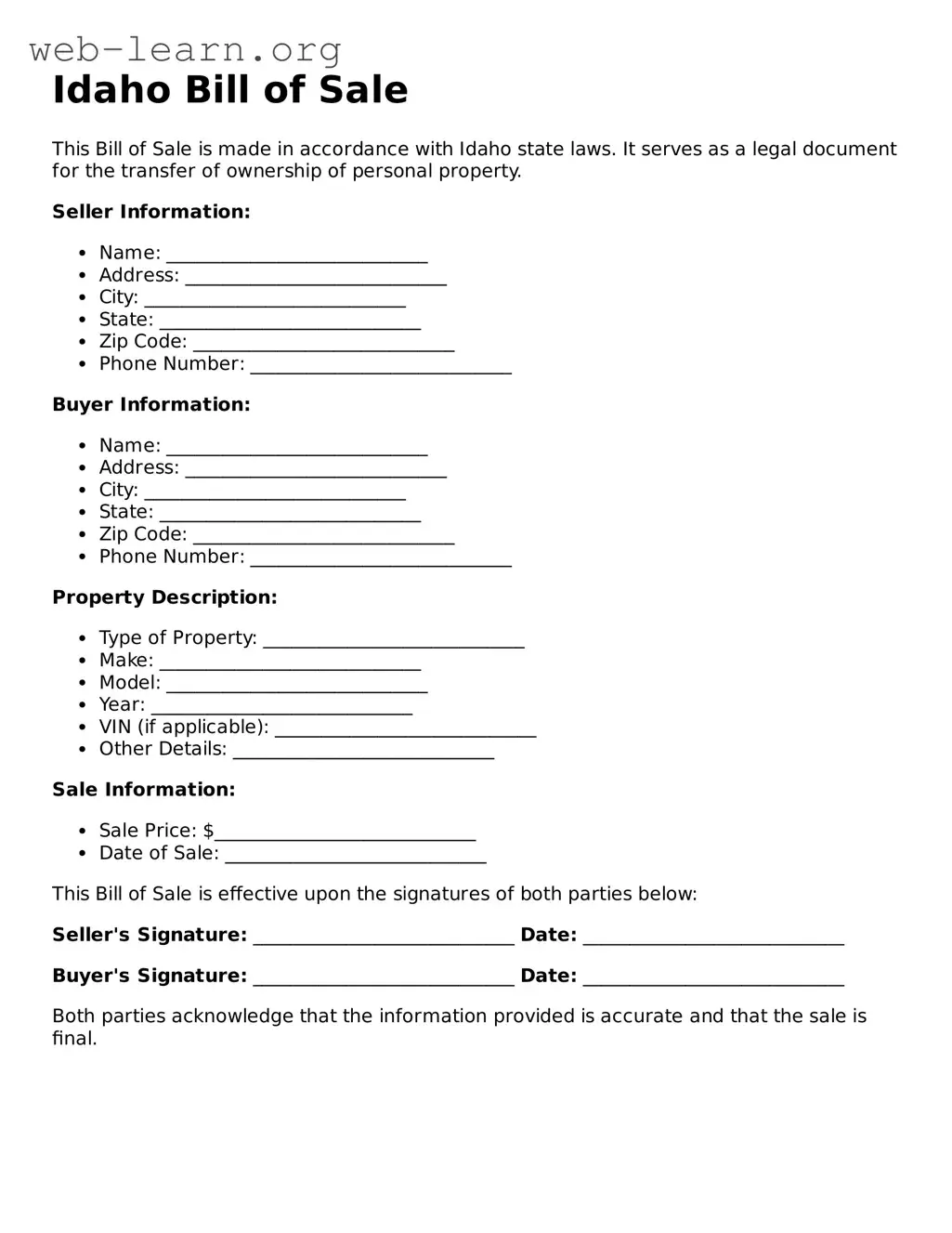
The Idaho Bill of Sale form is a crucial document for individuals engaged in the sale or transfer of personal property within the state. This form serves as a written record of the transaction, providing essential details about the buyer, seller, and the item being sold. It typically includes information such as the names and addresses of both parties, a description of the item, the sale price, and the date of the transaction. Additionally, the Bill of Sale may outline any warranties or guarantees, as well as the method of payment. Having a properly completed Bill of Sale helps protect both the buyer and seller by documenting the terms of the sale and ensuring that both parties have a clear understanding of their rights and responsibilities. In Idaho, this form is especially important for transactions involving vehicles, boats, and other significant assets, as it may be required for registration or titling purposes. Understanding how to correctly fill out this form can simplify the process and provide peace of mind for everyone involved.
Idaho Bill of Sale
This Bill of Sale is made in accordance with Idaho state laws. It serves as a legal document for the transfer of ownership of personal property.
Seller Information:
Buyer Information:
Property Description:
Sale Information:
This Bill of Sale is effective upon the signatures of both parties below:
Seller's Signature: ____________________________ Date: ____________________________
Buyer's Signature: ____________________________ Date: ____________________________
Both parties acknowledge that the information provided is accurate and that the sale is final.
| Fact Name | Description |
|---|---|
| Purpose | The Idaho Bill of Sale form is used to document the transfer of ownership of personal property from one party to another. |
| Governing Law | The form is governed by Idaho Statutes, specifically Title 28, Chapter 2, which covers the Uniform Commercial Code. |
| Property Types | This form can be used for various types of personal property, including vehicles, boats, and equipment. |
| Signatures Required | Both the seller and the buyer must sign the Bill of Sale to make it legally binding. |
| Notarization | While notarization is not required, it is recommended for added legal protection. |
| Record Keeping | Both parties should keep a copy of the completed Bill of Sale for their records. |
| Additional Information | The form should include details such as the date of sale, description of the property, and the sale price. |
Filling out the Idaho Bill of Sale form is a straightforward process. Once you have completed the form, you will be ready to finalize the sale of your vehicle or personal property. Make sure to gather all necessary information before you begin, as this will help streamline the process.
What is a Bill of Sale in Idaho?
A Bill of Sale in Idaho is a legal document that serves as proof of the transfer of ownership of personal property from one party to another. This document outlines the details of the transaction, including the description of the item being sold, the purchase price, and the names and addresses of both the buyer and seller.
Is a Bill of Sale required in Idaho?
While a Bill of Sale is not legally required for all transactions in Idaho, it is highly recommended. For certain items, such as vehicles, a Bill of Sale is essential for registering the transfer with the Idaho Department of Transportation. Having a Bill of Sale can also protect both parties in case of disputes regarding the transaction.
What information should be included in an Idaho Bill of Sale?
An effective Bill of Sale should include the following details:
Can I create my own Bill of Sale in Idaho?
Yes, you can create your own Bill of Sale in Idaho. It is important to ensure that the document includes all necessary information to be legally binding. Templates are available online, but customizing the document to reflect the specifics of your transaction is advisable.
Do I need to have the Bill of Sale notarized?
Notarization is not required for a Bill of Sale in Idaho. However, having the document notarized can add an extra layer of protection and credibility, especially in higher-value transactions. It can also help in case of future disputes.
How does a Bill of Sale affect the transfer of ownership?
A Bill of Sale acts as evidence of the transfer of ownership. Once signed by both parties, it indicates that the seller has relinquished their rights to the item, and the buyer has accepted ownership. This document can be crucial for establishing ownership in case of legal issues or claims.
Where can I obtain a Bill of Sale form for Idaho?
Bill of Sale forms can be obtained from various sources. Many online legal service providers offer customizable templates. Additionally, local office supply stores may carry generic Bill of Sale forms. It is important to ensure that any form used complies with Idaho state laws.
When filling out the Idaho Bill of Sale form, individuals often make common mistakes that can lead to complications later on. One frequent error is not providing complete information about the buyer and seller. It’s essential to include full names, addresses, and contact details for both parties. Incomplete information can create confusion and may even invalidate the document.
Another mistake occurs when the item being sold is not adequately described. The Bill of Sale should include specific details such as the make, model, year, and Vehicle Identification Number (VIN) for vehicles. For other items, clear descriptions that identify the item uniquely are crucial. Vague descriptions can lead to disputes over ownership.
Some people forget to include the purchase price. It’s important to state the amount agreed upon for the sale. This not only provides clarity but also serves as a record for tax purposes. Omitting this detail can lead to misunderstandings about the transaction.
Failing to sign the document is another common oversight. Both the buyer and seller must sign the Bill of Sale to make it legally binding. If either party neglects to sign, the document may not hold up in legal situations, which can complicate ownership transfer.
Additionally, individuals sometimes overlook the date of the transaction. Recording the date is vital for establishing when the sale took place. This information can be important for both parties in the event of future disputes or when filing taxes.
In some cases, people do not keep copies of the Bill of Sale. It is advisable for both the buyer and seller to retain a signed copy for their records. This ensures that both parties have proof of the transaction, which can be essential for future reference.
Another mistake is neglecting to check local laws regarding Bill of Sale requirements. Different states may have specific regulations that need to be followed. Not adhering to these laws can lead to problems with the transaction and ownership transfer.
Some individuals may also forget to include any warranties or guarantees associated with the sale. If there are any conditions or assurances about the item being sold, these should be clearly stated in the Bill of Sale. This protects both parties and clarifies expectations.
Lastly, a common error involves not having witnesses or notarization when required. While not always necessary, having a witness or notary can add an extra layer of security and legitimacy to the transaction. It can be beneficial in resolving any potential disputes in the future.
The Idaho Bill of Sale form serves as a crucial document for transferring ownership of personal property, such as vehicles or equipment. However, several other forms and documents may accompany this transaction to ensure that all legal requirements are met and that both parties are protected. Below is a list of commonly used documents that often accompany the Idaho Bill of Sale.
Utilizing these documents alongside the Idaho Bill of Sale can facilitate a smoother transaction process. Each document plays a vital role in ensuring that the transfer of ownership is clear, legal, and binding, ultimately protecting both the buyer and the seller.
The Bill of Sale is a crucial document in the transfer of ownership for various types of property. However, it shares similarities with several other important documents. Below are six documents that are comparable to the Bill of Sale, along with explanations of how they relate:
Understanding these documents and their similarities can help individuals navigate the complexities of property transactions more effectively.
When filling out the Idaho Bill of Sale form, it's important to ensure that the document is completed accurately. Here are some key dos and don'ts to keep in mind:
By following these guidelines, you can help ensure that your Bill of Sale is valid and serves its purpose effectively.
Understanding the Idaho Bill of Sale form is essential for anyone involved in buying or selling personal property. However, several misconceptions can lead to confusion. Here’s a list of common misunderstandings about this important document.
By dispelling these misconceptions, individuals can navigate the process of buying and selling property in Idaho with greater confidence and clarity.
When engaging in a transaction that involves the sale of personal property in Idaho, understanding the Bill of Sale form is essential. Here are some key takeaways to consider:
Using the Bill of Sale correctly can protect both the buyer and the seller in the event of a dispute. Always keep a copy for your records.
Proof of Ownership Car - This form can be beneficial for both private sales and transactions through dealers or brokers.
Bill Sale Vehicle - The form can be an essential tool in various industries, from automotive to real estate.
How to Sell Your Car Privately - The form can facilitate smoother transactions by clearly outlining terms.