Homepage Blank Idaho 850 Form
Outline

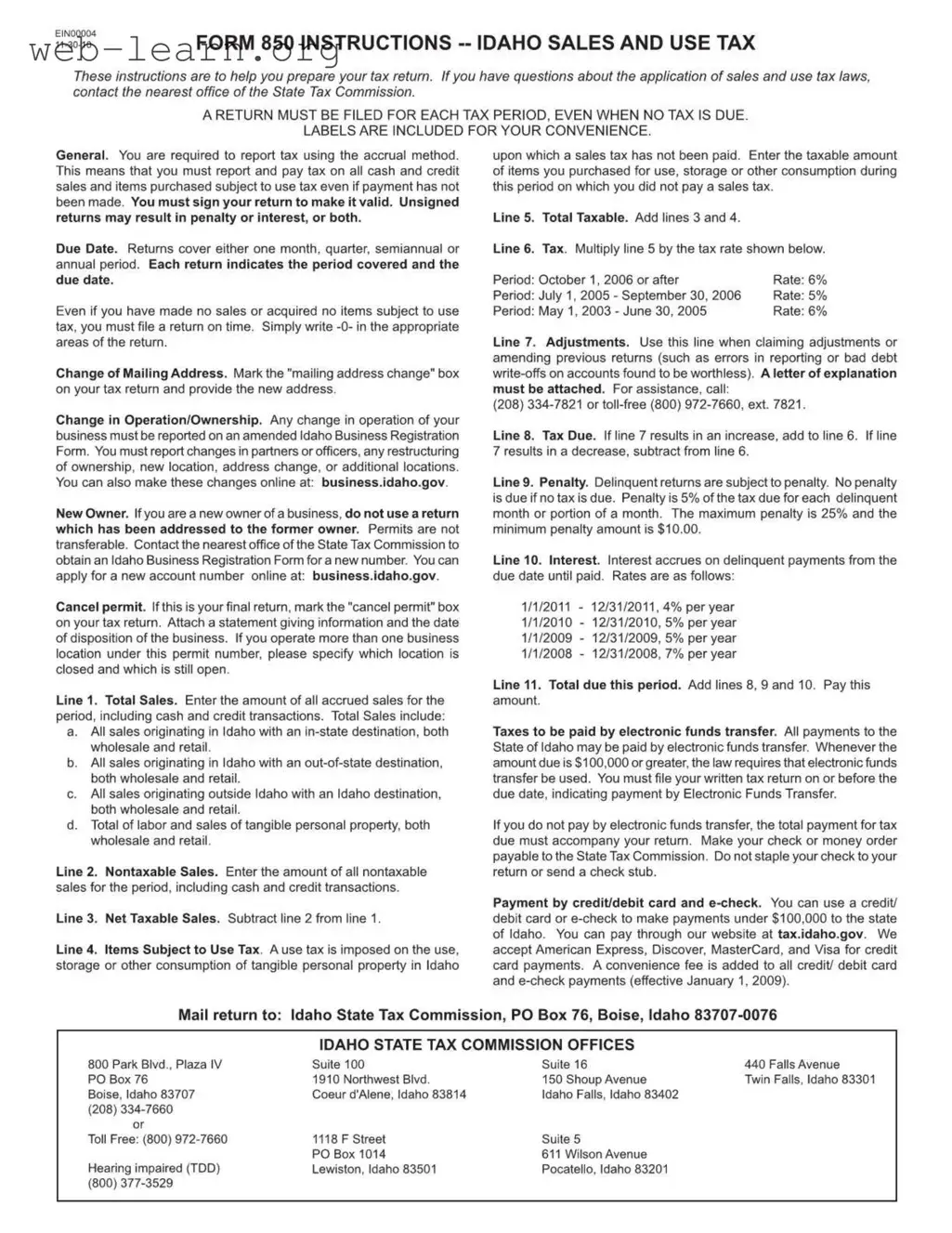
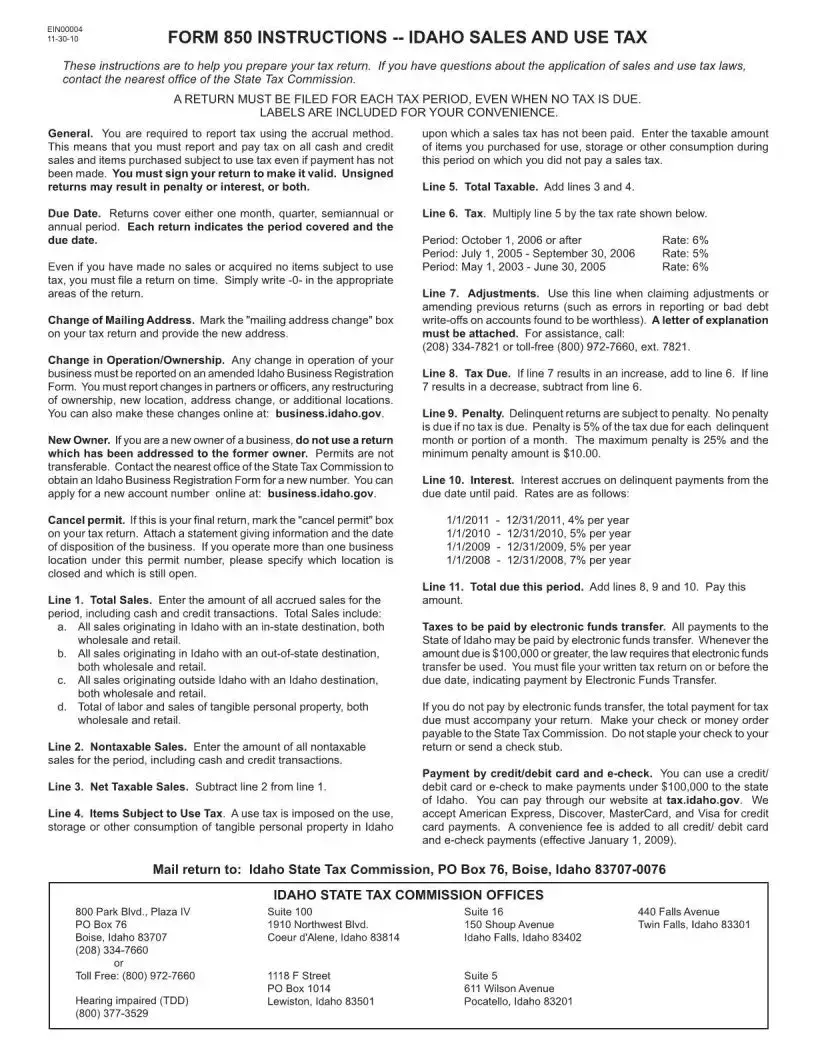
The Idaho 850 form is a crucial document for businesses operating in the state, as it is used to report sales and use tax. Understanding its various components is essential for compliance with state tax laws. Each business must file a return for every tax period, regardless of whether any tax is owed. This ensures that the state has a complete record of all sales and use transactions. The form requires businesses to report their total sales, including both cash and credit transactions, and to differentiate between taxable and nontaxable sales. Additionally, it addresses items subject to use tax, which applies to tangible personal property that has not been taxed at the point of sale. Businesses must also be aware of deadlines, as returns can cover different periods—monthly, quarterly, semiannually, or annually. Changes in ownership or operation must be reported, and if a business is closing, the form provides a way to cancel the permit. Penalties and interest may apply for late submissions, emphasizing the importance of timely filing. Overall, the Idaho 850 form serves as a comprehensive tool for businesses to fulfill their tax obligations while providing the state with necessary financial data.
Sample - Idaho 850 Form

Form Information

Fact Name Description
Filing Requirement A return must be filed for each tax period, even if no tax is due. This ensures compliance with state regulations.
Due Dates Returns cover various periods: monthly, quarterly, semiannually, or annually. Each return specifies its due date.
Accrual Method Tax must be reported using the accrual method, meaning all sales and use tax must be reported regardless of payment status.
New Ownership New owners must obtain a new Idaho Business Registration Form. Returns addressed to the former owner are not valid.
Governing Law The Idaho Sales and Use Tax laws govern the use of Form 850, ensuring adherence to state tax regulations.

Detailed Guide for Filling Out Idaho 850

Filling out the Idaho 850 form is a necessary step for businesses to report sales and use tax. After completing the form, it should be submitted by the due date indicated on the return. Timely filing is crucial, even if no tax is due. Below are the steps to accurately fill out the form.

  1. Obtain the Idaho 850 form from the State Tax Commission website or your local office.
  2. Identify the tax period covered by the return and the corresponding due date.
  3. Fill in your business name and address at the top of the form.
  4. If your mailing address has changed, mark the "mailing address change" box and provide the new address.
  5. Enter the total sales amount for the period on Line 1. Include all cash and credit transactions.
  6. On Line 2, enter the amount of nontaxable sales for the same period.
  7. Calculate the net taxable sales by subtracting Line 2 from Line 1 and enter the result on Line 3.
  8. For Line 4, report the taxable amount of items purchased for use, storage, or consumption on which sales tax was not paid.
  9. Add the amounts from Line 3 and Line 4, and write the total on Line 5.
  10. Multiply the amount on Line 5 by the appropriate tax rate and enter the result on Line 6.
  11. If applicable, enter any adjustments on Line 7 and attach a letter of explanation.
  12. Determine the tax due by adjusting Line 6 with any amounts from Line 7, and enter the result on Line 8.
  13. Calculate any penalties on Line 9 if the return is delinquent, and enter the amount.
  14. Calculate interest on Line 10 if applicable, based on the delinquent payment rates.
  15. Add Lines 8, 9, and 10 to find the total amount due this period and write it on Line 11.
  16. Sign the form to validate it. Unsigned returns may incur penalties or interest.
  17. Submit the completed form by the due date, along with payment if applicable. Payments can be made electronically or by check.

Obtain Answers on Idaho 850

  1. What is the Idaho 850 form?

    The Idaho 850 form is a tax return used to report sales and use tax in the state of Idaho. It is required for businesses that engage in selling goods or services subject to sales tax or that purchase items for use in Idaho without having paid sales tax. Each business must file a return for every tax period, even if no tax is due.

  2. When is the Idaho 850 form due?

    The due date for filing the Idaho 850 form varies based on the reporting period selected by the business. This can be monthly, quarterly, semiannual, or annual. Each return will specify the period covered and the corresponding due date. Even if there are no sales or taxable items, the return must still be filed on time, with a notation of -0- in the relevant sections.

  3. What should I do if I change my business address?

    If you have a change of mailing address, you need to mark the "mailing address change" box on your tax return and provide the new address. It is crucial to keep your records updated to ensure you receive important tax information and notices from the State Tax Commission.

  4. What if I am a new owner of a business?

    As a new owner, you should not use a tax return addressed to the previous owner. Permits are not transferable. You must contact the nearest office of the State Tax Commission to obtain a new Idaho Business Registration Form and apply for a new account number. This can also be done online at business.idaho.gov.

  5. How do I report nontaxable sales on the form?

    Nontaxable sales should be reported on Line 2 of the Idaho 850 form. This line requires you to enter the total amount of all nontaxable sales made during the reporting period, including both cash and credit transactions. Accurate reporting is essential to ensure compliance with tax regulations.

  6. What happens if I file my return late?

    If you file your return late, you may incur penalties and interest. The penalty for delinquent returns is 5% of the tax due for each month or part of a month that the return is late, with a maximum penalty of 25% and a minimum of $10. Interest also accrues on any unpaid taxes from the due date until the payment is made. It is important to file on time to avoid these additional costs.

Common mistakes

Completing the Idaho 850 form can be straightforward, but several common mistakes can lead to complications. One frequent error is failing to file a return even when no tax is due. It’s essential to remember that a return must be filed for each tax period, regardless of whether any sales were made. Simply indicating “-0-” in the relevant areas is sufficient to fulfill this requirement.

Another mistake is neglecting to sign the return. An unsigned return is not valid and may incur penalties or interest. Ensure that you take a moment to sign your return before submission. This small step can prevent unnecessary complications down the line.

Incorrectly reporting sales figures is also a common issue. Line 1 requires the total sales amount, including all cash and credit transactions. Some individuals mistakenly omit certain sales or misclassify them, which can lead to inaccurate tax calculations. Double-checking your entries against your sales records can help avoid this pitfall.

Additionally, many people forget to account for nontaxable sales on Line 2. This line is crucial for accurately determining net taxable sales. Failing to report these sales can inflate your taxable amount and lead to overpayment of taxes.

When it comes to use tax, Line 4 often causes confusion. Some filers either forget to include items subject to use tax or miscalculate the amount. It is vital to remember that this tax applies to tangible personal property used in Idaho where sales tax has not been paid. Keeping thorough records of such purchases will assist in accurate reporting.

Another frequent oversight occurs with adjustments on Line 7. If you are claiming adjustments or amending previous returns, a letter of explanation must be attached. Omitting this letter can delay processing and lead to further inquiries from the tax commission.

Moreover, many filers neglect to check for changes in mailing address or ownership. If you have moved or changed ownership, marking the appropriate boxes on the form is essential. This ensures that all communications from the State Tax Commission reach you without delay.

Lastly, not adhering to the electronic funds transfer requirement can lead to significant issues. If your tax due is $100,000 or greater, you are legally obligated to pay via electronic funds transfer. Failing to comply with this requirement can result in penalties and delays. Always verify the payment method before submitting your return.

Documents used along the form

The Idaho 850 form is a crucial document for reporting sales and use tax in Idaho. However, it often works alongside several other forms and documents that can help streamline the process or provide additional information. Below is a list of these related documents, each serving a specific purpose.

  • Idaho Business Registration Form: This form is necessary for new businesses or when there are changes in ownership. It registers the business with the state and provides a unique identification number.
  • Sales Tax Exemption Certificate: If your business qualifies for sales tax exemption, this certificate allows you to make purchases without paying sales tax on eligible items.
  • Amended Tax Return: Use this form to correct any errors on previously filed tax returns. It ensures that the state has accurate information regarding your tax obligations.
  • Tax Payment Voucher: This voucher accompanies payments made to the state. It provides details about the payment, ensuring it is applied to the correct tax account.
  • IRS Form W-9: This form is used to provide your taxpayer identification number to clients or businesses that need to report payments made to you. It’s essential for tax reporting purposes.
  • Form 1099-MISC: If you receive payments as an independent contractor, this form is used by clients to report payments made to you. It’s important for your tax filings.
  • Tax Clearance Certificate: This document certifies that all tax obligations have been met. It may be required for certain business transactions or permits.
  • Sales and Use Tax Audit Report: If your business is audited, this report summarizes the findings and any adjustments needed for your tax filings.
  • Payment Confirmation Receipt: After making a tax payment, this receipt serves as proof of payment. Keep it for your records in case of any disputes.

These documents can significantly aid in managing your tax responsibilities effectively. Keeping them organized and accessible will help ensure compliance and make the process smoother for your business.

Similar forms

The Idaho 850 form is a crucial document for reporting sales and use tax in Idaho. It shares similarities with several other tax-related documents. Here are five forms that are comparable to the Idaho 850, along with explanations of their similarities:

  • IRS Form 1040: This is the standard individual income tax return form used in the United States. Like the Idaho 850, it requires taxpayers to report income and calculate taxes owed for a specific period. Both forms must be filed even if no tax is due, emphasizing the importance of compliance with tax laws.
  • IRS Form 941: This form is used by employers to report income taxes, Social Security tax, and Medicare tax withheld from employee wages. Similar to the Idaho 850, Form 941 requires periodic filing and includes calculations of tax liabilities, ensuring that all tax obligations are reported accurately.
  • Sales Tax Return (varies by state): Many states have their own versions of sales tax return forms that require businesses to report sales and calculate sales tax owed. These forms, like the Idaho 850, focus on reporting sales transactions and ensuring that taxes are collected and remitted correctly, regardless of whether any sales occurred during the reporting period.
  • Form ST-3 (Sales Tax Exempt Certificate): This form is used by purchasers to claim exemption from sales tax on certain purchases. While the Idaho 850 reports tax owed, the ST-3 serves as documentation that certain sales are exempt, highlighting the interplay between taxable and nontaxable sales, much like the Idaho 850's reporting of both categories.
  • Form 1065 (U.S. Return of Partnership Income): This form is used to report income, deductions, gains, and losses from partnerships. It requires detailed reporting similar to the Idaho 850, as both forms necessitate accurate accounting of financial activities for a specified period, ensuring compliance with tax regulations.

Dos and Don'ts

When filling out the Idaho 850 form, it’s important to ensure accuracy and compliance. Here are seven essential do's and don'ts to guide you through the process.

  • Do report all sales, including cash and credit transactions, on Line 1.
  • Do file a return for each tax period, even if no tax is due. Simply write -0- in the appropriate areas.
  • Do sign your return to validate it. An unsigned return may incur penalties.
  • Do mark the "mailing address change" box if your address has changed.
  • Don't use a return addressed to a former owner if you are a new owner. Obtain a new Idaho Business Registration Form.
  • Don't forget to cancel your permit if this is your final return. Mark the "cancel permit" box and provide necessary information.
  • Don't ignore the deadlines. Ensure your return is filed on time to avoid penalties and interest.

By following these guidelines, you can navigate the Idaho 850 form with greater ease and confidence. Always double-check your entries for accuracy to minimize issues down the line.

Misconceptions

Here are some common misconceptions about the Idaho 850 form:

  • Only businesses with sales must file. Many believe that if they have no sales, they don't need to file. However, a return must be filed for each tax period, even if no tax is due. Simply write -0- in the appropriate areas.
  • Unsigned returns are acceptable. Some think that they can submit their returns without a signature. This is incorrect. Unsigned returns may incur penalties or interest.
  • All sales are taxable. There is a misconception that every sale is subject to tax. In reality, nontaxable sales must be reported separately on the form.
  • Permits are transferable. New business owners often assume they can use the previous owner's permit. This is false. Permits are not transferable, and new owners must apply for a new number.
  • Filing late is not a big deal. Some believe that filing returns late won't have consequences. In fact, delinquent returns are subject to penalties and interest that can accumulate quickly.
  • Changes in ownership don’t need to be reported. It's a common error to think that ownership changes can be ignored. Any change must be reported on an amended Idaho Business Registration Form.
  • Payments can be made in any form. Many assume they can pay their taxes in any way they choose. However, payments of $100,000 or more must be made via electronic funds transfer.

Key takeaways

Here are some key takeaways regarding the Idaho 850 form:

  • Filing Requirement: A return must be filed for each tax period, even if no tax is due.
  • Accrual Method: Report all cash and credit sales, as well as items purchased subject to use tax, regardless of payment status.
  • Due Dates: Each return specifies the period covered and its due date. Timely filing is essential.
  • Address Changes: If your mailing address changes, mark the appropriate box and provide the new address on your return.
  • New Ownership: New owners must obtain a new Idaho Business Registration Form and cannot use returns addressed to the former owner.
  • Final Returns: If this is your final return, mark the "cancel permit" box and attach a statement with details of the business disposition.
  • Tax Calculation: Total taxable sales and items subject to use tax are calculated on specific lines of the form.
  • Penalties and Interest: Delinquent returns incur penalties and interest, which accrue from the due date until paid.
  • Electronic Payments: Payments of $100,000 or more must be made via electronic funds transfer. Other payments can be made using credit/debit cards or e-checks.