Homepage Blank Icr Illinois Dept Form
Outline

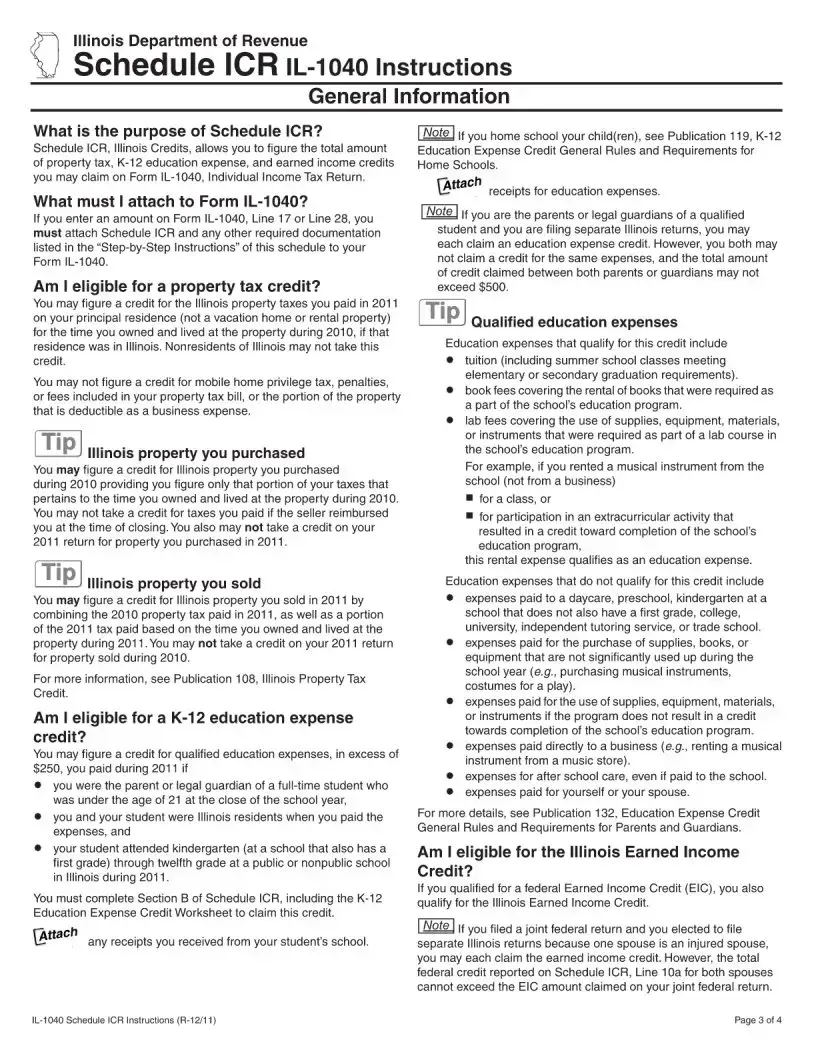
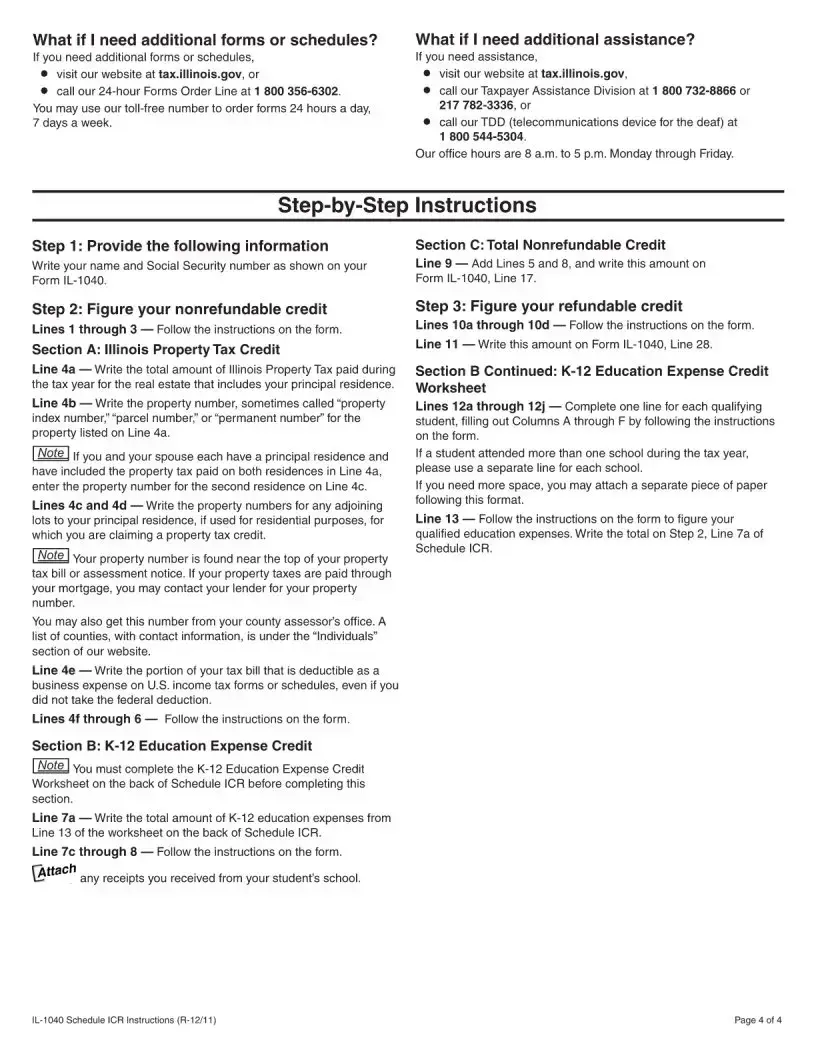
The Illinois Department of Revenue's Schedule ICR is a crucial document for taxpayers seeking to claim various credits on their state income tax return. This form allows individuals to apply for the Illinois Property Tax Credit, K-12 Education Expense Credit, and Earned Income Credit (EIC), provided they meet specific eligibility criteria. Before diving into the details of the ICR form, it is essential to complete the IL-1040 through Line 15 and Schedule CR, if necessary. The schedule requires taxpayers to provide personal information, such as their name and Social Security number, and to calculate their nonrefundable and refundable credits based on their tax situation. For instance, the Illinois Property Tax Credit is limited to the lesser of the calculated credit or the total tax owed, while the K-12 Education Expense Credit has its own set of guidelines and requires documentation of education expenses. Understanding these components is vital for accurate completion and maximization of potential tax benefits.
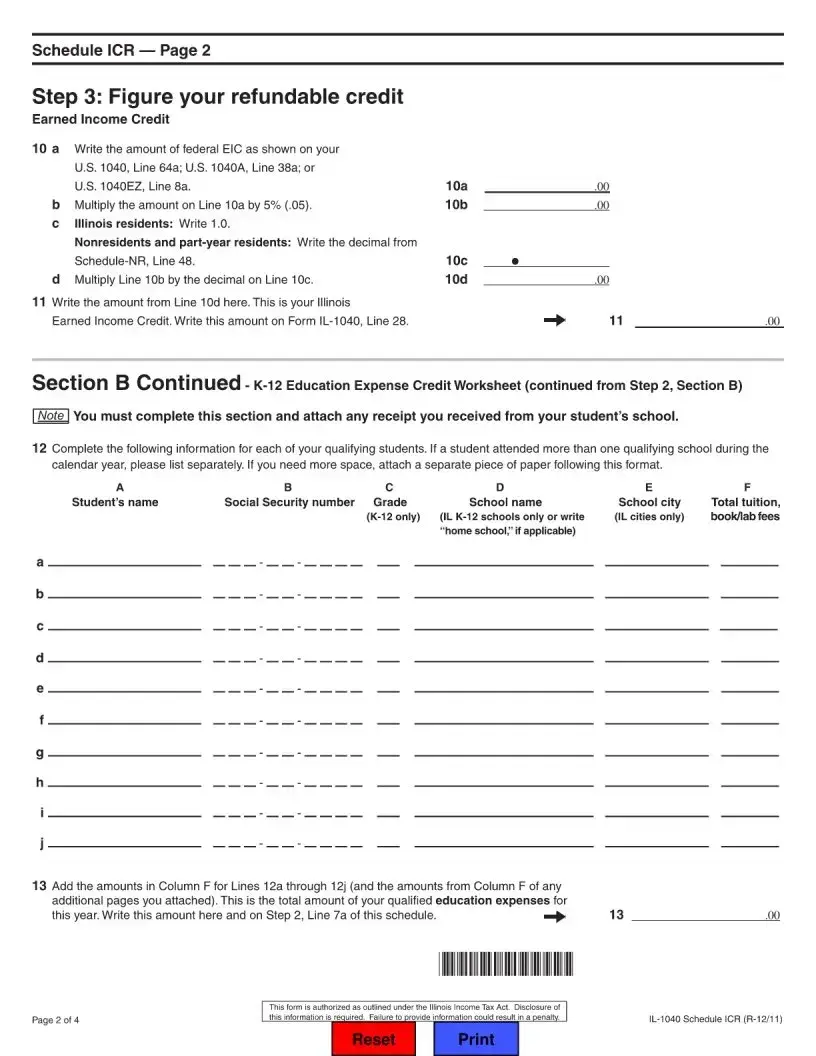
Sample - Icr Illinois Dept Form

Form Information

Fact Name Details
Governing Law The ICR form is governed by the Illinois Income Tax Act.
Eligible Credits This schedule is for claiming the Illinois Property Tax Credit, K-12 Education Expense Credit, and Earned Income Credit.
Completion Requirement Taxpayers must complete Form IL-1040 through Line 15 and Schedule CR, if applicable, before filling out this schedule.
Nonrefundable Credit Limit The total amount of the Illinois Property Tax Credit and K-12 Education Expense Credit cannot exceed the taxpayer's total tax liability, except for the Earned Income Credit, which may exceed the tax.

Detailed Guide for Filling Out Icr Illinois Dept

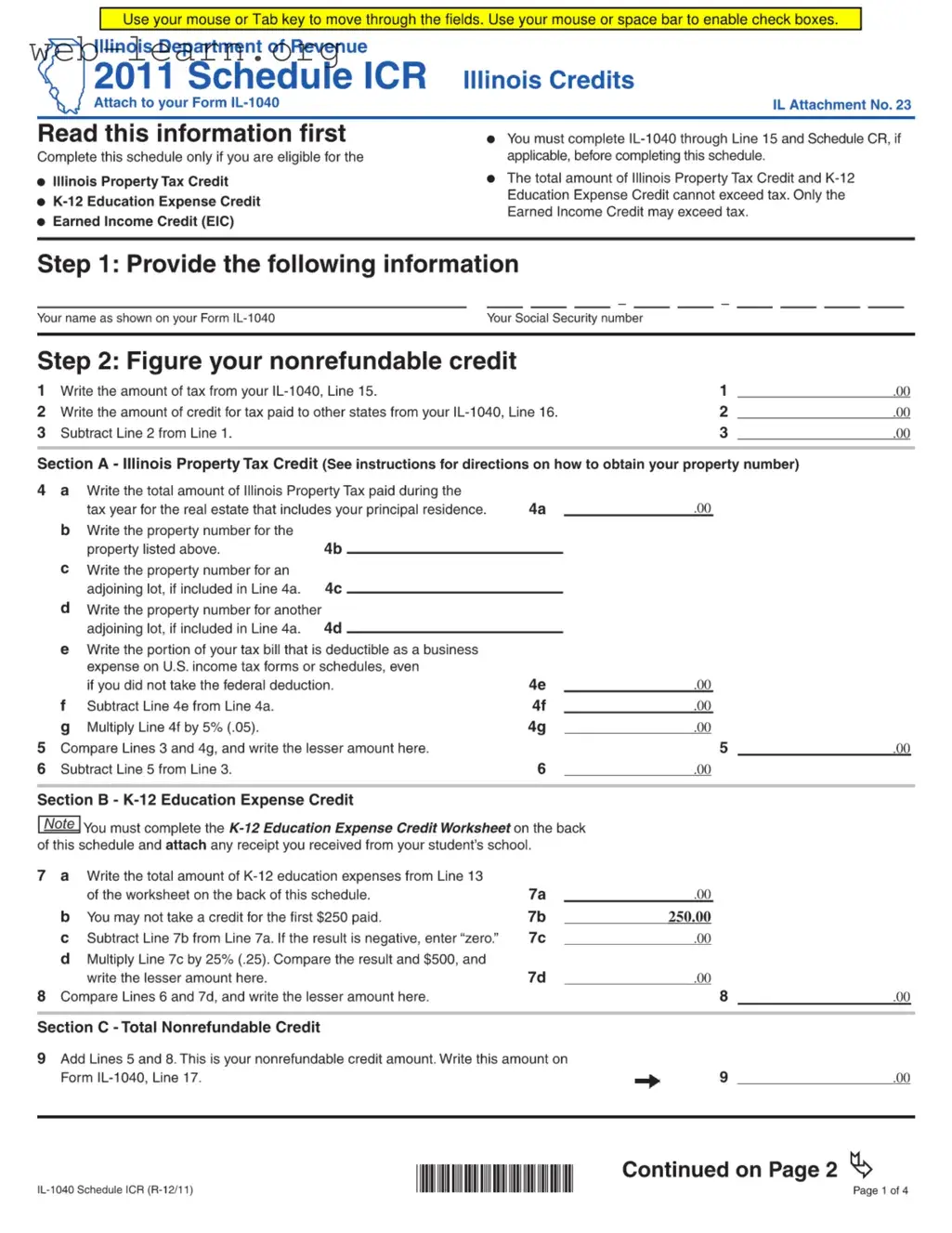
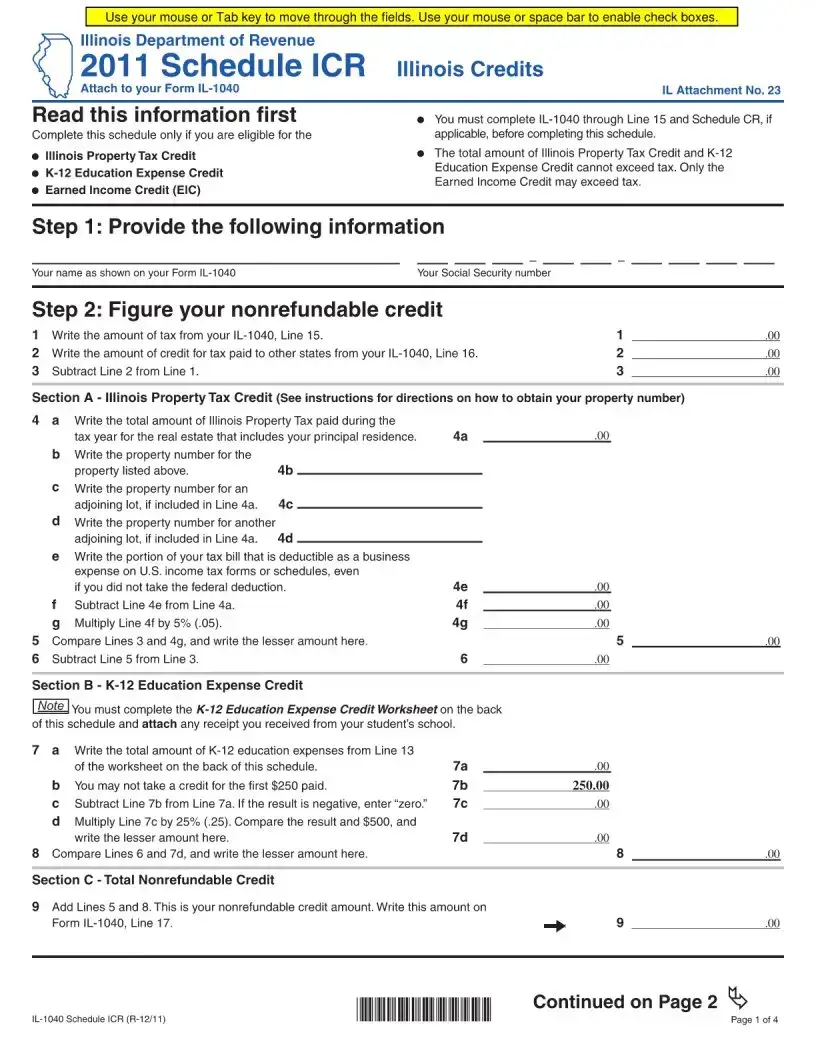
Filling out the ICR form from the Illinois Department of Revenue is an essential step if you qualify for certain tax credits. After completing this form, you'll need to attach it to your Form IL-1040. Make sure you have all necessary information and documentation ready before starting.

  1. Provide your name as it appears on your Form IL-1040.
  2. Enter your Social Security number.
  3. For Line 1, write the amount of tax from your IL-1040, Line 15.
  4. For Line 2, write the amount of credit for tax paid to other states from your IL-1040, Line 16.
  5. Subtract Line 2 from Line 1 and write the result on Line 3.

Next, you will complete Section A for the Illinois Property Tax Credit.

  1. On Line 4a, write the total amount of Illinois Property Tax paid during the tax year for your principal residence.
  2. On Line 4b, write the property number for the property listed above.
  3. If applicable, write the property number for any adjoining lots on Line 4c and 4d.
  4. On Line 4e, write the portion of your tax bill that is deductible as a business expense.
  5. Subtract Line 4e from Line 4a and write the result on Line 4f.
  6. Multiply Line 4f by 5% (0.05) and write this amount on Line 4g.
  7. Compare Lines 3 and 4g, and write the lesser amount on Line 5.
  8. Subtract Line 5 from Line 3 and write the result on Line 6.

Now, proceed to Section B for the K-12 Education Expense Credit.

  1. Complete the K-12 Education Expense Credit Worksheet on the back of the schedule.
  2. On Line 7a, write the total amount of K-12 education expenses from Line 13 of the worksheet.
  3. On Line 7b, write $250.00, as you cannot claim a credit for this amount.
  4. Subtract Line 7b from Line 7a and write the result on Line 7c. If the result is negative, enter “zero.”
  5. Multiply Line 7c by 25% (0.25) and compare this result to $500. Write the lesser amount on Line 7d.
  6. Compare Lines 6 and 7d, and write the lesser amount on Line 8.

Finally, calculate your total nonrefundable credit.

  1. Add Lines 5 and 8, and write this amount on Line 9. This is your nonrefundable credit amount.
  2. For the refundable credit, write the amount of federal Earned Income Credit (EIC) from your U.S. 1040, Line 64a, U.S. 1040A, Line 38a, or U.S. 1040EZ, Line 8a on Line 10a.
  3. Multiply Line 10a by 5% (0.05) and write the result on Line 10b.
  4. Write 1.0 on Line 10c if you are an Illinois resident. If you are a nonresident or part-year resident, write the decimal from Schedule-NR, Line 48.
  5. Multiply Line 10b by the decimal on Line 10c and write the result on Line 10d.
  6. Finally, write the amount from Line 10d on Line 11. This is your Illinois Earned Income Credit.

Make sure to review your completed form before submission, ensuring all information is accurate and all required attachments are included.

Obtain Answers on Icr Illinois Dept

  1. What is the ICR Illinois Department form?

    The ICR Illinois Department form, specifically the Schedule ICR, is used to claim certain tax credits available to Illinois residents. These credits include the Illinois Property Tax Credit, K-12 Education Expense Credit, and the Earned Income Credit (EIC). This form must be attached to your Form IL-1040 when filing your state taxes.

  2. Who should complete the ICR form?

    Individuals eligible for the Illinois Property Tax Credit, K-12 Education Expense Credit, or Earned Income Credit should complete this form. Before filling out the ICR, ensure that you have completed your IL-1040 through Line 15 and Schedule CR, if applicable. This ensures that you have the necessary information to accurately calculate your credits.

  3. How do I calculate my nonrefundable credit?

    To calculate your nonrefundable credit, follow these steps:

    • Start with the tax amount from your IL-1040, Line 15.
    • Subtract any credit for tax paid to other states from Line 16 of your IL-1040.
    • For the Illinois Property Tax Credit, list the total property tax paid for your principal residence and any adjoining lots. Deduct any portion of the tax bill that is a business expense.
    • Multiply the adjusted property tax amount by 5% to find the eligible credit.
    • Finally, compare this amount with your calculated tax amount to determine your nonrefundable credit.
  4. What documentation do I need for the K-12 Education Expense Credit?

    To claim the K-12 Education Expense Credit, you must complete the K-12 Education Expense Credit Worksheet included in the ICR form. Additionally, attach any receipts from your child's school that verify the education expenses incurred. Remember, you cannot claim a credit for the first $250 paid in education expenses.

  5. How do I determine my refundable credit for the Earned Income Credit?

    To calculate your refundable Earned Income Credit, you will need to start with the federal EIC amount from your U.S. 1040. Multiply this amount by 5%. Then, based on your residency status, input the appropriate decimal from Schedule-NR. Multiply the two results to find your Illinois Earned Income Credit, which you will then report on your IL-1040.

  6. What if I need more space to list my qualifying students for the K-12 Education Expense Credit?

    If you have more qualifying students than the form allows, you can attach a separate piece of paper. Ensure that this additional information follows the same format as the form, including the student's name, Social Security number, grade, school name, school city, and total tuition or fees.

Common mistakes

Filling out the Illinois Department of Revenue ICR form can be a straightforward process, but there are common mistakes that individuals often make. One significant error is failing to complete the IL-1040 and Schedule CR before starting the ICR form. The instructions clearly state that these forms must be completed first. Skipping this step can lead to confusion and inaccuracies in reporting your credits.

Another frequent mistake involves incorrect or missing personal information. It’s essential to provide your name exactly as it appears on your Form IL-1040 and to include your Social Security number. Omitting this information or entering it incorrectly can delay processing or result in the rejection of your application.

Many people also overlook the requirement to calculate their nonrefundable credit accurately. When subtracting the amount of credit for tax paid to other states from the total tax amount, errors in basic arithmetic can occur. This step is crucial because it determines the amount of credit you can claim. Double-checking these calculations can save time and frustration later on.

In Section A, some individuals mistakenly enter property tax amounts without verifying their eligibility. The form requires the total amount of Illinois Property Tax paid during the tax year for your principal residence. If you include property taxes for properties that do not qualify, you risk receiving a reduced credit or facing penalties.

Another common oversight occurs in Section B, where filers must complete the K-12 Education Expense Credit Worksheet. Failing to attach receipts from the student’s school can lead to disqualification of the credit. This documentation is necessary to substantiate your claims and ensure that you receive the appropriate credits.

Lastly, many applicants forget to compare the results of their calculations correctly. For instance, in Section C, the form requires you to compare the amounts from different lines and write the lesser amount. Misunderstanding this requirement can result in claiming more than you are entitled to, which could lead to further complications with the Illinois Department of Revenue.

Documents used along the form

The Illinois Department of Revenue Schedule ICR form is essential for taxpayers seeking various credits. Several other documents are often used in conjunction with this form. Below is a list of these documents, along with brief descriptions of their purposes.

  • Form IL-1040: This is the primary individual income tax return form for Illinois residents. Taxpayers must complete this form to report their income and determine their tax liability.
  • Schedule CR: This schedule is used to claim tax credits for taxes paid to other states. It is necessary to complete this schedule if you are eligible for credits that may reduce your Illinois tax liability.
  • K-12 Education Expense Credit Worksheet: This worksheet is required to calculate the K-12 Education Expense Credit. Taxpayers must list qualifying expenses for each student and attach any relevant receipts.
  • Form IL-NR: Nonresidents and part-year residents use this form to report income earned in Illinois. It helps determine tax obligations for those who do not reside in Illinois full-time.
  • Property Tax Bill: This document provides proof of property taxes paid during the tax year. It is necessary for claiming the Illinois Property Tax Credit on the Schedule ICR.
  • Federal Tax Return (Form 1040): This form is used to report federal income and calculate the federal Earned Income Credit. Information from this return is needed to complete the Illinois Earned Income Credit section of the Schedule ICR.

Using these documents together ensures that taxpayers can accurately claim the credits they are entitled to and comply with Illinois tax regulations. It is crucial to gather all necessary forms and information before submitting your tax return.

Similar forms

The Illinois Department of Revenue's Schedule ICR form is designed to help taxpayers claim specific credits related to property taxes and education expenses. Several other documents serve similar purposes in different contexts or jurisdictions. Here’s a list of ten such documents:

  • Form IL-1040: This is the primary individual income tax return form for Illinois residents. It requires taxpayers to report their income, calculate their tax liability, and claim various credits, including those reported on Schedule ICR.
  • Schedule CR: This schedule is used in conjunction with Form IL-1040 to claim various tax credits. Taxpayers must complete this form before filling out Schedule ICR, as it provides necessary credit information.
  • Form 8862: This is the IRS form for claiming the Earned Income Credit (EIC) after it has been disallowed in the past. Like Schedule ICR, it focuses on eligibility for specific tax credits.
  • Form 8863: Used to claim education credits, this IRS form allows taxpayers to receive credits for qualified education expenses, similar to the K-12 Education Expense Credit on Schedule ICR.
  • Form 1040A: This simplified version of the standard 1040 form allows for claiming certain credits and deductions, including education-related credits, akin to those on Schedule ICR.
  • Form 1098-T: This form is issued by educational institutions to report tuition payments. It serves as documentation for claiming education credits, paralleling the K-12 Education Expense Credit.
  • Form IL-PTAX-2: This form is used to claim the General Homestead Exemption in Illinois. It relates to property tax credits, similar to the Illinois Property Tax Credit on Schedule ICR.
  • Form IL-1040-X: This is the amended return form for Illinois taxpayers. It allows for corrections to previous returns, including adjustments to credits claimed, much like adjustments made on Schedule ICR.
  • Form 1040NR: This form is for non-resident aliens who need to file a U.S. tax return. While it serves a different population, it similarly addresses tax liabilities and credits.
  • Form 8880: This form is used to claim the Retirement Savings Contributions Credit. It is another example of a form focusing on specific tax credits, similar to those found on Schedule ICR.

Dos and Don'ts

When filling out the ICR form for the Illinois Department of Revenue, it’s essential to follow specific guidelines to ensure accuracy and compliance. Here’s a list of things you should and shouldn’t do:

  • Do complete your Form IL-1040 through Line 15 before starting the ICR form.
  • Do ensure you are eligible for the credits before filling out the schedule.
  • Do write your name and Social Security number exactly as they appear on your Form IL-1040.
  • Do carefully read the instructions regarding property numbers for the Illinois Property Tax Credit.
  • Do keep all receipts for K-12 education expenses and attach them as required.
  • Do double-check your calculations, especially when subtracting and multiplying values.
  • Don't forget to compare the amounts on the specified lines and write the lesser amount where indicated.
  • Don't skip any sections of the form; each part is necessary for accurate processing.
  • Don't use incorrect or outdated forms; ensure you have the latest version.
  • Don't leave any required fields blank; provide all requested information to avoid delays.

Misconceptions

Here are nine common misconceptions about the Illinois Department of Revenue ICR form:

  • Only homeowners can apply for credits. Many believe that only homeowners qualify for the Illinois Property Tax Credit. However, renters may also be eligible under certain conditions.
  • The ICR form is optional. Some think that completing the ICR form is optional. In reality, if you qualify for credits, you must complete it to receive those benefits.
  • You can claim all credits regardless of tax liability. It’s a misconception that you can claim all credits even if your tax liability is zero. Only the Earned Income Credit can exceed your tax liability.
  • All education expenses are eligible for the K-12 Education Expense Credit. Not all education expenses qualify. Only specific expenses outlined in the instructions are eligible.
  • Filing the ICR form is complicated. While the form may seem complex, following the instructions step-by-step simplifies the process significantly.
  • You don't need to attach receipts for education expenses. Many believe receipts are not required. However, you must attach receipts for K-12 expenses to support your claims.
  • Credits are automatically applied to your tax return. Some assume that credits will automatically apply. You must manually enter the calculated credit amount on your Form IL-1040.
  • Only residents can claim the Earned Income Credit. Non-residents may also qualify for the Earned Income Credit, depending on their income and residency status during the tax year.
  • All property taxes are fully deductible. Many think all property taxes can be deducted. Only the portion that is not claimed as a business expense can be considered for the credit.

Key takeaways

Filling out the ICR form from the Illinois Department of Revenue can be straightforward if you follow these key points:

  • Eligibility Requirements: Complete the ICR form only if you qualify for specific credits, such as the Illinois Property Tax Credit, K-12 Education Expense Credit, or Earned Income Credit (EIC).
  • Prior Completion: Ensure that you fill out your Form IL-1040 up to Line 15 and Schedule CR, if necessary, before starting the ICR form.
  • Nonrefundable Credits: The total for the Illinois Property Tax Credit and K-12 Education Expense Credit cannot exceed your tax liability, with the exception of the Earned Income Credit, which may exceed it.
  • Documentation: Keep all receipts related to K-12 education expenses, as you will need to attach them to the form.
  • Final Steps: After calculating your nonrefundable and refundable credits, ensure you write the final amounts on the appropriate lines of your Form IL-1040.