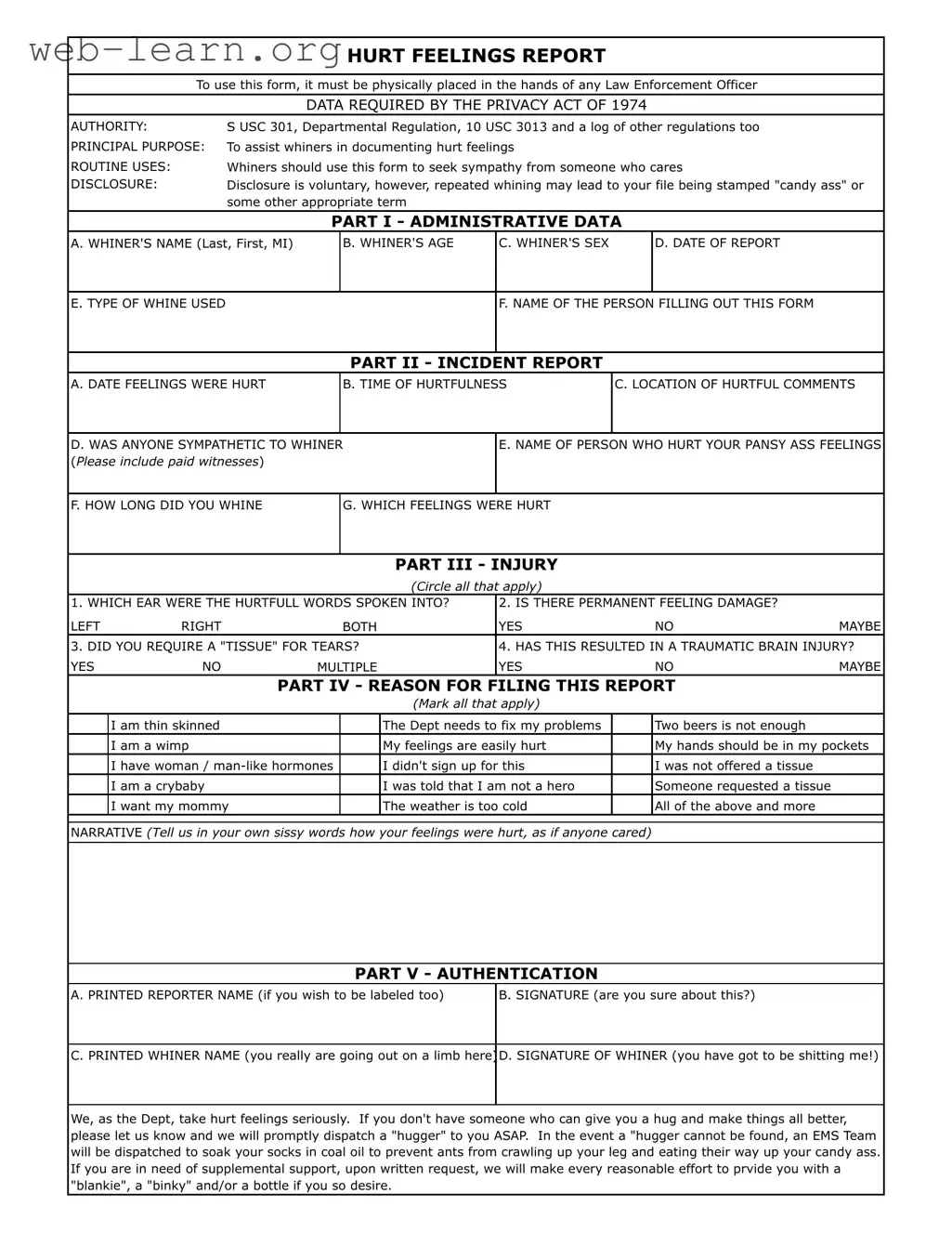
The Hurt Feelings Report form is designed to provide individuals with a structured way to express and document their emotional distress. This form, which must be physically submitted to a law enforcement officer, serves several purposes. It aims to assist those who feel wronged—referred to in a light-hearted manner as "whiners"—in seeking sympathy and support. The form requires basic administrative data, such as the name, age, and sex of the individual reporting their feelings, along with details about the incident that caused the hurt. Key sections include a narrative portion where individuals can describe their experiences, as well as a checklist for various types of emotional injuries. The report also humorously addresses the potential for “permanent feeling damage” and even offers options for supplemental support, such as a comforting “hugger” or other comforting items. While the tone may be playful, the underlying message emphasizes the importance of acknowledging and validating feelings. This article will explore the various components of the Hurt Feelings Report form, its intended use, and the broader implications of emotional well-being in our communities.

HURT FEELINGS REPORT
To use this form, it must be physically placed in the hands of any Law Enforcement Officer
DATA REQUIRED BY THE PRIVACY ACT OF 1974
AUTHORITY: PRINCIPAL PURPOSE:
ROUTINE USES:
DISCLOSURE:
S USC 301, Departmental Regulation, 10 USC 3013 and a log of other regulations too To assist whiners in documenting hurt feelings
Whiners should use this form to seek sympathy from someone who cares
Disclosure is voluntary, however, repeated whining may lead to your file being stamped "candy ass" or some other appropriate term
PART I - ADMINISTRATIVE DATA
A. WHINER'S NAME (Last, First, MI)
B. WHINER'S AGE
C. WHINER'S SEX
D. DATE OF REPORT
E. TYPE OF WHINE USED
F. NAME OF THE PERSON FILLING OUT THIS FORM
PART II - INCIDENT REPORT
A. DATE FEELINGS WERE HURT
B. TIME OF HURTFULNESS
C. LOCATION OF HURTFUL COMMENTS
D. WAS ANYONE SYMPATHETIC TO WHINER (Please include paid witnesses)
E. NAME OF PERSON WHO HURT YOUR PANSY ASS FEELINGS
F. HOW LONG DID YOU WHINE
G. WHICH FEELINGS WERE HURT
PART III - INJURY
(Circle all that apply)
1. WHICH EAR WERE THE HURTFULL WORDS SPOKEN INTO? |
2. IS THERE PERMANENT FEELING DAMAGE? |
|
||||||
LEFT |
RIGHT |
|
BOTH |
|
YES |
NO |
MAYBE |
|
3. DID YOU REQUIRE A "TISSUE" FOR TEARS? |
|
4. HAS THIS RESULTED IN A TRAUMATIC BRAIN INJURY? |
||||||
YES |
NO |
MULTIPLE |
|
YES |
NO |
MAYBE |
||
|
|
PART IV - REASON FOR |
FILING THIS REPORT |
|
||||
|
|
|
|
(Mark all that apply) |
|
|
||
|
I am thin skinned |
|
|
The Dept needs to fix my problems |
|
Two beers is not enough |
|
|
|
I am a wimp |
|
|
My feelings are easily hurt |
|
My hands should be in my pockets |
||
|
I have woman / |
|
I didn't sign up for this |
|
I was not offered a tissue |
|
||
|
I am a crybaby |
|
|
I was told that I am not a hero |
|
Someone requested a tissue |
|
|
|
I want my mommy |
|
|
The weather is too cold |
|
All of the above and more |
|
|
NARRATIVE (Tell us in your own sissy words how your feelings were hurt, as if anyone cared)
PART V - AUTHENTICATION
A. PRINTED REPORTER NAME (if you wish to be labeled too)
B. SIGNATURE (are you sure about this?)
C. PRINTED WHINER NAME (you really are going out on a limb here) D. SIGNATURE OF WHINER (you have got to be shitting me!)
We, as the Dept, take hurt feelings seriously. If you don't have someone who can give you a hug and make things all better, please let us know and we will promptly dispatch a "hugger" to you ASAP. In the event a "hugger cannot be found, an EMS Team will be dispatched to soak your socks in coal oil to prevent ants from crawling up your leg and eating their way up your candy ass. If you are in need of supplemental support, upon written request, we will make every reasonable effort to prvide you with a "blankie", a "binky" and/or a bottle if you so desire.
| Fact Name | Fact Description |
|---|---|
| Purpose of the Form | This form is designed to assist individuals in documenting their hurt feelings. |
| Privacy Act Compliance | The form complies with the Privacy Act of 1974, ensuring that personal data is handled appropriately. |
| Submission Requirement | The completed form must be physically handed to a law enforcement officer for processing. |
| Voluntary Disclosure | While disclosure of information is voluntary, excessive use of the form may result in derogatory labeling. |
| Incident Reporting | Part II of the form requires details about the incident, including date, time, and location of hurtful comments. |
| Types of Injuries | Part III allows individuals to circle applicable injuries, including emotional and physical responses. |
| State-Specific Forms | Some states may have specific laws governing the use of such forms; users should consult local regulations. |
| Support Availability | The department offers supplemental support, including "huggers" and comfort items, upon request. |
After completing the Hurt Feelings Report form, submit it directly to a Law Enforcement Officer. The officer will review the report and determine the next steps based on the information provided.
What is the purpose of the Hurt Feelings Report form?
The Hurt Feelings Report form is designed to help individuals document their feelings when they believe they have been wronged. It provides a structured way for someone to express their hurt and seek sympathy from others. While it may seem lighthearted, the form aims to address emotional distress in a way that encourages communication and support.
Who can fill out this form?
Anyone who feels their feelings have been hurt can fill out this form. The form requires basic information about the individual, including their name, age, and the details of the incident. It's important to remember that the form should be submitted to a law enforcement officer in person.
What information do I need to provide on the form?
The form consists of several sections, each requiring specific details:
What happens after I submit the form?
Once the form is submitted to a law enforcement officer, it will be reviewed. The department takes hurt feelings seriously and may take steps to provide support. This could include sending a "hugger" to offer comfort or, in more extreme cases, dispatching an EMS team for additional assistance. The goal is to ensure that your feelings are acknowledged and that you receive the care you need.
Can I remain anonymous when filing this report?
Filling out the Hurt Feelings Report form can be a straightforward process, but many people make mistakes that can complicate their experience. One common error is failing to provide complete information in the administrative data section. This includes not filling in the whiner's name, age, or sex. Incomplete information can lead to delays in processing the report and may result in the report being deemed invalid. Always ensure that all required fields are filled out accurately to avoid unnecessary complications.
Another frequent mistake is neglecting to specify the details of the incident in Part II. Whiners often leave out critical information, such as the date and time when their feelings were hurt or the location of the hurtful comments. This lack of detail can make it difficult for law enforcement to understand the context of the situation. Providing clear and concise information helps convey the seriousness of the incident and ensures that the report is taken seriously.
Some individuals also struggle with the narrative section of the form. Instead of clearly articulating how their feelings were hurt, they may provide vague or overly dramatic descriptions. This can lead to misunderstandings and may diminish the impact of their report. It's important to express feelings honestly and directly, focusing on the specifics of the incident rather than embellishing the story. This approach not only makes the report more effective but also helps in receiving the appropriate support.
Finally, a significant mistake occurs when individuals forget to sign the report. This oversight can render the entire form invalid. Both the reporter and the whiner must provide their signatures to authenticate the document. Without these signatures, the report may not be processed, leaving the individual without the support they seek. Always double-check that all signatures are included before submitting the form to ensure it is complete and valid.
The Hurt Feelings Report form is a unique document that allows individuals to express their emotional grievances in a structured manner. However, it is often accompanied by other forms and documents that serve various purposes related to emotional well-being, support, and documentation. Below is a list of some commonly used documents that may complement the Hurt Feelings Report form.
These forms and documents work together to create a supportive environment for individuals navigating their emotional challenges. By utilizing these resources, individuals can better articulate their feelings, seek assistance, and foster healing in a structured manner.
The Hurt Feelings Report form shares similarities with several other documents that aim to address personal grievances or emotional distress. Below is a list of six documents that are comparable, highlighting their similarities:
When filling out the Hurt Feelings Report form, it is important to approach the process with care and consideration. Here are some guidelines to follow:
Following these guidelines can help ensure that your report is taken seriously and processed efficiently. Remember, this is about addressing your feelings in a constructive manner.
Misconceptions about the Hurt Feelings Report form often arise from misunderstandings about its purpose and use. Here are ten common misconceptions, clarified for better understanding:
Understanding these misconceptions can help clarify the intent behind the Hurt Feelings Report form. It serves more as a humorous reflection on societal attitudes towards emotional sensitivity than as a serious legal instrument.
Filling out the Hurt Feelings Report form requires careful attention to detail. Here are key takeaways to consider:
By keeping these takeaways in mind, you can effectively communicate your feelings through the Hurt Feelings Report form.