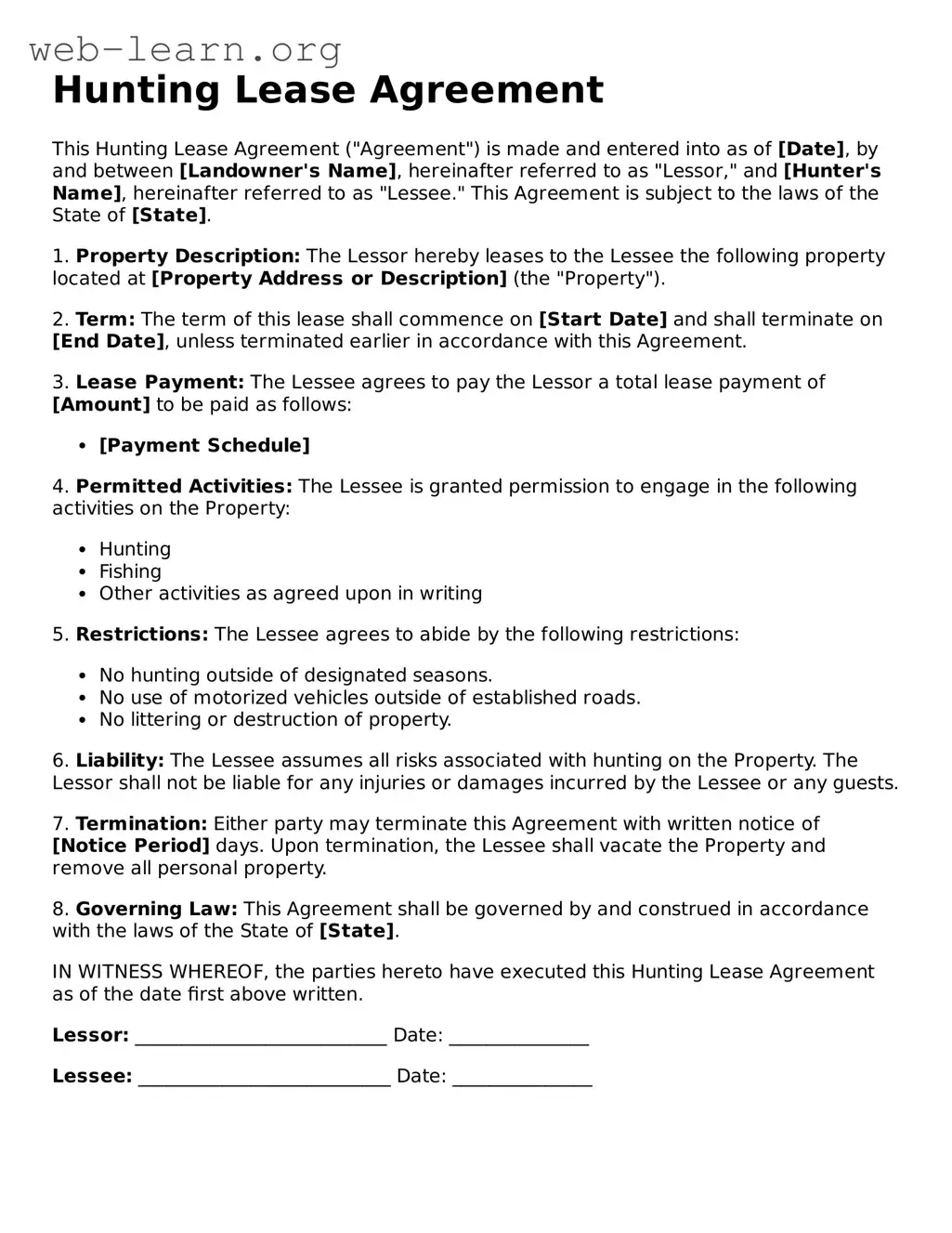
When it comes to hunting on private land, a Hunting Lease Agreement is an essential tool for both landowners and hunters. This legally binding document outlines the terms and conditions under which hunters can access and use the land for hunting purposes. It typically includes key elements such as the duration of the lease, the specific areas designated for hunting, and any restrictions or rules that must be followed. Additionally, the agreement often details the financial aspects, including lease payments and any potential deposits required. By clearly defining the rights and responsibilities of both parties, the Hunting Lease Agreement helps prevent misunderstandings and disputes, ensuring a smooth and enjoyable hunting experience. Whether you are a landowner looking to monetize your property or a hunter seeking a place to pursue your passion, understanding the components of this agreement is crucial for a successful arrangement.
Hunting Lease Agreement
This Hunting Lease Agreement ("Agreement") is made and entered into as of [Date], by and between [Landowner's Name], hereinafter referred to as "Lessor," and [Hunter's Name], hereinafter referred to as "Lessee." This Agreement is subject to the laws of the State of [State].
1. Property Description: The Lessor hereby leases to the Lessee the following property located at [Property Address or Description] (the "Property").
2. Term: The term of this lease shall commence on [Start Date] and shall terminate on [End Date], unless terminated earlier in accordance with this Agreement.
3. Lease Payment: The Lessee agrees to pay the Lessor a total lease payment of [Amount] to be paid as follows:
4. Permitted Activities: The Lessee is granted permission to engage in the following activities on the Property:
5. Restrictions: The Lessee agrees to abide by the following restrictions:
6. Liability: The Lessee assumes all risks associated with hunting on the Property. The Lessor shall not be liable for any injuries or damages incurred by the Lessee or any guests.
7. Termination: Either party may terminate this Agreement with written notice of [Notice Period] days. Upon termination, the Lessee shall vacate the Property and remove all personal property.
8. Governing Law: This Agreement shall be governed by and construed in accordance with the laws of the State of [State].
IN WITNESS WHEREOF, the parties hereto have executed this Hunting Lease Agreement as of the date first above written.
Lessor: ___________________________ Date: _______________
Lessee: ___________________________ Date: _______________
| Fact Name | Description |
|---|---|
| Definition | A Hunting Lease Agreement is a contract between landowners and hunters, outlining terms for hunting on private property. |
| Purpose | This agreement protects the rights of both parties and clarifies expectations regarding hunting activities. |
| Duration | The lease typically specifies a start and end date for the hunting season, ensuring clarity on access times. |
| Payment Terms | It includes details on rental fees, payment schedules, and any additional costs associated with the lease. |
| Liability Clauses | These clauses outline responsibilities and liabilities of both the landowner and the hunters in case of accidents or damages. |
| State-Specific Laws | Each state may have specific laws governing hunting leases, such as Texas Property Code and Florida Statutes. |
| Permitted Activities | The agreement should specify which activities are allowed, such as hunting, fishing, or camping, to avoid misunderstandings. |
| Termination Conditions | It outlines the conditions under which either party can terminate the agreement, ensuring a clear exit strategy. |
| Indemnification | Indemnification clauses protect the landowner from legal claims arising from the hunter's activities on the property. |
| Governing Law | The agreement specifies which state's laws govern the lease, providing a legal framework for enforcement. |
Filling out a Hunting Lease Agreement form is an important step in establishing the terms of the lease between the landowner and the hunter. This process ensures that both parties are clear on their rights and responsibilities. By following the steps outlined below, you can complete the form accurately and efficiently.
Once the form is completed, both the landowner and the hunter should keep a copy for their records. This ensures that all parties are aware of the agreed-upon terms and can refer back to them if needed.
A Hunting Lease Agreement is a legal document that outlines the terms and conditions under which one party (the lessor) allows another party (the lessee) to hunt on their property. This agreement typically includes details about the duration of the lease, the type of game that can be hunted, and any restrictions or rules that must be followed.
This agreement is beneficial for both landowners and hunters. Landowners can protect their property rights and set clear expectations, while hunters gain permission to hunt legally on private land. Both parties can avoid misunderstandings and disputes by having a written agreement in place.
Key elements of the agreement should include:
The duration of a Hunting Lease Agreement can vary. Some leases are for a single hunting season, while others may extend for several years. It is important for both parties to agree on the length of the lease and include that information in the document.
Yes, the agreement can be modified if both parties agree to the changes. Any modifications should be documented in writing and signed by both the lessor and lessee to ensure clarity and enforceability.
Filling out a Hunting Lease Agreement form can seem straightforward, but many people make common mistakes that can lead to misunderstandings or legal issues. One frequent error is failing to provide accurate property descriptions. It is essential to include precise details about the land being leased, such as boundaries and any specific areas designated for hunting. Without this information, disputes may arise over what land is included in the lease.
Another mistake involves neglecting to specify the duration of the lease. The agreement should clearly state the start and end dates. Vague terms can create confusion and lead to disagreements about when hunting rights begin and end. It’s crucial to outline these dates to avoid any potential conflicts.
People often overlook the importance of detailing the rental payment terms. This includes not only the amount but also the payment schedule and method. If these terms are unclear, it can lead to disputes over when payments are due or what constitutes a late payment. Clarity in financial obligations is key to a smooth leasing experience.
Additionally, some individuals fail to address liability and insurance requirements. A well-drafted agreement should outline who is responsible for injuries or damages that occur on the property. Without clear terms, both parties may find themselves at risk should an incident occur.
Another common error is not including rules regarding the use of the land. It’s important to specify what activities are allowed, such as hunting methods or the use of vehicles. Ambiguities in this area can lead to disagreements and potentially damage the relationship between the lessor and lessee.
Some people also forget to include termination clauses. These clauses define how either party can end the lease early. If these terms are not established, one party may find themselves unable to exit the agreement when necessary, leading to further complications.
Lastly, many individuals neglect to have the agreement reviewed by a legal professional. Even if the form seems simple, having an expert look it over can help identify potential pitfalls and ensure that all necessary elements are included. Skipping this step can result in costly mistakes down the line.
When entering into a Hunting Lease Agreement, it’s important to understand that several other documents may accompany this agreement. Each of these documents serves a specific purpose and can help clarify the terms of the lease, protect the rights of both parties, and ensure a smooth experience for everyone involved. Below is a list of commonly used forms and documents that are often associated with a Hunting Lease Agreement.
Understanding these documents can help ensure that both the landowner and the hunters have a clear understanding of their rights and responsibilities. A well-prepared set of documents can facilitate a positive hunting experience and foster good relationships between all parties involved.
The Hunting Lease Agreement form shares similarities with several other legal documents related to property use and leasing. Here are six such documents, each with a brief explanation of how they relate to the Hunting Lease Agreement:
When filling out a Hunting Lease Agreement form, attention to detail is crucial. Here are some essential dos and don’ts to keep in mind:
Understanding the Hunting Lease Agreement form is crucial for both landowners and hunters. However, several misconceptions can lead to confusion. Here are six common misconceptions:
In reality, hunting leases can vary significantly based on location, type of game, and specific terms negotiated between the parties involved.
Many believe that a handshake or verbal agreement is enough, but a written lease is essential for clarity and legal protection.
Some may think that a hunting lease allows for any type of hunting, but specific rights must be outlined in the agreement.
Many assume they won’t face liability issues. However, the lease should address liability and insurance to protect both parties.
Some believe that payment terms can be easily adjusted, but these should be clearly defined in the lease to avoid disputes.
Many think they can terminate the lease at any time without consequences. In truth, the lease will specify the conditions under which it can be terminated.
By addressing these misconceptions, both landowners and hunters can better navigate the complexities of hunting leases and ensure a mutually beneficial agreement.
Filling out and using a Hunting Lease Agreement form is an important step for both landowners and hunters. Here are some key takeaways to keep in mind:
By following these key points, both landowners and hunters can create a clear and effective Hunting Lease Agreement that protects their interests and fosters a positive hunting experience.
Does Microsoft Word Have a Free Lease Agreement Template? - Includes the storage facility's liability limitations.