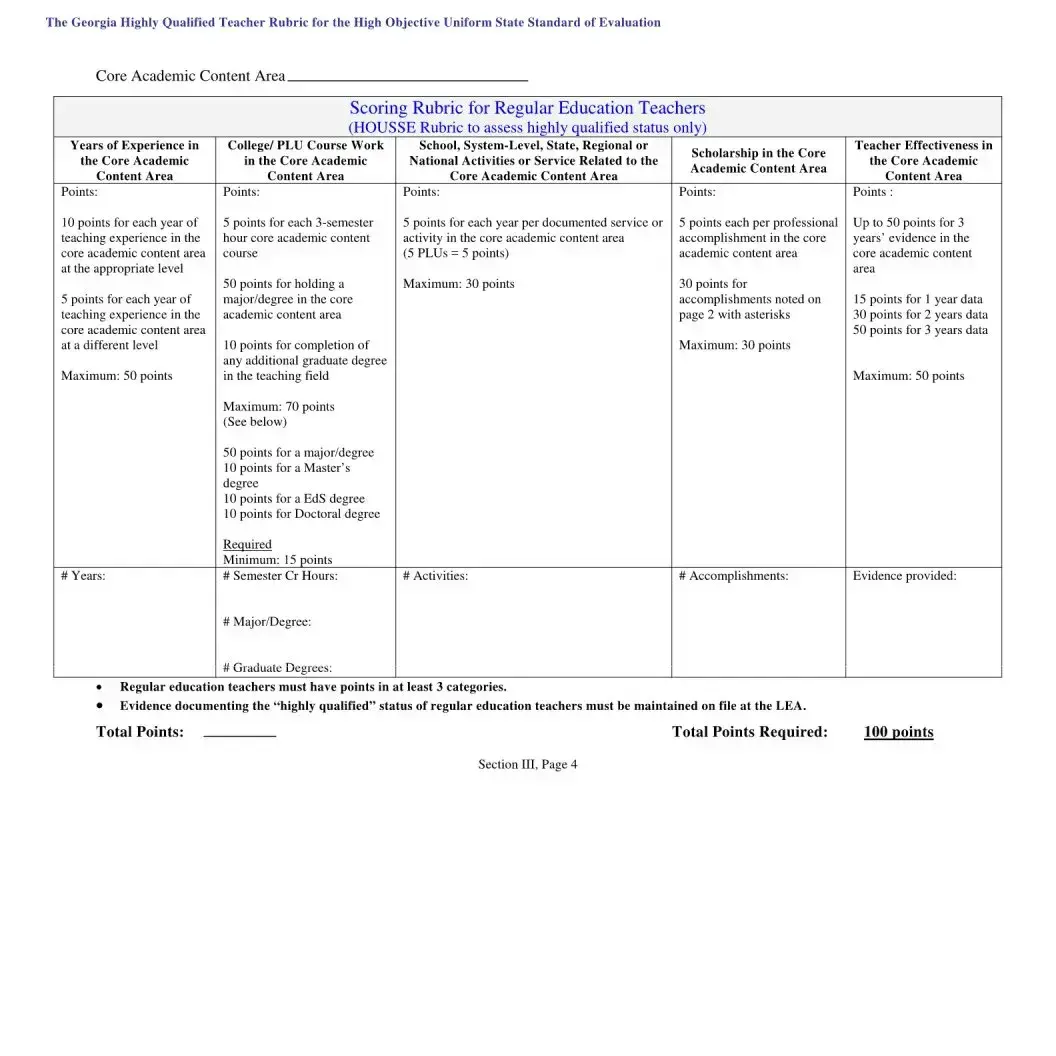
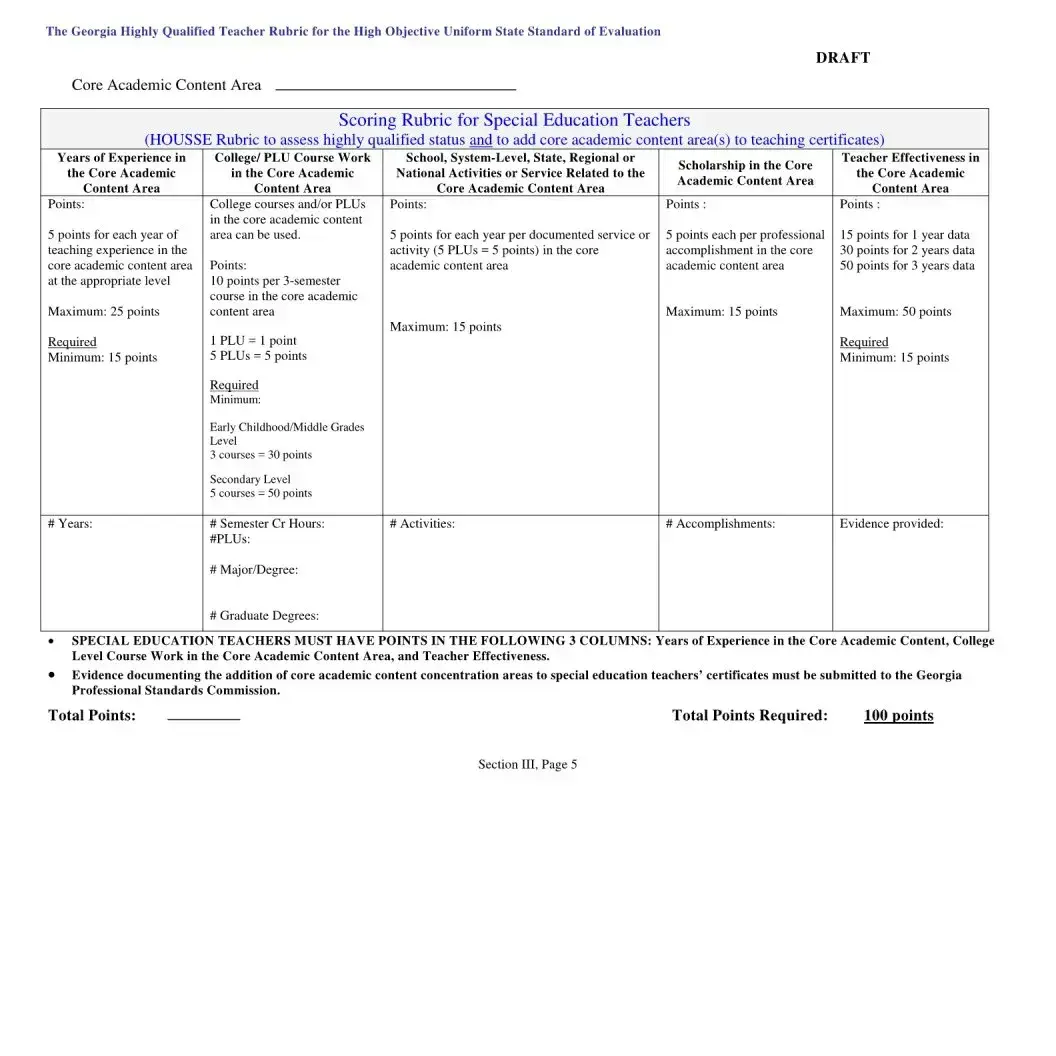
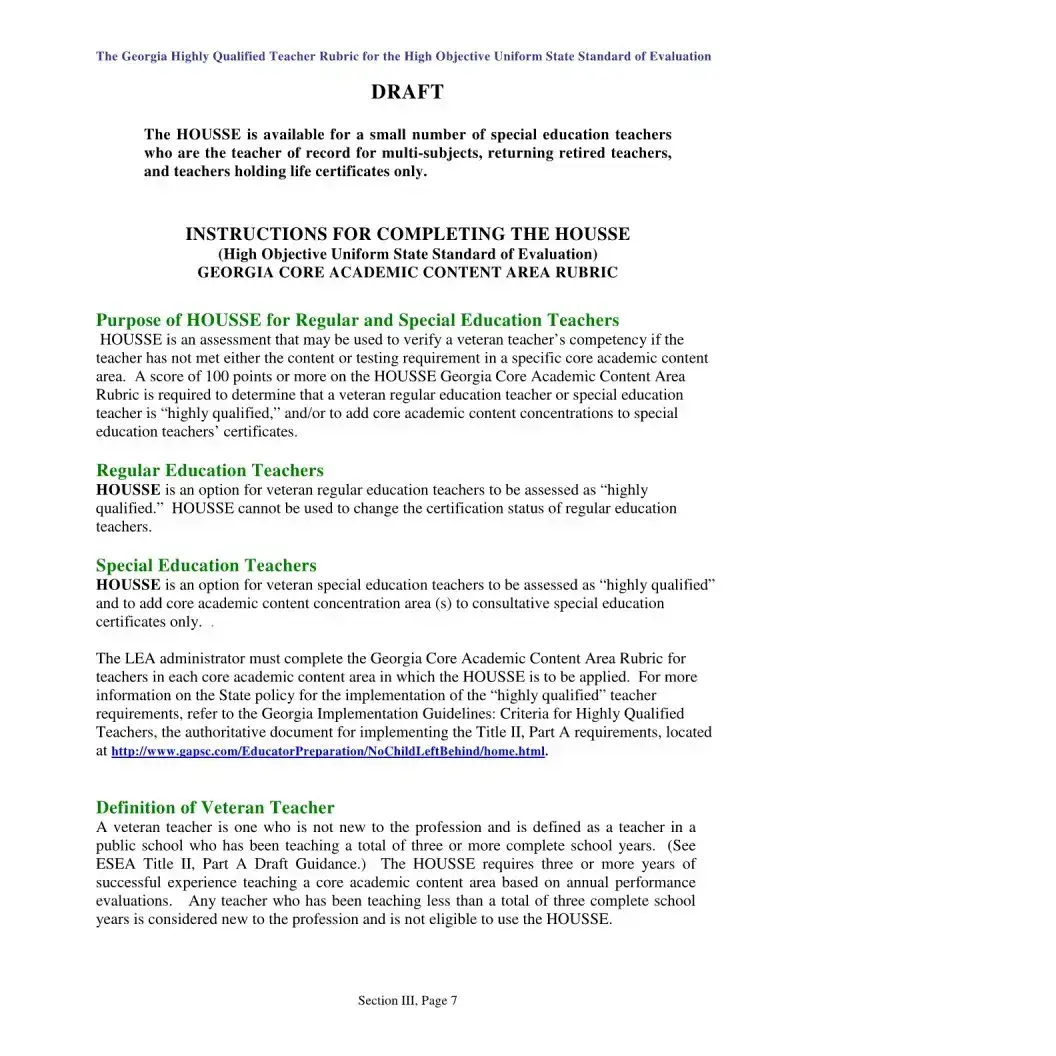
The Georgia HOUSSE Rubric, part of the Title II-A Handbook, serves as a vital tool for evaluating the qualifications of veteran teachers in the state. Designed to ensure that educators meet high standards, this assessment system is particularly useful for those who may not fulfill the typical content or testing requirements to be deemed "highly qualified." The rubric is applicable to a select group of educators, including veteran special education teachers, retired teachers returning to the classroom, and those holding life certificates. It emphasizes the importance of experience, requiring teachers to demonstrate at least three years of successful teaching in core academic subjects, supported by performance evaluations. Additionally, the HOUSSE Rubric allows for the addition of core academic content areas for special education teachers, enhancing their certifications. By outlining specific criteria such as years of experience, relevant coursework, and professional activities, the rubric provides a comprehensive framework for assessing teacher competency in subjects ranging from mathematics to the arts. Understanding this evaluation process is crucial for educators aiming to maintain their certification and ensure they are equipped to provide quality education to their students.
| Fact Name | Details |
|---|---|
| Title | The form is titled "Title II-A Handbook: A Guide for Advancing Educator Quality in Georgia Schools." |
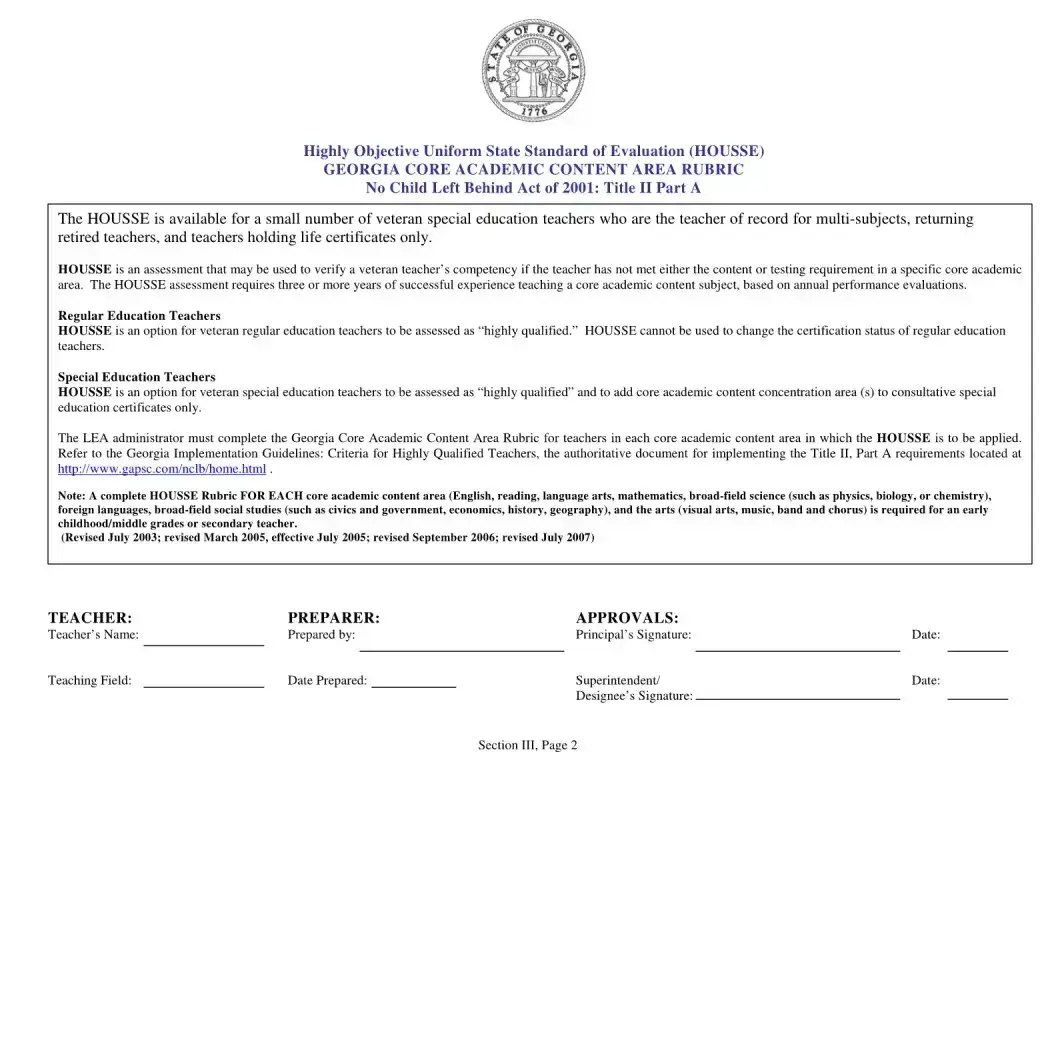
| Purpose | The Georgia HOUSSE serves as an assessment system to verify veteran teachers' competency in academic subjects. |
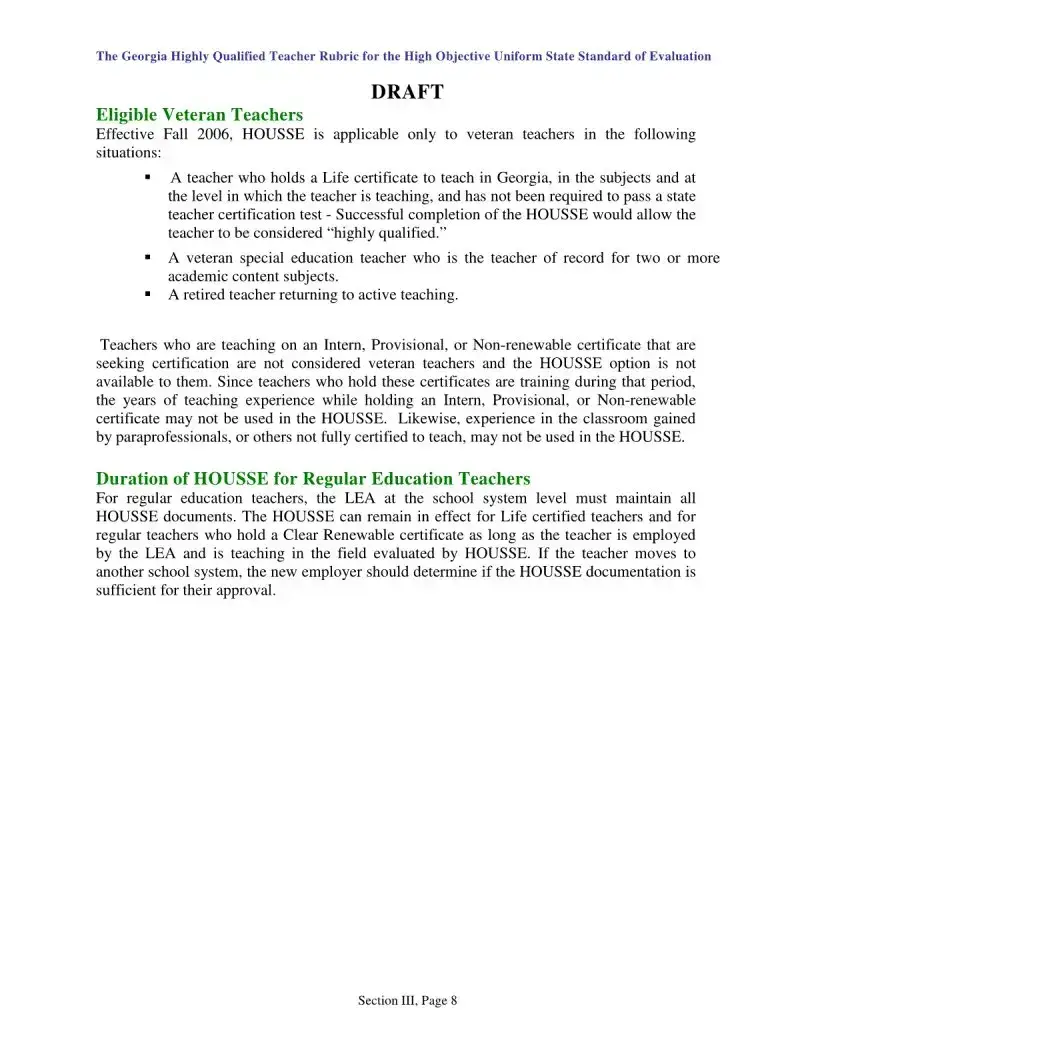
| Eligibility | Available to veteran teachers who are fully certified but do not meet the "highly qualified" status. |
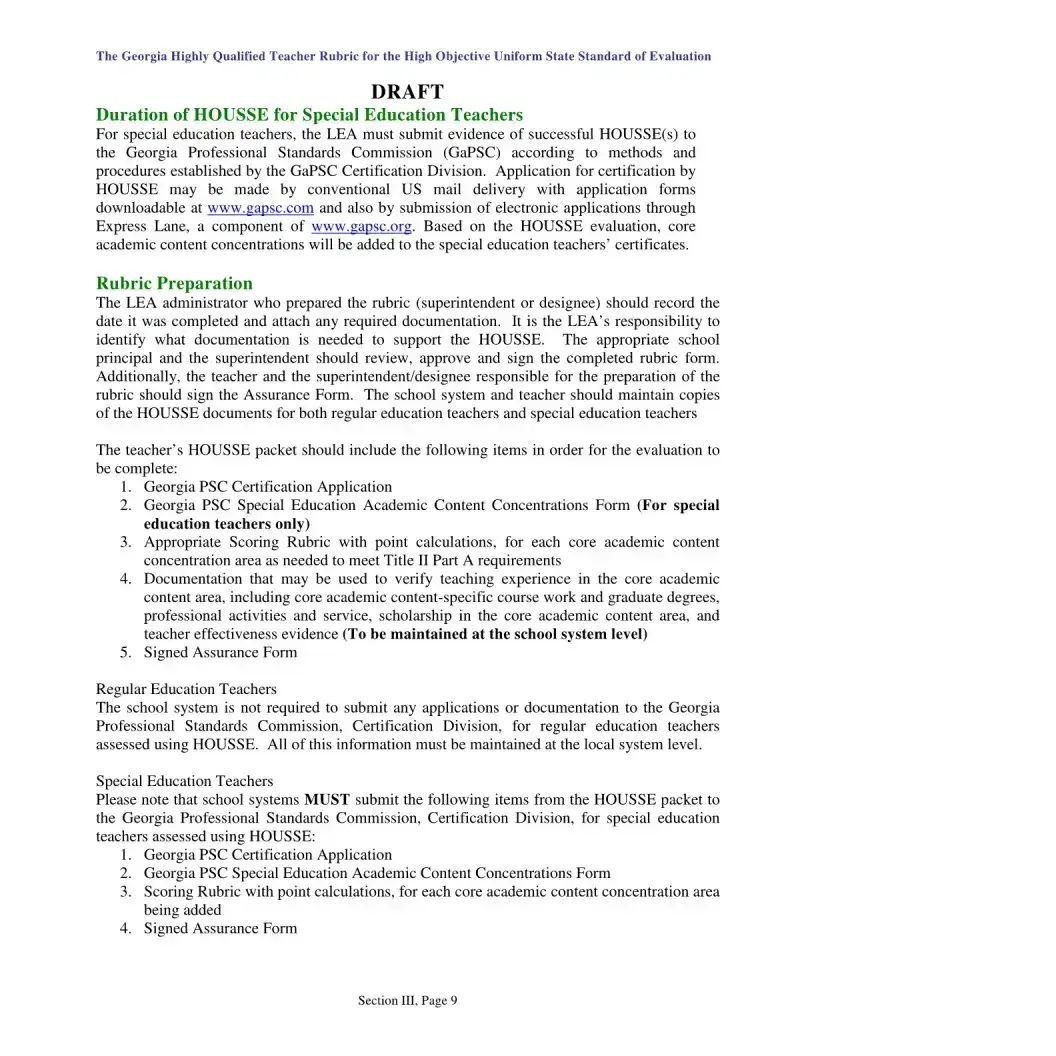
| Special Education Focus | HOUSSE can be utilized by veteran special education teachers for multi-subjects and consultative special education certificates. |
| Experience Requirement | Teachers must have three or more years of successful experience teaching a core academic subject. |
| Regular Education Teachers | HOUSSE allows veteran regular education teachers to be assessed as "highly qualified," but it does not change their certification status. |
| Implementation Guidelines | Refer to the Georgia Implementation Guidelines for criteria on highly qualified teachers under Title II, Part A. |
| Core Academic Areas | A complete HOUSSE Rubric is required for each core academic area, including subjects like English, mathematics, and the arts. |
| Governing Law | The HOUSSE is governed by the No Child Left Behind Act of 2001, specifically Title II Part A. |
| Revision History | The form has undergone multiple revisions, with updates made in July 2003, March 2005, July 2005, September 2006, and July 2007. |
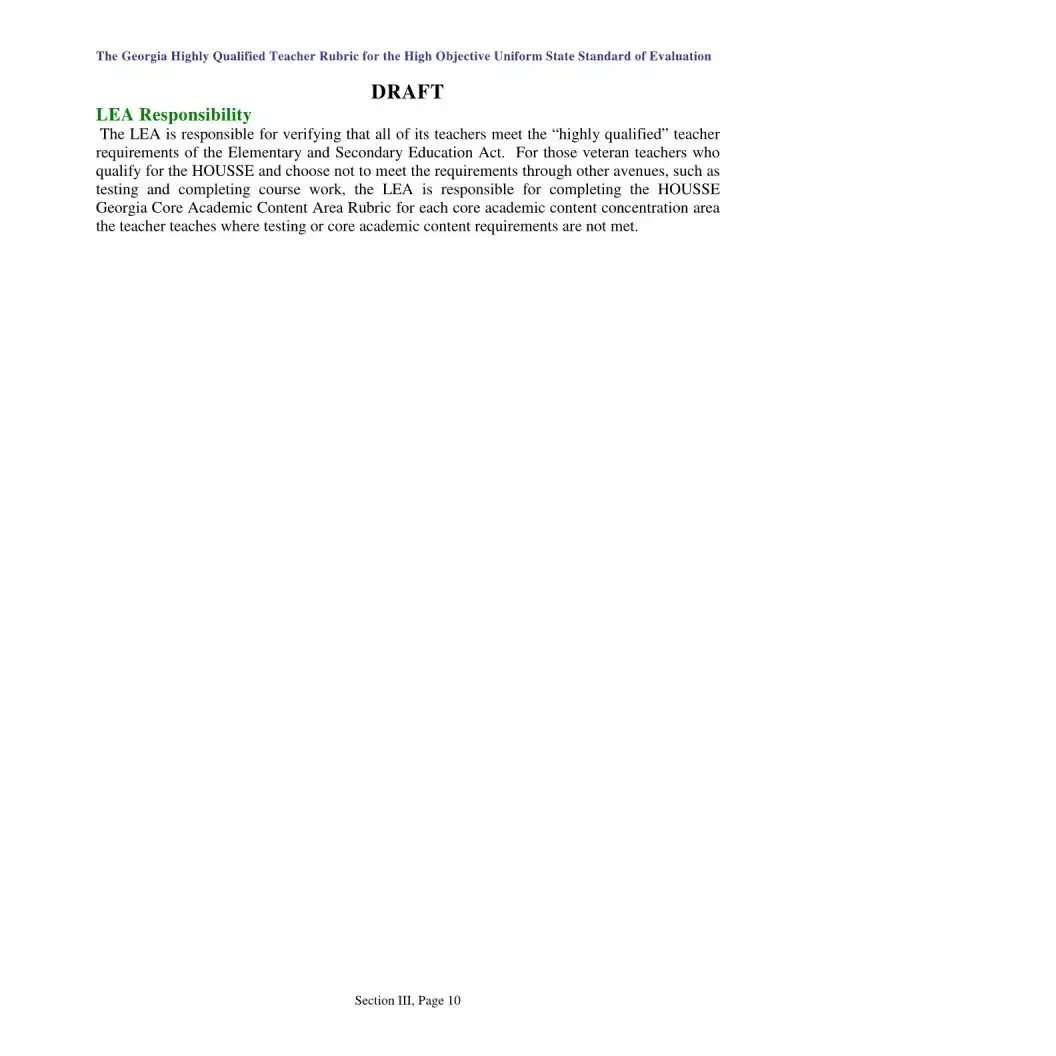
Completing the Georgia HOUSSE Rubric requires careful attention to detail. This form assesses a veteran teacher's qualifications in core academic areas, ensuring they meet the necessary criteria to be considered “highly qualified.” Below are the steps to accurately fill out the form.
Once the form is completed, it should be submitted to the appropriate educational authority for review and approval. This process ensures that all veteran teachers are evaluated fairly and consistently, maintaining high standards in education.
What is the purpose of the HOUSSE Rubric in Georgia?
The HOUSSE Rubric, or Highly Objective Uniform State Standard of Evaluation, serves as an assessment tool designed to evaluate the competency of veteran teachers in core academic subjects. It is particularly useful for those who have not met the content or testing requirements to be classified as “highly qualified.” This evaluation is essential for ensuring that teachers possess the necessary skills and knowledge to provide quality education.
Who is eligible to use the HOUSSE Rubric?
Eligibility for the HOUSSE Rubric is limited to specific groups. It is primarily available for:
Regular education teachers may also use HOUSSE to demonstrate their qualifications, but it cannot change their certification status.
What are the requirements for a teacher to be assessed using the HOUSSE Rubric?
To qualify for assessment under the HOUSSE Rubric, a teacher must have at least three years of successful teaching experience in a core academic content area. This experience must be documented through annual performance evaluations. Additionally, teachers must meet other criteria outlined in the Georgia Implementation Guidelines for Highly Qualified Teachers.
What core academic content areas does the HOUSSE Rubric cover?
The HOUSSE Rubric encompasses a variety of core academic content areas, including:
A complete HOUSSE Rubric is required for each core academic area applicable to the teacher.
How does the HOUSSE Rubric assess teacher effectiveness?
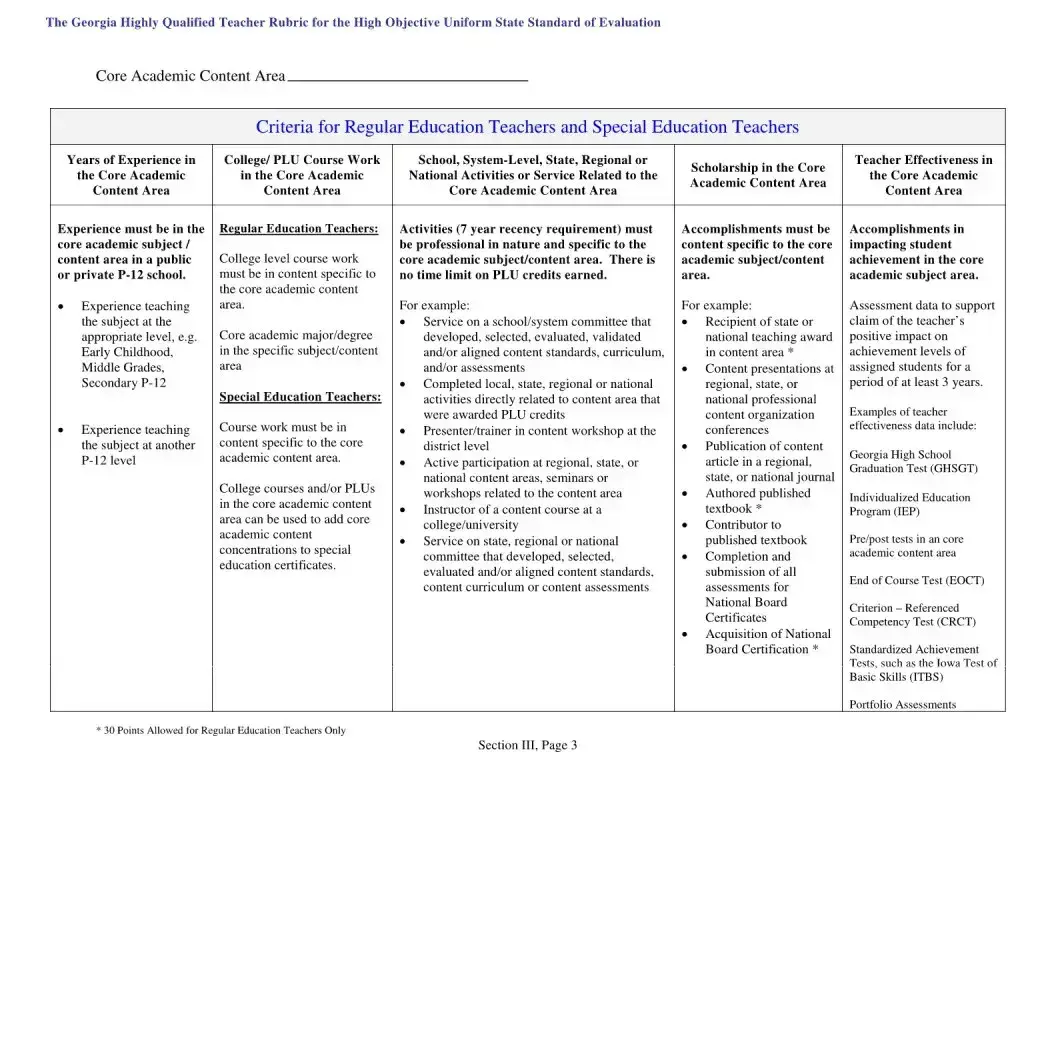
Teacher effectiveness is evaluated based on a teacher's impact on student achievement over a minimum of three years. This assessment may include various data points, such as:
These data points help substantiate claims regarding the teacher's positive influence on student learning.
What documentation is required for the HOUSSE Rubric?
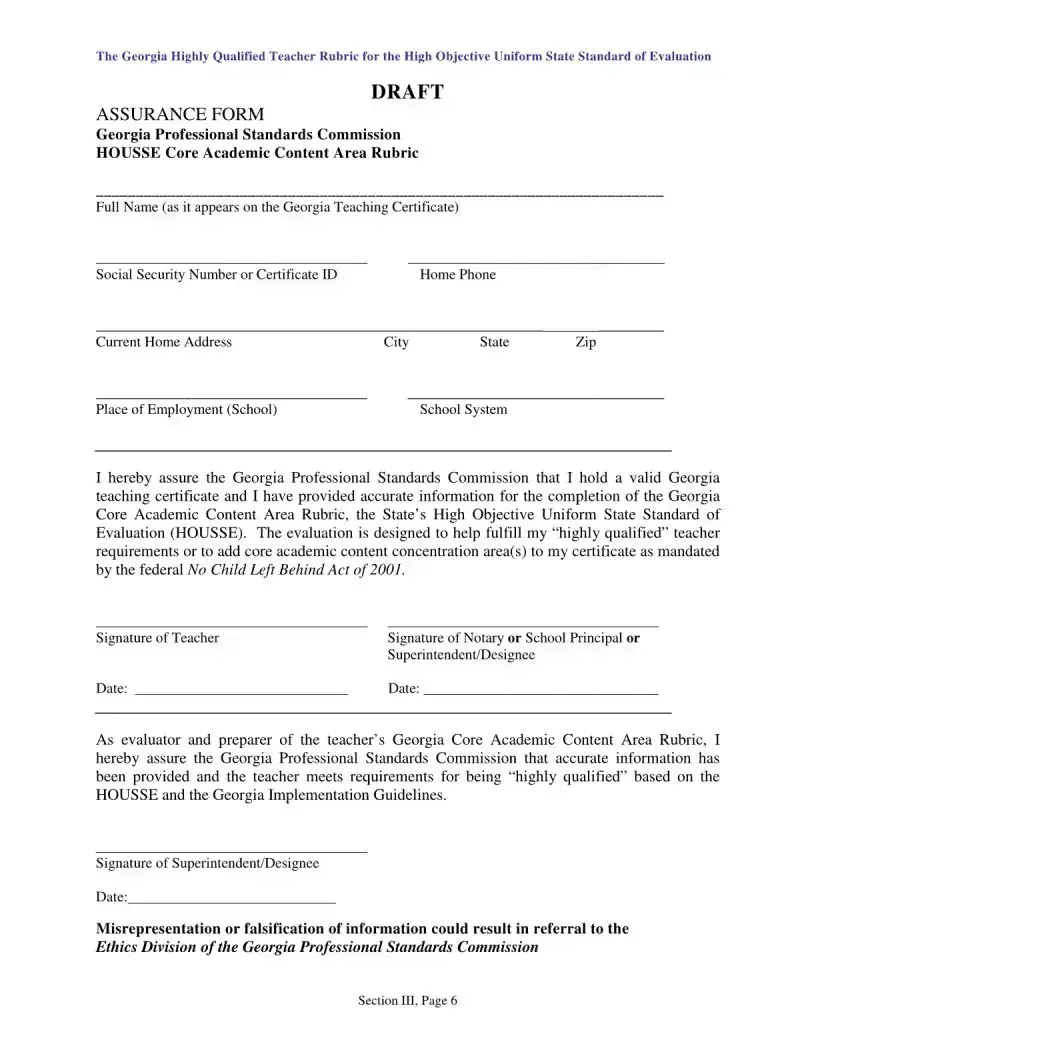
Teachers must prepare a complete HOUSSE Rubric for each core academic content area they wish to be assessed in. This includes documentation of their years of experience, college coursework, professional activities related to the content area, scholarship, and evidence of teacher effectiveness. Signatures from the teacher, principal, and superintendent or designee are also necessary to validate the assessment.
Filling out the Georgia HOUSSE Rubric form correctly is crucial for veteran teachers seeking to demonstrate their qualifications. However, several common mistakes can hinder this process. Understanding these pitfalls can help ensure a smooth submission.
One frequent error is incomplete information. Teachers often fail to provide all required details, such as their teaching field or years of experience. Each section of the form must be filled out completely to avoid delays in processing.
Another common mistake involves incorrect documentation. Teachers may submit documents that do not align with the core academic content area they are applying for. It is essential to ensure that all supporting materials directly relate to the specific subject area to meet the evaluation criteria.
Some individuals also overlook the recency requirement for professional activities. Activities must be recent, typically within the last seven years. Failing to adhere to this timeline can result in disqualification of certain experiences.
Additionally, teachers sometimes misinterpret the criteria for scholarship in the content area. It is not enough to simply list accomplishments; they must be relevant and demonstrate a clear connection to the core academic subject being evaluated.
Another mistake is the failure to provide evidence of teacher effectiveness. Teachers need to include assessment data that illustrates their impact on student achievement. Without this data, claims of effectiveness may not be substantiated, leading to potential rejection of the application.
Teachers may also neglect to obtain necessary approvals from administrators. The form requires signatures from the principal and superintendent or their designees. Missing these signatures can delay the submission process significantly.
In some cases, individuals may submit outdated versions of the form. It is crucial to ensure that the most current version is being used, as guidelines and requirements can change over time.
Another common oversight is not keeping track of deadlines. Each submission must adhere to specific timelines, and missing these deadlines can result in the inability to apply for the HOUSSE assessment.
Lastly, teachers often fail to review their submissions for accuracy. Simple typographical errors or inconsistencies can lead to misunderstandings or misinterpretations by evaluators. A thorough review can prevent these mistakes.
By being aware of these common errors, teachers can take proactive steps to ensure that their HOUSSE Rubric form is completed accurately and effectively, enhancing their chances of being recognized as highly qualified.
The Georgia HOUSSE Rubric is a vital tool for evaluating veteran teachers. However, several other forms and documents are often used in conjunction with it to support the certification process and ensure compliance with educational standards. Below is a list of these important documents.
These documents work together with the HOUSSE Rubric to create a comprehensive evaluation framework for teachers in Georgia. Ensuring that all forms are completed accurately and submitted on time is crucial for maintaining educational standards and supporting teacher effectiveness.
The HOUSSE Rubric in Georgia shares similarities with several other documents used for evaluating teacher qualifications and competencies. Below are six documents that are comparable, along with a brief explanation of how they relate to the HOUSSE Rubric.
When filling out the HOUSSE Rubric Georgia form, there are important guidelines to follow. Here are nine things you should and shouldn't do:
Following these guidelines can enhance your application and help ensure a smoother process.
Misconceptions about the Georgia HOUSSE Rubric can lead to confusion for educators navigating certification requirements. Here are six common misunderstandings:
Understanding these misconceptions can help educators better navigate the certification process and ensure they meet the necessary requirements to teach effectively in Georgia.
Here are key takeaways regarding the use of the HOUSSE Rubric Georgia form: