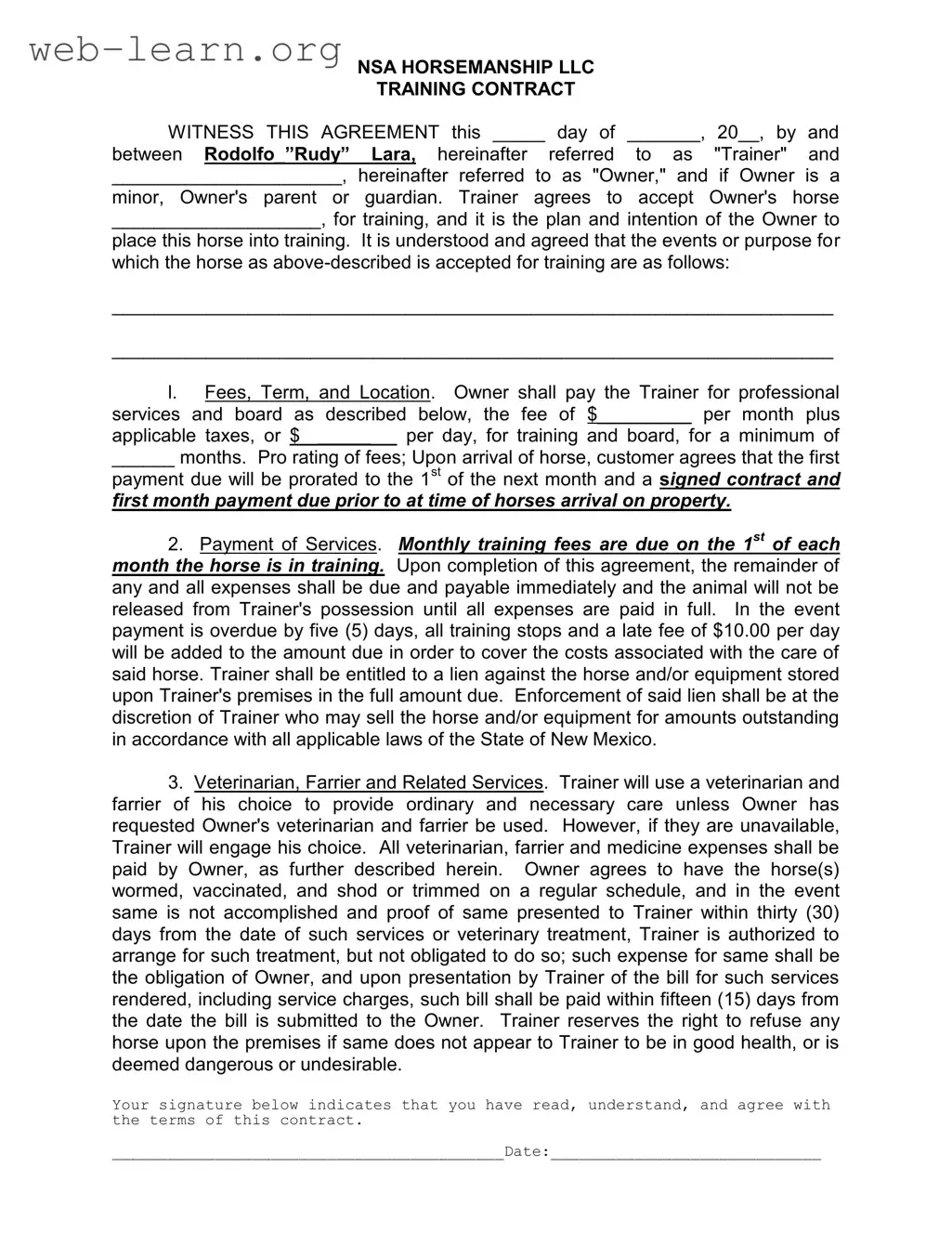
The Horse Training Contract is an essential document designed to establish a clear understanding between the Trainer and the Owner regarding the training and care of the horse. This contract outlines the responsibilities and expectations of both parties, ensuring that the Owner's horse receives the necessary training while also addressing the financial aspects involved. Key components of the contract include the agreed-upon fees for training and board, which may be structured as a monthly or daily rate, along with details about payment schedules and late fees. Furthermore, it specifies the Trainer's authority to select veterinarians and farriers for the horse's care, while also detailing the Owner's obligations for covering these expenses. The contract emphasizes the importance of maintaining the horse's health and well-being, including provisions for emergency care and the necessity of regular vaccinations and hoof care. Additionally, it addresses the risks associated with horse training, including liability limitations and the Owner's responsibility for any injuries or damages that may occur. In the event of the horse's death or unfitness for training, the contract provides options for the Owner, ensuring that all parties are aware of their rights and obligations. Overall, this contract serves as a comprehensive guide to facilitate a positive training experience for both the horse and the Owner, fostering a relationship built on trust and mutual respect.

NSA HORSEMANSHIP LLC
TRAINING CONTRACT
WITNESS THIS AGREEMENT this _____ day of _______, 20__, by and
between Rodolfo_”Rudy” Lara, hereinafter referred to as "Trainer" and
______________________, hereinafter referred to as "Owner," and if Owner is a
minor, Owner's parent or guardian. Trainer agrees to accept Owner's horse
____________________, for training, and it is the plan and intention of the Owner to
place this horse into training. It is understood and agreed that the events or purpose for which the horse as
_____________________________________________________________________
_____________________________________________________________________
l.Fees, Term, and Location. Owner shall pay the Trainer for professional services and board as described below, the fee of $_________ per month plus applicable taxes, or $ _____ per day, for training and board, for a minimum of
______ months. Pro rating of fees; Upon arrival of horse, customer agrees that the first payment due will be prorated to the 1st of the next month and a signed contract and first month payment due prior to at time of horses arrival on property.
2.Payment of Services. Monthly training fees are due on the 1st of each month the horse is in training. Upon completion of this agreement, the remainder of any and all expenses shall be due and payable immediately and the animal will not be released from Trainer's possession until all expenses are paid in full. In the event payment is overdue by five (5) days, all training stops and a late fee of $10.00 per day will be added to the amount due in order to cover the costs associated with the care of said horse. Trainer shall be entitled to a lien against the horse and/or equipment stored upon Trainer's premises in the full amount due. Enforcement of said lien shall be at the discretion of Trainer who may sell the horse and/or equipment for amounts outstanding in accordance with all applicable laws of the State of New Mexico.
3.Veterinarian, Farrier and Related Services. Trainer will use a veterinarian and farrier of his choice to provide ordinary and necessary care unless Owner has requested Owner's veterinarian and farrier be used. However, if they are unavailable, Trainer will engage his choice. All veterinarian, farrier and medicine expenses shall be paid by Owner, as further described herein. Owner agrees to have the horse(s) wormed, vaccinated, and shod or trimmed on a regular schedule, and in the event same is not accomplished and proof of same presented to Trainer within thirty (30) days from the date of such services or veterinary treatment, Trainer is authorized to arrange for such treatment, but not obligated to do so; such expense for same shall be the obligation of Owner, and upon presentation by Trainer of the bill for such services rendered, including service charges, such bill shall be paid within fifteen (15) days from the date the bill is submitted to the Owner. Trainer reserves the right to refuse any horse upon the premises if same does not appear to Trainer to be in good health, or is deemed dangerous or undesirable.
Your signature below indicates that you have read, understand, and agree with the terms of this contract.
__________________________________________Date:_____________________________
4.Training of Horse. The Trainer shall train horse and perform all services in accordance with generally accepted professional standards. Trainer cannot and does not guarantee the effect of the training program or that any particular results will be achieved, since this depends a great deal on the individual physical and mental ability of each horse. Trainer shall furnish all labor, provide suitable facilities and care for horse in an adequate manner with feed being determined by the Trainer. The Trainer has complete control over the manner of training and shall take all precautions for the proper performance thereof. In order to get the most of the training methods used,
Trainer offers and suggests individual lessons with Owner and horse so that Owner can fully understand the training methods used. These lessons will be charged at an hourly rate set forth by Trainer and said fees are due at the time the lesson is provided. Any lessons will be scheduled by the trainer at a time determined to be best for both horse and owner.
Owner shall submit a fully completed Owner's Information Sheet for each horse on the premises belonging to Owner at time of delivery.
5.Death of Horse. It is hereby agreed that in the event of the death of the horse, sale of the horse, or if the horse becomes unfit to train, Trainer has the option of accepting another horse, in accordance with this condition set forth herein within seven
(7)days; or, in the alternative, terminating this agreement upon payment of all expenses and fees.
6.Feed, Facilities, and Services. Trainer agrees to provide adequate feed and facilities for normal and reasonable care required to maintain the health and
7.Risk of Loss and Standard of Care. During the time that the horse(s) is/are in custody of Trainer, Trainer shall not be liable for any sickness, disease, estray, theft, death or injury which may be suffered by the horse(s) or any other cause of action whatsoever, arising out of or being connected in any way with the boarding of said horse(s), except in the event of negligence on the part of Trainer, its agents, and/or employees. This includes, but is not limited to, any personal injury or disability the horse Owner, or Owner's guest, may receive on Trainer's premises.
The Owner fully understands that Trainer does not carry any insurance on any horses not owned by it for boarding or for any other purposes, whether public liability, accidental injury, theft or equine mortality insurance and that all risks connected with boarding or for any other reason for which the horse(s) in the possession of, and on the premises of Trainer are to be borne by the Owner.
Your signature below indicates that you have read, understand, and agree with the terms of this contract.
__________________________________________Date:_____________________________
The standard of care applicable to Trainer is that of ordinary care of a prudent horse owner and not as a compensated bailee. In no event shall Trainer be held liable to Owner for equine death or injury in an amount in excess of Five Thousand Dollars ($5,000) per animal. Owner agrees to obtain equine insurance for any animals valued in excess of Five Thousand Dollars ($5,000), at Owner's expense, or forego any claim for amounts in excess of Five Thousand Dollars ($5,000). Owner agrees to disclose this entire agreement to Owner's insurance company and provide Trainer with the company's name, address and policy number. Failure to disclose insurance information shall be at Owner's risk.
8.Inherent Risks and Assumption of Risk. The undersigned acknowledges there are inherent risks associated with equine activities such as described below, and hereby expressly assumes all risks associated with participating in such activities. The inherent risks include, but are not limited to the propensity of equines to behave in ways such as, running, bucking, biting, kicking, shying, stumbling, rearing, falling or stepping
on, that may result in an injury, harm or death to persons on or around them; the unpredictability of equine’s reaction to such things as sounds, sudden movement and
unfamiliar objects, persons or other animals; certain hazards such as surface and subsurface conditions; collisions with other animals; the limited availability of emergency medical care; and the potential of a participant to act in a negligent manner
that may contribute to injury to the participant or others, such as failing to maintain control over the animal or not acting within such participant’s ability.
Owner expressly releases Stable from any and all claims for personal injury or property damage, even if caused by negligence (if allowed by the laws of this State) by Stable or its representatives, agents or employees.
Warning
Under New Mexico law, no person, corporation of partnership is liable for personal injuries to or for the death of a rider that may occur as a result of the behavior of equine animals while engaged in any equine activities, pursuant to the New Mexico Equine Liability Act,
9.Hold Harmless. Owner agrees to hold Trainer harmless from any and all claims arising from damage or injury caused by said horse(s) to anyone, and defend Trainer from any such claims. Owner agrees to disclose any and all hazardous or dangerous propensities of horse(s) boarded with Trainer. Trainer reserves the right to notify owner within seven (7) days of the horse's arrival if said horse, in Trainer's opinion, is dangerous, untrainable, unhealthy, handicapped, or otherwise unfit for training. Upon such notification, Owner shall remove said horse within seven (7) days, and all expenses incurred for the horse's stay shall be paid prior to departure. Upon payment of all fees, this contract shall be deemed terminated.
Your signature below indicates that you have read, understand, and agree with the terms of this contract.
__________________________________________Date:_____________________________
10.Emergency Care. Trainer agrees to attempt to contact Owner should Trainer determine veterinary treatment is needed for said horse(s), but, if Trainer is unable to contact Owner, Trainer is then authorized to secure emergency veterinary, and farrier care required for the health and
Trainer shall assume that Owner desires surgical care if recommended by a veterinarian in the event of colic, or other
Owner agrees to notify Trainer of any and all change of addresses, emergency telephone numbers, itineraries or other information reasonably necessary to contact Owner in the event of an emergency. In the event Owner departs for vacation or is otherwise unavailable, prior to departure Owner shall notify Trainer as to what party is authorized to make decisions in the Owner's place with regard to the health,
11.
12.Changes or Termination of This Agreement. It is agreed by the Parties that this Agreement may be changed or terminated by Trainer upon thirty (30) days notice, regardless of the rental or training period. All notices must be issued in writing unless otherwise agreed upon by the parties. There will be an early termination fee if Owner removes horse from training prior to the initial period set forth in this contract. Owner is also required to provide thirty (30) days notice that they wish to discontinue said services and remove the horse from traing.
13.Rules and Regulations. The Owner agrees to abide by all the rules and regulations of the Trainer. In the event someone other than the Owner shall call for the horse(s), such person shall have written authority signed by the Owner to obtain said horse(s).
Your signature below indicates that you have read, understand, and agree with the terms of this contract.
__________________________________________Date:_____________________________
14.Right of Lien. The Owner is given notice that Trainer has a right of lien as set forth in the laws of the State of New Mexico, for the amount due for the board and keep of such horse(s), and also for storage and services, and shall have the right, without process of law, to retain said horse(s) and other property until the amount of said indebtedness is discharged. However, Trainer will not be obligated to retain and/or maintain the horse(s) in question in the event the amount of the bill exceeds the
anticipated unregistered value of the horse(s.) In the event Trainer exercises Trainer's lien rights as
15.Property in Storage on Trainer’s Premises. Owner may store certain tack and equipment on the premises of Trainer at no additional charge to Owner. However, Trainer shall not be responsible for the theft, loss, damage or disappearance of any tack or equipment or other property stored at the facility as same is stored at the Owner's risk. Trainer shall not be liable for the theft, loss, damage, or disappearance of any tack or equipment taken to horse shows or clinics. Vehicles stored upon the premises will be subject to a $_____/day storage cost for all delinquent accounts.
16.Entire Agreement. This contract represents the entire agreement between the parties. No other agreements, promises, or representations, verbal or implied, are included herein unless specifically stated in this written agreement. This contract is made and entered into in the state of Trainer's stable, and shall be enforced and interpreted in accordance with the laws of said State.
17.Enforceability of Contract and Severability. In the event one or more parts of this contract are found to be unenforceable or illegal, the other portions hereof shall be deemed in full force and effect.
18.Consent to use media. The owner agrees to allow No Strings Attached Horsemanship to use photographs and/or video clips on the website. If you do not wish to have any information about your horse published, please initial and date here.
_____________
19.Owner visits. Trainer encourages you to check on your horse’s progress by regularly visiting the barn. Feel free to stop by at any time and I will make every effort to accommodate you but will not stop any training session that may be ongoing when you arrive. In the event that your horse has already had his training session for the day that you stop by unannounced, another session will not be provided. However, if you set up an appointment ahead of time, I can ensure you will be given the attention you deserve.
Your signature below indicates that you have read, understand, and agree with the terms of this contract.
__________________________________________Date:_____________________________
20.All dogs must be on a leash and not allowed to run loose or cause any sort of disruption.
OWNER or (AUTHORIZED AGENT)
Address:
Telephone:
Home:_______________________________
Work: _______________________________
Cell:_________________________________
Your signature below indicates that you have read, understand, and agree with the terms of this contract.
__________________________________________Date:_____________________________

OWNER'S INFORMATION SHEET
Owner's Name |
|
|
|
|
|
|
|
|
|
|
|
|
|
|
Phone No.(h) |
|
|
|
|
|
|
|||||||||||||||
(as recorded with the Registry) |
|
|
|
|
|
|
|
|
|
|
|
(w) |
|
|
|
|
|
|||||||||||||||||||
Address |
|
|
|
|
|
|
|
|
|
|
|
|
|
|
|
|
|
|
|
|
|
|
|
|
|
|
|
|||||||||
|
|
|
|
|
|
|
|
|
|
|
|
|
|
|
|
|
|
|
|
|
|
|
|
|
|
|
||||||||||
|
|
|
|
|
|
|
|
|
|
|
|
|
|
|
|
|
|
|
|
|
|
|
|
|
|
|
|
|
|
|
|
|
|
|
||
|
|
|
|
|
Street |
|
|
|
|
|
|
|
City |
|
|
|
|
|
|
|
State |
|
Zip |
|||||||||||||
Horse's Name |
|
|
|
|
|
|
|
|
|
|
|
|
|
|
|
|
|
|
|
|
|
|
|
|
|
|
|
|||||||||
|
|
|
|
|
|
|
|
|
|
|
|
|
|
|
|
|
|
|
|
|
|
|
|
|
|
|
|
|
|
|
|
|
||||
Age |
|
|
|
Color |
|
|
|
|
|
Markings |
|
|
|
|
|
|
||||||||||||||||||||
Does Horse have any dangerous propensities? If yes, describe: |
|
|
|
|
|
|||||||||||||||||||||||||||||||
|
|
|
|
|
|
|
|
|
|
|
|
|
|
|
|
|
|
|
|
|
|
|
|
|
|
|
|
|
|
|
|
|
||||
Medical History of Horse: |
|
|
|
|
|
|
|
Colic |
|
|
|
|
|
|
Frequency |
|
|
|
|
|
||||||||||||||||
Founder |
|
|
|
|
|
|
|
|
When |
|
|
|
|
|
|
|
|
|
|
|
|
|
|
|
|
|
|
|||||||||
Allergies, if known |
|
|
|
|
|
|
|
|
|
|
|
|
|
|
|
|
|
|
|
|
|
|
|
|
|
|
|
|||||||||
|
|
|
|
|
|
|
|
|
|
|
|
|
|
|
|
|
|
|
|
|
|
|
|
|
|
|
|
|
|
|
|
|
|
|||
Other |
|
|
|
|
|
|
|
|
|
|
|
|
|
|
|
|
|
|
|
|
|
|
|
|
|
|
|
|||||||||
|
|
|
|
|
|
|
|
|
|
|
|
|
|
|
|
|
|
|
|
|
|
|
|
|
|
|
|
|
|
|
||||||
Tetanus Toxoid |
|
|
|
|
|
|
|
|
|
|
|
|
|
|
|
|
Date |
|
|
|
|
|
|
|||||||||||||
VEE |
|
|
|
|
|
|
|
|
|
|
|
|
|
|
|
|
|
|
|
|
|
|
|
|
|
|
|
|
||||||||
Encephalomyelitis (sleeping sickness), Eastern & Western Strains |
|
|
|
|
|
|||||||||||||||||||||||||||||||
Date of last worming |
|
|
|
|
|
|
|
|
|
|
|
|
Coggins Test |
|
|
|
|
|
|
|||||||||||||||||
Feeding Program: |
Hay type |
|
|
|
|
|
|
|
|
|
|
|
Amount |
|
|
|
|
|
||||||||||||||||||
|
|
|
|
|
|
|
|
|
|
|
|
|
|
|
|
|
|
|
|
|
|
|
|
|
|
|
|
|
|
|
|
|
||||
|
|
|
|
|
|
|
|
Grain type(s) |
|
|
|
|
|
|
|
|
|
|
|
Amount |
|
|
|
|
|
|||||||||||
|
|
|
|
|
|
|
|
|
|
|
|
|
|
|
|
|
|
|
|
|
|
|
|
|
|
|
|
|
|
|
|
|
|
|
||
|
|
|
|
|
|
|
|
|
|
|
Pellets |
|
|
|
|
|
|
|
|
|
|
|
Amount |
|
|
|
|
|
||||||||
Known allergies to feeds |
|
|
|
|
|
|
|
|
|
|
|
|
|
|
|
|
|
|
|
|
|
|
|
|
|
|
|
|||||||||
Special Care Requirements |
|
|
|
|
|
|
|
|
|
|
|
|
|
|
|
|
|
|
|
|
|
|||||||||||||||
Habits |
|
|
|
|
|
|
|
|
|
|
|
|
|
|
|
|
|
|
|
|
|
|
|
|
|
|
|
|||||||||
|
|
|
|
|
|
|
|
|
|
|
|
|
|
|
|
|
|
|
|
|
|
|
|
|
|
|
||||||||||
|
|
|
|
|
|
|
|
|
|
|
|
|
|
|
|
|||||||||||||||||||||
To be contacted in case of emergency, if owner cannot be reached: |
|
|
|
|
|
|||||||||||||||||||||||||||||||
|
|
|
|
|
|
|
|
|
|
|
|
|
|
|
|
|
|
|
|
|
|
|
|
|
|
|
|
|
|
|||||||
|
|
Name |
|
|
|
|
|
|
|
|
|
|
|
|
|
|
|
|
Phone Number |
|
|
|
|
|
||||||||||||
|
|
|
|
|
|
|
|
|
|
|
|
|
|
|
|
|
|
|
|
|
|
|
|
|
|
|
|
|
|
|
|
|||||
|
|
Address |
|
|
|
|
|
|
|
|
|
|
|
|
|
|
|
|
|
|
|
|
|
|
|
|
|
|
|
|||||||
Is Horse insured? |
|
|
|
|
|
|
|
|
|
|
|
|
|
|
|
|
|
|
|
|
|
|
|
|
|
|
|
|
||||||||
Insurance Carrier |
|
|
|
|
|
|
|
|
|
|
|
|
|
|
|
|
Policy # |
|
|
|
|
|
|
|||||||||||||
Carrier's Address |
|
|
|
|
|
|
|
|
|
|
|
|
|
|
|
|
|
|
|
|
|
|
|
|
|
|
|
|||||||||
|
|
|
|
|
|
|
|
|
|
|
|
|
|
|
|
|
|
|
|
|||||||||||||||||
Insurance contact for emergencies and phone number: |
|
|
|
|
|
|
|
|
|
|
|
|
|
|
|
|
|
|||||||||||||||||||
Veterinary emergency contact: |
|
|
|
|
|
|
|
|
|
|
|
|
|
|
|
|
|
|
|
|
|
|||||||||||||||
Name |
|
|
|
|
|
|
|
|
|
|
|
|
Phone Number |
|
|
|
|
|
||||||||||||||||||
This Horse is/is not considered a surgical candidate in the event of colic or serious illness (check one).
_______IS ______IS NOT
Owner's Initials__________
Your signature below indicates that you have read, understand, and agree with the terms of this contract.
__________________________________________Date:_____________________________
| Fact Name | Details |
|---|---|
| Parties Involved | This contract is between Trainer Rodolfo “Rudy” Lara and the Owner of the horse. |
| Training Fees | Owner agrees to pay a monthly fee for training and board, with pro-rated initial payments. |
| Payment Terms | Monthly fees are due on the 1st of each month. Late payments incur a $10 fee per day. |
| Veterinary Care | Trainer will select a veterinarian unless the Owner specifies otherwise. Owner covers all related costs. |
| Risk of Loss | Trainer is not liable for any injuries or losses unless due to negligence. Owner assumes all risks. |
| Inherent Risks | Owner acknowledges inherent risks in equine activities and assumes responsibility for any resulting injuries. |
| Hold Harmless Clause | Owner agrees to protect Trainer from claims related to injuries caused by the horse. |
| Emergency Care Authorization | Trainer can secure emergency veterinary care if the Owner cannot be contacted. |
| Governing Law | This contract is governed by the laws of the State of New Mexico. |
Filling out the Horse Training Contract form is an important step in ensuring a clear understanding between the Trainer and the Owner. This contract outlines the terms and conditions of the training agreement, providing protection and clarity for both parties. Below are the steps to complete the form accurately.
Once the form is completed, it is advisable to keep a copy for your records. This contract serves as a mutual agreement that outlines the expectations and responsibilities of both the Trainer and the Owner throughout the training process.
The Horse Training Contract serves as a formal agreement between the Trainer and the Owner regarding the training of a horse. It outlines the responsibilities of both parties, including payment terms, care provisions, and the scope of training services provided. This contract is essential for ensuring that both parties have a clear understanding of their obligations and expectations.
The Owner is responsible for paying the Trainer a fee of $_________ per month, plus applicable taxes, or $_____ per day for training and board. It is important to note that fees are due on the 1st of each month. If payment is late by five days, a late fee of $10.00 per day will be added. Additionally, any costs incurred for veterinary or farrier services will also be the Owner's responsibility.
In the event that the horse requires veterinary treatment, the Trainer will attempt to contact the Owner. However, if the Owner cannot be reached, the Trainer is authorized to seek emergency care. All costs associated with this care will be billed to the Owner. It is advisable for the Owner to provide updated contact information to ensure timely communication in emergencies.
The Trainer is responsible for providing adequate feed, facilities, and general care necessary to maintain the horse's health. This includes regular feeding and ensuring a safe environment. However, any additional supplements required by the Owner will be at the Owner's expense. The Trainer also reserves the right to refuse any horse that appears unhealthy or dangerous.
If the Owner wishes to terminate the contract before the agreed period, they must provide a thirty-day notice. An early termination fee may apply. It is crucial to review the contract's terms regarding early termination to avoid any misunderstandings or additional charges.
The Trainer is not liable for any illness, injury, or death of the horse, except in cases of negligence. The Owner assumes all risks associated with equine activities, including potential injuries to themselves or others. Therefore, it is recommended that Owners obtain insurance for their horses, particularly if valued over $5,000.
Yes, the Trainer encourages Owners to visit their horses regularly. However, visits should be scheduled in advance to ensure that the Owner receives proper attention. If an Owner arrives unannounced and the horse has already completed its training session for the day, another session will not be provided. Setting up an appointment will ensure a more productive visit.
Filling out a Horse Training Contract form can seem straightforward, but there are several common mistakes that individuals often make. Recognizing these pitfalls can help ensure that the agreement is completed correctly and that all parties are protected.
One frequent error is failing to provide complete information about the horse. Owners should ensure that they fill in the horse's name and any relevant details regarding its breed, age, and medical history. Incomplete information can lead to misunderstandings regarding the horse’s training needs and health requirements.
Another common mistake involves neglecting to specify the training fees clearly. Owners must fill in the monthly or daily rate and the minimum training duration. If these details are left blank or incorrectly stated, it can create confusion about payment expectations and obligations.
Some individuals overlook the importance of signing and dating the contract. A signature indicates that the owner has read and understood the terms of the agreement. Without this, the contract may not be enforceable, leaving both the trainer and owner vulnerable to disputes.
Additionally, owners sometimes fail to communicate special needs or concerns about their horse. It is crucial to disclose any known health issues or behavioral traits that could affect training. This information helps the trainer to provide the best care and training possible.
Another mistake is not providing emergency contact information. Owners should include reliable contact details, ensuring that the trainer can reach them in case of an emergency. This is particularly important when veterinary care is needed.
Some owners may also overlook the section regarding insurance. It is essential to clarify whether the owner has insurance for the horse and to disclose this information to the trainer. Failing to do so can lead to complications in the event of an accident or injury.
Finally, many individuals forget to read the entire contract thoroughly before signing. Understanding all terms and conditions is vital. Owners should ensure they are aware of their rights and responsibilities, as well as any potential liabilities they may incur.
By avoiding these common mistakes, horse owners can ensure a smoother training experience and foster a productive relationship with their trainer.
When engaging in a Horse Training Contract, there are several other important documents that may be used to ensure clarity and protect the interests of both the Owner and the Trainer. Below are five common forms and documents that often accompany the Horse Training Contract.
Utilizing these documents alongside the Horse Training Contract can foster a smoother training experience. Clear communication and well-defined responsibilities are essential in ensuring the well-being of the horse and the satisfaction of both the Owner and Trainer.
When filling out the Horse Training Contract form, there are important guidelines to follow. Here are four things you should do and four things you should avoid:
Understanding the Horse Training Contract form is crucial for both trainers and horse owners. However, several misconceptions can lead to confusion. Here’s a list of common misunderstandings:
Many believe that signing the contract means the Trainer will guarantee specific outcomes. In reality, results depend on various factors, including the horse's individual abilities.
Some assume that all veterinary and farrier costs are included. However, these expenses are the responsibility of the Owner unless otherwise specified.
While visits are encouraged, they may not always be possible during training sessions. It's best to schedule visits in advance.
Many people think the Trainer is responsible for any injuries to the horse or Owner. However, the contract specifies that the Owner assumes certain risks.
Some Owners believe they can end the agreement at any time. In fact, a written notice is required, and early termination fees may apply.
Owners might think they can dictate which veterinarian is used. The Trainer has the discretion to choose if the Owner's preferred provider is unavailable.
It is a common belief that the Trainer carries insurance for the horses in their care. However, the Owner is responsible for obtaining any necessary insurance.
Some Owners think that signing the contract protects them from all risks. However, certain inherent risks are assumed by the Owner.
It is often misunderstood that any horse can be accepted for training. The Trainer reserves the right to refuse horses deemed unhealthy or dangerous.
Many believe they can pay fees at their convenience. In reality, payments are due on specific dates, and late fees apply if payments are overdue.
Being aware of these misconceptions can help both Owners and Trainers navigate their agreements more effectively. Clear communication and understanding the terms of the contract are essential for a successful training experience.
Here are some key takeaways for filling out and using the Horse Training Contract form: