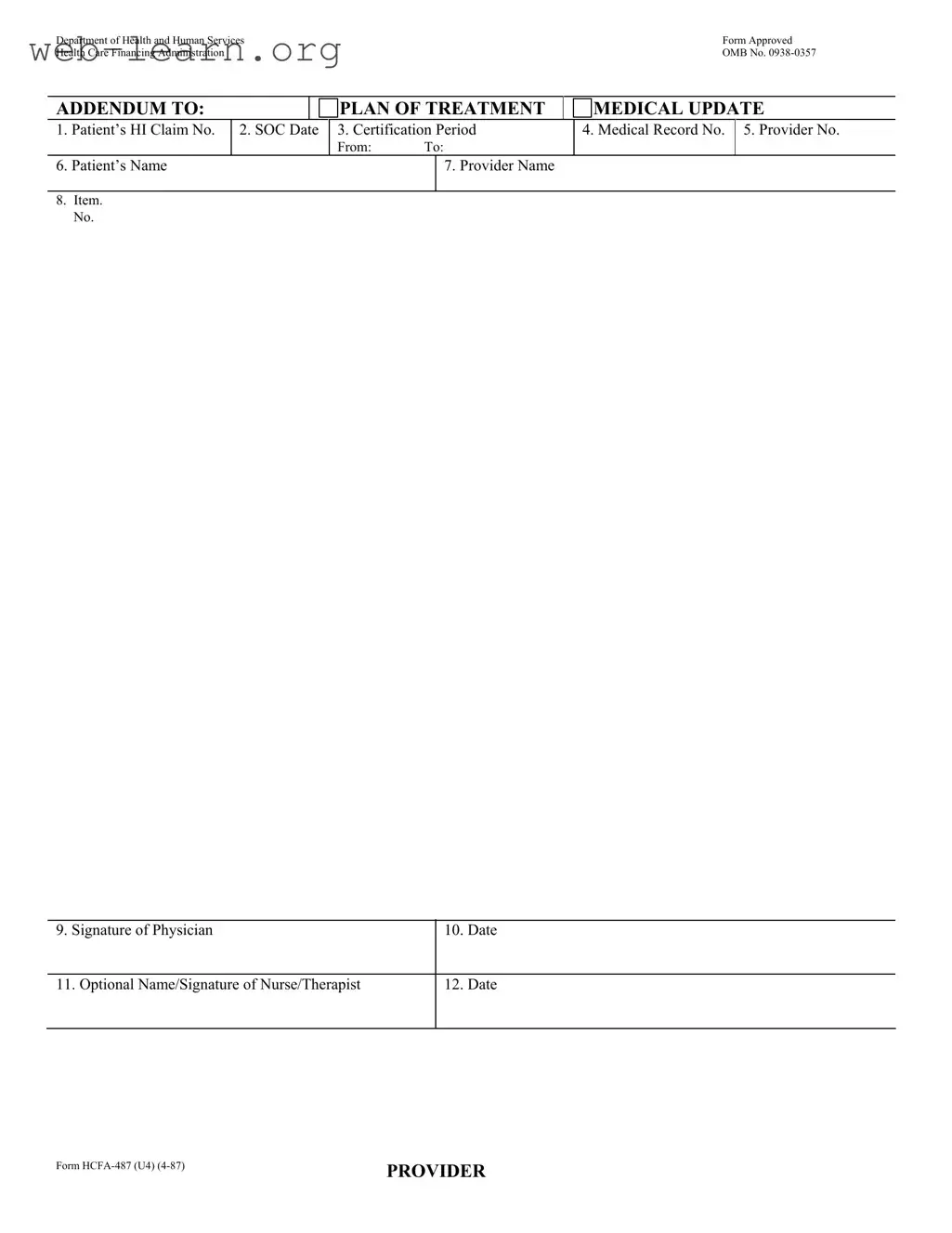
The HCFA 487 form serves as an essential tool in the healthcare system, particularly in documenting medical updates and treatment plans for patients. This form is primarily utilized by healthcare providers to communicate critical information regarding a patient's ongoing care. It includes various fields that capture necessary details such as the patient's health insurance claim number, the date of service, and the certification period for treatment. Additionally, the form requires the patient's name and medical record number, ensuring that all information is accurately linked to the correct individual. Providers must also input their identification numbers and sign off on the document, confirming the authenticity of the information provided. There is an optional section for a nurse or therapist to add their name and signature, further validating the care plan. The HCFA 487 form is crucial for maintaining compliance with healthcare regulations and facilitating effective communication among healthcare professionals.

Department of Health and Human Services |
Form Approved |
Health Care Financing Administration |
OMB No. |
ADDENDUM TO: |
|
|
PLAN OF TREATMENT |
|
MEDICAL UPDATE |
||||
|
|
|
|
|
|
|
|
|
|
1. |
Patient’s HI Claim No. |
2. SOC Date |
3. Certification Period |
|
4. Medical Record No. |
5. Provider No. |
|||
|
|
|
|
From: |
To: |
|
|
|
|
6. |
Patient’s Name |
|
|
|
|
7. Provider Name |
|
|
|
|
|
|
|
|
|
|
|
|
|
8.Item.
No.
9. Signature of Physician
10. Date
11. Optional Name/Signature of Nurse/Therapist
12. Date
Form
PROVIDER
| Fact Name | Description |
|---|---|
| Form Purpose | The HCFA 487 form is an addendum to the plan of treatment, specifically for medical updates. |
| Governing Body | This form is approved by the Department of Health and Human Services under the Health Care Financing Administration. |
| OMB Approval | The form carries the OMB approval number 0938-0357, indicating it meets federal standards. |
| Patient Information | Key patient details required include the patient's HI claim number, SOC date, and medical record number. |
| Provider Details | Providers must include their name and provider number, essential for proper identification and billing. |
| Certification Period | The form specifies a certification period, which is crucial for determining the validity of the treatment plan. |
| Signature Requirements | A physician's signature is mandatory, along with the date, ensuring accountability and compliance. |
| Optional Signatures | Nurses or therapists can also sign the form optionally, providing additional validation of the treatment update. |
| State-Specific Forms | Some states may have specific regulations governing the use of this form; always check local laws for compliance. |
After gathering the necessary information, the next step involves accurately filling out the HCFA 487 form. Each section must be completed with the appropriate details to ensure proper processing.
What is the HCFA 487 form?
The HCFA 487 form, also known as the Addendum to Plan of Treatment Medical Update, is used in the healthcare system to provide updates on a patient's treatment plan. It is essential for documenting changes in a patient's medical status and ensuring that the care provided aligns with the latest medical information.
Who needs to fill out the HCFA 487 form?
This form is typically completed by healthcare providers, including physicians, nurses, and therapists. They must provide accurate information about the patient's treatment and any updates that have occurred since the last assessment.
What information is required on the HCFA 487 form?
The form requires several key pieces of information, including:
When should the HCFA 487 form be submitted?
The HCFA 487 form should be submitted whenever there is a significant change in a patient's treatment plan or medical condition. This ensures that all parties involved in the patient's care are updated and can make informed decisions moving forward.
Is the HCFA 487 form mandatory?
While the HCFA 487 form is not always mandatory, it is highly recommended for maintaining accurate and up-to-date records. Many insurance providers and healthcare facilities require this form to process claims and ensure continuity of care.
How can I obtain the HCFA 487 form?
The HCFA 487 form can typically be obtained through healthcare facilities, providers, or online from the Department of Health and Human Services. Ensure you have the most current version to avoid any issues with submission.
Filling out the HCFA 487 form can be a straightforward process, but mistakes can easily happen. One common error is failing to include the patient’s Health Insurance (HI) Claim Number. This number is crucial for processing claims. Without it, the form may be rejected or delayed, causing unnecessary frustration for both providers and patients.
Another frequent mistake involves incorrect dates. Specifically, the dates for the Start of Care (SOC) and the Certification Period must be accurate. If these dates are not filled out correctly, it can lead to confusion about the treatment timeline. This confusion can affect reimbursement and the continuity of care.
Many people also overlook the importance of the patient’s name. It must be filled out exactly as it appears on their insurance documents. A simple misspelling can lead to significant issues. Insurance companies may deny claims if they do not match the official records.
Additionally, providers sometimes forget to sign the form. The signature of the physician is essential for validating the treatment plan. Without it, the form lacks authenticity, and the claim could be considered incomplete.
Another mistake is neglecting the optional section for the nurse or therapist’s name and signature. While this section is not mandatory, including it can provide additional support for the treatment provided. Omitting this information might lead to questions about the care given.
Finally, many individuals fail to double-check the medical record number. This number should correspond with the patient's records. If it is incorrect, it may complicate the review process and delay necessary approvals.
The HCFA 487 form, known as the Addendum to Plan of Treatment Medical Update, serves a critical function in the healthcare system. It provides essential updates regarding a patient's treatment plan. In conjunction with this form, several other documents are commonly utilized to ensure comprehensive patient care and accurate billing. Below is a list of related forms that may accompany the HCFA 487 form.
Each of these documents plays a vital role in the healthcare process, ensuring that patient care is well-coordinated and that billing practices are accurate. Together with the HCFA 487 form, they contribute to a comprehensive approach to patient management and care delivery.
The HCFA 487 form is an important document used in healthcare settings, particularly for updating treatment plans. Several other forms share similar purposes and functions. Below are six documents that are comparable to the HCFA 487 form:
Each of these documents plays a vital role in the healthcare system, ensuring that patient information is accurately recorded and communicated among providers.
When filling out the HCFA 487 form, it's important to follow guidelines to ensure accuracy and compliance. Here are eight things to do and avoid:
The HCFA 487 form, also known as the Addendum to Plan of Treatment Medical Update, is often misunderstood. Below are seven common misconceptions about this form, along with clarifications to help demystify its purpose and use.
This form is not limited to Medicare patients. It can be utilized for various healthcare programs that require updates to treatment plans, regardless of the patient's insurance type.
In reality, the HCFA 487 form is designed for ongoing updates. Healthcare providers may need to submit this form multiple times throughout a patient's treatment to reflect changes in the plan.
While the signature of a physician is required, the form also allows for the optional signature of a nurse or therapist. This flexibility can enhance collaboration among healthcare providers.
This form is applicable to both inpatient and outpatient services. It serves as an important tool for documenting updates to treatment plans in various healthcare settings.
The HCFA 487 form can be used for both physical and mental health updates. It is a versatile document that can accommodate a wide range of medical conditions.
Although it may seem complex, the HCFA 487 form is straightforward. Providers can fill it out efficiently by following the clear sections and instructions provided.
Even if there are no changes to the treatment plan, submitting the HCFA 487 form can be beneficial. It ensures that all relevant information is documented and up-to-date, which is crucial for compliance and continuity of care.
When filling out the HCFA 487 form, it’s essential to pay attention to detail. Here are some key takeaways to keep in mind:
Using the HCFA 487 form effectively ensures that patient care is documented properly and that healthcare providers are compensated for their services.