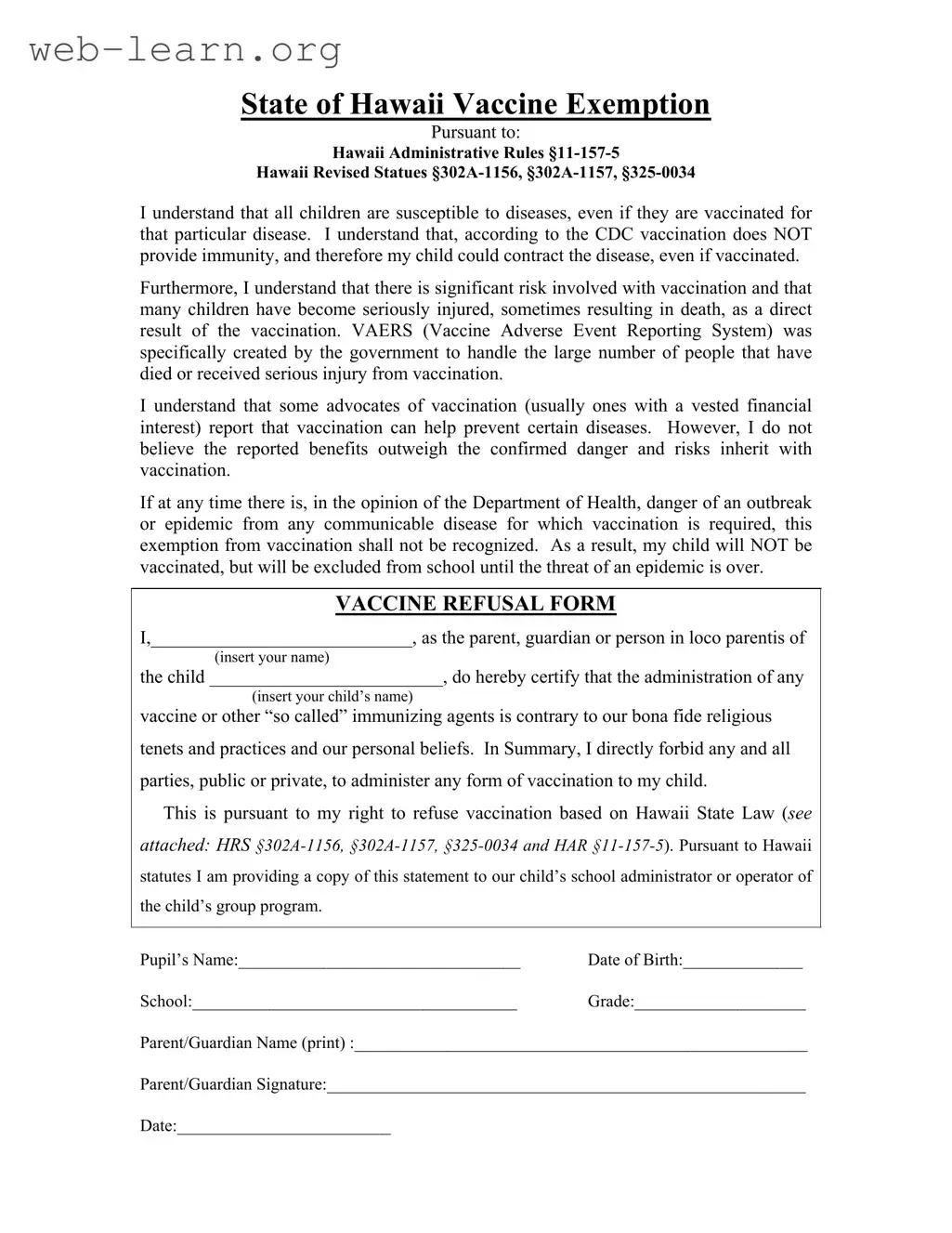
The Hawaii Vaccine Exemption form is an important document for parents and guardians who wish to opt out of mandatory vaccinations for their children based on personal beliefs or religious tenets. This form outlines the rights of parents to refuse vaccinations while also addressing the potential health risks associated with vaccines. It emphasizes that even vaccinated children can still contract diseases and acknowledges the serious adverse effects that vaccinations may have on some individuals. Parents must provide a written objection to immunization, citing their religious beliefs or personal convictions, to the appropriate school officials. However, it's crucial to note that in the event of a public health threat, such as an outbreak, exemptions may not be honored, and unvaccinated children could be temporarily excluded from school. The form requires specific information, including the child's name, date of birth, and the parent's signature, affirming their decision to refuse vaccination. By utilizing this form, families can navigate their choices regarding vaccinations while adhering to state laws and regulations.

State of Hawaii Vaccine Exemption
Pursuant to:
Hawaii Administrative Rules
Hawaii Revised Statues
I understand that all children are susceptible to diseases, even if they are vaccinated for that particular disease. I understand that, according to the CDC vaccination does NOT provide immunity, and therefore my child could contract the disease, even if vaccinated.
Furthermore, I understand that there is significant risk involved with vaccination and that many children have become seriously injured, sometimes resulting in death, as a direct result of the vaccination. VAERS (Vaccine Adverse Event Reporting System) was specifically created by the government to handle the large number of people that have died or received serious injury from vaccination.
I understand that some advocates of vaccination (usually ones with a vested financial interest) report that vaccination can help prevent certain diseases. However, I do not believe the reported benefits outweigh the confirmed danger and risks inherit with vaccination.
If at any time there is, in the opinion of the Department of Health, danger of an outbreak or epidemic from any communicable disease for which vaccination is required, this exemption from vaccination shall not be recognized. As a result, my child will NOT be vaccinated, but will be excluded from school until the threat of an epidemic is over.
VACCINE REFUSAL FORM
I,____________________________, as the parent, guardian or person in loco parentis of
(insert your name)
the child _________________________, do hereby certify that the administration of any
(insert your child’s name)
vaccine or other “so called” immunizing agents is contrary to our bona fide religious
tenets and practices and our personal beliefs. In Summary, I directly forbid any and all
parties, public or private, to administer any form of vaccination to my child.
This is pursuant to my right to refuse vaccination based on Hawaii State Law (see
Pupil’s Name:_________________________________ |
Date of Birth:______________ |
School:______________________________________ |
Grade:____________________ |
Parent/Guardian Name (print) :_____________________________________________________
Parent/Guardian Signature:________________________________________________________
Date:_________________________
(1)If a licensed physician certifies that the physical condition of the child is such that immunizations would endanger the child's life or health; or
(2)If any parent, custodian, guardian, or any other person in loco parentis to a child objects to immunization in writing on the grounds that the immunization conflicts with that person's bona fide religious tenets and practices. Upon showing the appropriate school official satisfactory evidence of the exemption, no certificate or other evidence of immunization shall be required for entry into school. [L 1996, c 89, pt of §2]
If at any time there is, in the opinion of the department of health, danger of an epidemic from any of the communicable diseases for which immunization is required under sections
Section
No person shall be subjected to vaccination, revaccination or immunization, who shall in writing object thereto on the grounds that the requirements are not in accordance with the religious tenets of an established church of which the person is a member or adherent, or, if the person is a minor or under guardianship, whose parent or guardian shall in writing object thereto on such grounds, but no objection shall be recognized when, in the opinion of the director of health, there is danger of an epidemic from any communicable disease.
(a)Medical exemptions from the requirements for specific immunizing agents shall be granted upon certification by a physician on the physician’s professional stationery that an immunization is medically contraindicated for a specific period of time. The original certificate shall be provided to the exempt person or parent or guardian. A copy of the certificate shall be maintained in the student’s school health record. Reports of such certificates shall be submitted to the department by each school.
(b)A religious exemption shall be granted to a student whose parent, custodian, guardian, or other person in loco parentis certifies that the person’s religious beliefs prohibit the practice of immunization. Requests for religious exemptions based on objections to specific immunizing agents will not be granted. Students who have reached the age of majority shall apply on their own behalf. The certification shall be retained in the student’s health record. Reports of such exemptions shall be submitted to the department by each school.
(c)If at any time, the director determines that there is the danger or presence of an outbreak or epidemic from any of the communicable diseases for which immunization is required under this chapter, the exemption from immunization against such disease shall not be recognized and inadequately immunized students shall be excluded from school until the director has determined that the presence or danger of the outbreak or epidemic no longer exists.
Making Informed Decisions
Your decision to vaccinate or not should be an informed decision. Vaccines can cause severe injuries such as seizures, death, anaphylaxis, brain damage and other reactions. The type and severity of reactions may vary from vaccine to vaccine and child to child. The effects of a vaccine injury may be temporary or permanent. If you notice any changes in your child’s condition after receiving a vaccine, you should contact your doctor immediately or go to a hospital. Vaccines have never been proven to be safe or effective and your child may contract the disease even if he is vaccinated. What has been proven is that you can get the disease from the vaccine or from coming into contact with a recently vaccinated person. The polio vaccine is just one example. It is a known fact that most healthcare providers do not fully inform patients of the side effects a vaccine can have on the body, brain and immune system. Because of the highly toxic ingredients all vaccines contain, you should thoroughly research vaccines for yourself before making such an important decision. DO NOT allow someone else, even your healthcare provider, scare or force you into making this decision without being fully informed. Many healthcare providers have not researched vaccine history or toxicology and are not fully informed. Always provide a detailed history of your child’s health to your doctor. Make sure they know of allergies, neurological problems, nutritional deficiencies, any immune system disorder and skin diseases such as eczema. Most physicians and nurses do not warn parents that if their child’s health is compromised in any way, such as having a common cold or previous reaction to a vaccine, they should not receive vaccines.
Benefits of
When you choose to not vaccinate your child, you have the responsibility to educate yourself on how to maintain the
For More Information
To make a truly informed decision there are numerous sources of information on the risks of vaccines and the risks and benefits of childhood diseases. Sources of information to determine if the risks associated with vaccines outweigh any perceived benefits include: vaccine package inserts, the Physicians Desk Reference, the U.S. Center for Disease Control and Prevention, public and medical libraries or state and local health agencies. (NOTE: These sources do not give complete and total information on vaccine ingredients and their toxicity, nor do they provide accurate statistics.)
Vaccination Liberation – www.vaclib.org or (888)
National Vaccine Information Center – www.909shot.com or (800)
(NOTE: The two websites above, Vaccination Liberation and the National Vaccine Information Center, have proven to be excellent sources for extensive vaccine information.)
Reporting Reactions
If you do decide to vaccinate, report vaccine reactions to:
Vaccine Adverse Event Reporting System (800)
Always get the vaccine name, vaccine manufacturer and lot number. Keep records of day to day reactions from the time of vaccination for at least 6 months to 2 years, no matter how slight the reactions.
Revised 11/2008 Source: |
A New Life Family Chiropractic |
|
803 Kamehameha Hwy., Suite 301 |
|
Pearl City, HI 96782 |
This form may be reproduced
| Fact Name | Description |
|---|---|
| Governing Laws | The Hawaii Vaccine Exemption form is governed by Hawaii Administrative Rules §11-157-5 and Hawaii Revised Statutes §302A-1156, §302A-1157, §325-0034. |
| Exemption Criteria | A child can be exempt from vaccinations if a licensed physician certifies that immunization would endanger the child's health or if a parent objects on religious grounds. |
| Epidemic Clause | The exemption may not be recognized if the Department of Health determines there is a danger of an outbreak of a communicable disease. |
| Religious Beliefs | Parents can refuse vaccinations based on bona fide religious tenets, which must be documented in writing. |
| School Notification | A copy of the exemption statement must be provided to the child’s school administrator or the operator of the child’s group program. |
| Health Considerations | The form emphasizes that all children, even those vaccinated, are still susceptible to diseases and that vaccination carries risks of serious injury or death. |
| Informed Decisions | Parents are encouraged to thoroughly research vaccinations and their potential risks before making a decision regarding their child's health. |
Filling out the Hawaii Vaccine Exemption form is an important step for parents or guardians who wish to formally refuse vaccinations for their child based on religious beliefs. Once you complete the form, it will need to be submitted to your child's school administrator or the operator of your child's group program. Here’s how to fill it out step-by-step:
The Hawaii Vaccine Exemption form is a document that allows parents or guardians to formally refuse vaccinations for their children based on personal beliefs or religious tenets. This form must be submitted to the child's school or group program administrator to ensure that the exemption is recognized and that the child can attend school without being vaccinated.
The form can be filled out by a parent, guardian, or any person in loco parentis (a person who has taken on the responsibilities of a parent) for the child. It requires the name of the child, the parent or guardian's name, and a signature to certify the request for exemption.
Exemptions can be requested on the basis of bona fide religious beliefs or personal beliefs. The law in Hawaii recognizes these exemptions, provided that the request is made in writing. It is important to clearly state the reasons for the exemption in the form.
Yes, there are potential risks associated with vaccinations. Some children may experience severe reactions, including seizures or other serious health issues. The form highlights that vaccines have not been proven to be completely safe or effective, and that children can contract diseases even if vaccinated. Parents are encouraged to research and understand these risks before making a decision.
If the Department of Health determines that there is a danger of an outbreak from a communicable disease, the exemption may not be recognized. In such cases, unvaccinated children may be excluded from school until the threat has passed. This is to protect the health of the community.
The completed form should be submitted to the school administrator or operator of the child’s group program. It’s advisable to keep a copy of the submitted form for your records. This ensures that you have proof of the exemption request in case it is needed in the future.
If your child experiences any adverse reactions after vaccination, it’s crucial to report these to the Vaccine Adverse Event Reporting System (VAERS). Keeping detailed records of the reactions, including the vaccine name, manufacturer, and lot number, is important for future reference and potential compensation claims under the National Vaccine Injury Compensation Program.
There are several resources available for parents seeking more information. The CDC, public health agencies, and libraries can provide valuable insights. Additionally, websites like Vaccination Liberation and the National Vaccine Information Center offer extensive information about vaccines, their ingredients, and potential risks. It is recommended to consult multiple sources to make an informed decision.
Filling out the Hawaii Vaccine Exemption form can be a straightforward process, but many people make common mistakes that can lead to delays or complications. One frequent error is failing to provide complete and accurate information. When filling out the form, every section must be filled out correctly. Missing details, such as the child’s name or date of birth, can result in the form being rejected.
Another mistake is not signing the form. A signature is essential to validate the exemption request. Without it, the form is incomplete, and the school may not recognize the exemption. Parents should double-check that they have signed and dated the document before submission.
Some individuals overlook the requirement to provide a copy of the form to the child’s school. This step is crucial because it ensures that the school is aware of the exemption and can update their records accordingly. Failing to do this can lead to misunderstandings regarding the child's vaccination status.
Additionally, people often neglect to check for any updates to the law or form requirements. Regulations can change, and it is important to ensure that the most current version of the form is being used. Using outdated forms can result in complications or denial of the exemption.
Many also make the mistake of not clearly stating their religious beliefs or personal beliefs in the appropriate section of the form. This section is critical for justifying the exemption. A vague or unclear statement may not be accepted by the school or health officials.
Another common error is not providing sufficient evidence to support the exemption claim. If the exemption is based on religious beliefs, it may help to include a brief explanation or documentation that supports the claim. This can strengthen the request and prevent potential challenges.
Some parents may also forget to keep a copy of the completed form for their own records. Having a copy can be beneficial for future reference or if any issues arise regarding the exemption. It serves as proof of submission and can be useful in discussions with school officials.
Lastly, individuals sometimes submit the form too close to the school year or deadlines. It is advisable to submit the exemption form well in advance to avoid any last-minute issues. Schools may require time to process the exemption, and delays can lead to complications with enrollment.
When navigating the process of opting out of vaccinations in Hawaii, several forms and documents often accompany the Hawaii Vaccine Exemption form. Each of these documents serves a specific purpose and helps clarify the intentions and beliefs of the parent or guardian. Understanding these forms is crucial for ensuring that the exemption process is handled smoothly and in accordance with state regulations.
Being informed about these forms and their significance can empower parents and guardians in making decisions that align with their values and beliefs. It is essential to approach this process thoughtfully and ensure that all necessary documentation is completed and submitted correctly. This way, families can navigate the school system while honoring their convictions regarding vaccinations.
The Hawaii Vaccine Exemption form shares similarities with several other documents related to vaccination exemptions. Each document serves a unique purpose but generally aligns in terms of intent and content. Here are six documents that are comparable:
When filling out the Hawaii Vaccine Exemption form, there are several important dos and don'ts to keep in mind to ensure that your submission is valid and effective.
There are several misconceptions surrounding the Hawaii Vaccine Exemption form that can lead to confusion for parents and guardians. Understanding these misconceptions is crucial for making informed decisions about vaccination. Here are four common misunderstandings:
This is not entirely accurate. While the exemption allows parents to refuse vaccinations for their children based on personal beliefs or religious tenets, it does not protect them during an outbreak of a vaccine-preventable disease. If the Department of Health determines there is a risk of an epidemic, the exemption may not be recognized, and unvaccinated children could be excluded from school.
This is misleading. While parents can submit a written objection based on religious beliefs, they must still provide satisfactory evidence to school officials. Additionally, medical exemptions require certification from a licensed physician, which must be based on a legitimate health concern.
This is a common misunderstanding. The exemption does not provide immunity; it simply allows for the refusal of vaccination. Children who are not vaccinated remain susceptible to the diseases that vaccines are designed to prevent, and they may contract these diseases if exposed.
While some parents have concerns about vaccination, it is essential to recognize that vaccines have been shown to prevent serious diseases and their complications. The exemption form does not eliminate the risks associated with these diseases. It is important to weigh the potential risks of vaccination against the risks of contracting the diseases themselves.
Before filling out the Hawaii Vaccine Exemption form, ensure you understand your rights under Hawaii State Law. The law allows for exemptions based on personal beliefs or religious tenets, but it is essential to provide a written objection.
Be aware that if there is a declared epidemic, your exemption may not be recognized. The Department of Health can mandate vaccinations if they determine there is a risk of an outbreak.
When completing the form, include accurate information about your child, such as their name, date of birth, and school details. This information is crucial for the school to process the exemption properly.
After submitting the exemption form, keep a copy for your records. It is advisable to provide a copy to your child's school administrator to ensure they have the necessary documentation on file.