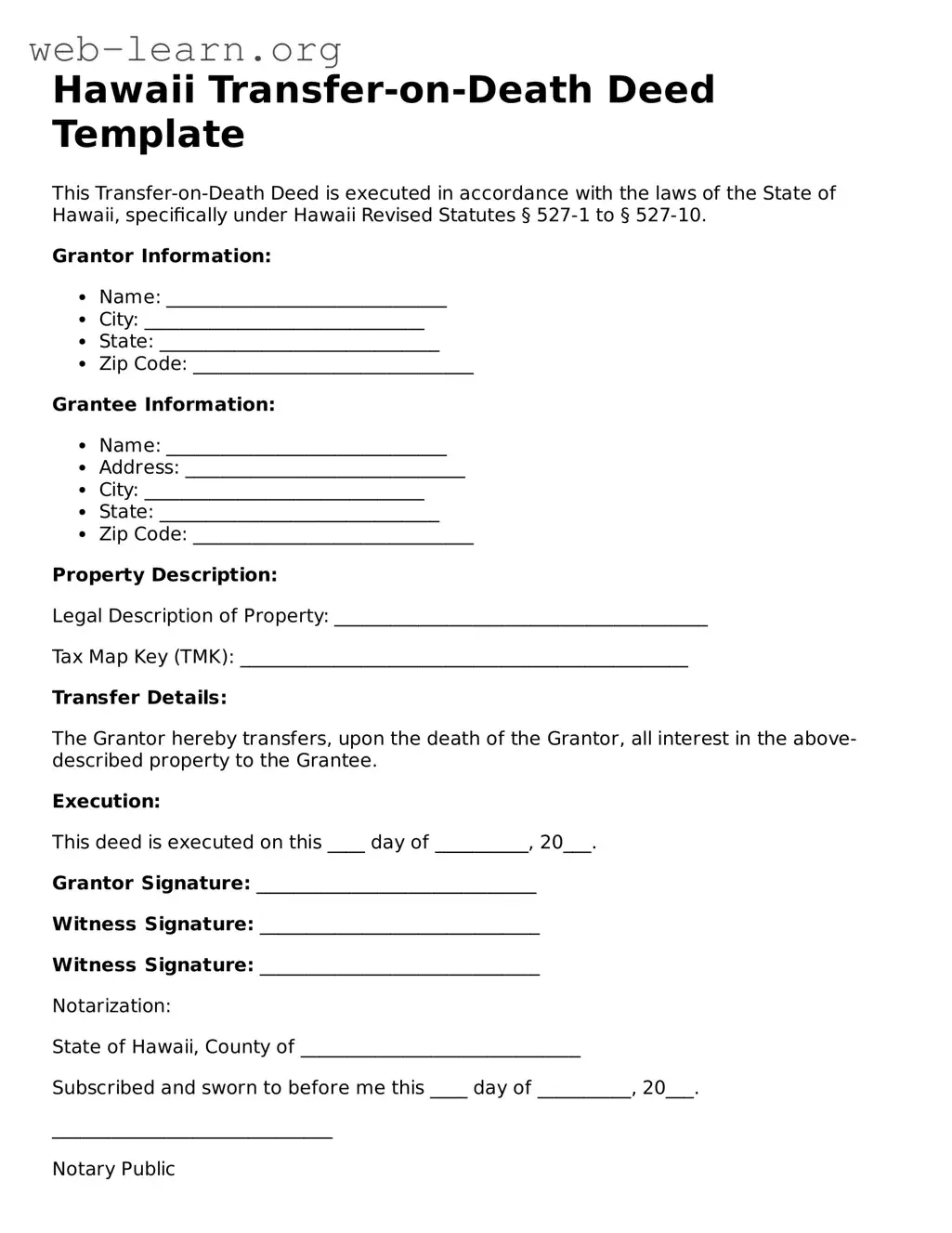
The Hawaii Transfer-on-Death Deed form serves as a valuable tool for property owners who wish to ensure a smooth transition of their real estate assets upon their passing. This legal document allows individuals to designate one or more beneficiaries who will automatically receive ownership of the property without the need for probate. By utilizing this form, property owners can maintain control over their assets during their lifetime while providing clarity and simplicity for their heirs. The deed must be properly executed and recorded to be effective, ensuring that the transfer occurs seamlessly after the owner's death. Additionally, the form can be revoked or modified at any time before the owner's passing, offering flexibility in estate planning. Understanding the nuances of the Transfer-on-Death Deed is essential for anyone looking to navigate the complexities of property transfer in Hawaii, as it can significantly impact the distribution of assets and the financial well-being of loved ones left behind.
Hawaii Transfer-on-Death Deed Template
This Transfer-on-Death Deed is executed in accordance with the laws of the State of Hawaii, specifically under Hawaii Revised Statutes § 527-1 to § 527-10.
Grantor Information:
Grantee Information:
Property Description:
Legal Description of Property: ________________________________________
Tax Map Key (TMK): ________________________________________________
Transfer Details:
The Grantor hereby transfers, upon the death of the Grantor, all interest in the above-described property to the Grantee.
Execution:
This deed is executed on this ____ day of __________, 20___.
Grantor Signature: ______________________________
Witness Signature: ______________________________
Witness Signature: ______________________________
Notarization:
State of Hawaii, County of ______________________________
Subscribed and sworn to before me this ____ day of __________, 20___.
______________________________
Notary Public
My commission expires: _____________
| Fact Name | Details |
|---|---|
| Definition | A Transfer-on-Death (TOD) deed allows property owners in Hawaii to transfer real estate to beneficiaries upon their death without going through probate. |
| Governing Law | The Hawaii TOD deed is governed by Hawaii Revised Statutes § 527-1 through § 527-9. |
| Eligibility | Any individual who owns real property in Hawaii can create a TOD deed. |
| Beneficiary Designation | Property owners can designate one or more beneficiaries in the TOD deed. |
| Revocability | A TOD deed can be revoked or amended by the property owner at any time before their death. |
| Filing Requirements | The TOD deed must be recorded with the Bureau of Conveyances in Hawaii to be effective. |
| Effect on Creditors | Property transferred via a TOD deed is not subject to probate, but it may still be accessible to creditors of the deceased. |
| Tax Implications | Transferring property through a TOD deed generally does not trigger gift taxes, but it may have estate tax implications. |
| Survivorship | If multiple beneficiaries are named, the property is divided equally among them unless stated otherwise. |
| Legal Assistance | While it’s possible to create a TOD deed without legal help, consulting an attorney is advisable to ensure proper execution and compliance with state laws. |
Filling out the Hawaii Transfer-on-Death Deed form is a straightforward process. Once completed, the form needs to be filed with the appropriate county office to ensure that your wishes are properly documented. Here are the steps to guide you through filling out the form.
What is a Transfer-on-Death Deed in Hawaii?
A Transfer-on-Death Deed (TOD) in Hawaii is a legal document that allows property owners to designate a beneficiary who will receive their property upon their death. This deed bypasses the probate process, allowing for a smoother and quicker transfer of property. It is important to note that the property owner retains full control over the property while they are alive, and they can revoke or change the deed at any time before their death.
Who can be named as a beneficiary?
Any individual or entity can be named as a beneficiary in a Transfer-on-Death Deed. This includes family members, friends, or even charitable organizations. However, it is crucial to ensure that the beneficiary is clearly identified in the deed to avoid any confusion or disputes later on. Additionally, if multiple beneficiaries are named, it is advisable to specify how the property will be divided among them.
How do I create a Transfer-on-Death Deed?
To create a Transfer-on-Death Deed, the property owner must complete the official form provided by the state of Hawaii. The form requires specific information, including the property owner's name, the property description, and the beneficiary's name. Once completed, the deed must be signed by the property owner in the presence of a notary public. After notarization, it should be recorded with the appropriate county office to ensure its validity.
Can I change or revoke the Transfer-on-Death Deed?
Yes, property owners can change or revoke a Transfer-on-Death Deed at any time before their death. To do this, a new deed must be executed and recorded, or a revocation form must be completed and filed with the county office. It is essential to follow the proper procedures to ensure that the changes are legally recognized and that the previous deed is no longer valid.
What happens if the beneficiary predeceases the property owner?
If the named beneficiary passes away before the property owner, the Transfer-on-Death Deed may become void unless alternative arrangements are specified in the deed itself. Property owners can include contingent beneficiaries to address this situation. If no contingent beneficiaries are named, the property will typically be distributed according to the property owner’s will or, if there is no will, according to state intestacy laws.
Filling out a Transfer-on-Death (TOD) Deed form in Hawaii can seem straightforward, but many people make common mistakes that can lead to complications down the line. Understanding these pitfalls can help ensure that your intentions are honored and that the transfer of property goes smoothly.
One frequent mistake is failing to properly identify the property. It's essential to provide a clear and accurate description of the property being transferred. This includes the address and any relevant tax parcel numbers. Inaccuracies can create confusion or legal disputes later, so double-checking this information is crucial.
Another common error is neglecting to include all necessary signatures. Both the owner and any co-owners must sign the deed for it to be valid. If one person forgets to sign or is unavailable, the entire process can be delayed. Ensuring that all required parties are present and sign the document is a vital step.
People often overlook the requirement for notarization. A TOD Deed must be notarized to be legally binding. Skipping this step can render the deed ineffective, meaning the property may not transfer as intended. Always make arrangements for a notary to witness the signing.
Additionally, some individuals forget to record the deed with the appropriate county office. Even if the deed is filled out correctly and notarized, failing to file it can lead to complications. Recording the deed is what officially puts the public on notice about the transfer, so don’t skip this important step.
Another mistake involves not considering the implications of the transfer on taxes. While a TOD Deed can help avoid probate, it may still have tax consequences. It’s wise to consult with a tax professional to understand how the transfer might affect your estate and the beneficiaries.
People sometimes assume that a TOD Deed can be revoked easily. While it is possible to revoke or modify a TOD Deed, doing so requires following specific procedures. Not understanding these processes can lead to unintended consequences, so it’s important to know how to properly manage the deed after it’s been established.
Lastly, failing to communicate intentions with beneficiaries can lead to misunderstandings. Discussing your plans with those who will inherit the property can help avoid disputes and ensure everyone is on the same page. Clear communication can prevent confusion and foster harmony among family members.
By being aware of these common mistakes when filling out the Hawaii Transfer-on-Death Deed form, individuals can better prepare themselves for a smooth property transfer process. Taking the time to ensure accuracy and clarity can make a significant difference in honoring your wishes.
The Hawaii Transfer-on-Death Deed form is a valuable tool for property owners looking to pass their real estate to beneficiaries without going through probate. However, several other forms and documents may be needed to ensure a smooth transfer process. Below is a list of these essential documents.
Understanding these documents can help property owners navigate the process of transferring their assets smoothly. Each plays a unique role in ensuring that the wishes of the property owner are honored after their passing.
The Transfer-on-Death Deed (TOD Deed) allows individuals to designate beneficiaries who will receive property upon the owner's death, bypassing probate. This document shares similarities with several other legal documents. Here are five of them:
When completing the Hawaii Transfer-on-Death Deed form, it is important to follow specific guidelines to ensure accuracy and compliance. Below is a list of things to do and avoid during the process.
Things You Should Do:
Things You Shouldn't Do:
Understanding the Hawaii Transfer-on-Death Deed can be tricky. Here are nine common misconceptions about this legal tool, along with clarifications to help demystify it.
By clearing up these misconceptions, individuals can make more informed decisions about their estate planning in Hawaii.
Filling out and using the Hawaii Transfer-on-Death Deed form involves several important considerations. Here are key takeaways to keep in mind:
Understanding these points can help individuals navigate the process of using the Transfer-on-Death Deed in Hawaii effectively.
Transfer on Death Deed Florida Form - The Transfer-on-Death Deed can be a straightforward solution for those looking to simplify their estate.
Arizona Beneficiary Deed - The form may require notarization to be legally binding in some jurisdictions.
Problems With Transfer on Death Deeds in Indiana - It can be particularly beneficial for individuals with minor children or dependents.
Beneficiary Deed Colorado - It is a legally recognized method to transfer property without the complexities of a traditional will.