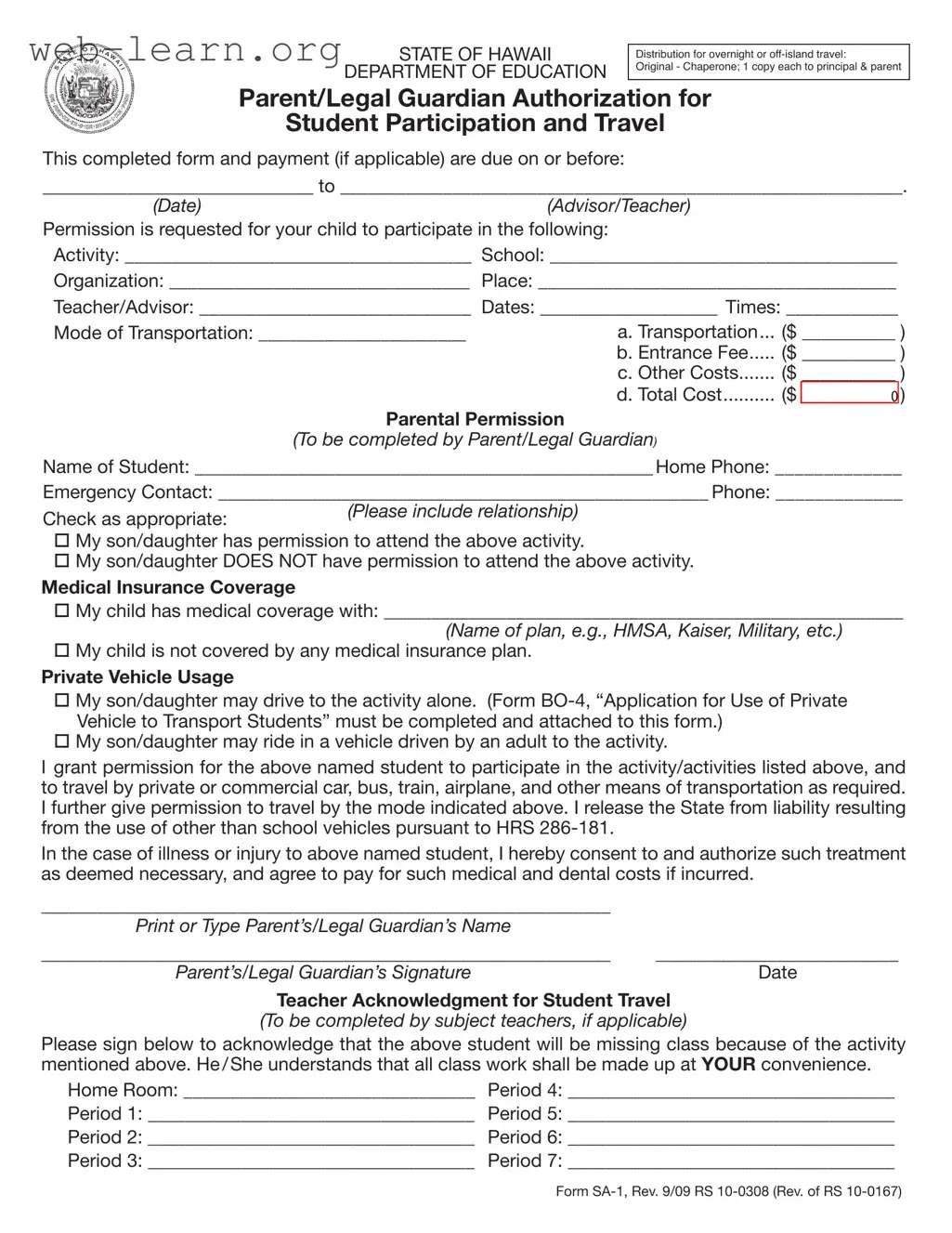
Planning a school trip can be an exciting yet daunting task for both students and parents. One essential part of this process is the Hawaii SA 1 form, which serves as a crucial document for obtaining parental permission for student participation in various activities, especially those involving overnight or off-island travel. This form not only outlines the details of the event, such as the activity, school, and organization involved, but also addresses important logistical aspects like transportation modes and associated costs. Parents or legal guardians are required to provide their consent, indicating whether their child has permission to attend, while also confirming medical insurance coverage. The form includes sections for acknowledging any private vehicle usage and outlines the responsibilities of both the guardians and the school. Additionally, it requires teachers to acknowledge that the student will be missing class, ensuring that academic responsibilities are addressed. By understanding the components of the Hawaii SA 1 form, parents can confidently navigate the permissions process, ensuring their child’s safety and participation in enriching school experiences.

STATE OF HAWAII
DEPARTMENT OF EDUCATION
Distribution for overnight or
Original - Chaperone; 1 copy each to principal & parent
Parent/Legal Guardian Authorization for
Student Participation and Travel
This completed form and payment (if applicable) are due on or before:
_____________________________ to ____________________________________________________________.
(Date) |
(Advisor/Teacher) |
||
Permission is requested for your child to participate in the following: |
|||
Activity: _____________________________________ |
School: _____________________________________ |
||
Organization: ________________________________ |
Place: ______________________________________ |
||
Teacher/Advisor: _____________________________ |
Dates: ___________________ Times: ____________ |
||
Mode of Transportation: ______________________ |
a. Transportation... ($ __________ ) |
||
|
b. Entrance Fee..... ($ __________ ) |
||
|
c. Other Costs....... ($ __________ ) |
||
|
d. Total Cost.......... ($ |
__________0 |
) |
Parental Permission
(To be completed by Parent/Legal Guardian)
Name of Student: _________________________________________________ Home Phone: _____________
Emergency Contact: ____________________________________________________ Phone: _____________
Check as appropriate: |
(Please include relationship) |
|
My son/daughter has permission to attend the above activity.
My son/daughter DOES NOT have permission to attend the above activity.
Medical Insurance Coverage
My child has medical coverage with: _______________________________________________________
(Name of plan, e.g., HMSA, Kaiser, Military, etc.)
My child is not covered by any medical insurance plan.
Private Vehicle Usage
My son/daughter may drive to the activity alone. (Form
My son/daughter may ride in a vehicle driven by an adult to the activity.
Igrant permission for the above named student to participate in the activity/activities listed above, and to travel by private or commercial car, bus, train, airplane, and other means of transportation as required.
Ifurther give permission to travel by the mode indicated above. I release the State from liability resulting from the use of other than school vehicles pursuant to HRS
In the case of illness or injury to above named student, I hereby consent to and authorize such treatment as deemed necessary, and agree to pay for such medical and dental costs if incurred.
_____________________________________________________________
Print or Type Parent’s/Legal Guardian’s Name |
|
_____________________________________________________________ |
__________________________ |
Parent’s/Legal Guardian’s Signature |
Date |
Teacher Acknowledgment for Student Travel (To be completed by subject teachers, if applicable)
Please sign below to acknowledge that the above student will be missing class because of the activity mentioned above. He/She understands that all class work shall be made up at YOUR convenience.
Home Room: _______________________________ Period 4: ___________________________________
Period 1: ___________________________________ Period 5: ___________________________________
Period 2: ___________________________________ Period 6: ___________________________________
Period 3: ___________________________________ Period 7: ___________________________________
Form
| Fact Name | Description |
|---|---|
| Governing Authority | The Hawaii SA-1 form is governed by the Hawaii Revised Statutes (HRS) 286-181. |
| Purpose | This form is used to obtain parental authorization for student participation in overnight or off-island travel activities. |
| Distribution | Original copies are provided to the chaperone, with one copy each sent to the principal and the parent. |
| Submission Deadline | The completed form and any applicable payment must be submitted by a specified date to the advisor or teacher. |
| Transportation Details | Parents must indicate the mode of transportation and any associated costs, including entrance fees. |
| Medical Insurance | Parents must disclose whether their child has medical insurance coverage and provide the name of the plan if applicable. |
| Private Vehicle Usage | Parents can grant permission for their child to drive or ride in a vehicle driven by an adult. |
| Liability Release | Parents release the State from liability for any incidents involving transportation other than school vehicles. |
| Teacher Acknowledgment | Teachers must acknowledge that the student will miss class due to the activity and that all classwork must be made up. |
Completing the Hawaii SA 1 form is a straightforward process that requires careful attention to detail. This form is essential for obtaining parental permission for a student’s participation in school activities, especially those involving travel. Follow these steps to ensure the form is filled out correctly and submitted on time.
What is the purpose of the Hawaii SA 1 form?
The Hawaii SA 1 form is designed to obtain parental or legal guardian authorization for a student’s participation in school-related activities that involve overnight or off-island travel. This includes providing necessary information about the activity, the costs involved, and the mode of transportation. It ensures that parents are informed and have given their consent for their child to participate.
What information do I need to provide on the form?
When filling out the Hawaii SA 1 form, parents or guardians must provide:
Completing all sections accurately is crucial for the form to be valid.
What happens if my child does not have medical insurance?
If your child is not covered by any medical insurance plan, you must indicate this on the form. By doing so, you acknowledge that you understand the risks involved in your child participating in the activity. It is essential to be aware that you may be responsible for any medical expenses that arise during the event.
When is the Hawaii SA 1 form due?
The completed form must be submitted along with any applicable payment by the specified due date. This date is typically indicated on the form itself. It is important to adhere to this deadline to ensure your child’s participation in the planned activity.
Filling out the Hawaii SA-1 form can seem straightforward, but many people make common mistakes that can lead to delays or complications. One of the most frequent errors is not providing complete information. Every section of the form is important, from the activity details to the emergency contact information. Omitting any part can result in the form being returned for corrections, which can cause unnecessary stress.
Another common mistake is failing to sign the form. Parents or legal guardians must provide their signature to authorize their child's participation. Without this crucial step, the form is incomplete. It's essential to double-check that all required signatures are in place before submitting the document.
Some individuals overlook the payment section, which can lead to misunderstandings later. If there are costs associated with the activity, it's important to fill in the amounts clearly. Whether it's transportation fees or entrance costs, providing accurate financial information helps avoid confusion and ensures that all necessary payments are made on time.
Additionally, many people forget to specify the mode of transportation. This detail is vital for understanding how students will get to the activity. Whether it's a school bus, private vehicle, or another means, this information should be clearly indicated to ensure safety and proper planning.
Another mistake involves the medical insurance section. Some parents either leave this section blank or fail to provide accurate details about their child's coverage. It's crucial to either confirm that your child has insurance or indicate that they do not have coverage at all. This information is important for the safety and well-being of the student during the activity.
Finally, not keeping a copy of the completed form can lead to issues later on. Parents should always retain a copy for their records. This ensures they have all necessary information at hand and can refer back to it if any questions arise. Keeping a copy also helps in case there are any discrepancies or if the school needs to verify details after submission.
When planning for student participation in activities that require travel, several important forms and documents often accompany the Hawaii SA 1 form. Each of these documents serves a specific purpose to ensure the safety and proper authorization for students. Below is a list of commonly used forms that may be required in conjunction with the Hawaii SA 1 form.
Using these forms alongside the Hawaii SA 1 form helps ensure that all necessary precautions are taken for student travel. Each document plays a role in safeguarding students and providing peace of mind for parents and guardians.
When filling out the Hawaii SA-1 form, it is crucial to ensure accuracy and completeness. Here are some essential dos and don'ts to keep in mind:
Understanding the Hawaii SA 1 form can be tricky, and there are several misconceptions that often arise. Here are ten common misunderstandings, clarified for better comprehension:
By addressing these misconceptions, parents and guardians can better navigate the Hawaii SA 1 form and ensure their child’s participation in school activities is smooth and well-prepared.
When filling out and using the Hawaii SA 1 form, keep the following key takeaways in mind: