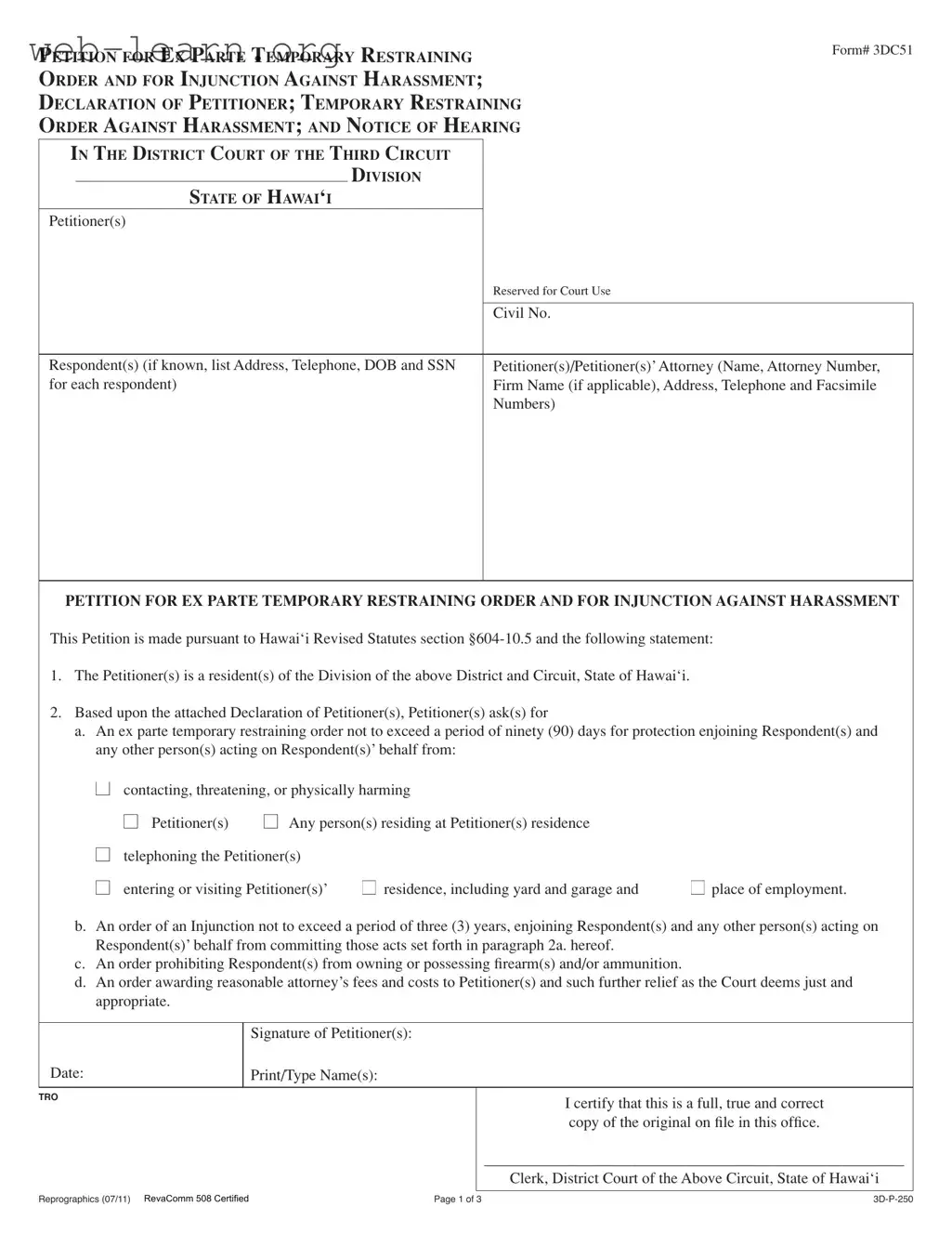
In Hawaii, individuals seeking protection from harassment can utilize the Restraining Order form, specifically designed to address urgent situations. This form allows petitioners to request an ex parte temporary restraining order, which can be granted without the presence of the respondent, providing immediate relief for up to 90 days. The form includes essential sections where petitioners must provide personal information, details about the respondent, and a declaration outlining the harassment experienced. It also enables petitioners to seek a longer-term injunction, lasting up to three years, to prevent further harassment. Additionally, the form addresses the potential prohibition of firearm possession by the respondent, ensuring a comprehensive approach to safety. The process culminates in a notice of hearing, where both parties can present their cases before a judge. Understanding the components of this form is crucial for anyone considering filing for a restraining order in Hawaii, as it lays the groundwork for legal protection and peace of mind.

PETITION FOR EX PARTE TEMPORARY RESTRAINING |
Form# 3DC51 |
|||
|
||||
ORDER AND FOR INJUNCTION AGAINST HARASSMENT; |
|
|||
DECLARATION OF PETITIONER; TEMPORARY RESTRAINING |
|
|||
ORDER AGAINST HARASSMENT; AND NOTICE OF HEARING |
|
|||
|
|
|
|
|
IN THE DISTRICT COURT OF THE THIRD CIRCUIT |
|
|||
|
|
DIVISION |
|
|
|
|
|
||
|
STATE OF HAWAI‘I |
|
||
Petitioner(s)
|
|
|
|
Reserved for Court Use |
|
|
|
|
|
|
|
|
|
|
|
Civil No. |
|
|
|
|
|
||
Respondent(s) (if known, list Address, Telephone, DOB and SSN |
Petitioner(s)/Petitioner(s)’ Attorney (Name, Attorney Number, |
||||
for each respondent) |
|
|
|
Firm Name (if applicable), Address, Telephone and Facsimile |
|
|
|
|
|
Numbers) |
|
|
|||||
PETITION FOR EX PARTE TEMPORARY RESTRAINING ORDER AND FOR INJUNCTION AGAINST HARASSMENT |
|||||
This Petition is made pursuant to Hawai‘i Revised Statutes section |
|||||
1. The Petitioner(s) is a resident(s) of the Division of the above District and Circuit, State of Hawai‘i. |
|
||||
2. Based upon the attached Declaration of Petitioner(s), Petitioner(s) ask(s) for |
|
||||
a. An ex parte temporary restraining order not to exceed a period of ninety (90) days for protection enjoining Respondent(s) and |
|||||
any other person(s) acting on Respondent(s)’ behalf from: |
|
|
|||
q# contacting, threatening, or physically harming |
|
|
|||
q Petitioner(s) |
q Any person(s) residing at Petitioner(s) residence |
|
|||
q telephoning the Petitioner(s) |
|
|
|
|
|
q entering or visiting Petitioner(s)’ |
q residence, including yard and garage and |
q place of employment. |
|||
b. An order of an Injunction not to exceed a period of three (3) years, enjoining Respondent(s) and any other person(s) acting on |
|||||
Respondent(s)’ behalf from committing those acts set forth in paragraph 2a. hereof. |
|
||||
c. An order prohibiting Respondent(s) from owning or possessing firearm(s) and/or ammunition. |
|
||||
d. An order awarding reasonable attorney’s fees and costs to Petitioner(s) and such further relief as the Court deems just and |
|||||
appropriate. |
|
|
|
|
|
|
|
|
|
|
|
|
Signature of Petitioner(s): |
|
|
||
Date: |
Print/Type Name(s): |
|
|
||
|
|
|
|
|
|
tro |
|
|
|
I certify that this is a full, true and correct |
|
|
|
|
|
||
|
|
|
|
copy of the original on file in this office. |
|
|
|
|
|
______________________________________________________ |
|
|
|
|
|
Clerk, District Court of the Above Circuit, State of Hawai‘i |
|
|
|
|
|
|
|
Reprographics (07/11) RevaComm 508 Certified |
Page 1 of 3 |

page 2 of 3
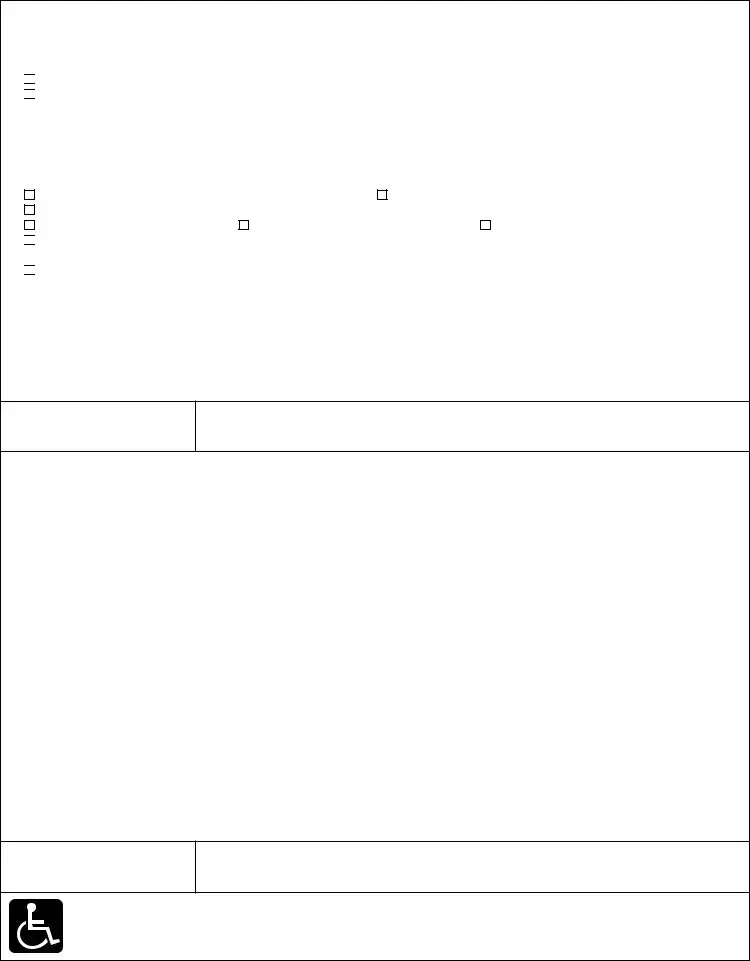
DECLARATION OF PETITIONER(S)
Petitioner(s) states the following is true:
q |
Recent or past act(s) of harassment occurred; and/or |
q |
Threats of harassment make it probable that acts of harassment may occur soon. |
Respondent(s) |
q own; |
# |
q possess, or |
q intend to obtain or possess |
q firearm(s) and or ammunition that may be used to threaten or injure Petitioner(s). |
||||
Describe the firearm(s)/ammunition: ______________________________________________________________________ .
Location of the firearm(s)/ammunition: ____________________________________________________________________ .
Date last seen:________________ .
Street address/specific location where last seen: ___________________________________________________________________ .
(Explain in detail recent or past acts or threats of harassment, using additional sheets, if necessary. Please include dates of events.)
q Unless Respondent(s)’ wrongful conduct is stopped or prevented by order of the Court, Petitioner(s) will suffer substantial emotional distress.
I have read the Petition and Declaration, know their contents, and verify that the statements contained therein are true to my personal knowledge and belief.
I DECLARE UNDER PENALTY OF PERJURY UNDER THE LAWS OF THE STATE OF HAWAI‘I THAT THE FACTS AND CIRCUMSTANCES STATED IN THE PETITION AND DECLARATION ARE TRUE AND CORRECT.
Date:
Signature of Petitioner(s):
Print/Type Name:
Reprographics (07/11) RevaComm 508 Certified |
Page 2 of 3 |
page 3 of 3
TEMPORARY RESTRAINING ORDER AGAINST HARASSMENT
(reserved for Court use only)
Based upon the attached Petition for Ex Parte Temporary Restraining Order and Declaration of Petitioner(s) and pursuant to Hawai‘i Revised Statutes
q Recent or past acts of harassment by Respondent(s) have occurred.
q Threats of harassment by Respondent(s) make it probable that acts of harassment may be imminent against Petitioner(s).
It appears to the Court that a Temporary Restraining Order should be granted and is necessary to prevent acts of harassment. Accordingly, IT IS ORDERED that Respondent(s) shall appear before the Judge in the
TO THE RESPONDENT:
YOU AND ANYONE ACTING ON YOUR BEHALF ARE ORDERED AS FOLLOWS:
q |
Do not contact, threaten, or physically harass Petitioner(s) and q any person(s) residing at Petitioner(s) residence |
|
q Do not telephone Petitioner(s) |
|
|
q |
Do not enter or visit Petitioner(s)’ q residence, including yard and garage, and |
q place of employment |
q Pursuant to HAWAI‘I REVISED STATUTES
q You shall immediately turn over for safekeeping all firearms and/or ammunition in your possession and control to the Hawai‘i
County Police Department (any District Police Station in Hawai‘i County), for the duration of this Order or any extension thereof.
This Order becomes effective upon its signing and filing and shall remain in effect for fifteen (15) days, unless extended or terminated by the Court.
ANY KNOWING OR INTENTIONAL VIOLATION OF THIS TEMPORARY RESTRAINING ORDER AGAINST HARASSMENT IS A MISDEMEANOR PUNISHABLE BY A JAIL SENTENCE OF UP TO ONE YEAR AND/OR UP TO A $2,000 FINE.
A SENTENCE OF 48 HOURS JAIL FOR A SECOND CONVICTION AND 30 DAYS JAIL FOR ANY SUBSEQUENT CONVICTION(S) IS MANDATORY. [HAWAI‘I REVISED STATUTES
Date:
Judge of the
NOTICE OF HEARING
TO _________________________________________________________________________
__________________________________________________________________________________________________________________
NOTICE IS GIVEN that the Petitioner(s) above named has/have filed the foregoing Petition for Ex Parte Temporary Restraining Order and for Injunction Against Harassment.
YOU ARE COMMANDED to appear before the Presiding Judge of the
at _____________________________________________________________________________________________________________ ,
on ____________________________________________________________________________ , 20 ____ at ______ o’clock ____ .M.
Prior to the scheduled hearing date, you or your attorney may file a written response explaining, justifying, or denying the alleged at or acts of harassment. At the hearing, the parties shall be prepared to testify, call and examine witnesses, present any documents, and give legal or factual reasons why the Injunction should or should not be granted. Each party may be represented by an attorney and shall be prepared to proceed at the hearing. IF YOU OR YOUR ATTORNEY FAIL TO ATTEND AT THE TIME AND PLACE DESIGNATED, AN ORDER
GRANTING PETITION FOR INJUNCTION AGAINST HARASSMENT WILL BE TAKEN AGAINST YOU FOR THE RELIEF DEMANDED IN THE PETITION.
The Court shall receive all evidence that is relevant at the hearing, and may make independent inquiry. If the Court finds by clear and con-
vincing evidence that harassment by Respondent(s) in the form of physical harm, bodily injury, assault, of the threat of imminent physical harm, bodily injury to Petitioner(s) exists, it may enjoin for no more than three years further harassment by Respondent(s). If the court finds by clear and convincing evidence that harassment by Respondent(s) in the form of an intentional or knowing course of conduct directed at Petitioner(s) that seriously alarms or disturbs consistently or continually bothers Petitioner(s) and that serves no legitimate purpose exists, and such course of conduct would cause a reasonable person to suffer emotional distress, the court shall enjoin for no more than three years, further harassment by Respondent(s).
This Order shall not be personally delivered between 10:00 p.m. and 6:00 a.m. on premises not open to the public, unless a judge of the
Date:
Clerk of the
In accordance with the Americans with Disabilities Act , and other applicable State and Federal laws, if you require an accommodation for your disability when working with a court program, service, or activity please contact the District Court Administration Office at PHONE NO. (808)
ForallCivilrelatedmatters,pleasecallorvisittheDistrictCourtat:HiloDivision,777KilaueaAvenue,Hilo,Ph.(808)961-7515ウKohalaDivision, 67-5187KamamaluStreet,Kamuela,Ph.(808)443-2030ウKonaDivision,79-1020HaukapilaStreet,Kealakekua,Ph.(808)322-8700.
Reprographics (07/11) RevaComm 508 Certified |
Page 3 of 3 |
| Fact Name | Details |
|---|---|
| Governing Law | The form is governed by Hawai‘i Revised Statutes §604-10.5. |
| Purpose | This form is used to request an ex parte temporary restraining order and injunction against harassment. |
| Duration of Order | The temporary restraining order can last up to 90 days, while the injunction may last for up to three years. |
| Petitioner Requirements | The petitioner must be a resident of the district and circuit where the petition is filed. |
| Respondent Restrictions | The order prohibits the respondent from contacting, threatening, or physically harming the petitioner. |
| Firearm Prohibition | The order may include a prohibition against the respondent owning or possessing firearms and ammunition. |
| Consequences of Violation | A violation of the restraining order is a misdemeanor, punishable by up to one year in jail and/or a fine of up to $2,000. |
Once you have the Hawaii Restraining Order form ready, you’ll need to complete it accurately. This process is essential to ensure your request is properly considered by the court. Follow these steps to fill out the form.
After completing the form, you’ll need to file it with the court. Be prepared for the next steps, which may include attending a hearing where you can present your case. Make sure to keep copies of everything for your records.
A Hawaii Restraining Order is a legal document issued by a court to protect individuals from harassment or threats. It can prevent the person named in the order from contacting, threatening, or physically harming the petitioner.
To apply for a Restraining Order in Hawaii, you need to fill out the Petition for Ex Parte Temporary Restraining Order form. This form requires you to provide details about the harassment or threats you've experienced, as well as information about the respondent. Once completed, submit the form to the appropriate district court.
"Ex parte" refers to a legal proceeding brought by one party without the other party being present. In the context of a Restraining Order, this means you can request immediate protection without the respondent being notified beforehand. A hearing will be scheduled later for both parties to present their cases.
A temporary Restraining Order can last up to 15 days. If the court finds sufficient evidence during the hearing, it may issue a longer-term injunction that can last up to three years.
If the respondent violates the Restraining Order, they can face serious legal consequences. This may include criminal charges, fines, or even jail time. It's crucial to document any violations and report them to law enforcement.
Yes, you can request an order prohibiting the respondent from possessing firearms or ammunition. If granted, this order will remain in effect for the duration of the Restraining Order.
While it is not mandatory to have a lawyer, having legal representation can be beneficial. A lawyer can help you navigate the process, ensure your paperwork is correct, and represent you at the hearing.
If you feel unsafe, consider reaching out to local law enforcement or a domestic violence hotline for immediate assistance. They can provide support and resources to help ensure your safety while the legal process unfolds.
Filling out the Hawaii Restraining Order form can be a daunting task, and several common mistakes can hinder the process. One significant error is failing to provide complete and accurate personal information. This includes the names, addresses, and contact details of both the petitioner and the respondent. Incomplete information can delay the processing of the order and may even result in the dismissal of the petition.
Another mistake is not clearly stating the reasons for requesting the restraining order. The petitioner must provide specific details about the harassment or threats experienced. Vague descriptions do not convey the urgency of the situation. Including dates, locations, and the nature of the incidents can strengthen the case.
Many individuals overlook the importance of documenting past incidents of harassment. Providing a detailed account of previous occurrences, including dates and descriptions, is crucial. This documentation helps establish a pattern of behavior, which is often necessary for the court to grant the restraining order.
Additionally, some petitioners neglect to mention any firearms or weapons involved in the situation. If the respondent possesses firearms, this information should be included in the petition. It is essential to indicate the type of weapon and its location, as this can significantly impact the court's decision regarding safety measures.
Petitioners sometimes fail to sign and date the form correctly. An unsigned or improperly dated petition can lead to delays or rejections. It is vital to ensure that all required signatures are present before submitting the document.
Another common error is not following the instructions for filing the petition. Each court may have specific requirements regarding the number of copies needed or the method of submission. Ignoring these guidelines can result in unnecessary complications.
Some individuals may also underestimate the importance of attending the scheduled hearing. Failing to appear can lead to the court granting the restraining order by default, potentially without considering the petitioner's perspective. It is crucial to be present and prepared to present evidence and testimony.
Inadequate preparation for the hearing is another mistake. Petitioners should gather all relevant documents and evidence to support their claims. This preparation can include witness statements, photographs, or any other pertinent information that may bolster the case.
Moreover, individuals sometimes misinterpret the scope of the restraining order. They may believe it covers all forms of contact, but it is essential to understand the specific restrictions imposed. Clarifying these terms with legal counsel can prevent future misunderstandings.
Lastly, some petitioners may not seek legal advice when necessary. While it is possible to file a restraining order without an attorney, consulting with a legal professional can provide valuable guidance. Legal expertise can help navigate the complexities of the process and ensure that the petition is as strong as possible.
The process of obtaining a restraining order in Hawaii involves several important documents. Each document serves a specific purpose in the legal proceedings and helps ensure that the rights and safety of all parties are considered. Below is a list of forms commonly used alongside the Hawaii Restraining Order form.
Understanding these documents is crucial for anyone involved in the restraining order process in Hawaii. Each form plays a vital role in ensuring that legal protections are enforced and that all parties have the opportunity to present their case. Proper completion and submission of these forms can significantly impact the outcome of the proceedings.
When filling out the Hawaii Restraining Order form, it is essential to approach the process with care and attention. Here are ten things to consider, including both actions to take and pitfalls to avoid.
Many people have misconceptions about the Hawaii Restraining Order form. Understanding these misconceptions can help individuals navigate the process more effectively. Here are six common misunderstandings:
While a restraining order can provide legal protection, it does not guarantee immediate safety. It is essential to take additional safety precautions.
Harassment can include threats, stalking, and emotional abuse. A restraining order can be sought for various forms of harassment, not just physical violence.
While having legal representation can be helpful, individuals can file for a restraining order on their own. The process is designed to be accessible.
Most restraining orders are temporary and need to be renewed or made permanent through a court hearing. They typically last for a limited time unless extended.
Violating a restraining order is a serious offense. It can lead to criminal charges, including fines and jail time.
Restraining orders can be sought in various situations, including harassment by strangers, neighbors, or coworkers. They are not limited to domestic relationships.