The Hawaii Quitclaim Deed form serves as a vital tool for property transfers, allowing individuals to convey their interest in real estate without guaranteeing the title's validity. This form is particularly useful in situations where the granter may not be able to provide a warranty deed, such as transferring property between family members or clearing up title issues. It is essential to include specific details, such as the names of the granter and grantee, a legal description of the property, and the date of execution. The document must be signed by the granter, and while notarization is not strictly required, it is highly recommended to ensure the deed's acceptance by the county recorder. Additionally, understanding the implications of using a quitclaim deed, including its limitations and potential risks, is crucial for both parties involved. This article will delve deeper into the specifics of the Hawaii Quitclaim Deed form, providing insights into its usage, benefits, and best practices for a smooth property transfer process.
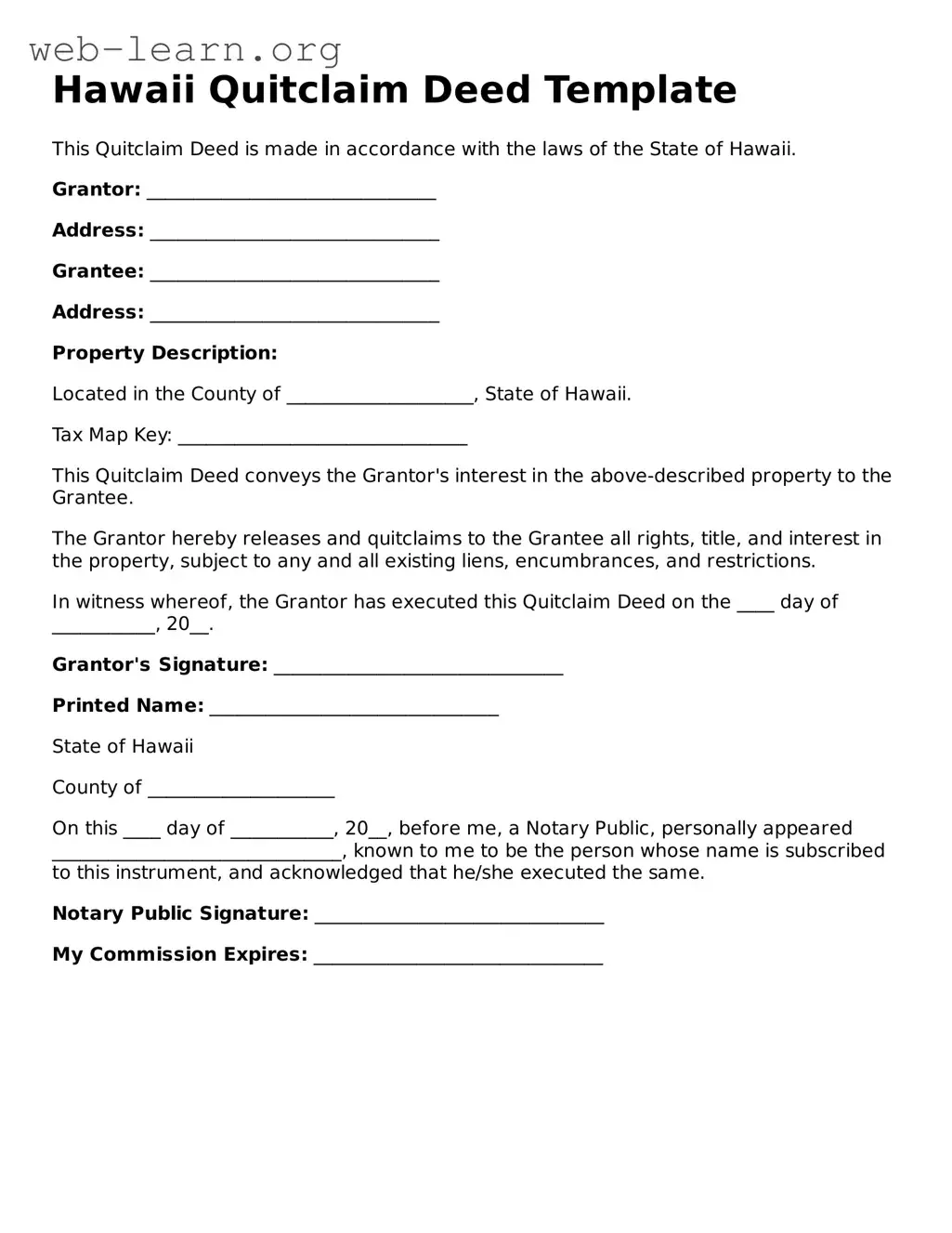
Hawaii Quitclaim Deed Template
This Quitclaim Deed is made in accordance with the laws of the State of Hawaii.
Grantor: _______________________________
Address: _______________________________
Grantee: _______________________________
Address: _______________________________
Property Description:
Located in the County of ____________________, State of Hawaii.
Tax Map Key: _______________________________
This Quitclaim Deed conveys the Grantor's interest in the above-described property to the Grantee.
The Grantor hereby releases and quitclaims to the Grantee all rights, title, and interest in the property, subject to any and all existing liens, encumbrances, and restrictions.
In witness whereof, the Grantor has executed this Quitclaim Deed on the ____ day of ___________, 20__.
Grantor's Signature: _______________________________
Printed Name: _______________________________
State of Hawaii
County of ____________________
On this ____ day of ___________, 20__, before me, a Notary Public, personally appeared _______________________________, known to me to be the person whose name is subscribed to this instrument, and acknowledged that he/she executed the same.
Notary Public Signature: _______________________________
My Commission Expires: _______________________________
| Fact Name | Description |
|---|---|
| Definition | A quitclaim deed is a legal document used to transfer ownership of property without any warranties or guarantees. |
| Governing Law | In Hawaii, quitclaim deeds are governed by Hawaii Revised Statutes, Chapter 501. |
| Use Case | Commonly used among family members or in situations where the parties know each other well. |
| Requirements | The deed must be signed by the grantor and notarized to be valid. |
| Property Description | A clear description of the property being transferred must be included in the deed. |
| Consideration | While monetary consideration is often included, it is not required for a quitclaim deed. |
| Recording | To protect the new owner's rights, the quitclaim deed should be recorded with the local county recorder's office. |
| Tax Implications | Transfer taxes may apply, depending on the value of the property and local regulations. |
| Limitations | A quitclaim deed does not guarantee that the grantor has clear title to the property. |
| Alternative Deeds | Other types of deeds, such as warranty deeds, offer more protections for the buyer. |
Filling out the Hawaii Quitclaim Deed form is an important step in transferring property ownership. Once completed, this form will need to be filed with the appropriate county office to make the transfer official. Follow these steps carefully to ensure accuracy.
A Quitclaim Deed is a legal document used to transfer ownership of real estate from one party to another. It conveys whatever interest the grantor has in the property without making any guarantees about the title. This means that if the grantor has a clear title, the grantee receives it; if not, the grantee assumes the risk.
People often use Quitclaim Deeds in situations such as transferring property between family members, adding or removing a spouse from a title after marriage or divorce, or clearing up title issues. It is a straightforward way to transfer interest without a lengthy process.
A Warranty Deed provides a guarantee that the grantor holds clear title to the property and has the right to transfer it. In contrast, a Quitclaim Deed offers no such assurances. The risk lies entirely with the grantee, who may end up with no legal claim if the grantor's title is defective.
A Quitclaim Deed typically includes the following information:
Yes, a Quitclaim Deed must be notarized to be legally valid. This step ensures that the identity of the grantor is verified and adds an extra layer of authenticity to the document.
Yes, it is essential to file the Quitclaim Deed with the county recorder’s office where the property is located. This action updates public records and provides legal notice of the change in ownership.
Filing fees vary by county in Hawaii. It is advisable to check with the local county recorder's office for specific fee amounts. Additional costs may include notarization fees.
A Quitclaim Deed can be used for most types of real property, including residential, commercial, and vacant land. However, it is not suitable for transferring property that is subject to mortgages or liens without addressing those issues first.
The primary risk involves the lack of guarantees about the title. If there are existing liens, claims, or other encumbrances, the grantee may be responsible for those issues. It is wise to conduct a title search before accepting a Quitclaim Deed.
Once a Quitclaim Deed is executed and filed, it cannot be revoked unilaterally. The grantor would need to execute another legal document, such as a Revocation of Quitclaim Deed, to reverse the transfer. Consulting with a legal professional is recommended for this process.
When completing a Hawaii Quitclaim Deed form, individuals often make several common mistakes that can lead to complications. One frequent error is failing to provide accurate property descriptions. A precise legal description is crucial. It should include details such as lot numbers or boundaries. Inaccurate descriptions can cause confusion about property ownership.
Another mistake involves not properly identifying the grantor and grantee. The names of both parties must be clearly stated. Omitting middle initials or using incorrect spellings can create issues later on. It's essential to double-check that all names are consistent with official identification documents.
People also tend to overlook the need for notarization. A Quitclaim Deed must be signed in the presence of a notary public. Without this step, the document may not be legally binding. Ensure that the notary's signature and seal are included to validate the deed.
Additionally, some individuals forget to include the date of the transfer. This date is important for establishing when the ownership change takes effect. Without it, the deed may be considered incomplete, leading to potential disputes in the future.
Another common mistake is neglecting to check local recording requirements. Each county in Hawaii may have specific rules regarding how and where to file the Quitclaim Deed. Failing to adhere to these requirements can result in delays or even rejection of the filing.
Finally, people often forget to keep copies of the completed deed. After filing, it is vital to retain a copy for personal records. This documentation serves as proof of ownership and can be crucial for future transactions or legal matters.
When dealing with property transfers in Hawaii, the Quitclaim Deed is a key document. However, it is often accompanied by several other forms and documents that help ensure a smooth transaction. Understanding these documents can clarify the process and help avoid potential legal complications.
Each of these documents plays a vital role in the property transfer process. Being familiar with them can help streamline the transaction and provide clarity to all parties involved. Always consider consulting with a legal professional to ensure compliance with local laws and regulations.
A Quitclaim Deed is a specific type of legal document used to transfer ownership of property. It is similar to several other documents in terms of function and purpose. Here are seven documents that share similarities with a Quitclaim Deed:
Understanding these documents can help clarify the various ways property ownership can be transferred. Each serves its unique purpose while sharing common elements with the Quitclaim Deed.
When filling out the Hawaii Quitclaim Deed form, it’s important to be careful and thorough. Here are some key things to keep in mind:
When it comes to the Hawaii Quitclaim Deed, several misconceptions often arise. Understanding the truth behind these can help individuals make informed decisions about property transfers. Here’s a list of common misconceptions:
Understanding these misconceptions can empower individuals to navigate property transactions more effectively and with greater confidence.
Filling out and using the Hawaii Quitclaim Deed form can be straightforward if you keep a few important points in mind. Here are some key takeaways to consider:
Ensure that the form is filled out completely and accurately. Any missing or incorrect information can lead to delays or complications in the transfer of property.
Both the grantor (the person transferring the property) and the grantee (the person receiving the property) must be clearly identified. This includes full names and addresses.
The property description should be precise. Include the property's legal description, which can typically be found in the current deed or tax records.
It is advisable to have the Quitclaim Deed notarized. This step adds an extra layer of verification and can help prevent disputes in the future.
After completing the form, it must be filed with the appropriate county office in Hawaii. This ensures that the transfer is officially recorded and recognized.
By following these guidelines, you can facilitate a smoother property transfer process in Hawaii.
Indiana Quit Claim Deed Pdf - A Quitclaim Deed may not be suitable for complex property transactions.
Quick Claim Deed Florida - It can be filed with the county recorder to make the transfer official.
Quitclaim Deed Georgia Cost - Use this deed to clear up title issues or disputes.