In the beautiful state of Hawaii, financial agreements often require a clear and concise understanding of obligations, especially when it comes to borrowing money. The Hawaii Promissory Note form serves as a vital tool in establishing the terms under which one party agrees to pay a specific amount to another. This legal document outlines essential details such as the loan amount, interest rate, repayment schedule, and any applicable late fees. By clearly defining these terms, the form helps protect both the lender and the borrower, ensuring that everyone is on the same page regarding expectations. Additionally, it may include provisions for default, which specify the actions that can be taken if the borrower fails to meet their obligations. Whether you are lending money to a friend or entering into a more formal financial agreement, understanding the components of the Hawaii Promissory Note form is crucial for fostering trust and clarity in your financial dealings.
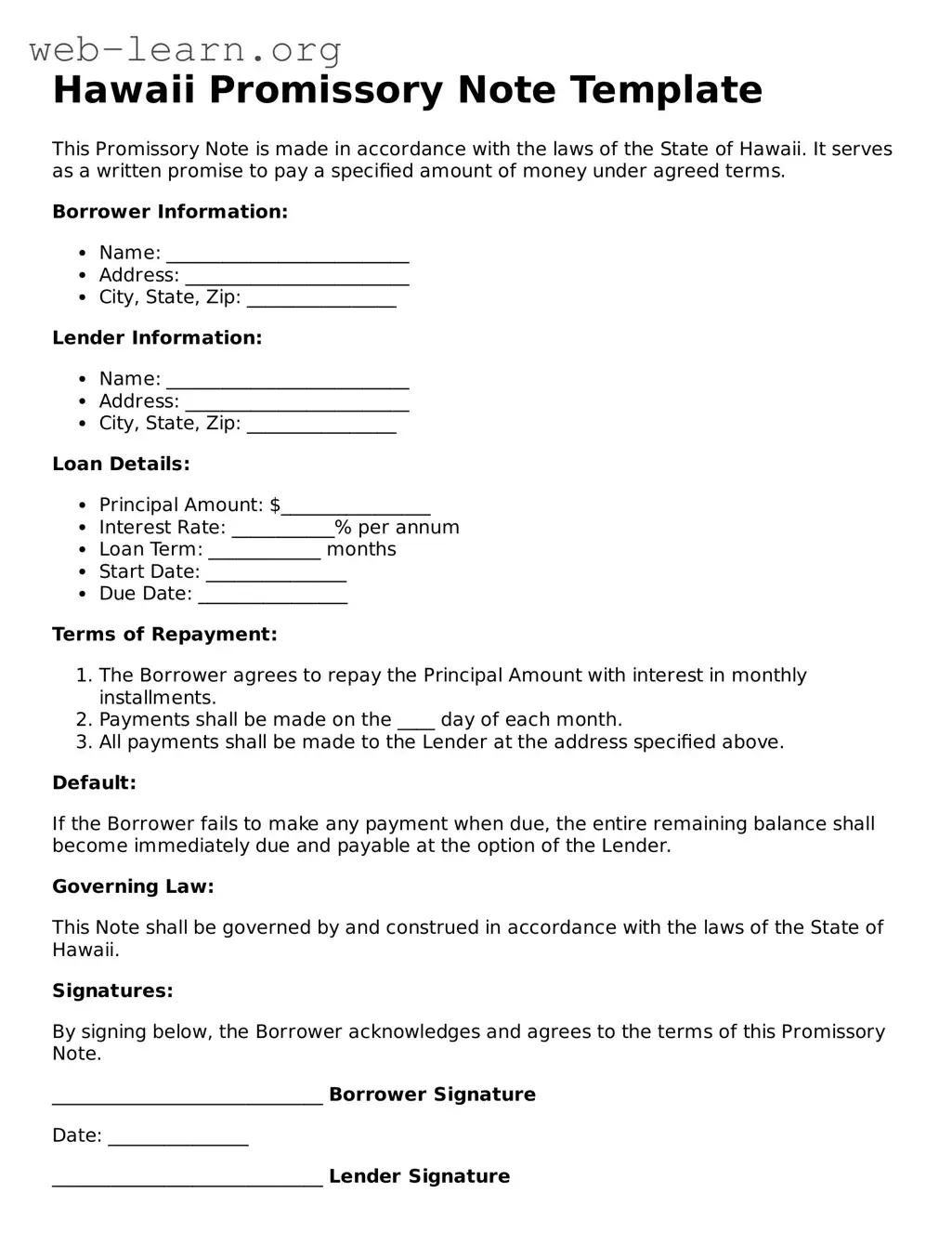
Hawaii Promissory Note Template
This Promissory Note is made in accordance with the laws of the State of Hawaii. It serves as a written promise to pay a specified amount of money under agreed terms.
Borrower Information:
Lender Information:
Loan Details:
Terms of Repayment:
Default:
If the Borrower fails to make any payment when due, the entire remaining balance shall become immediately due and payable at the option of the Lender.
Governing Law:
This Note shall be governed by and construed in accordance with the laws of the State of Hawaii.
Signatures:
By signing below, the Borrower acknowledges and agrees to the terms of this Promissory Note.
_____________________________ Borrower Signature
Date: _______________
_____________________________ Lender Signature
Date: _______________
| Fact Name | Description |
|---|---|
| Definition | A Hawaii Promissory Note is a written promise to pay a specified amount of money to a designated party at a specified time. |
| Governing Law | The laws governing promissory notes in Hawaii are found in the Hawaii Revised Statutes, specifically Chapter 478. |
| Parties Involved | The note typically involves two parties: the borrower (maker) and the lender (payee). |
| Interest Rate | The interest rate must be clearly stated in the note. Hawaii law allows for both fixed and variable rates. |
| Payment Terms | Payment terms should outline the schedule for repayment, including due dates and installment amounts. |
| Default Clause | Including a default clause is essential. It outlines the consequences if the borrower fails to make payments. |
| Signatures Required | The note must be signed by the borrower to be legally enforceable. A witness or notary is not required but is often recommended. |
After obtaining the Hawaii Promissory Note form, it is essential to fill it out accurately to ensure that all necessary information is included. The next steps will guide you through the process of completing the form effectively.
Once the form is completed, it is advisable to keep copies for both parties involved. This ensures that all parties have access to the agreed-upon terms and conditions.
A Hawaii Promissory Note is a legal document that outlines a borrower's promise to repay a specific amount of money to a lender, typically with interest, by a certain date. This document serves as a record of the transaction and can be used in legal proceedings if necessary.
Individuals, businesses, and financial institutions often use Promissory Notes. For example, a person borrowing money from a friend may create a note, while a bank may issue one for a loan. It is a common tool in both personal and commercial finance.
A typical Promissory Note includes:
Yes, a Promissory Note is legally binding in Hawaii as long as it meets certain requirements. Both parties must agree to the terms, and the document should be signed. It is advisable to have the note notarized for added legal protection.
Yes, a Promissory Note can be modified if both parties agree to the changes. It is important to document any modifications in writing and have both parties sign the updated note to ensure clarity and enforceability.
If a borrower defaults, the lender has the right to take legal action to recover the owed amount. This may include filing a lawsuit or seeking a judgment against the borrower. The specific actions available will depend on the terms outlined in the note and applicable state laws.
While it is not required to have an attorney draft a Promissory Note, it can be beneficial, especially for larger loans or complex agreements. An attorney can help ensure that the document complies with state laws and adequately protects your interests.
Templates for Hawaii Promissory Notes can be found online through legal websites, document preparation services, or local law libraries. It is essential to ensure that any template used complies with Hawaii's legal requirements.
When filling out the Hawaii Promissory Note form, individuals often overlook critical details that can lead to complications later. One common mistake is failing to include all necessary parties. It is essential to ensure that both the borrower and lender are clearly identified. Omitting a party's name can create confusion and may render the note unenforceable.
Another frequent error involves incorrect information about the loan amount. Borrowers sometimes write down the wrong figures, which can cause disputes over repayment terms. Accuracy in this section is crucial; even a small discrepancy can lead to significant issues down the line.
People often neglect to specify the interest rate. Without this key detail, the terms of the loan can become ambiguous. It is important to outline whether the interest is fixed or variable, as this impacts the total repayment amount. Clarity here is paramount.
Many individuals also fail to include a repayment schedule. This schedule should detail when payments are due and the amount of each payment. Without a clear timeline, both parties may have differing expectations about when the loan will be repaid.
Another mistake is not signing the document in the appropriate places. Both the borrower and lender must sign the Promissory Note for it to be valid. A missing signature can invalidate the agreement and lead to legal challenges.
Some people overlook the importance of having witnesses or notarization. While not always required, having a witness or a notary can provide additional credibility to the document. This step can be crucial if disputes arise in the future.
Additionally, individuals sometimes forget to date the Promissory Note. A missing date can lead to confusion regarding when the agreement was made. This information is vital for establishing timelines for repayment and interest accrual.
Another common oversight is not keeping a copy of the signed document. Both parties should retain a copy for their records. This practice ensures that everyone has access to the same information, which can prevent misunderstandings.
Lastly, people may fail to review the entire document before signing. Taking the time to read through the Promissory Note ensures that all terms are understood and agreed upon. Rushing through this process can lead to costly mistakes.
When dealing with a Hawaii Promissory Note, several other forms and documents may accompany it to ensure clarity and legal compliance. Each of these documents serves a specific purpose in the lending and borrowing process.
Understanding these documents can help both lenders and borrowers navigate the complexities of loan agreements more effectively. Each form plays a vital role in protecting the interests of both parties involved in the transaction.
Loan Agreement: Like a promissory note, a loan agreement outlines the terms of a loan, including the amount borrowed, interest rate, and repayment schedule. Both documents establish a legal obligation for repayment.
Mortgage: A mortgage is a specific type of loan secured by real property. Similar to a promissory note, it includes terms for repayment but also details the collateral backing the loan, making it more comprehensive.
Credit Agreement: This document governs the terms of credit extended by a lender to a borrower. It shares similarities with a promissory note in that it specifies repayment terms and obligations, but it often covers a broader range of borrowing conditions.
Installment Agreement: An installment agreement allows a borrower to repay a debt in regular payments over time. Like a promissory note, it clearly states the payment schedule and total amount owed, ensuring both parties understand their obligations.
When filling out the Hawaii Promissory Note form, it’s important to follow certain guidelines to ensure accuracy and legality. Here are some dos and don'ts to consider:
When it comes to the Hawaii Promissory Note form, there are several misconceptions that people often have. Understanding these can help clarify how the form works and its importance in financial agreements.
Many people think a Promissory Note is merely an informal IOU. In reality, it is a formal legal document that outlines the terms of a loan, including repayment schedules and interest rates. It carries legal weight and can be enforced in court.
Some believe that a verbal agreement is sufficient for a loan. However, a written Promissory Note is essential. It provides clear evidence of the terms agreed upon, which helps prevent disputes later on.
This is not true. Anyone can create a Promissory Note, whether it’s an individual or a business. As long as the terms are clear and agreed upon by both parties, it can be a useful tool for personal loans or business transactions.
Many think that a signed Promissory Note is set in stone. In fact, the terms can be modified if both parties agree to the changes. It’s important to document any amendments in writing to avoid confusion.
When filling out and using the Hawaii Promissory Note form, there are several important aspects to consider. Here are some key takeaways:
Basic Promissory Note - They often require signatures from both parties to be considered valid and enforceable.
Notarized Promissory Note Sample - It can be beneficial to outline the purpose of the loan within the note itself.