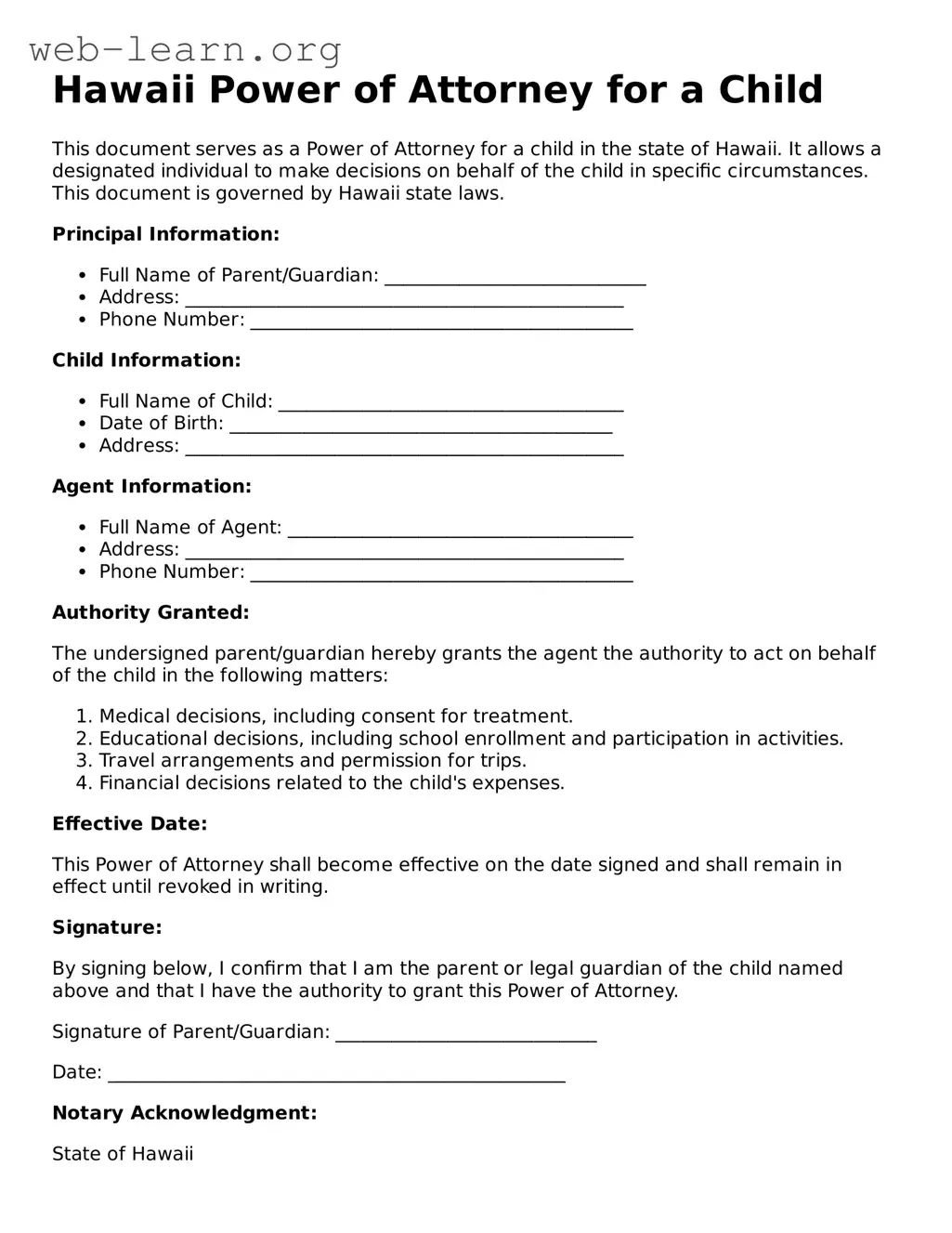
When it comes to ensuring the well-being of your child in your absence, the Hawaii Power of Attorney for a Child form serves as a vital tool. This legal document allows a parent or guardian to designate another adult to make decisions on behalf of their child, covering a range of responsibilities from medical care to education. By granting this authority, you can ensure that your child’s needs are met even when you are not available to provide direct oversight. The form typically includes essential details such as the names and addresses of the child and the appointed agent, the specific powers granted, and the duration of the authority. It is designed to be straightforward, allowing parents to specify what decisions the designated adult can make, which can include everything from authorizing medical treatment to enrolling the child in school. Understanding the nuances of this form can help you make informed decisions that prioritize your child's safety and welfare, especially in emergencies or when traveling. Additionally, knowing how to properly execute and revoke this power of attorney can further safeguard your family's interests.
Hawaii Power of Attorney for a Child
This document serves as a Power of Attorney for a child in the state of Hawaii. It allows a designated individual to make decisions on behalf of the child in specific circumstances. This document is governed by Hawaii state laws.
Principal Information:
Child Information:
Agent Information:
Authority Granted:
The undersigned parent/guardian hereby grants the agent the authority to act on behalf of the child in the following matters:
Effective Date:
This Power of Attorney shall become effective on the date signed and shall remain in effect until revoked in writing.
Signature:
By signing below, I confirm that I am the parent or legal guardian of the child named above and that I have the authority to grant this Power of Attorney.
Signature of Parent/Guardian: ____________________________
Date: _________________________________________________
Notary Acknowledgment:
State of Hawaii
County of ______________________
Subscribed and sworn to before me this _____ day of ___________, 20__.
Notary Public: __________________________________________
My Commission Expires: __________________________________
| Fact Name | Details |
|---|---|
| Definition | A Power of Attorney for a Child allows a parent or legal guardian to designate another adult to make decisions on behalf of their child. |
| Governing Law | The form is governed by Hawaii Revised Statutes, specifically HRS § 577-1 to § 577-10. |
| Duration | The authority granted can be temporary or permanent, depending on the specific needs outlined in the document. |
| Eligibility | Any adult can be designated as an agent, provided they are willing and able to act in the best interest of the child. |
| Revocation | The Power of Attorney can be revoked by the parent or guardian at any time, as long as it is done in writing. |
| Limitations | The agent's authority may be limited to specific areas, such as medical decisions or educational matters. |
| Notarization | While notarization is not always required, it is recommended to ensure the document's validity and acceptance. |
Filling out the Hawaii Power of Attorney for a Child form is an important step in ensuring that your child is cared for in your absence. By completing this form, you grant someone you trust the authority to make decisions on behalf of your child. Below are the steps to guide you through the process.
Once you have completed these steps, the Power of Attorney for a Child form is ready for use. Ensure that the appointed individual understands their responsibilities and has access to the necessary information about your child.
What is a Power of Attorney for a Child in Hawaii?
A Power of Attorney for a Child in Hawaii allows a parent or legal guardian to grant another adult the authority to make decisions on behalf of their child. This can include decisions about education, healthcare, and general welfare. It's useful for situations where the parent or guardian is temporarily unavailable.
Who can be designated as an attorney-in-fact?
The attorney-in-fact can be any adult whom the parent or guardian trusts. This could be a relative, family friend, or neighbor. The key is that the person should be responsible and capable of making decisions in the best interest of the child.
How long is the Power of Attorney valid?
The Power of Attorney for a Child remains valid until the parent or guardian revokes it, the specified time period expires, or the child turns 18. It's essential to keep track of the timeframe if a specific duration is indicated in the document.
Do I need to notarize the Power of Attorney?
Yes, in Hawaii, the Power of Attorney must be signed in the presence of a notary public. This adds an extra layer of validity and ensures that the document is legally recognized.
Can I revoke the Power of Attorney?
Absolutely. A parent or guardian can revoke the Power of Attorney at any time by providing written notice to the attorney-in-fact. It's advisable to notify any relevant parties, such as schools or medical providers, to avoid confusion.
What happens if the attorney-in-fact cannot fulfill their duties?
If the designated attorney-in-fact is unable to carry out their responsibilities, the parent or guardian should appoint a new attorney-in-fact. This should be done through a new Power of Attorney document to ensure clarity and legality.
Is there a specific form I must use?
While there is no official state form required, it is highly recommended to use a template that complies with Hawaii laws. This ensures that all necessary elements are included and that the document is valid.
Can the attorney-in-fact make medical decisions?
Yes, the attorney-in-fact can make medical decisions if this authority is explicitly granted in the Power of Attorney document. It’s important to specify this if you want the attorney-in-fact to have that power.
What if I have more than one child?
If you have multiple children, you can create a separate Power of Attorney for each child or include all of them in one document. Make sure to clearly identify each child to avoid any confusion.
Where should I keep the Power of Attorney document?
Store the Power of Attorney in a safe but accessible place. You may also want to provide copies to the attorney-in-fact, schools, and healthcare providers to ensure they have the necessary documentation when needed.
Filling out the Hawaii Power of Attorney for a Child form can be a straightforward process, but there are common mistakes that individuals often make. Understanding these pitfalls can help ensure that the document is completed accurately, which is essential for the well-being of the child involved.
One frequent mistake is neglecting to include the full legal names of both the child and the agent. It is crucial to provide accurate and complete information. Omitting any part of a name can lead to confusion or even invalidate the document.
Another common error is failing to specify the duration of the power of attorney. Without a clear timeframe, it may be unclear how long the agent has the authority to act on behalf of the child. This can lead to complications if the arrangement needs to be in place for an extended period.
People sometimes forget to sign the document in the presence of a notary public. Notarization is a critical step that adds a layer of authenticity to the form. If the document is not notarized, it may not be recognized as valid by schools, medical facilities, or other institutions.
In addition, individuals may overlook the importance of detailing the specific powers granted to the agent. The form allows for customization, and specifying the extent of authority helps prevent misunderstandings. General statements can lead to confusion about what decisions the agent can make.
Another mistake is not keeping copies of the signed document. After the form has been completed and notarized, it is essential to retain copies for personal records and to provide copies to the agent and any relevant institutions. This ensures that everyone involved has access to the same information.
Some people also fail to review the form for errors before submission. Simple typographical errors or omissions can create significant issues later on. Taking the time to double-check the document can save a great deal of trouble down the line.
Additionally, individuals may not inform the child about the arrangement. It is important for the child to understand who will be responsible for their care and what that means. Open communication can help alleviate any anxiety the child might feel about the situation.
Another oversight is neglecting to update the power of attorney if circumstances change. Life events such as a change in the agent's ability to serve or a shift in the child's needs can necessitate updates to the document. Keeping the form current is essential for ensuring that it remains effective.
Lastly, individuals sometimes fail to consider the implications of granting power of attorney. Understanding the responsibilities and potential consequences of this decision is vital. It is advisable to discuss the arrangement with trusted family members or legal professionals to ensure that it aligns with the best interests of the child.
By being aware of these common mistakes, individuals can take proactive steps to complete the Hawaii Power of Attorney for a Child form correctly. This diligence helps protect the child’s welfare and ensures that their needs are met appropriately.
When parents or guardians need to delegate authority for the care of a child, the Hawaii Power of Attorney for a Child form is often accompanied by several other important documents. These documents help ensure that the child's needs are met and that legal matters are handled smoothly. Below is a list of some commonly used forms and documents that may be relevant.
Having these documents prepared and organized can provide peace of mind for parents and caregivers alike. Each form serves a specific purpose, ensuring that the child's health, education, and overall well-being are prioritized during times of transition or absence.
The Power of Attorney for a Child form is a crucial document that allows a designated individual to make decisions on behalf of a minor. This form shares similarities with several other legal documents that also grant authority or rights to act on behalf of another person. Here are four documents that are similar to the Power of Attorney for a Child:
When filling out the Hawaii Power of Attorney for a Child form, it is important to follow certain guidelines to ensure the document is completed correctly. Below is a list of things to do and avoid during this process.
Understanding the Hawaii Power of Attorney for a Child form can be challenging. Here are seven common misconceptions about this important document:
Clearing up these misconceptions can help parents make informed decisions about their child's care and ensure that their wishes are respected.
When filling out and using the Hawaii Power of Attorney for a Child form, it is essential to understand several key aspects to ensure its proper execution and effectiveness. Below are important takeaways to consider:
Colorado Power of Attorney Requirements - The form can be tailored to fit various circumstances, including short-term or long-term needs.
Power of Attorney Georgia - Permits an individual to manage a child’s affairs when parents are unavailable.
Power of Attorney for Child Traveling With Grandparents - It can provide peace of mind for parents who need to be away from their child.
How to Get Power of Attorney in Arkansas - The form can specify the types of decisions the designated person can make, such as educational placements.