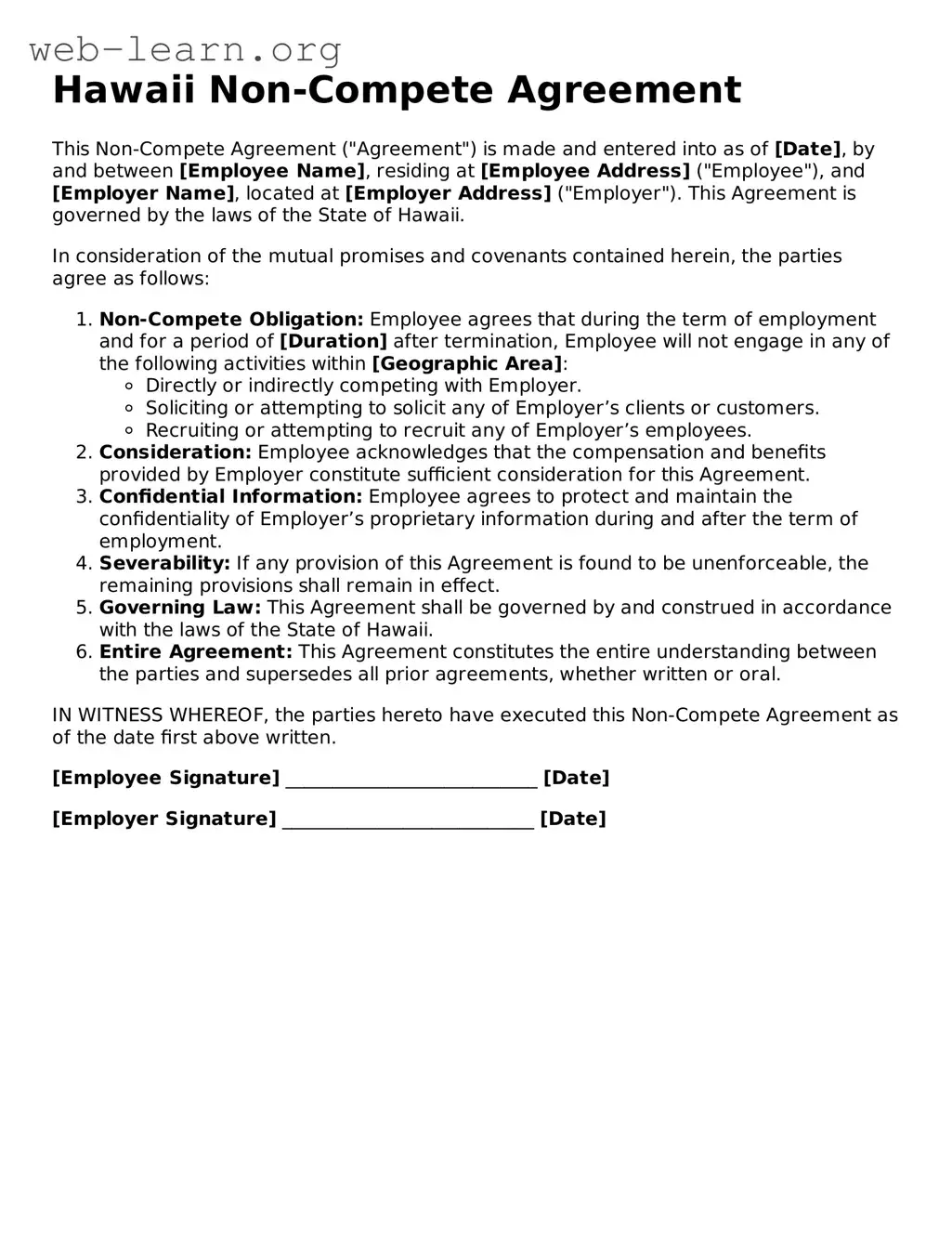
In the vibrant landscape of Hawaii's employment laws, the Non-compete Agreement form plays a significant role in defining the relationship between employers and employees. This legal document is designed to protect a company's proprietary information and trade secrets by restricting employees from engaging in competitive activities for a specified period after leaving the organization. The form outlines critical elements such as the duration of the non-compete clause, the geographical area it covers, and the specific activities that are deemed competitive. Additionally, it emphasizes the need for mutual consideration, ensuring that both parties understand the terms and implications of the agreement. While Hawaii law permits non-compete agreements, they must adhere to certain limitations to be enforceable, reflecting the state's commitment to fostering fair competition and protecting workers' rights. Thus, understanding the nuances of this form is essential for both employers looking to safeguard their business interests and employees aiming to navigate their career paths effectively.
Hawaii Non-Compete Agreement
This Non-Compete Agreement ("Agreement") is made and entered into as of [Date], by and between [Employee Name], residing at [Employee Address] ("Employee"), and [Employer Name], located at [Employer Address] ("Employer"). This Agreement is governed by the laws of the State of Hawaii.
In consideration of the mutual promises and covenants contained herein, the parties agree as follows:
IN WITNESS WHEREOF, the parties hereto have executed this Non-Compete Agreement as of the date first above written.
[Employee Signature] ___________________________ [Date]
[Employer Signature] ___________________________ [Date]
| Fact Name | Details |
|---|---|
| Governing Law | The Hawaii Non-compete Agreement is governed by Hawaii Revised Statutes, Chapter 480. |
| Enforceability | Non-compete agreements in Hawaii are enforceable only if they are reasonable in scope and duration. |
| Duration Limit | The duration of a non-compete agreement should generally not exceed two years. |
| Geographic Scope | The geographic area covered by the agreement must be clearly defined and reasonable. |
| Consideration Requirement | A valid non-compete agreement requires consideration, such as employment or access to trade secrets. |
| Employee Protections | Hawaii law protects employees from overly restrictive non-compete clauses that limit their ability to earn a living. |
| Trade Secrets | Non-compete agreements may be used to protect legitimate business interests, such as trade secrets. |
| Legal Review | It is advisable for both parties to seek legal review before signing a non-compete agreement to ensure fairness. |
After obtaining the Hawaii Non-compete Agreement form, it is essential to carefully complete it to ensure clarity and compliance with state regulations. Follow these steps to fill out the form accurately.
Once you have completed the form, review it for any errors or missing information. It is advisable to keep a copy for your records before submitting it to the appropriate party.
A Non-compete Agreement is a contract between an employer and an employee. It restricts the employee from working for competitors or starting a similar business for a specified period after leaving the company. In Hawaii, these agreements must be reasonable in scope, duration, and geographic area to be enforceable.
Yes, Non-compete Agreements can be enforceable in Hawaii, but they are subject to strict scrutiny. Courts will evaluate whether the agreement protects legitimate business interests without imposing undue hardship on the employee. Factors considered include:
Agreements that are overly broad may be deemed unenforceable.
The duration of a Non-compete Agreement in Hawaii should be reasonable. Typically, a duration of six months to two years is considered acceptable, depending on the industry and specific circumstances. Longer durations may be challenged in court if deemed excessive.
Yes, employees can negotiate the terms of a Non-compete Agreement before signing it. It's advisable to discuss any concerns regarding the agreement’s duration, geographic scope, and specific restrictions. Seeking legal advice can also help ensure that the terms are fair and reasonable.
Filling out the Hawaii Non-compete Agreement form can be a straightforward process, but many individuals make common mistakes that can lead to complications. One frequent error is failing to provide accurate and complete information. When individuals leave out essential details or provide incorrect data, it can invalidate the agreement. It's crucial to double-check all entries for accuracy to ensure that the document reflects the true intentions of both parties.
Another common mistake is not understanding the terms of the agreement. Many people sign documents without fully comprehending the implications of the non-compete clauses. This lack of understanding can lead to unintended consequences, such as restrictions on future employment opportunities. It is advisable to take the time to read and understand each section of the agreement before signing.
Additionally, individuals often overlook the need for specific timeframes and geographical limitations in the agreement. A non-compete agreement must clearly outline how long the restrictions will last and the areas in which they apply. Failing to define these parameters can result in a vague agreement that may be difficult to enforce. Clear definitions help prevent misunderstandings in the future.
Lastly, many people neglect to seek legal advice before finalizing the agreement. While it may seem like a simple formality, consulting with a legal professional can provide valuable insights. An attorney can help clarify any confusing terms and ensure that the agreement complies with Hawaii law. Taking this step can save individuals from potential legal disputes down the line.
When entering into a non-compete agreement in Hawaii, several other forms and documents may accompany it to ensure clarity and legal compliance. These documents serve to protect the interests of both parties and outline specific terms and conditions related to employment and competition.
Incorporating these documents alongside the Hawaii Non-compete Agreement can provide a more robust legal framework. This ensures that both parties are fully aware of their rights and obligations, fostering a transparent and fair working relationship.
When filling out the Hawaii Non-compete Agreement form, it is important to follow certain guidelines. Here are some things you should and shouldn't do:
Following these guidelines can help protect your rights and interests. Be thorough and deliberate in your approach.
When it comes to non-compete agreements in Hawaii, there are several misconceptions that can lead to confusion for both employers and employees. Understanding these misconceptions is essential for making informed decisions regarding employment contracts. Below is a list of seven common misconceptions about the Hawaii Non-compete Agreement form, along with explanations to clarify each point.
This is not true. In Hawaii, non-compete agreements are only enforceable under certain conditions. They must be reasonable in scope, duration, and geographic area. If they are overly restrictive, a court may deem them unenforceable.
This is a common fear, but it is usually not the case. A non-compete agreement typically restricts employment for a specific period and within a certain geographic area. Once that time frame has passed, you are free to pursue opportunities in your field.
Not all employers require employees to sign non-compete agreements. Many businesses, especially smaller ones, may not find it necessary to impose such restrictions. It depends on the nature of the business and the role of the employee.
While both agreements aim to protect a company's interests, they serve different purposes. A non-compete agreement restricts where and when an employee can work after leaving a job, whereas a non-disclosure agreement focuses on keeping sensitive information confidential.
This is a misconception. Employees can negotiate the terms of a non-compete agreement before signing it. It is important to discuss any concerns with the employer to reach a mutually agreeable arrangement.
While it is more common for executives and key employees to sign non-compete agreements, they can be applied to any employee, depending on the company's needs and the nature of the work performed.
Violating a non-compete agreement does not automatically result in a lawsuit. Employers may choose to enforce the agreement, but they often consider the circumstances and potential impact before taking legal action.
Understanding these misconceptions can help both employers and employees navigate the complexities of non-compete agreements in Hawaii. Always consider seeking legal advice if you have specific questions or concerns regarding a non-compete agreement.
When considering the Hawaii Non-compete Agreement form, it is important to understand its implications and requirements. Here are some key takeaways:
Understanding these aspects can help in effectively filling out and utilizing the Hawaii Non-compete Agreement form.
Alabama Non-compete Law - Employers may use Non-compete Agreements to deter employee turnover.
Are Non Competes Enforceable in Idaho - This document is crucial for defining the scope and duration of non-competition obligations.
Nys Non Compete - This agreement helps protect a company's trade secrets and sensitive information.