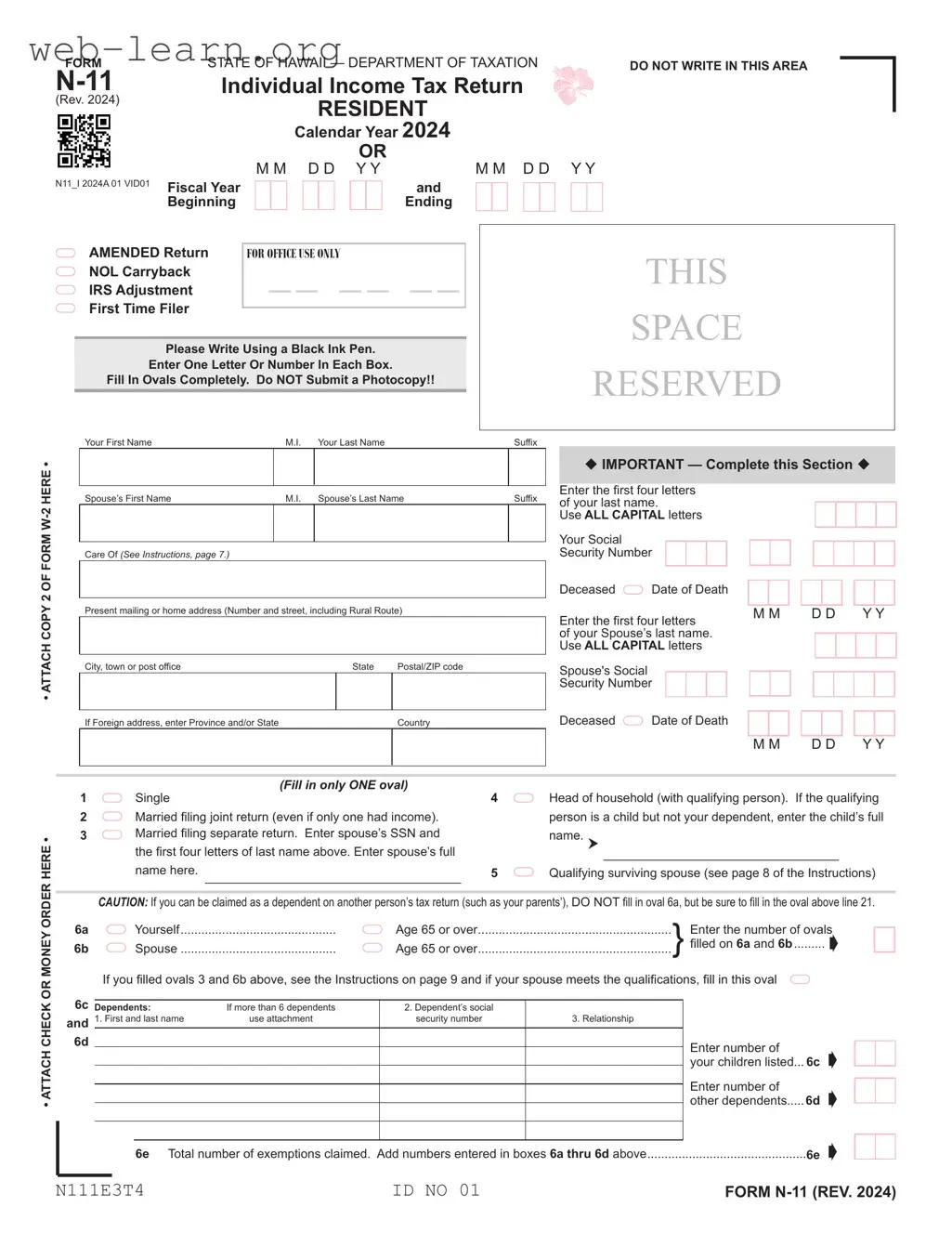
The Hawaii N-11 form is an essential document for residents of Hawaii who are filing their individual income tax returns. This form serves multiple purposes, including the reporting of income, claiming deductions, and determining tax liability for the calendar year. Residents must indicate their filing status, which can range from single to qualifying widow(er) with a dependent child. The N-11 also requires taxpayers to provide personal information, such as Social Security numbers and details about dependents, ensuring accurate processing. Additionally, it incorporates sections for both Hawaii additions and subtractions to federal adjusted gross income, allowing taxpayers to adjust their income based on specific state regulations. Tax credits, including those for low-income renters and child care expenses, are also addressed within the form, providing opportunities for financial relief. Ultimately, the N-11 form is not just a tax return; it is a comprehensive tool that reflects the unique aspects of Hawaii's tax structure, making it crucial for residents to understand and complete accurately.

FORM |
STATE OF HAWAII — DEPARTMENT OF TAXATION |
DO NOT WRITE IN THIS AREA |
|
Individual Income Tax Return |
|
||
(Rev. 2024) |
RESIDENT |
|
|
|
|
|
|
|
Calendar Year 2024 |
|
|
|
OR |
M M D D Y Y |
|
|
M M D D Y Y |
|
|
N11_I 2024A 01 VID01 Fiscal Year
Beginning
and
Ending
AMENDED Return |
FOR OFFICE USE ONLY |
|
|||||||||||
NOL Carryback |
|
|
|
|
|
||||||||
IRS Adjustment |
|
||||||||||||
|
|
|
|
|
|
|
|
|
|
|
|
||
First Time Filer |
|
|
|
|
|
|
|
|
|
|
|
|
|
|
|
|
|
|
|
|
|
|
|
|
|
|
|
Please Write Using a Black Ink Pen.
Enter One Letter Or Number In Each Box.
Fill In Ovals Completely. Do NOT Submit a Photocopy!!
THIS
SPACE
RESERVED
FORM
Your First Name |
M.I. |
Your Last Name |
Suffix |
|
|
|
|
Spouse’s First Name |
M.I. |
Spouse’s Last Name |
Suffix |
|
|
|
|
Care Of (See Instructions, page 7.) |
|
|
|
u IMPORTANT — Complete this Section u
Enter the first four letters of your last name.
Use ALL CAPITAL letters
Your Social Security Number
• ATTACH CHECK OR MONEY ORDER HERE • • ATTACH COPY 2 OF
|
|
|
|
|
|
|
Deceased |
Date of Death |
|
|
|
|
|
|
|
|
|
|
|
|||||
|
|
|
|
|
|
|
|
|
|
|
|
|
|
|
|
|
|
|||||||
|
Present mailing or home address (Number and street, including Rural Route) |
|
|
|
|
|
|
|
|
|
|
|
|
|
|
|
|
|
|
|
||||
|
|
Enter the first four letters |
|
M |
M |
D D |
Y Y |
|||||||||||||||||
|
|
|
|
|
|
|
|
|
|
|
|
|
|
|
|
|
|
|||||||
|
|
|
|
|
|
|
of your Spouse’s last name. |
|
|
|
|
|
|
|
|
|
|
|
||||||
|
|
|
|
|
|
|
Use ALL CAPITAL letters |
|
|
|
|
|
|
|
|
|
|
|
||||||
|
City, town or post office |
|
State |
Postal/ZIP code |
|
Spouse's Social |
|
|
|
|
|
|
|
|
|
|
|
|
|
|
|
|||
|
|
|
|
|
|
|
|
|
|
|
|
|
|
|
|
|
|
|||||||
|
|
|
|
|
|
|
Security Number |
|
|
|
|
|
|
|
|
|
|
|
|
|
|
|
||
|
|
|
|
|
|
|
|
|
|
|
|
|
|
|
|
|
|
|
|
|
|
|
||
|
|
|
|
|
|
|
Deceased |
Date of Death |
|
|
|
|
|
|
|
|
|
|
|
|||||
|
If Foreign address, enter Province and/or State |
|
|
Country |
|
|
|
|
|
|
|
|
|
|
|
|
||||||||
|
|
|
|
|
|
|
|
|
|
|
|
|
|
|
|
|
|
|
|
|
|
|
|
|
|
|
|
|
|
|
|
|
|
|
|
|
|
|
|
M |
M |
|
D D |
Y Y |
|||||
|
|
|
|
|
|
|
|
|
|
|
|
|
|
|
|
|
|
|
|
|
|
|
|
|
|
|
|
|
|
|
|
|
|
|
|
|
|
|
|
|
|
|
|
|
|
|
|
|
|
1 |
Single |
(Fill in only ONE oval) |
4 |
Head of household (with qualifying person). If the qualifying |
||||||||||||||||||||
|
|
|
||||||||||||||||||||||
2 |
Married filing joint return (even if only one had income). |
|
person is a child but not your dependent, enter the child’s full |
|||||||||||||||||||||
3 |
Married filing separate return. Enter spouse’s SSN and |
|
name. |
|
|
|
|
|
|
|
|
|
|
|
|
|
|
|
|
|
||||
the first four letters of last name above. Enter spouse’s full |
|
__________________________________ |
|
|
|
|||||||||||||||||||
|
|
|
|
|
|
|
||||||||||||||||||
|
|
name here. _____________________________________ |
5 |
Qualifying surviving spouse (see page 8 of the Instructions) |
||||||||||||||||||||
CAUTION: If you can be claimed as a dependent on another person’s tax return (such as your parents’), DO NOT fill in oval 6a, but be sure to fill in the oval above line 21.
6a |
|
Yourself |
Age 65 or over |
} |
Enter the number of ovals |
||||
6b |
|
Spouse |
Age 65 or over |
filled on 6a and 6b |
 |
||||
|
|
|
|||||||
|
If you filled ovals 3 and 6b above, see the Instructions on page 9 and if your spouse meets the qualifications, fill in this oval |
|
|
||||||
6c |
|
|
|
|
|
|
|
|
|
Dependents: |
If more than 6 dependents |
2. Dependent’s social |
|
|
|
|
|
||
and |
1. First and last name |
use attachment |
security number |
3. Relationship |
|
|
|
|
|
6d |
|
|
|
|
|
|
Enter number of |
6c |
 |
|
|
|
|
|
|
||||
|
|
|
|
|
|
|
your children listed... |
||
|
|
|
|
|
|
|
|||
|
|
|
|
|
|
|
Enter number of |
6d |
 |
|
|
|
|
|
|
|
|||
|
|
|
|
|
|
|
other dependents |
||
|
|
|
|
|
|
|
|||
|
|
|
|
|
|
|
|
 |
|
|
|
|
|
|
|
|
|
|
|
|
|
6e Total number of exemptions claimed. Add numbers entered in boxes 6a thru 6d above |
6e |
||||||
|
|
ID NO 01 |
N111E3T4 |
||
FORM
| Fact Name | Description |
|---|---|
| Form Purpose | The Hawaii N-11 form is used for filing individual income tax returns for residents of Hawaii. |
| Filing Status Options | Taxpayers can choose from several filing statuses, including single, married filing jointly, married filing separately, head of household, and qualifying widow(er). |
| Exemptions | Taxpayers may claim exemptions for themselves, their spouses, and dependent children, which can reduce their taxable income. |
| Standard Deduction | The form allows taxpayers to take a standard deduction based on their filing status, which further reduces taxable income. |
| Tax Credits | Various refundable tax credits are available, including those for low-income renters and child care expenses, which can lower the overall tax liability. |
| Governing Law | The N-11 form is governed by the Hawaii Income Tax Law, specifically Chapter 235 of the Hawaii Revised Statutes (HRS). |
Filling out the Hawaii N-11 form is essential for residents to report their individual income tax. Ensure that all information is accurate to avoid delays or issues with your tax return. Follow the steps below carefully to complete the form correctly.
After completing the form, review all entries for accuracy. Ensure that any necessary attachments, such as W-2s or schedules, are included before submitting your return. Timely submission will help prevent any penalties or delays in processing your tax return.
What is the Hawaii N-11 form?
The Hawaii N-11 form is the Individual Income Tax Return for residents of Hawaii. It is used to report income, claim deductions, and calculate the state income tax owed for the calendar year. If you are a resident of Hawaii and need to file your state taxes, this is the form you will use.
Who needs to file the N-11 form?
Any resident of Hawaii who has earned income during the tax year must file the N-11 form. This includes individuals who are self-employed, employed by others, or receive income from other sources. If you are claimed as a dependent on someone else’s tax return, different rules apply, so it's important to check the instructions carefully.
What information is required to complete the N-11 form?
You will need to provide personal information such as your name, Social Security Number, and address. Additionally, you must report your income, any deductions you are claiming, and the number of dependents you have. Be prepared to include details about your spouse if you are filing jointly.
What filing statuses can I choose on the N-11 form?
The N-11 form allows you to select from several filing statuses:
Choose the status that accurately reflects your situation to ensure your taxes are calculated correctly.
Can I amend my N-11 form after filing?
Yes, if you need to make changes to your original N-11 form, you can file an amended return. Make sure to follow the specific instructions for amending your tax return, as there may be additional forms or documentation required.
What happens if I miss the filing deadline?
If you miss the filing deadline for the N-11 form, you may incur penalties and interest on any taxes owed. It's always best to file on time. If you need more time, you can request an extension, but make sure to pay any taxes owed by the original deadline to avoid penalties.
Where can I find help if I have questions about the N-11 form?
If you have questions, the Hawaii Department of Taxation provides resources and assistance. You can visit their website or contact them directly. Additionally, consulting with a tax professional can help clarify any specific concerns you might have.
Filling out the Hawaii N-11 form can be a straightforward process, but many individuals make common mistakes that can lead to delays or complications. One frequent error is failing to include all necessary information. For instance, not providing a complete mailing address or omitting the spouse’s details can result in processing issues. Always double-check that all fields are filled out accurately.
Another mistake is not using the correct format for names and social security numbers. The form specifies that names should be written in all capital letters, yet some filers neglect this instruction. Additionally, it is crucial to ensure that social security numbers are entered correctly. A single digit error can lead to significant problems down the line.
Many people also overlook the importance of checking the appropriate filing status. Selecting the wrong status can affect tax calculations and potential refunds. For example, if a person is married but chooses to file as single, they may miss out on valuable deductions. Understanding the options and selecting the correct one is essential.
Another common pitfall involves the calculation of exemptions. Some filers fail to accurately count the number of dependents or incorrectly sum the total exemptions claimed. This oversight can lead to an incorrect taxable income calculation, which may result in either owing more taxes or receiving a smaller refund than expected.
Moreover, individuals often forget to sign the form. The declaration at the end of the N-11 requires both the taxpayer and spouse’s signatures if filing jointly. Submitting an unsigned form can lead to delays in processing or even rejection of the return.
Many filers also neglect to attach necessary documentation. For instance, if claiming certain credits or deductions, supporting schedules or forms must be included. Failing to provide these can lead to the denial of claims and potential audits.
Lastly, some individuals do not keep a copy of their submitted forms. It’s vital to retain a copy for personal records, as it can be useful for future reference or in case of any disputes. Keeping organized records helps ensure a smoother experience when filing taxes in subsequent years.
The Hawaii N-11 form is an essential document for residents filing their individual income tax returns. Alongside this form, several other documents may be required to complete the tax filing process accurately. Below is a list of related forms and documents that individuals often use in conjunction with the N-11 form.
Incorporating these documents can streamline the tax filing process and help ensure compliance with state regulations. Each form serves a unique purpose, contributing to a comprehensive understanding of a taxpayer's financial situation and obligations.
The Hawaii N-11 form is an essential document for residents filing their individual income tax returns. It shares similarities with several other tax-related forms. Below are five documents that are comparable to the Hawaii N-11 form, along with a brief explanation of how they are similar.
When filling out the Hawaii N-11 form, there are important guidelines to follow. Here’s a list of things you should and shouldn’t do:
The Hawaii N-11 form is the individual income tax return for residents of Hawaii. Several misconceptions exist regarding this form. Below is a list of six common misunderstandings along with clarifications.
Filling out the Hawaii N-11 form is an essential step for residents to report their income and taxes accurately. Here are key takeaways to keep in mind:
Completing the Hawaii N-11 form accurately and on time is crucial for fulfilling your tax obligations. Take these points seriously to ensure a smooth filing process.