Homepage Attorney-Approved Power of Attorney Template Attorney-Approved Motor Vehicle Power of Attorney Template Attorney-Approved Motor Vehicle Power of Attorney Document for the State of Hawaii
Outline

In the beautiful state of Hawaii, the Motor Vehicle Power of Attorney form serves as a vital tool for individuals seeking to delegate authority related to their vehicle transactions. This form allows a designated agent to act on behalf of the vehicle owner, enabling them to handle various tasks such as registering a vehicle, transferring ownership, or obtaining necessary documentation. By utilizing this form, individuals can ensure that their interests are protected, even when they are unable to attend to these matters personally. The form is designed to be straightforward, requiring essential information such as the vehicle owner's details, the agent's information, and a clear outline of the powers being granted. Additionally, it is important to note that the form must be signed and dated to be legally effective. Understanding the implications of this document can empower vehicle owners to make informed decisions, ensuring that their needs are met efficiently and effectively.

Sample - Hawaii Motor Vehicle Power of Attorney Form

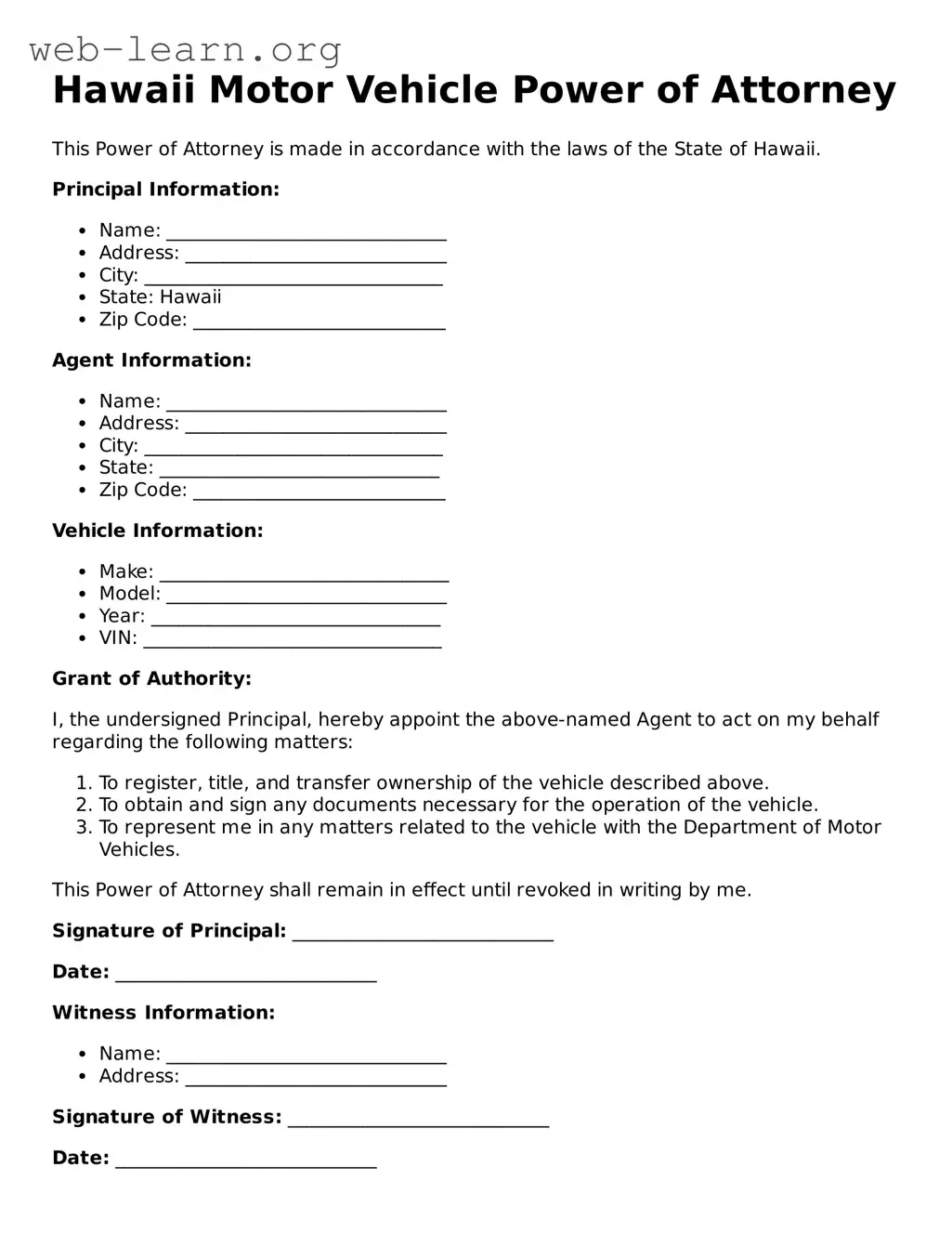
Hawaii Motor Vehicle Power of Attorney

This Power of Attorney is made in accordance with the laws of the State of Hawaii.

Principal Information:

  • Name: ______________________________
  • Address: ____________________________
  • City: ________________________________
  • State: Hawaii
  • Zip Code: ___________________________

Agent Information:

  • Name: ______________________________
  • Address: ____________________________
  • City: ________________________________
  • State: ______________________________
  • Zip Code: ___________________________

Vehicle Information:

  • Make: _______________________________
  • Model: ______________________________
  • Year: _______________________________
  • VIN: ________________________________

Grant of Authority:

I, the undersigned Principal, hereby appoint the above-named Agent to act on my behalf regarding the following matters:

  1. To register, title, and transfer ownership of the vehicle described above.
  2. To obtain and sign any documents necessary for the operation of the vehicle.
  3. To represent me in any matters related to the vehicle with the Department of Motor Vehicles.

This Power of Attorney shall remain in effect until revoked in writing by me.

Signature of Principal: ____________________________

Date: ____________________________

Witness Information:

  • Name: ______________________________
  • Address: ____________________________

Signature of Witness: ____________________________

Date: ____________________________

File Characteristics

Fact Name Description
Purpose The Hawaii Motor Vehicle Power of Attorney form allows an individual to appoint someone else to handle motor vehicle transactions on their behalf.
Governing Law This form is governed by Hawaii Revised Statutes, Section 487-1.
Principal The person granting the authority is known as the principal.
Agent The individual receiving the authority is referred to as the agent or attorney-in-fact.
Signature Requirement The principal must sign the form to make it valid.
Notarization While notarization is not always required, it is recommended to enhance the form's credibility.
Scope of Authority The form can specify particular actions, such as transferring ownership or registering a vehicle.
Duration The power of attorney remains in effect until revoked by the principal or until the specified duration expires.
Revocation The principal can revoke the power of attorney at any time, as long as they are competent.
Usage This form is commonly used for vehicle sales, registration, and title transfers in Hawaii.

Detailed Guide for Filling Out Hawaii Motor Vehicle Power of Attorney

After obtaining the Hawaii Motor Vehicle Power of Attorney form, you will need to fill it out carefully. Ensure that all information is accurate and complete before submitting the form to the appropriate authority.

  1. Obtain the Hawaii Motor Vehicle Power of Attorney form from a reliable source, such as the Hawaii Department of Transportation website or a local DMV office.
  2. Read the instructions provided with the form to understand what information is required.
  3. Fill in your name and address in the designated section as the principal (the person granting the power of attorney).
  4. Provide the name and address of the attorney-in-fact (the person you are granting authority to) in the appropriate section.
  5. Specify the powers you are granting to the attorney-in-fact. This may include actions related to the vehicle, such as registration or title transfer.
  6. Include the vehicle information, such as the make, model, year, and VIN (Vehicle Identification Number).
  7. Sign and date the form in the designated area. Ensure your signature matches the name provided as the principal.
  8. Have the form notarized if required. Check local requirements to confirm if notarization is necessary.
  9. Make a copy of the completed form for your records before submitting it.
  10. Submit the form to the appropriate agency, such as the DMV, along with any required fees or additional documentation.

Obtain Answers on Hawaii Motor Vehicle Power of Attorney

  1. What is a Hawaii Motor Vehicle Power of Attorney form?

    The Hawaii Motor Vehicle Power of Attorney form is a legal document that allows one person to authorize another person to act on their behalf regarding motor vehicle matters. This can include tasks such as transferring vehicle ownership, registering a vehicle, or obtaining a duplicate title.

  2. Who can use this form?

    Any individual who owns a motor vehicle in Hawaii can use this form. It is particularly useful for those who may not be able to handle vehicle-related tasks in person, such as military personnel stationed elsewhere or individuals with health issues.

  3. What information is required to complete the form?

    To complete the form, you will need to provide:

    • Your name and address.
    • The name and address of the person you are designating as your agent.
    • Details about the motor vehicle, including the Vehicle Identification Number (VIN), make, model, and year.
    • Your signature and date.
  4. How do I submit the form once it is completed?

    After completing the form, you should submit it to the appropriate state agency. This is typically the Hawaii Department of Transportation or the local county office that handles motor vehicle registrations. Ensure that you keep a copy for your records.

  5. Does the form need to be notarized?

    In Hawaii, the Motor Vehicle Power of Attorney form does not require notarization. However, it is advisable to check with the specific agency you are submitting it to, as requirements can vary.

  6. Can I revoke the Power of Attorney once it is granted?

    Yes, you can revoke the Power of Attorney at any time. To do this, you should create a written notice of revocation and provide it to your agent as well as the agency where the original form was submitted. This ensures that all parties are aware that the authority has been terminated.

  7. What happens if my agent does not act in my best interest?

    If you believe your agent is not acting in your best interest, you have the right to revoke the Power of Attorney. You may also want to consult with a legal professional if you believe your agent is misusing their authority.

Common mistakes

Filling out the Hawaii Motor Vehicle Power of Attorney form can be straightforward, but there are common mistakes that individuals often make. One frequent error is failing to provide accurate information about the principal. The principal is the person granting authority. If the name, address, or other identifying details are incorrect, it could lead to complications in the future.

Another mistake involves not signing the form correctly. The signature of the principal is essential for the document to be valid. Some individuals may overlook the requirement for witnesses or notarization, depending on the specific needs of the situation. Omitting these steps can render the document ineffective.

People also sometimes neglect to specify the powers granted to the attorney-in-fact. The form should clearly outline what actions the attorney-in-fact can take on behalf of the principal. Without this clarity, there may be misunderstandings or disputes regarding the extent of authority granted.

Lastly, individuals may forget to date the form. A date is important as it indicates when the power of attorney becomes effective. Without a date, it may be unclear whether the document is current or valid, which can lead to delays or issues when trying to execute the powers granted.

Documents used along the form

When dealing with the transfer or management of motor vehicles in Hawaii, the Motor Vehicle Power of Attorney form is often accompanied by several other important documents. Each of these forms serves a specific purpose and helps ensure that all legal requirements are met, facilitating a smooth transaction or process.

  • Hawaii Vehicle Registration Application: This form is essential for registering a vehicle in Hawaii. It provides necessary details about the vehicle, such as its make, model, and identification number, and is typically submitted to the Department of Motor Vehicles (DMV).
  • Bill of Sale: A Bill of Sale acts as a receipt for the purchase of a vehicle. It includes information about the buyer and seller, the sale price, and details about the vehicle. This document can help protect both parties in the event of a dispute.
  • Odometer Disclosure Statement: This statement is required by federal law when transferring ownership of a vehicle. It verifies the vehicle's mileage at the time of sale, helping to prevent fraud related to odometer tampering.
  • Title Transfer Application: When a vehicle changes ownership, a Title Transfer Application must be completed. This document transfers the title from the seller to the buyer and is crucial for establishing legal ownership.
  • Affidavit of Heirship: In cases where a vehicle is inherited, this affidavit may be necessary. It provides proof of the heir's right to claim the vehicle and can simplify the transfer process when the original owner has passed away.

Understanding these additional documents can significantly ease the process of managing motor vehicle transactions in Hawaii. Each form plays a vital role in ensuring that all legal aspects are covered, protecting the rights of all parties involved.

Similar forms

  • General Power of Attorney: This document allows one person to grant another the authority to act on their behalf in a wide range of matters, including financial and legal decisions, similar to the specific vehicle-related powers granted in a Motor Vehicle Power of Attorney.
  • Limited Power of Attorney: Like the Motor Vehicle Power of Attorney, this document restricts the agent’s authority to specific tasks or time frames, making it suitable for particular transactions or situations.
  • Durable Power of Attorney: This type of document remains effective even if the principal becomes incapacitated, similar to how a Motor Vehicle Power of Attorney can be used for ongoing vehicle transactions.
  • Medical Power of Attorney: This form allows an individual to designate someone to make medical decisions on their behalf, akin to how a Motor Vehicle Power of Attorney designates someone to manage vehicle-related matters.
  • Real Estate Power of Attorney: This document grants authority to manage real estate transactions, paralleling the Motor Vehicle Power of Attorney in its function of facilitating specific property-related activities.
  • Financial Power of Attorney: This document allows an agent to handle financial matters, similar to the way the Motor Vehicle Power of Attorney enables an agent to manage vehicle-related financial transactions.
  • Trustee Power of Attorney: This form allows a trustee to manage trust assets, much like a Motor Vehicle Power of Attorney empowers an agent to handle specific vehicle transactions.
  • Business Power of Attorney: This document allows an individual to designate someone to act on behalf of a business entity, similar to the authority granted in a Motor Vehicle Power of Attorney for vehicle-related business transactions.

Dos and Don'ts

When filling out the Hawaii Motor Vehicle Power of Attorney form, it is essential to approach the task with care. Here is a list of things you should and shouldn't do to ensure the process goes smoothly.

  • Do read the entire form carefully before you begin. Understanding what is required will help you avoid mistakes.
  • Do provide accurate information. Double-check names, addresses, and vehicle details to ensure everything is correct.
  • Do sign the form in the designated area. Your signature is crucial for the document to be valid.
  • Do date the form. Including the date helps establish when the authority was granted.
  • Don't leave any blank spaces. If a section does not apply, write "N/A" instead of leaving it empty.
  • Don't rush through the process. Take your time to ensure that all information is filled out completely and correctly.
  • Don't forget to have the form notarized if required. Notarization may be necessary to validate the document.

By following these guidelines, you can help ensure that your Power of Attorney form is completed correctly, reducing the risk of complications in the future.

Misconceptions

Understanding the Hawaii Motor Vehicle Power of Attorney form is important for those who need to delegate authority regarding vehicle matters. Here are some common misconceptions about this form:

  1. It can only be used for personal vehicles. Many believe this form is limited to personal vehicles, but it can also be used for commercial vehicles.
  2. Only the vehicle owner can complete the form. In reality, an authorized agent can help fill out the form on behalf of the owner.
  3. The form must be notarized. While notarization can add an extra layer of validity, it is not always required for the form to be effective.
  4. It is only valid in Hawaii. This form is recognized in other states, but it is wise to check local laws for specific requirements.
  5. It can be used for any type of transaction. The form is specific to motor vehicle transactions and cannot be used for other legal matters.
  6. Once signed, it cannot be revoked. The principal can revoke the Power of Attorney at any time, as long as it is done in writing.
  7. There is a fee to file the form. Generally, there is no filing fee associated with the Motor Vehicle Power of Attorney in Hawaii.
  8. The agent must be a lawyer. The agent can be anyone the vehicle owner trusts, not just a legal professional.
  9. It has to be submitted to the DMV. The form is not submitted to the DMV; it is kept by the agent and the vehicle owner.
  10. It is a complicated document. The form is straightforward and can be completed without extensive legal knowledge.

Key takeaways

Filling out and using the Hawaii Motor Vehicle Power of Attorney form involves several important considerations. Here are key takeaways to keep in mind:

  • The form allows an individual to designate another person to act on their behalf regarding motor vehicle transactions.
  • It is essential to provide accurate and complete information about both the principal (the person granting authority) and the agent (the person receiving authority).
  • The form should specify the powers granted to the agent, which may include signing documents, transferring ownership, and handling registration issues.
  • Signatures from both the principal and the agent are required for the form to be valid.
  • Consider having the form notarized to enhance its legal validity and to prevent potential disputes.
  • Keep a copy of the completed form for your records and provide one to the agent for their reference.
  • It is advisable to review the form periodically, especially if there are changes in circumstances or relationships.
  • Consulting with a legal professional can provide additional guidance tailored to your specific situation.