Homepage Attorney-Approved Bill of Sale Template Attorney-Approved Motor Vehicle Bill of Sale Template Attorney-Approved Motor Vehicle Bill of Sale Document for the State of Hawaii
Outline

When buying or selling a vehicle in Hawaii, the Motor Vehicle Bill of Sale form plays a crucial role in ensuring a smooth transaction. This document serves as a written record of the sale, capturing essential details such as the vehicle's make, model, year, and identification number, along with the sale price. Both the buyer and seller must provide their names and signatures, affirming their agreement to the terms of the sale. Additionally, the form often includes spaces for the date of the transaction and any relevant disclosures, such as odometer readings or warranties. Having this form completed accurately protects both parties and simplifies the transfer of ownership, making it an indispensable part of the vehicle sale process in Hawaii.

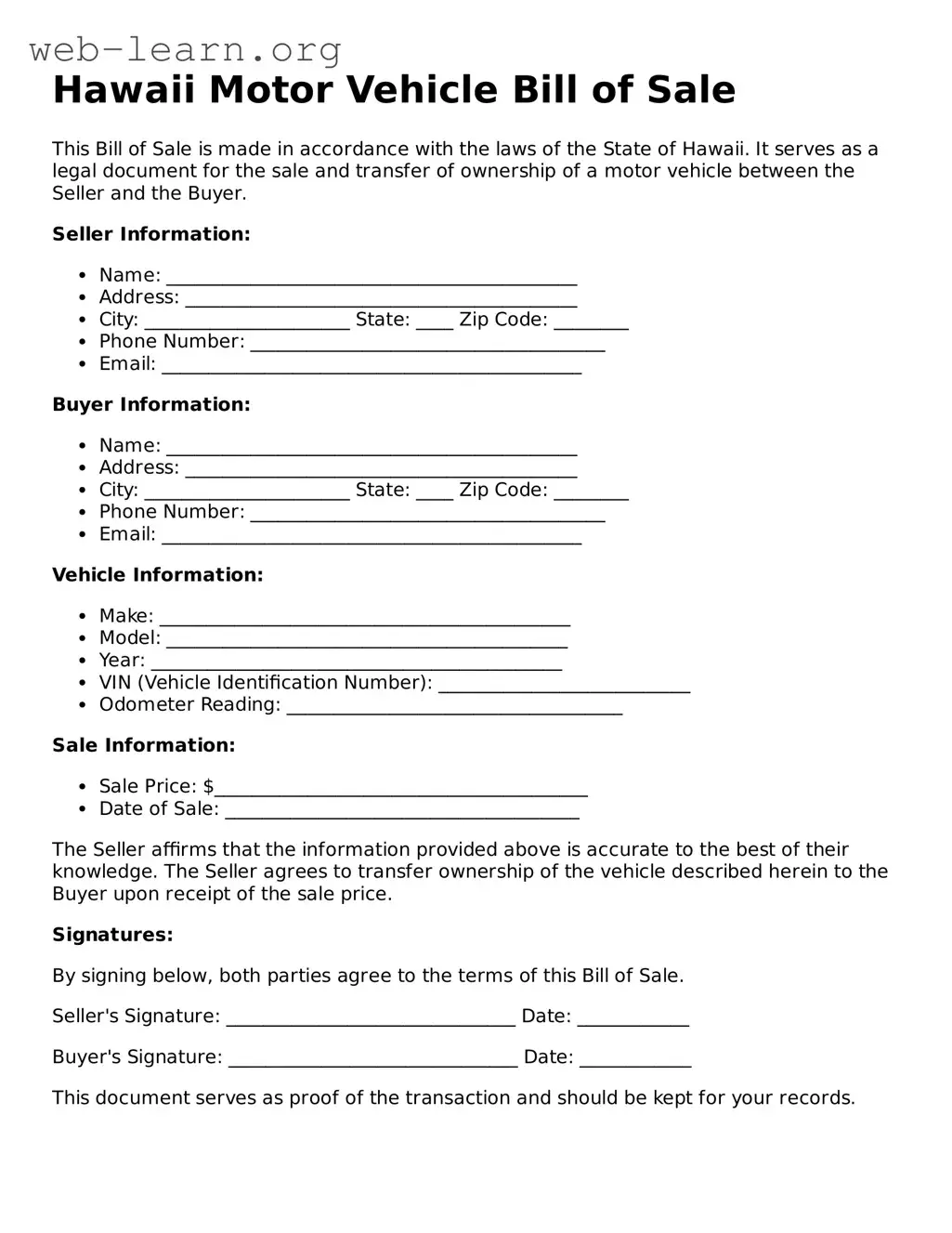
Sample - Hawaii Motor Vehicle Bill of Sale Form

Hawaii Motor Vehicle Bill of Sale

This Bill of Sale is made in accordance with the laws of the State of Hawaii. It serves as a legal document for the sale and transfer of ownership of a motor vehicle between the Seller and the Buyer.

Seller Information:

  • Name: ____________________________________________
  • Address: __________________________________________
  • City: ______________________ State: ____ Zip Code: ________
  • Phone Number: ______________________________________
  • Email: _____________________________________________

Buyer Information:

  • Name: ____________________________________________
  • Address: __________________________________________
  • City: ______________________ State: ____ Zip Code: ________
  • Phone Number: ______________________________________
  • Email: _____________________________________________

Vehicle Information:

  • Make: ____________________________________________
  • Model: ___________________________________________
  • Year: ____________________________________________
  • VIN (Vehicle Identification Number): ___________________________
  • Odometer Reading: ____________________________________

Sale Information:

  • Sale Price: $________________________________________
  • Date of Sale: ______________________________________

The Seller affirms that the information provided above is accurate to the best of their knowledge. The Seller agrees to transfer ownership of the vehicle described herein to the Buyer upon receipt of the sale price.

Signatures:

By signing below, both parties agree to the terms of this Bill of Sale.

Seller's Signature: _______________________________ Date: ____________

Buyer's Signature: _______________________________ Date: ____________

This document serves as proof of the transaction and should be kept for your records.

File Characteristics

Fact Name Details
Purpose The Hawaii Motor Vehicle Bill of Sale form is used to document the sale or transfer of ownership of a motor vehicle in Hawaii.
Requirements The form must include details such as the vehicle's make, model, year, VIN, sale price, and the names and addresses of both the seller and buyer.
Governing Law This form is governed by Hawaii Revised Statutes, specifically Chapter 286, which outlines vehicle registration and titling requirements.
Signature Both the seller and buyer must sign the form to validate the transaction. Witness signatures are not required but may be recommended for additional verification.
Usage The completed form is typically required when registering the vehicle in the buyer's name and may be needed for tax purposes.

Detailed Guide for Filling Out Hawaii Motor Vehicle Bill of Sale

Once you have the Hawaii Motor Vehicle Bill of Sale form, you’ll need to fill it out carefully. This document is essential for transferring ownership of a vehicle. Make sure you have all the necessary information handy, such as the vehicle details and the buyer's and seller's information. Follow these steps to complete the form accurately.

  1. Obtain the form. You can download it from the official state website or request a copy from a local DMV office.
  2. Fill in the date. Write the date of the sale at the top of the form.
  3. Enter the seller's information. Include the seller’s full name, address, and contact information.
  4. Provide the buyer's information. Write the buyer’s full name, address, and contact information.
  5. Describe the vehicle. Fill in the make, model, year, vehicle identification number (VIN), and odometer reading.
  6. State the sale price. Clearly write the amount the buyer is paying for the vehicle.
  7. Include any additional terms. If there are any specific conditions or agreements, note them in the designated area.
  8. Sign the form. Both the seller and the buyer must sign and date the document to make it valid.
  9. Make copies. Keep a copy for your records and give one to the buyer.

After completing the form, both parties should ensure they keep their copies safe. The buyer will need this document for registration and title transfer with the DMV.

Obtain Answers on Hawaii Motor Vehicle Bill of Sale

  1. What is a Hawaii Motor Vehicle Bill of Sale?

    The Hawaii Motor Vehicle Bill of Sale is a legal document that serves as proof of the sale and transfer of ownership of a motor vehicle. This form outlines essential details about the vehicle, the seller, and the buyer, ensuring that both parties have a clear record of the transaction.

  2. Who needs to use the Bill of Sale?

    Both the seller and the buyer of a motor vehicle in Hawaii should use the Bill of Sale. The seller needs it to document the transfer of ownership, while the buyer requires it for registration purposes and to establish proof of purchase.

  3. What information is required on the Bill of Sale?

    The Bill of Sale must include several key pieces of information:

    • The names and addresses of both the seller and the buyer
    • The vehicle identification number (VIN)
    • The make, model, and year of the vehicle
    • The sale price of the vehicle
    • The date of the sale

    Including accurate information is crucial to avoid any future disputes or issues during the registration process.

  4. Is the Bill of Sale required for all vehicle sales in Hawaii?

    While it is not legally required to have a Bill of Sale for every vehicle transaction, it is highly recommended. Having this document can protect both parties and provide a clear record of the sale, especially in cases of disputes or issues with registration.

  5. Can I create my own Bill of Sale?

    Yes, you can create your own Bill of Sale as long as it includes all necessary information. However, using a standardized form can help ensure that you include all required details and that the document meets state regulations.

  6. How do I complete the Bill of Sale?

    To complete the Bill of Sale, follow these steps:

    • Fill in the names and addresses of both parties.
    • Provide the vehicle's details, including the VIN, make, model, and year.
    • Specify the sale price and date of the transaction.
    • Both the seller and the buyer should sign the document.

    Once completed, each party should retain a copy for their records.

  7. What should I do with the Bill of Sale after completing it?

    After completing the Bill of Sale, both the seller and the buyer should keep a copy for their records. The buyer will need to present the Bill of Sale when registering the vehicle with the Hawaii Department of Transportation. It serves as proof of ownership and is an essential part of the registration process.

Common mistakes

Filling out the Hawaii Motor Vehicle Bill of Sale form can be straightforward, but many individuals make common mistakes that can lead to complications. One frequent error is failing to provide complete information about the vehicle. This includes missing details such as the Vehicle Identification Number (VIN), make, model, and year. Inaccurate or incomplete information can result in issues with registration or ownership transfer.

Another mistake is neglecting to include the sale price. The sale price is essential for both parties and for tax purposes. If the price is omitted, it can create confusion later on, especially if there are disputes regarding the transaction. Always ensure that the sale price is clearly stated.

People often overlook the importance of signatures. Both the seller and the buyer must sign the form for it to be valid. Without these signatures, the document does not serve its purpose. Remember, a lack of signatures can lead to disputes about the sale and ownership.

Additionally, not dating the form is a common oversight. The date of the transaction should be included to establish when the sale occurred. This information is crucial for record-keeping and can help prevent misunderstandings in the future.

Another mistake involves not providing identification details. Sellers should include their driver's license number or other identifying information. This helps verify the identity of the seller and protects against fraud. Buyers should also provide their information for the same reasons.

Lastly, many individuals fail to keep a copy of the completed Bill of Sale. This document serves as proof of the transaction and is important for both the buyer and seller. Keeping a copy can help resolve any future issues related to the sale.

Documents used along the form

When engaging in a vehicle transaction in Hawaii, the Motor Vehicle Bill of Sale form is a crucial document. However, several other forms and documents may accompany it to ensure a smooth transfer of ownership and compliance with state regulations.

  • Title Certificate: This document serves as proof of ownership for the vehicle. It contains essential information, such as the vehicle identification number (VIN), the owner's name, and any liens on the vehicle. The title must be signed over to the new owner during the sale.
  • Odometer Disclosure Statement: This form is required to disclose the mileage on the vehicle at the time of sale. It protects both the buyer and seller by ensuring transparency regarding the vehicle's condition and history.
  • Application for Title: After the sale, the new owner must complete this application to register the vehicle in their name. This form is submitted to the local Department of Motor Vehicles (DMV) along with the necessary fees and supporting documents.
  • Vehicle Registration: Once the title is transferred, the new owner must register the vehicle. This document provides legal permission to operate the vehicle on public roads and includes details such as license plate information and registration expiration dates.

Completing these forms accurately is vital for a successful vehicle transaction in Hawaii. Proper documentation helps protect the rights of both parties and ensures compliance with state laws.

Similar forms

  • Vehicle Title: This document serves as proof of ownership for a vehicle. Like the Bill of Sale, it includes details about the vehicle, such as the make, model, and Vehicle Identification Number (VIN). Both documents are essential during the transfer of ownership.
  • Purchase Agreement: A Purchase Agreement outlines the terms of sale between the buyer and seller. Similar to the Bill of Sale, it includes details about the vehicle and the agreed-upon price, ensuring that both parties are clear on the terms of the transaction.
  • Odometer Disclosure Statement: This document records the vehicle's mileage at the time of sale. It is often required alongside the Bill of Sale to prevent fraud and ensure transparency in the transaction.
  • Release of Liability: This form protects the seller from future claims related to the vehicle after the sale. Like the Bill of Sale, it confirms that the vehicle has been transferred to the new owner, providing peace of mind for both parties.
  • Vehicle Registration Application: When a vehicle is sold, the new owner must register it with the state. The registration application often requires information found in the Bill of Sale, such as the purchase price and seller details, making both documents interrelated.
  • Insurance Policy: While not a direct equivalent, an insurance policy is crucial when acquiring a vehicle. The Bill of Sale can be used to obtain insurance, as it provides proof of ownership and vehicle details necessary for coverage.
  • Loan Agreement: If the vehicle is financed, a Loan Agreement will outline the terms of the loan. This document, like the Bill of Sale, includes information about the vehicle and serves as a record of the financial transaction involved in the purchase.
  • Vehicle Inspection Report: This report details the condition of the vehicle at the time of sale. It complements the Bill of Sale by providing buyers with information about the vehicle’s mechanical state, ensuring they make an informed decision.

Dos and Don'ts

When completing the Hawaii Motor Vehicle Bill of Sale form, attention to detail is crucial. Here are nine important do's and don'ts to consider.

  • Do ensure that all information is accurate and complete.
  • Do include the Vehicle Identification Number (VIN) to avoid any confusion.
  • Do sign and date the form to validate the transaction.
  • Do provide the buyer's and seller's full names and addresses.
  • Do keep a copy of the Bill of Sale for your records.
  • Don't leave any sections blank; fill out every required field.
  • Don't use abbreviations that may cause misunderstandings.
  • Don't forget to check for any outstanding liens on the vehicle.
  • Don't sign the form before the buyer has completed their part.

Following these guidelines can help ensure a smooth transaction when selling or purchasing a vehicle in Hawaii.

Misconceptions

Understanding the Hawaii Motor Vehicle Bill of Sale form is essential for anyone involved in buying or selling a vehicle in the state. However, several misconceptions can lead to confusion. Here are seven common misunderstandings:

  1. It is not required for all vehicle transactions. Many people believe that a bill of sale is optional. In Hawaii, it is a critical document for transferring ownership and is often required for registration.
  2. Only the seller needs to sign the form. Some assume that only the seller's signature is necessary. In reality, both the buyer and seller must sign the bill of sale to validate the transaction.
  3. The form must be notarized. There is a misconception that notarization is mandatory. While notarizing can add an extra layer of security, it is not a requirement for the bill of sale in Hawaii.
  4. It can be filled out after the sale. Many think they can complete the bill of sale at any time. It is best to fill it out at the time of the transaction to ensure all details are accurate and agreed upon.
  5. All information is optional. Some believe that they can leave out certain details. However, specific information, such as the vehicle identification number (VIN) and purchase price, is essential for the form to be valid.
  6. It serves as a title transfer. Many think the bill of sale acts as a title. While it is a crucial document, it does not replace the vehicle title, which must also be transferred for ownership to change legally.
  7. It is only for private sales. Some people think that the bill of sale is only necessary for private transactions. However, it can also be used for dealer sales and auctions to document the transfer of ownership.

By clarifying these misconceptions, individuals can better navigate the process of buying or selling a vehicle in Hawaii, ensuring a smoother transaction for all parties involved.

Key takeaways

When filling out and using the Hawaii Motor Vehicle Bill of Sale form, consider the following key points:

  1. Essential Information: Include all necessary details such as the vehicle's make, model, year, and VIN (Vehicle Identification Number).
  2. Seller and Buyer Details: Clearly state the full names and addresses of both the seller and the buyer.
  3. Purchase Price: Accurately record the sale price of the vehicle to avoid any disputes later.
  4. Signatures Required: Both the seller and the buyer must sign the document to validate the transaction.
  5. Date of Sale: Indicate the date when the sale takes place. This is important for record-keeping and legal purposes.
  6. Notarization: While notarization is not mandatory, having the bill of sale notarized can provide additional protection.
  7. Transfer of Ownership: This form serves as proof of the transfer of ownership, which is crucial for the new owner.
  8. Record Keeping: Both parties should keep a copy of the bill of sale for their records, as it may be needed for future reference.
  9. Local Regulations: Be aware of any specific local regulations or requirements that may apply to vehicle sales in Hawaii.

Understanding these points can help ensure a smooth transaction when buying or selling a vehicle in Hawaii.