In the beautiful state of Hawaii, the Living Will form serves as a crucial document for individuals wishing to outline their medical care preferences in the event they become unable to communicate their wishes. This form allows you to express your desires regarding life-sustaining treatments, ensuring that your values and choices are respected even when you cannot voice them. It covers various aspects of medical treatment, including the use of resuscitation, mechanical ventilation, and nutrition through feeding tubes. By completing this form, you empower your loved ones and healthcare providers to make informed decisions that align with your wishes. Moreover, it can help alleviate the emotional burden on family members during difficult times, as they will have clear guidance on your preferences. Understanding the importance of this document is essential for anyone who wants to take control of their healthcare decisions and ensure their legacy is honored in the face of serious medical challenges.
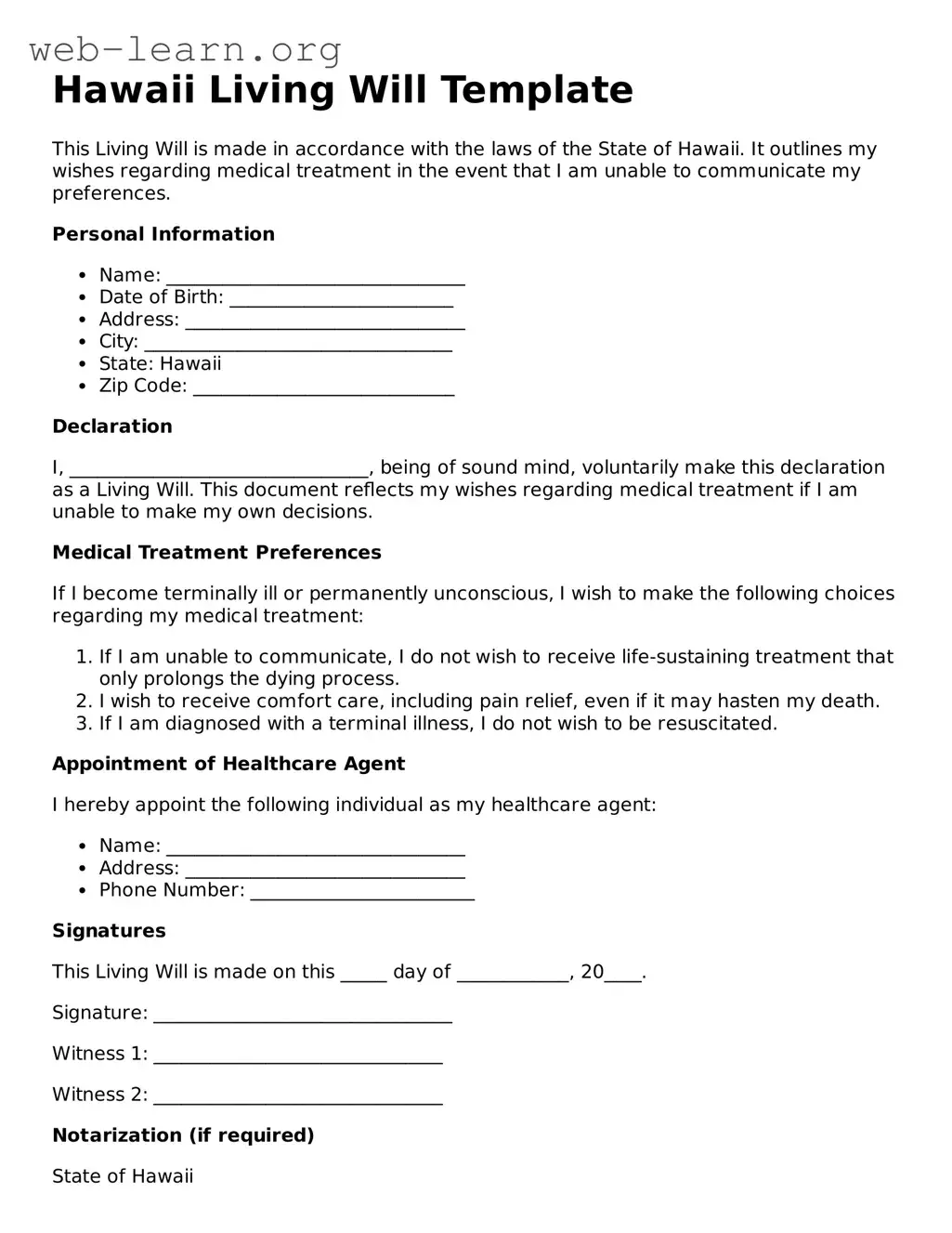
Hawaii Living Will Template
This Living Will is made in accordance with the laws of the State of Hawaii. It outlines my wishes regarding medical treatment in the event that I am unable to communicate my preferences.
Personal Information
Declaration
I, ________________________________, being of sound mind, voluntarily make this declaration as a Living Will. This document reflects my wishes regarding medical treatment if I am unable to make my own decisions.
Medical Treatment Preferences
If I become terminally ill or permanently unconscious, I wish to make the following choices regarding my medical treatment:
Appointment of Healthcare Agent
I hereby appoint the following individual as my healthcare agent:
Signatures
This Living Will is made on this _____ day of ____________, 20____.
Signature: ________________________________
Witness 1: _______________________________
Witness 2: _______________________________
Notarization (if required)
State of Hawaii
County of _______________________________
Subscribed and sworn before me on this _____ day of ____________, 20____.
Notary Public: ___________________________
My Commission Expires: __________________
| Fact Name | Description |
|---|---|
| Governing Law | The Hawaii Living Will is governed by Hawaii Revised Statutes, Chapter 327E. |
| Purpose | A Living Will outlines an individual's wishes regarding medical treatment in the event they become unable to communicate their preferences. |
| Eligibility | Any adult who is at least 18 years old can create a Living Will in Hawaii. |
| Witness Requirements | The form must be signed in the presence of two witnesses who are not related to the individual or entitled to any part of their estate. |
| Revocation | A Living Will can be revoked at any time by the individual, provided they communicate their intent to revoke. |
| Durability | The Living Will remains effective until it is revoked or the individual passes away. |
| Healthcare Proxy | A Living Will does not appoint a healthcare proxy; a separate document is needed for that purpose. |
| Healthcare Provider Obligations | Healthcare providers are required to follow the instructions outlined in a valid Living Will, as long as they are aware of its existence. |
Completing the Hawaii Living Will form is an important step in making your healthcare wishes known. This form allows you to outline your preferences regarding medical treatment in the event that you are unable to communicate those wishes yourself. Follow the steps below to fill out the form accurately and ensure your intentions are clearly expressed.
What is a Hawaii Living Will?
A Hawaii Living Will is a legal document that allows individuals to outline their preferences for medical treatment in the event that they become unable to communicate their wishes. This document typically addresses end-of-life care and specifies the types of medical interventions an individual does or does not want to receive.
Who should consider creating a Living Will?
Any adult who wishes to ensure their medical treatment preferences are respected should consider creating a Living Will. This is particularly important for those with serious health conditions, individuals approaching advanced age, or anyone who wants to communicate their values regarding end-of-life care.
How does a Living Will differ from a Power of Attorney?
A Living Will specifically addresses medical treatment preferences, while a Power of Attorney for healthcare designates a person to make medical decisions on behalf of an individual if they are unable to do so. Both documents serve important roles in healthcare planning but focus on different aspects of decision-making.
What are the requirements for a Living Will in Hawaii?
In Hawaii, a Living Will must be signed by the individual creating it and witnessed by two adults who are not related to the individual or beneficiaries of their estate. It is important to ensure that the document complies with state laws to be considered valid.
Can I change or revoke my Living Will?
Yes, individuals have the right to change or revoke their Living Will at any time, as long as they are mentally competent. To do so, it is advisable to create a new document or provide written notice of the revocation to relevant parties, including healthcare providers and family members.
Is a Living Will legally binding in Hawaii?
Yes, a properly executed Living Will is legally binding in Hawaii. Healthcare providers are required to follow the instructions outlined in the document, provided it complies with state laws and accurately reflects the individual's wishes.
Where should I keep my Living Will?
It is advisable to keep the original copy of your Living Will in a safe but accessible location. Additionally, you should provide copies to your healthcare provider, family members, and anyone designated as your healthcare agent. This ensures that your wishes are known and can be honored when necessary.
Filling out a Living Will in Hawaii is an important step in ensuring that one’s medical preferences are honored. However, many individuals make mistakes during this process that can lead to confusion or unintended consequences. One common error is failing to clearly specify the types of medical treatments one does or does not want. Without precise language, healthcare providers may struggle to interpret the individual’s wishes.
Another frequent mistake involves not updating the Living Will after significant life changes. Life events such as marriage, divorce, or the birth of a child can alter one’s preferences regarding medical care. Failing to revise the document can result in outdated instructions that do not reflect current desires.
People often neglect to sign and date the Living Will. In Hawaii, a signature is essential for the document to be legally binding. Without a signature, the Living Will may not hold up in a medical situation, leaving healthcare providers without clear guidance.
Additionally, many individuals overlook the importance of witnesses. Hawaii law requires that a Living Will be signed in the presence of two witnesses, who must also sign the document. Failing to include witnesses can render the document invalid, making it crucial to follow this step carefully.
Another mistake is not discussing the Living Will with family members or healthcare proxies. Open communication ensures that loved ones understand the individual’s wishes and can advocate for them if necessary. Without these discussions, family members may be left guessing about what the individual would have wanted.
Some people also make the error of using vague language. Phrases like “heroic measures” can be interpreted in various ways. Clear and specific terms should be used to avoid ambiguity and ensure that healthcare providers can follow the individual’s wishes accurately.
Moreover, individuals sometimes fail to consider the implications of their choices. For instance, stating a desire to refuse life-sustaining treatment can have far-reaching consequences. It’s essential to fully understand the potential outcomes of these decisions before including them in the Living Will.
Another common oversight is not keeping copies of the Living Will accessible. Once the document is completed, it should be stored in a safe but easily accessible location. Sharing copies with family members and healthcare providers ensures that everyone involved is aware of the individual’s preferences.
Finally, some individuals mistakenly believe that a Living Will is a one-time task. In reality, it should be reviewed regularly. As personal beliefs and medical technologies evolve, updating the document can help ensure that it remains relevant and reflective of current wishes.
A Living Will is an important document that outlines an individual's preferences for medical treatment in the event they become unable to communicate their wishes. In addition to the Living Will, several other forms and documents can complement it, ensuring that a person's healthcare decisions are honored. Below is a list of commonly used documents alongside the Hawaii Living Will form.
These documents, when used in conjunction with a Living Will, help ensure that a person's healthcare preferences are respected and followed. It is advisable to review and update these documents regularly to reflect any changes in health status or personal wishes.
The Living Will form shares similarities with several other important documents that address healthcare decisions and personal wishes. Here are five documents that are closely related:
When filling out the Hawaii Living Will form, it is essential to approach the task with care and consideration. Here are some important do's and don'ts to keep in mind:
When it comes to planning for the future, many people have questions about living wills, particularly in Hawaii. Unfortunately, misconceptions can cloud understanding and lead to poor decisions. Here are six common misconceptions about the Hawaii Living Will form:
Understanding these misconceptions can help individuals make informed decisions about their healthcare wishes. Planning ahead is a crucial step in ensuring that one's preferences are honored in times of need.
When considering a Living Will in Hawaii, it’s essential to understand the important aspects of this document. Here are some key takeaways:
Living Will Template Louisiana - A Living Will provides peace of mind for you and your family regarding your care.
How to Make a Will in Kentucky - A Living Will can be a crucial part of planning for aging and potential health declines.