Creating a Last Will and Testament is a crucial step in ensuring that your wishes are honored after your passing, particularly in a unique state like Hawaii. This legal document serves as a guide for the distribution of your assets, guardianship of your children, and the appointment of an executor to manage your estate. In Hawaii, the Last Will and Testament form must be signed in the presence of two witnesses, who also need to sign the document, confirming its authenticity. It's important to note that while a handwritten will is permissible, it still must meet specific requirements to be considered valid. Additionally, the form allows you to specify any special requests regarding your funeral arrangements or the care of your pets, providing a comprehensive approach to estate planning. Understanding these elements can help ensure that your final wishes are clearly communicated and legally binding, offering peace of mind to both you and your loved ones.
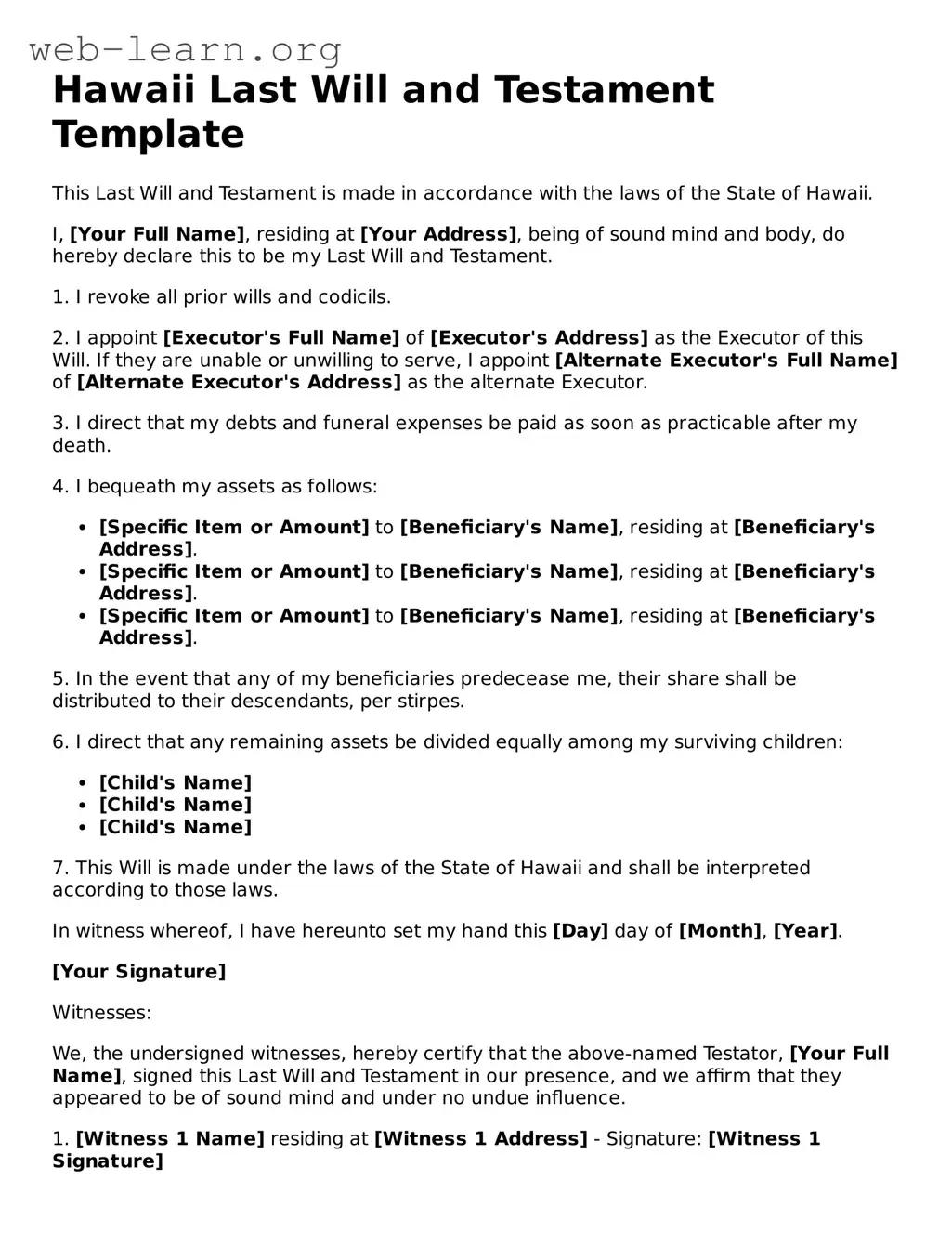
Hawaii Last Will and Testament Template
This Last Will and Testament is made in accordance with the laws of the State of Hawaii.
I, [Your Full Name], residing at [Your Address], being of sound mind and body, do hereby declare this to be my Last Will and Testament.
1. I revoke all prior wills and codicils.
2. I appoint [Executor's Full Name] of [Executor's Address] as the Executor of this Will. If they are unable or unwilling to serve, I appoint [Alternate Executor's Full Name] of [Alternate Executor's Address] as the alternate Executor.
3. I direct that my debts and funeral expenses be paid as soon as practicable after my death.
4. I bequeath my assets as follows:
5. In the event that any of my beneficiaries predecease me, their share shall be distributed to their descendants, per stirpes.
6. I direct that any remaining assets be divided equally among my surviving children:
7. This Will is made under the laws of the State of Hawaii and shall be interpreted according to those laws.
In witness whereof, I have hereunto set my hand this [Day] day of [Month], [Year].
[Your Signature]
Witnesses:
We, the undersigned witnesses, hereby certify that the above-named Testator, [Your Full Name], signed this Last Will and Testament in our presence, and we affirm that they appeared to be of sound mind and under no undue influence.
1. [Witness 1 Name] residing at [Witness 1 Address] - Signature: [Witness 1 Signature]
2. [Witness 2 Name] residing at [Witness 2 Address] - Signature: [Witness 2 Signature]
| Fact Name | Description |
|---|---|
| Governing Law | The Hawaii Last Will and Testament is governed by Hawaii Revised Statutes Chapter 560. |
| Witness Requirement | In Hawaii, a will must be signed by at least two witnesses who are present at the same time. |
| Age Requirement | To create a valid will in Hawaii, an individual must be at least 18 years old. |
| Self-Proving Wills | Hawaii allows for self-proving wills, which can simplify the probate process by eliminating the need for witness testimony. |
After gathering the necessary information and completing the Hawaii Last Will and Testament form, the next step involves ensuring that the document is properly executed. This typically requires signing the will in the presence of witnesses, adhering to Hawaii's legal requirements for a valid will. Once executed, the will should be stored in a safe place, and its location communicated to trusted individuals.
What is a Last Will and Testament in Hawaii?
A Last Will and Testament is a legal document that outlines how an individual wishes their assets to be distributed after their death. In Hawaii, this document also allows you to appoint guardians for minor children and specify your preferences regarding funeral arrangements.
Who can create a Last Will and Testament in Hawaii?
Any individual who is at least 18 years old and of sound mind can create a Last Will and Testament in Hawaii. This means you must understand the implications of your decisions and be able to communicate them clearly.
What are the requirements for a valid will in Hawaii?
These witnesses should not be beneficiaries of the will to avoid any potential conflicts of interest.
Can I change my will after it has been created?
Yes, you can change your will at any time as long as you are of sound mind. To make changes, you can either create a new will or add a codicil, which is an amendment to the original document. Make sure to follow the same formalities as the original will to ensure its validity.
What happens if I die without a will in Hawaii?
If you pass away without a will, your assets will be distributed according to Hawaii's intestacy laws. This means the state will determine how your property is divided, which may not align with your wishes. It is always advisable to have a will to ensure your preferences are honored.
Can I write my own will in Hawaii?
Yes, you can write your own will in Hawaii, known as a holographic will. However, it must be entirely in your handwriting and signed by you. While this is permissible, consulting with a legal professional can help ensure that your will meets all necessary requirements and accurately reflects your wishes.
Is it necessary to have a lawyer to create a will in Hawaii?
While it is not legally required to have a lawyer to create a will, consulting with one can be beneficial. A legal professional can provide guidance on complex issues, help ensure that the will is valid, and assist in minimizing potential disputes among heirs.
How do I ensure my will is executed properly after my death?
To ensure your will is executed properly, consider the following steps:
These actions can help facilitate the probate process and ensure your wishes are honored.
What is probate, and how does it relate to my will?
Probate is the legal process through which a deceased person's will is validated and their estate is administered. This process involves settling debts, distributing assets, and ensuring that the will is executed according to the testator's wishes. In Hawaii, probate can be a straightforward process if the will is clear and valid, but complications can arise if there are disputes or unclear instructions.
Creating a Last Will and Testament is a significant step in ensuring that your wishes are honored after you pass away. However, many people make common mistakes while filling out the Hawaii Last Will and Testament form. One frequent error is failing to properly identify beneficiaries. It's crucial to clearly name who will inherit your assets. Ambiguity can lead to disputes among family members and friends, causing unnecessary stress during an already difficult time.
Another mistake often seen is neglecting to update the will after major life changes. Life events such as marriage, divorce, or the birth of a child can significantly impact your wishes regarding asset distribution. If you don’t revise your will to reflect these changes, it may not align with your current intentions, leading to complications and misunderstandings.
Many individuals also overlook the importance of having the will properly witnessed and signed. In Hawaii, your will must be signed by you and witnessed by at least two individuals who are not beneficiaries. Skipping this step can render the will invalid, leaving your estate to be distributed according to state laws rather than your personal wishes.
Lastly, some people forget to store their will in a safe and accessible place. Even the most carefully crafted will is useless if it cannot be found when needed. It's advisable to inform a trusted family member or attorney about the location of your will. This way, your loved ones can easily access it when the time comes, ensuring that your wishes are followed as you intended.
When preparing a Last Will and Testament in Hawaii, several other forms and documents may be necessary to ensure that your estate is managed according to your wishes. These documents can help clarify your intentions and provide guidance to your loved ones and the courts.
Incorporating these documents alongside a Last Will and Testament can provide a comprehensive plan for your estate and healthcare preferences. This holistic approach ensures that your wishes are honored and can alleviate potential disputes among family members during difficult times.
The Last Will and Testament is an important legal document, but it shares similarities with several other documents in estate planning and legal matters. Below are four documents that are comparable to a Last Will and Testament:
When filling out the Hawaii Last Will and Testament form, it is essential to follow certain guidelines to ensure that your will is valid and reflects your intentions. Below is a list of things you should and shouldn't do.
When it comes to creating a Last Will and Testament in Hawaii, several misconceptions can lead to confusion. Understanding the realities of this important document is crucial for ensuring that your wishes are honored. Here are ten common misconceptions:
Understanding these misconceptions can help you navigate the process of creating a Last Will and Testament in Hawaii with confidence. Taking the time to educate yourself ensures that your wishes will be honored and that your loved ones are cared for according to your intentions.
Creating a Last Will and Testament in Hawaii is an important step in ensuring your wishes are honored after your passing. Here are some key takeaways to keep in mind:
By keeping these takeaways in mind, you can create a Last Will and Testament that reflects your wishes and provides peace of mind for you and your loved ones.
Free Idaho Will Form - Can provide specific bequests of money or items to individuals or organizations.
Free Illinois Will Template - Helps to ensure that your legacy is preserved as you intend.
How to Make a Will in Florida - May outline specific conditions for beneficiaries to inherit assets.
Free Will Forms to Print - Helps prevent disputes among family members regarding inheritance.