Hawaii's Homeschool Letter of Intent is a crucial document for families looking to educate their children at home. This form serves as a formal notification to the state that you intend to homeschool your child, ensuring compliance with local laws. It typically requires basic information such as the child's name, age, and grade level, along with the name and address of the parent or guardian. By submitting this letter, you not only affirm your commitment to homeschooling but also initiate the process of establishing an educational plan tailored to your child's needs. Additionally, the form may include a declaration of your educational philosophy, which can provide insight into your approach to teaching. Understanding the requirements and implications of this letter is essential for a smooth homeschooling experience in Hawaii.
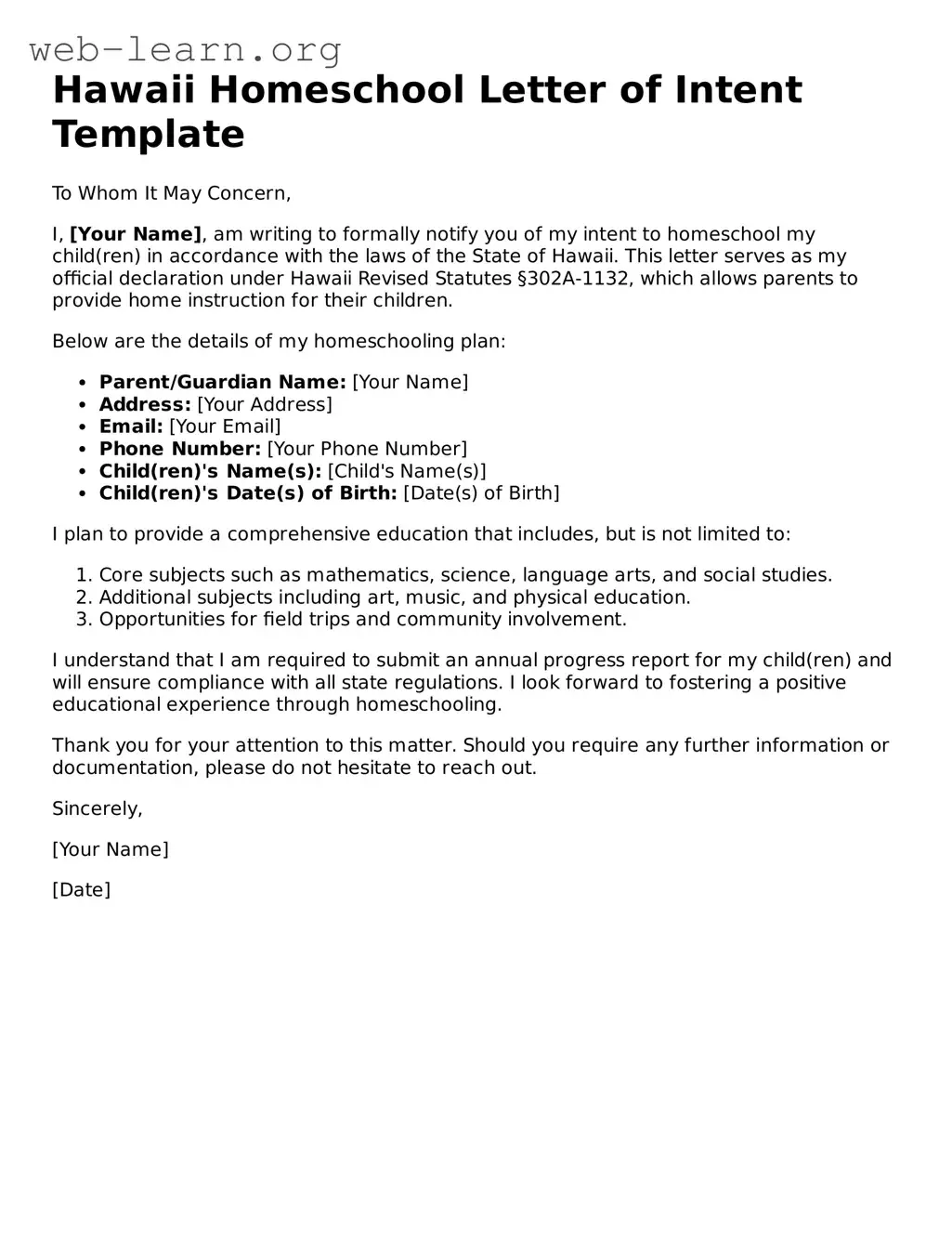
Hawaii Homeschool Letter of Intent Template
To Whom It May Concern,
I, [Your Name], am writing to formally notify you of my intent to homeschool my child(ren) in accordance with the laws of the State of Hawaii. This letter serves as my official declaration under Hawaii Revised Statutes §302A-1132, which allows parents to provide home instruction for their children.
Below are the details of my homeschooling plan:
I plan to provide a comprehensive education that includes, but is not limited to:
I understand that I am required to submit an annual progress report for my child(ren) and will ensure compliance with all state regulations. I look forward to fostering a positive educational experience through homeschooling.
Thank you for your attention to this matter. Should you require any further information or documentation, please do not hesitate to reach out.
Sincerely,
[Your Name]
[Date]
| Fact Name | Description |
|---|---|
| Purpose | The Hawaii Homeschool Letter of Intent form is used to formally notify the state of a parent's intention to homeschool their child. |
| Governing Law | The form is governed by Hawaii Revised Statutes §302A-1132, which outlines the requirements for homeschooling in the state. |
| Submission Deadline | Parents must submit the Letter of Intent at least 10 days before the start of the school year. |
| Required Information | The form requires the child's name, age, and the names of the parents or guardians. |
| Annual Renewal | Parents must submit a new Letter of Intent each year to continue homeschooling. |
| Record Keeping | While the form does not need to be submitted annually, parents should keep a copy for their records. |
| Additional Resources | The Hawaii Department of Education provides resources and guidelines for homeschooling families on its website. |
After completing the Hawaii Homeschool Letter of Intent form, you will submit it to the appropriate school district. This step is essential to ensure that your homeschooling plans are recognized and that you can proceed with your educational journey.
What is the Hawaii Homeschool Letter of Intent form?
The Hawaii Homeschool Letter of Intent form is a document that parents or guardians must submit to officially notify the state of Hawaii that they intend to homeschool their children. This form is an important step in the homeschooling process, as it ensures that the local education authorities are aware of your educational plans.
When should I submit the Letter of Intent?
It is recommended to submit the Letter of Intent at least 10 days before the start of your homeschooling program. This allows the Department of Education sufficient time to process your form. If you are withdrawing your child from a public school, you should also submit the form as soon as possible to ensure a smooth transition.
What information do I need to provide on the form?
The Letter of Intent requires basic information, including:
Make sure to fill out all sections completely. Incomplete forms may lead to delays in processing.
What happens after I submit the Letter of Intent?
Once you submit the Letter of Intent, the Department of Education will review your submission. You should receive a confirmation that your form has been received. Keep a copy of the submitted form for your records. It’s also a good idea to follow up if you do not receive confirmation within a reasonable timeframe.
Filling out the Hawaii Homeschool Letter of Intent form can be a straightforward process, but many make common mistakes that can delay their homeschooling journey. One frequent error is failing to provide accurate personal information. This includes the name of the child and the parent or guardian. Incomplete or incorrect names can lead to confusion and may result in the rejection of the application.
Another mistake involves not specifying the educational year. It’s crucial to clearly indicate the school year for which the homeschooling is intended. Without this information, the form may be deemed incomplete, and you might have to start over. Be sure to double-check the dates to ensure they align with your educational plans.
Some individuals overlook the requirement to sign the form. A signature is essential to validate the intent to homeschool. If the form lacks a signature, it will not be processed. Always remember to sign and date the document before submission.
Additionally, people sometimes forget to submit the form within the designated timeframe. The state of Hawaii requires that the Letter of Intent be filed at least 10 days before the start of the school year. Missing this deadline can result in delays or complications in starting your homeschooling program.
Another common mistake is neglecting to include any additional documentation that may be required. While the form itself is straightforward, some families may need to provide supplementary information, such as proof of residency or educational philosophy. Failing to include these documents can slow down the approval process.
Lastly, many individuals do not keep a copy of the submitted form. It’s important to retain a copy for your records. This can be helpful in case there are any questions or issues later on. Keeping track of your submissions can save you time and stress in the future.
The Hawaii Homeschool Letter of Intent form is a crucial document for families wishing to educate their children at home. In addition to this form, several other documents and forms may be necessary to ensure compliance with state regulations and to facilitate a smooth homeschooling experience. Below is a list of commonly used forms and documents that often accompany the Homeschool Letter of Intent in Hawaii.
These documents and forms contribute to a well-organized homeschooling environment. They ensure compliance with state laws and help families manage their educational responsibilities effectively.
When filling out the Hawaii Homeschool Letter of Intent form, it is important to follow specific guidelines to ensure a smooth process. Here are four things you should and shouldn't do:
When it comes to homeschooling in Hawaii, there are several misconceptions about the Letter of Intent form that can lead to confusion. Understanding the truth behind these myths is essential for parents considering homeschooling. Here are four common misconceptions:
This is false. Homeschooling is legal in Hawaii, provided that parents submit a Letter of Intent to the appropriate authorities. The state recognizes homeschooling as a valid educational option.
Many parents believe that the process is overwhelming. In reality, the Letter of Intent is straightforward and can be completed quickly. It requires basic information about the student and the educational plan.
This misconception can lead to issues later on. After submitting the Letter of Intent, parents must also provide annual assessments of their child's progress to the state. Staying informed about these requirements is crucial.
While parents are responsible for their child’s education, they are not required to teach every subject themselves. Many families use resources such as online courses, tutors, and co-ops to supplement their teaching.
By clarifying these misconceptions, parents can approach homeschooling in Hawaii with confidence and a better understanding of the requirements involved.
Filling out and using the Hawaii Homeschool Letter of Intent form is a crucial step for parents who wish to homeschool their children. Here are some key takeaways to consider:
Homeschool Programs Indiana - Acts as a formal declaration of your educational philosophy.
Does the State Pay You to Homeschool - This document can be used to express the family's educational values.
Colorado Homeschool Testing Requirements - It can help ensure that your child receives the support they need as a homeschooler.