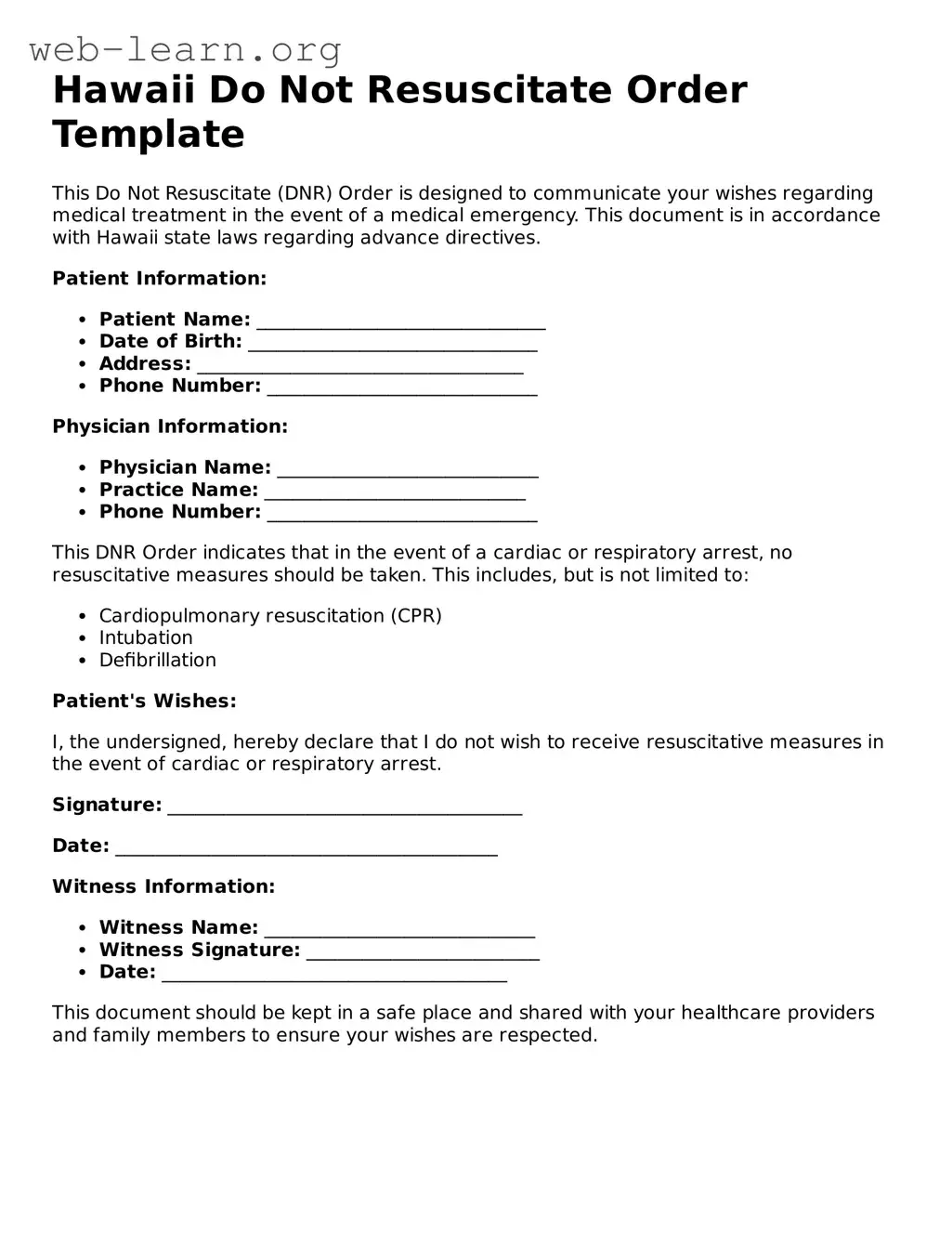
In Hawaii, the Do Not Resuscitate (DNR) Order form plays a crucial role in ensuring that individuals can express their wishes regarding medical treatment in critical situations. This form allows patients to communicate their desire to forgo resuscitation efforts, such as CPR, in the event of cardiac or respiratory arrest. It is essential for individuals to understand that completing a DNR Order is a personal decision, often influenced by medical conditions, personal beliefs, or end-of-life care preferences. The form must be signed by both the patient and a physician, ensuring that the decision is made with professional guidance. Furthermore, it is important to note that the DNR Order is effective only when it is properly executed and presented in a healthcare setting. By understanding the implications and requirements of the DNR Order, individuals can make informed choices that align with their values and healthcare goals, providing peace of mind for themselves and their families during difficult times.
Hawaii Do Not Resuscitate Order Template
This Do Not Resuscitate (DNR) Order is designed to communicate your wishes regarding medical treatment in the event of a medical emergency. This document is in accordance with Hawaii state laws regarding advance directives.
Patient Information:
Physician Information:
This DNR Order indicates that in the event of a cardiac or respiratory arrest, no resuscitative measures should be taken. This includes, but is not limited to:
Patient's Wishes:
I, the undersigned, hereby declare that I do not wish to receive resuscitative measures in the event of cardiac or respiratory arrest.
Signature: ______________________________________
Date: _________________________________________
Witness Information:
This document should be kept in a safe place and shared with your healthcare providers and family members to ensure your wishes are respected.
| Fact Name | Description |
|---|---|
| Definition | A Do Not Resuscitate (DNR) Order is a legal document that instructs medical personnel not to perform cardiopulmonary resuscitation (CPR) in the event of cardiac arrest. |
| Governing Law | The Hawaii DNR Order is governed by Hawaii Revised Statutes §327-61 to §327-66. |
| Eligibility | Any adult who is capable of making health care decisions can create a DNR Order in Hawaii. |
| Signature Requirement | The DNR Order must be signed by the individual or their legally authorized representative. |
| Health Care Provider's Role | Health care providers must honor a valid DNR Order and are legally protected when following it. |
| Form Availability | The DNR Order form can be obtained from healthcare providers, hospitals, or the Hawaii Department of Health. |
| Revocation | A DNR Order can be revoked at any time by the individual or their representative, verbally or in writing. |
| Emergency Medical Services | Emergency medical services (EMS) must be aware of the DNR Order and are required to comply with it. |
| Statewide Recognition | Hawaii recognizes DNR Orders from other states, provided they comply with the laws of the issuing state. |
| Additional Instructions | Individuals may include additional instructions regarding their end-of-life care in conjunction with the DNR Order. |
Filling out the Hawaii Do Not Resuscitate Order form is an important step in expressing your healthcare preferences. It is essential to ensure that your wishes are clearly documented and understood by your healthcare providers. Follow these steps to complete the form accurately.
Once the form is completed and signed, it is advisable to discuss your wishes with your healthcare provider. This ensures that they understand your preferences and can provide the appropriate care in line with your wishes.
What is a Do Not Resuscitate (DNR) Order in Hawaii?
A Do Not Resuscitate Order is a legal document that allows individuals to express their wishes regarding medical treatment in the event that their heart stops beating or they stop breathing. In Hawaii, this order specifically instructs healthcare providers not to perform cardiopulmonary resuscitation (CPR) or other resuscitative measures if the individual experiences a cardiac arrest. It is an important part of advance care planning, helping to ensure that a person's preferences are respected in critical situations.
Who can request a DNR Order in Hawaii?
In Hawaii, any adult who is of sound mind can request a DNR Order. This includes individuals who are facing terminal illnesses or have a serious medical condition. Additionally, a DNR Order can be requested by a legal guardian or an authorized representative if the individual is unable to make decisions for themselves. It is crucial that the person requesting the order fully understands the implications and is making the decision voluntarily.
How is a DNR Order implemented in Hawaii?
To implement a DNR Order in Hawaii, the individual must complete the official DNR form, which can be obtained from healthcare providers or online. The completed form must be signed by the individual and their physician. Once signed, the DNR Order should be kept in a place where it can be easily accessed by medical personnel, such as a hospital or emergency medical services. It is advisable to inform family members and caregivers about the existence of the DNR Order to ensure that everyone is aware of the individual's wishes.
Can a DNR Order be revoked or changed?
Yes, a DNR Order can be revoked or changed at any time. The individual who created the order has the right to alter their decision as their circumstances or preferences change. To revoke a DNR Order, the individual should communicate their wishes clearly to their healthcare provider and ensure that the original form is destroyed or marked as revoked. It is also important to provide updated instructions to family members and caregivers to prevent any confusion in the future.
Filling out the Hawaii Do Not Resuscitate (DNR) Order form can be a daunting task, and many people make mistakes that can lead to confusion or complications later on. One common error is failing to clearly communicate their wishes. It's essential to ensure that the form accurately reflects the individual's desires regarding resuscitation. Ambiguities can lead to misinterpretations by medical personnel, which may result in unwanted interventions.
Another frequent mistake is not including the required signatures. The DNR form must be signed by the patient or their authorized representative, as well as a witness. Omitting these signatures can render the document invalid. It's crucial to double-check that all necessary parties have signed and dated the form to avoid any potential issues when the time comes.
Some individuals overlook the importance of discussing their DNR wishes with family members and healthcare providers. Open conversations can help ensure that everyone understands the patient's preferences. This dialogue not only clarifies intentions but also helps prevent conflicts or confusion during critical moments.
In addition, many people neglect to keep their DNR forms easily accessible. Storing the document in a safe but hard-to-reach location can lead to delays in critical situations. It is advisable to carry a copy of the DNR order in a wallet or have it prominently displayed in the home. This way, medical professionals can quickly locate it when needed.
Lastly, failing to update the DNR form as circumstances change is a significant oversight. Life events, such as changes in health status or personal beliefs, may necessitate modifications to the order. Regularly reviewing and revising the DNR form ensures that it remains aligned with the individual's current wishes and legal requirements.
The Hawaii Do Not Resuscitate Order (DNR) form is an important document that allows individuals to express their wishes regarding resuscitation efforts in the event of a medical emergency. It is often accompanied by other forms and documents that help clarify an individual’s healthcare preferences. Below is a list of commonly used forms that may be relevant when preparing or discussing a DNR order.
Understanding these forms can help individuals and their families make informed decisions regarding healthcare preferences. Each document plays a role in ensuring that a person's wishes are respected and followed in medical situations.
A Do Not Resuscitate (DNR) Order is a critical document in healthcare that expresses a person's wishes regarding resuscitation efforts in the event of cardiac or respiratory arrest. Several other documents serve similar purposes, focusing on medical decisions and end-of-life care. Here are six documents that share similarities with a DNR Order:
When filling out the Hawaii Do Not Resuscitate (DNR) Order form, it is essential to approach the process with care and consideration. Here are some important do's and don'ts to keep in mind:
By following these guidelines, individuals can ensure that their wishes regarding resuscitation are respected and clearly communicated. It is a significant decision, one that deserves thoughtful consideration and open dialogue.
Understanding the Hawaii Do Not Resuscitate (DNR) Order form can be challenging. Many people hold misconceptions about its purpose and implications. Here are ten common misunderstandings:
This is false. A DNR specifically addresses resuscitation efforts, not all medical treatments. Patients can still receive other forms of care, including pain management and comfort measures.
While often associated with terminal illness, anyone can request a DNR order regardless of their health status. It reflects personal wishes about resuscitation.
This is not true. A DNR can be revoked or modified at any time by the patient or their legal representative, as long as they are competent to do so.
This misconception is misleading. A DNR order only prevents resuscitation attempts during a cardiac or respiratory arrest. It does not hasten death.
While most providers will respect a valid DNR, there may be exceptions in certain situations, such as during transfers between facilities. Always communicate your wishes clearly.
A DNR specifically addresses resuscitation efforts, while a living will covers broader end-of-life care decisions. They serve different purposes and should be considered separately.
For a DNR to be legally recognized, it must be documented on the official form and signed by the appropriate parties. Verbal wishes alone are not sufficient.
This is a common misconception. A DNR reflects a personal choice about the type of care one wishes to receive, focusing on quality of life rather than merely prolonging it.
People of all ages can have DNR orders. The decision is based on individual preferences and medical conditions, not age.
While legal advice can be helpful, it is not necessary to have a lawyer complete a DNR form. Patients can often fill it out with the assistance of their healthcare provider.
Understanding these misconceptions can help individuals make informed decisions regarding their healthcare preferences. Open discussions with healthcare providers and loved ones are essential for ensuring that wishes are understood and respected.
Filling out and using the Hawaii Do Not Resuscitate Order (DNR) form is an important process for individuals who wish to express their healthcare preferences. Here are key takeaways to consider:
Understanding these key points can help ensure that your healthcare wishes are respected in critical situations.
Do Not Resuscitate Form Indiana - A DNR order can help reduce the emotional burden on family members during a medical crisis by clarifying the patient’s wishes.
Georgia Dnr Form - Patients should ensure that their DNR wishes are communicated to all relevant parties.
Ct Dnr Form - A legal document indicating a person's wish to forgo resuscitation efforts.
Do Not Resuscitate Form - A DNR is an important aspect of patient autonomy, allowing individuals to make choices about their medical care.