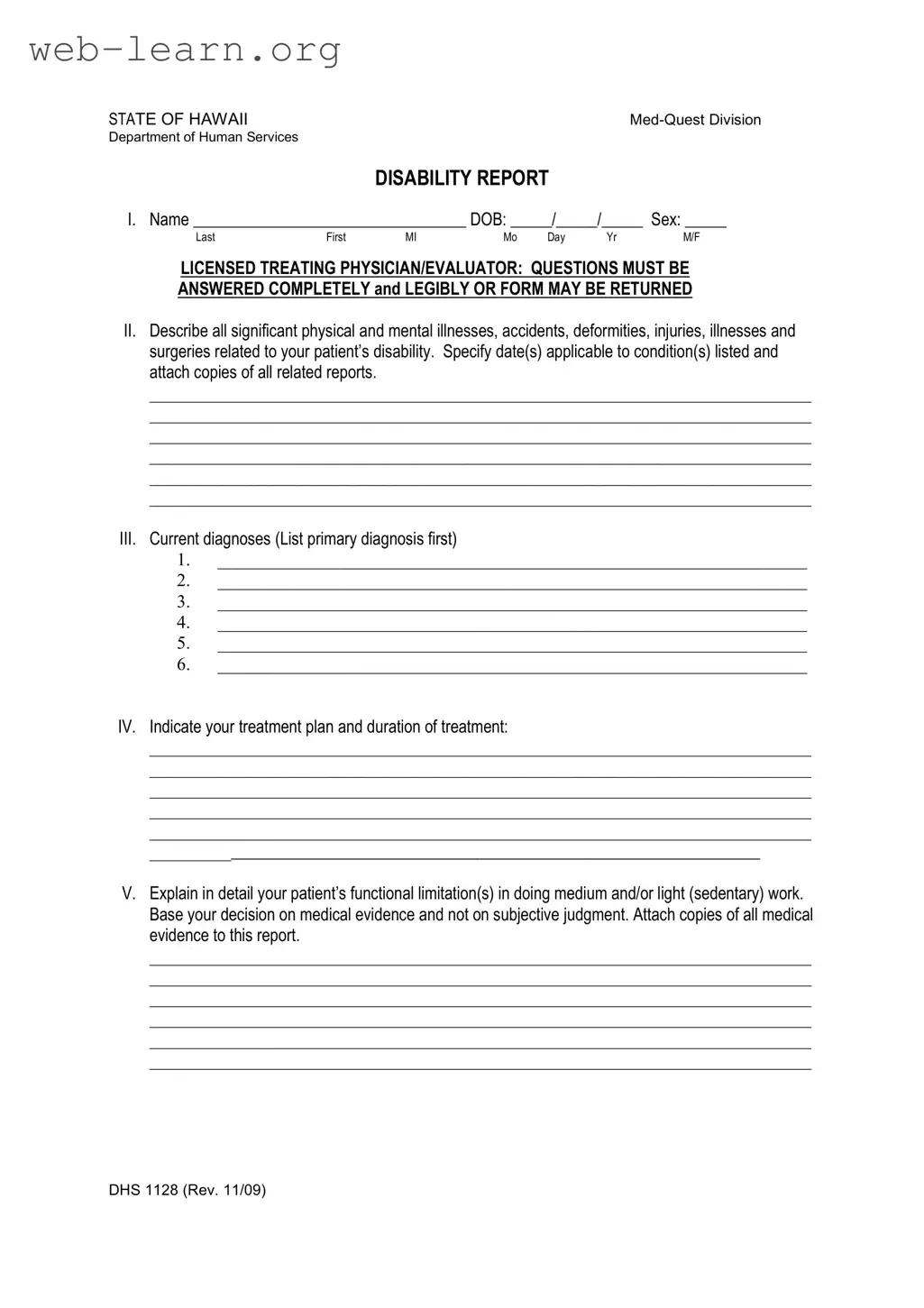
The Hawaii DHS 1128 form serves as a crucial document for individuals seeking disability benefits through the Med-Quest Division of the Department of Human Services. This form requires detailed information about the applicant's physical and mental health conditions, including significant illnesses, injuries, and any relevant surgeries. The licensed treating physician or evaluator must provide a thorough account of the patient's medical history, including current diagnoses and treatment plans. Essential to the application process, the form also asks for a clear explanation of the patient's functional limitations in performing work tasks. This ensures that decisions regarding disability status are based on solid medical evidence rather than subjective assessments. The physician’s statement of disability section specifies whether the condition is permanent or temporary, along with an expected duration for re-evaluation. Additionally, the patient’s acknowledgment section requires the signature of the applicant or their representative, confirming the accuracy of the information provided. Proper completion of the DHS 1128 form is vital, as any omissions or illegibility may lead to delays or rejection of the application.
STATE OF HAWAII |
|
Department of Human Services |
|
DISABILITY REPORT
I. Name _________________________________ DOB: _____/_____/_____ Sex: _____
Last |
First |
MI |
Mo |
Day |
Yr |
M/F |
LICENSED TREATING PHYSICIAN/EVALUATOR: QUESTIONS MUST BE
ANSWERED COMPLETELY AND LEGIBLY OR FORM MAY BE RETURNED
II.Describe all significant physical and mental illnesses, accidents, deformities, injuries, illnesses and surgeries related to your patient’s disability. Specify date(s) applicable to condition(s) listed and attach copies of all related reports.
_________________________________________________________________________
_________________________________________________________________________
_________________________________________________________________________
_________________________________________________________________________
_________________________________________________________________________
_________________________________________________________________________
III.Current diagnoses (List primary diagnosis first)
1._________________________________________________________________
2._________________________________________________________________
3._________________________________________________________________
4._________________________________________________________________
5._________________________________________________________________
6._________________________________________________________________
IV. Indicate your treatment plan and duration of treatment:
_________________________________________________________________________
_________________________________________________________________________
_________________________________________________________________________
_________________________________________________________________________
_________________________________________________________________________
_________________________________________________________________________
V.Explain in detail your patient’s functional limitation(s) in doing medium and/or light (sedentary) work. Base your decision on medical evidence and not on subjective judgment. Attach copies of all medical evidence to this report.
_________________________________________________________________________
_________________________________________________________________________
_________________________________________________________________________
_________________________________________________________________________
_________________________________________________________________________
_________________________________________________________________________
DHS 1128 (Rev. 11/09)

STATE OF HAWAII |
Department of Human Services
VI. LICENSED PHYSICIAN’S STATEMENT OF DISABILITY
Your patient’s disability is expected to be:
[
PERMANENT
AT LEAST 12 MONTHS,
(MO/YR)
[] TEMPORARY TO: ______________________
|
|
|
|
(MO/YR) |
|
|
______________________________________________________ |
__________________________________________________ |
|||||
(Print/Type Name of Licensed Treating Physician/Evaluator) |
|
(Signature of Licensed Treating Physician/Evaluator) |
|
|||
______________________________________________________ |
__________________________________________________ |
|||||
(Address) |
(City) |
(Zip Code) |
(Phone No.) |
(Date) |
||
______________________________________________________ |
__________________________________________________ |
|||||
(Name of Health Plan) |
|
|
(Medical Provider No. or NPI) |
|
||
VII. PATIENT ACKNOWLEDGEMENT |
|
|
|
|||
______________________________________________________ |
__________________________________________________ |
|||||
(Print/Type Name of applicant/recipient) |
|
(Patient Contact Number) |
|
|||
______________________________________________________ |
__________________________________________________ |
|||||
(Signature of applicant/recipient, Guardian or Representative) |
(Date) |
|
||||
If Applicant/Recipient or Guardian or Representative do not sign, indicate reason: ____________
___________________________________________________________________________
FOR OFFICIAL USE ONLY |
|
|
____________________________________ |
_______________________________ |
|
(Case Name) |
(Case No.) |
|
______________________________________________________ |
_________________________________________________ |
|
(Worker’s Name) |
(Section Unit) |
|
______________________________________________________ |
_________________________________________________ |
|
(Unit Address) |
(Phone No.) |
(Fax No.) |
DHS 1128 (Rev. 11/09)
| Fact Name | Details |
|---|---|
| Form Title | Hawaii DHS 1128 - Disability Report |
| Governing Law | Hawaii Revised Statutes, Chapter 346 - Public Welfare |
| Purpose | This form is used to report a patient's disability for Med-Quest services. |
| Required Information | Complete medical history, current diagnoses, treatment plan, and functional limitations must be provided. |
| Physician's Role | A licensed treating physician must complete and sign the form, verifying the patient's disability. |
| Patient Acknowledgment | The patient or their representative must sign to confirm the information provided. |
| Submission | The completed form must be submitted to the appropriate Med-Quest Division office for processing. |
Completing the Hawaii DHS 1128 form is an important step in the process of reporting disabilities. This form requires detailed information about the patient’s medical history and current condition. It is essential to provide accurate and comprehensive responses to ensure the form is processed smoothly.
What is the purpose of the Hawaii DHS 1128 form?
The Hawaii DHS 1128 form, also known as the Disability Report, is designed to gather comprehensive information about an individual's physical and mental health conditions that may affect their ability to work. This form is essential for determining eligibility for various state assistance programs, including Med-Quest. It requires detailed responses from the licensed treating physician or evaluator regarding the patient's medical history, current diagnoses, treatment plans, and functional limitations.
Who is responsible for completing the DHS 1128 form?
The form must be completed by a licensed treating physician or evaluator. This professional is tasked with providing accurate and thorough information about the patient's health status. It is crucial that the answers are legible and complete, as incomplete forms may be returned for additional information, potentially delaying the review process.
What information is required in the DHS 1128 form?
The DHS 1128 form requires several key pieces of information:
How can I ensure my DHS 1128 form is processed efficiently?
To facilitate a smooth processing of the DHS 1128 form, consider the following tips:
By following these guidelines, you can help ensure that the form is reviewed without unnecessary complications.
When filling out the Hawaii DHS 1128 form, several common mistakes can lead to complications or delays in processing. Understanding these pitfalls can help ensure that the application is completed accurately and efficiently.
One frequent error is failing to provide complete and legible information. Each section of the form must be filled out thoroughly. Missing details, such as the patient's full name or date of birth, can result in the form being returned for corrections. Always double-check that all fields are completed before submission.
Another mistake involves not attaching necessary medical documentation. The form requests copies of all related reports to support the claims made. Omitting these documents can weaken the application. It is crucial to gather and include all relevant medical evidence that illustrates the patient's condition and treatment history.
Many applicants also overlook the importance of listing current diagnoses in the correct order. The primary diagnosis should always be listed first, followed by secondary conditions. This order helps evaluators understand the most critical issues affecting the patient’s health and ability to work.
Additionally, some individuals do not provide a clear treatment plan. The form asks for a detailed description of the treatment and its expected duration. A vague or incomplete treatment plan can raise questions about the seriousness of the condition. Providing specific information about ongoing or future treatments can strengthen the application.
Finally, it is vital to ensure that the licensed physician’s statement is properly completed. This includes indicating whether the disability is permanent or temporary and providing the expected re-evaluation date if applicable. Incomplete or incorrect signatures can lead to further delays. Always verify that the physician has signed and dated the form before submission.
The Hawaii DHS 1128 form is an essential document used in the Med-Quest Division of the Department of Human Services for reporting disabilities. Alongside this form, several other documents may be required to ensure a comprehensive assessment of an individual's disability status. Below is a list of commonly associated forms and documents that can aid in the application process.
Gathering these documents can streamline the application process and enhance the chances of a favorable outcome. Each form plays a vital role in presenting a complete picture of the individual's situation, ensuring that all relevant information is considered.
The Hawaii DHS 1128 form, used for disability reporting, shares similarities with several other documents related to medical evaluations and disability assessments. Here is a list of nine such documents, each highlighting a specific aspect of their similarities:
When filling out the Hawaii DHS 1128 form, there are important guidelines to follow. Here are four things you should and shouldn't do:
The Hawaii DHS 1128 form is often misunderstood. Here are four common misconceptions about this form:
This is not true. The DHS 1128 form covers both physical and mental disabilities. It requires a detailed description of all significant conditions that may affect a patient's ability to work.
While a licensed treating physician or evaluator must sign the form, they can collaborate with other healthcare providers. Input from various professionals can strengthen the report.
This misconception is misleading. The information provided on the DHS 1128 form is crucial. It helps determine eligibility for disability benefits, so accuracy and completeness are vital.
This is incorrect. If there are changes in a patient's condition or treatment plan, updates can be made. It's important to keep the information current to reflect the patient's status accurately.
Filling out the Hawaii DHS 1128 form is an important step in the process of applying for disability benefits. Here are key takeaways to keep in mind:
By following these guidelines, you can help ensure that the form is processed efficiently and accurately.