When it comes to transferring property ownership in Hawaii, understanding the Hawaii Deed form is essential. This legal document serves as the official record of the transfer, ensuring that the rights and responsibilities associated with the property are clearly defined. The form typically includes key information such as the names of the parties involved, a detailed description of the property, and any relevant terms or conditions that govern the transfer. Additionally, the Hawaii Deed form may require notarization, which adds an extra layer of authenticity and security to the transaction. Whether you are buying, selling, or gifting real estate, having a firm grasp of this form can help facilitate a smooth transfer process, protecting the interests of all parties involved. By familiarizing yourself with the components and requirements of the Hawaii Deed, you can approach your real estate dealings with confidence and clarity.
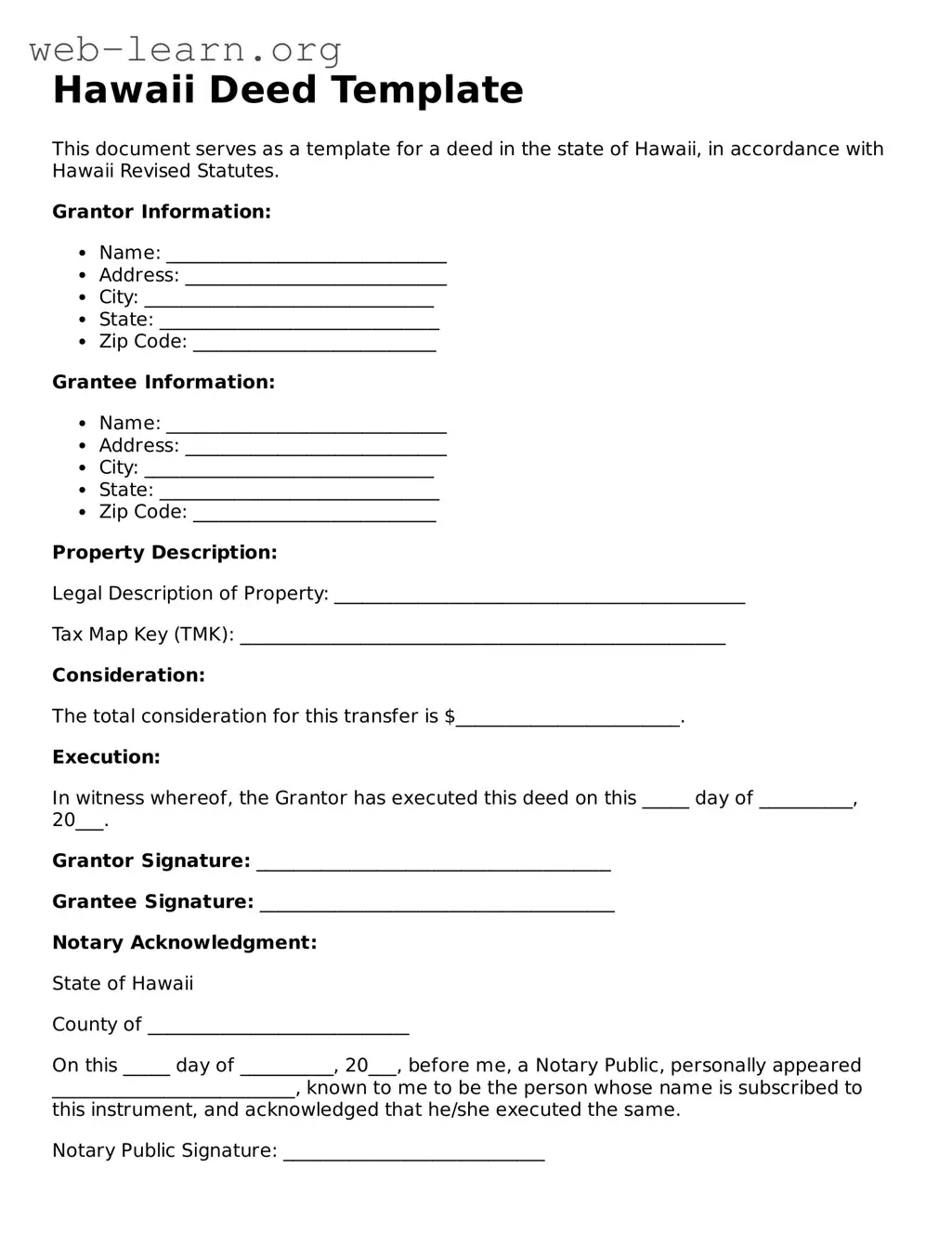
Hawaii Deed Template
This document serves as a template for a deed in the state of Hawaii, in accordance with Hawaii Revised Statutes.
Grantor Information:
Grantee Information:
Property Description:
Legal Description of Property: ____________________________________________
Tax Map Key (TMK): ____________________________________________________
Consideration:
The total consideration for this transfer is $________________________.
Execution:
In witness whereof, the Grantor has executed this deed on this _____ day of __________, 20___.
Grantor Signature: ______________________________________
Grantee Signature: ______________________________________
Notary Acknowledgment:
State of Hawaii
County of ____________________________
On this _____ day of __________, 20___, before me, a Notary Public, personally appeared __________________________, known to me to be the person whose name is subscribed to this instrument, and acknowledged that he/she executed the same.
Notary Public Signature: ____________________________
My commission expires: ____________________________
| Fact Name | Details |
|---|---|
| Governing Law | The Hawaii Deed form is governed by the Hawaii Revised Statutes, specifically Chapter 501. |
| Types of Deeds | Common types include Warranty Deed, Quitclaim Deed, and Special Warranty Deed. |
| Signature Requirements | Signatures of both the grantor and grantee are required for validity. |
| Notarization | A notary public must witness the signing of the deed for it to be recorded. |
| Recording | Deeds must be recorded with the Bureau of Conveyances in Hawaii to provide public notice. |
| Consideration | The deed must state the consideration (payment) for the transfer of property. |
| Legal Description | A legal description of the property must be included in the deed. |
| Transfer Tax | A conveyance tax may apply when transferring property in Hawaii. |
After completing the Hawaii Deed form, the next step involves submitting it to the appropriate county office for recording. This process ensures that the transfer of property ownership is officially recognized. Follow these steps to fill out the form accurately.
A Hawaii Deed form is a legal document used to transfer ownership of real property in the state of Hawaii. This form outlines the details of the transaction, including the names of the parties involved, the property description, and any conditions or restrictions on the transfer. It serves as the official record of the transfer and is essential for establishing legal ownership.
In Hawaii, there are several types of deeds, including:
To complete a Hawaii Deed form, follow these steps:
Ensure that all information is accurate to avoid complications in the future.
While it is not legally required to have a lawyer prepare a Hawaii Deed form, it is highly advisable. A legal professional can ensure that the deed complies with state laws and that all necessary elements are included. This can help prevent disputes and ensure a smooth transfer of ownership.
A Hawaii Deed form must be filed with the Bureau of Conveyances in the county where the property is located. It is important to file the deed promptly after execution to ensure that the transfer is officially recorded and recognized by the state.
Yes, there are fees associated with filing a Hawaii Deed form. These fees vary by county and are typically based on the value of the property being transferred. It is essential to check with the local Bureau of Conveyances for the most current fee schedule.
If a Hawaii Deed form is not properly executed, it may lead to complications regarding ownership. The transfer may be deemed invalid, and the parties involved could face legal disputes. To avoid these issues, ensure that the deed is signed, notarized, and filed correctly.
Revoking a Hawaii Deed form can be complex. Generally, once a deed has been executed and filed, it cannot be unilaterally revoked. However, a new deed can be created to transfer ownership back to the original owner or to another party. Legal advice is recommended in such situations to navigate the process effectively.
Filling out a Hawaii Deed form can be a straightforward process, but many people make common mistakes that can lead to complications. One frequent error is not providing complete and accurate information. Every section of the form must be filled out correctly. Omissions or inaccuracies can delay the transfer of property and may require additional steps to correct.
Another common mistake involves failing to properly identify the property. It's crucial to include the correct legal description of the property being transferred. This description should match the information on the current title. Inaccurate descriptions can create confusion and lead to disputes down the line.
People often overlook the importance of signatures. All parties involved in the transaction must sign the deed. If a required signature is missing, the deed may be considered invalid. Ensure that everyone who has an interest in the property is included and has signed the document.
Not having the deed notarized is another significant error. In Hawaii, a deed must be notarized to be legally binding. This step verifies the identities of the signers and confirms that they are signing voluntarily. Without notarization, the deed may not be accepted by the county recorder’s office.
Additionally, some individuals neglect to check for any liens or encumbrances on the property before filling out the deed. It’s essential to ensure that the property is free of any legal claims that could affect the transfer. Failure to address these issues can lead to legal problems after the deed is recorded.
Lastly, people sometimes forget to file the deed with the appropriate county office. After completing the form, it’s important to submit it for recording. This step is vital for making the transfer official and protecting the new owner’s rights. Without filing, the deed may not hold up in legal matters.
When preparing to transfer property in Hawaii, several forms and documents often accompany the Hawaii Deed form. Each of these documents serves a specific purpose in ensuring that the transaction is legal, clear, and properly recorded. Understanding these documents can help streamline the process and ensure that all necessary steps are taken.
Being aware of these documents and their purposes can facilitate a smoother property transaction in Hawaii. Each form plays a critical role in ensuring compliance with state laws and protecting the interests of all parties involved. Proper preparation can help avoid delays and complications, making the transfer of property as efficient as possible.
The Deed form is a crucial document in property transactions, but it shares similarities with several other legal documents. Below is a list of eight documents that are comparable to the Deed form, along with a brief explanation of how they are similar.
Understanding these documents can help clarify the various ways property rights and ownership are established and transferred in legal contexts.
When filling out the Hawaii Deed form, it is important to follow certain guidelines to ensure accuracy and compliance. Below is a list of things you should and shouldn't do:
By adhering to these guidelines, you can help ensure that the deed is processed smoothly and accurately.
Understanding the Hawaii Deed form is essential for anyone involved in real estate transactions in the state. However, several misconceptions can lead to confusion. Below is a list of common misconceptions about the Hawaii Deed form, along with clarifications.
Different types of deeds serve various purposes. For instance, a warranty deed provides guarantees about the title, while a quitclaim deed transfers ownership without such assurances.
While notarization is common and often recommended, it is not always legally required for a deed to be valid in Hawaii.
Recording a deed provides public notice and protects the interests of the parties involved, but a deed can still be valid without recording.
While it is advisable to consult with a legal professional, individuals can prepare their own deeds as long as they follow the necessary legal requirements.
Deeds can be used for any type of real estate, including commercial properties, land, and timeshares.
Although a title search is a good practice to ensure clear ownership, it is not a legal requirement to execute a deed.
While a deed is a legal document, it can be amended or revoked under certain conditions, following the appropriate legal procedures.
A deed remains valid indefinitely unless it is revoked or a new deed is executed to replace it.
Signatures can be obtained separately, provided that all necessary parties consent to the terms of the deed.
While there are steps to follow, completing a deed can be straightforward if the requirements are clearly understood.
When filling out and using the Hawaii Deed form, it is essential to keep several key points in mind:
Quitclaim Deed Ct - Helps ensure that all parties understand their rights and responsibilities.
What Does a House Deed Look Like in Illinois - Deeds can be used for residential, commercial, and agricultural properties.
Quick Claim Deeds Kansas - A Deed form must be signed by the current owner to be valid.
What Does a House Deed Look Like in Ny - A Deed is a formal document used to convey ownership of property.