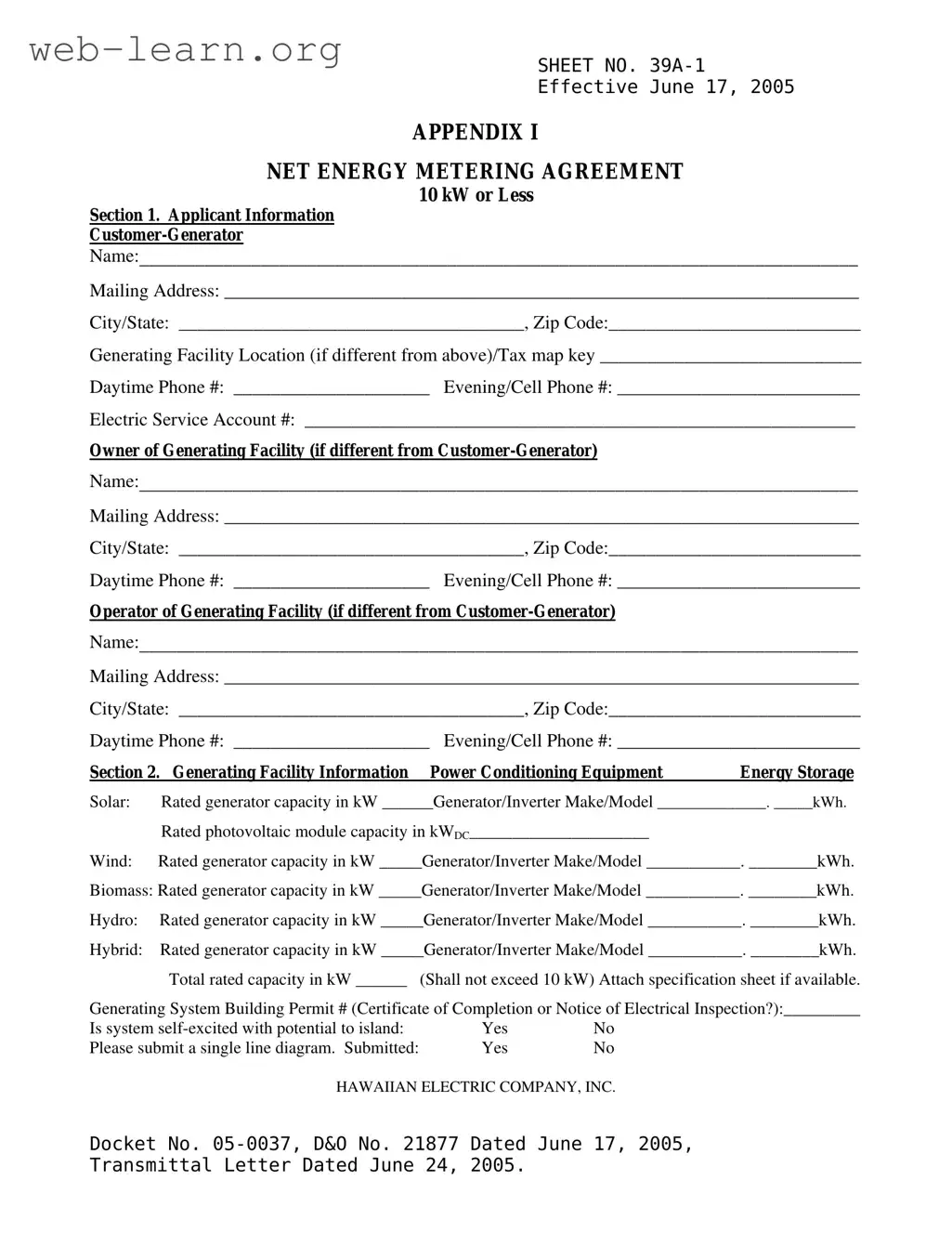
The Hawaii 39A form is a vital document for individuals and businesses looking to harness renewable energy through net energy metering agreements. Specifically designed for generating facilities with a capacity of 10 kW or less, this form serves as a comprehensive agreement between the customer-generator and the electric utility company. It covers essential details such as the applicant's information, including name, address, and contact details, along with specifics about the generating facility itself. This includes the type of energy source—be it solar, wind, biomass, or hydro—and the rated capacity of the equipment. Safety and compliance are paramount, so the form also requires certification from a licensed electrical contractor to ensure that the installation meets all applicable standards. The Hawaii 39A form outlines installation requirements, including the need for a disconnect device for safety, as well as the responsibilities of both parties regarding permits, metering, and indemnification. Additionally, it addresses billing procedures, providing clarity on how net energy production and consumption will be calculated. Understanding the intricacies of this form is crucial for anyone interested in contributing to Hawaii's renewable energy goals while ensuring compliance with local regulations.
SHEET NO.
Effective June 17, 2005
APPENDIX I
NET ENERGY METERING AGREEMENT
10 kW or Less
Section 1. Applicant Information
Name:_____________________________________________________________________________
Mailing Address: ____________________________________________________________________
City/State: _____________________________________, Zip Code:___________________________
Generating Facility Location (if different from above)/Tax map key ____________________________
Daytime Phone #: _____________________ Evening/Cell Phone #: __________________________
Electric Service Account #: ___________________________________________________________
Owner of Generating Facility (if different from
Name:_____________________________________________________________________________
Mailing Address: ____________________________________________________________________
City/State: _____________________________________, Zip Code:___________________________
Daytime Phone #: _____________________ Evening/Cell Phone #: __________________________
Operator of Generating Facility (if different from
Name:_____________________________________________________________________________
Mailing Address: ____________________________________________________________________
City/State: _____________________________________, Zip Code:___________________________
Daytime Phone #: _____________________ Evening/Cell Phone #: __________________________
Section 2. Generating Facility Information Power Conditioning Equipment |
Energy Storage |
|
Solar: |
Rated generator capacity in kW ______Generator/Inverter Make/Model ______________. _____kWh. |
|
|
Rated photovoltaic module capacity in kWDC_____________________ |
|
Wind: |
Rated generator capacity in kW _____Generator/Inverter Make/Model ___________. ________kWh. |
|
Biomass: Rated generator capacity in kW _____Generator/Inverter Make/Model ___________. ________kWh.
Hydro: Rated generator capacity in kW _____Generator/Inverter Make/Model ___________. ________kWh.
Hybrid: Rated generator capacity in kW _____Generator/Inverter Make/Model ___________. ________kWh.
Total rated capacity in kW ______ (Shall not exceed 10 kW) Attach specification sheet if available.
Generating System Building Permit # (Certificate of Completion or Notice of Electrical Inspection?):_________
Is system |
Yes |
No |
Please submit a single line diagram. Submitted: |
Yes |
No |
HAWAIIAN ELECTRIC COMPANY, INC.
Docket No.
SHEET NO.
Effective June 17, 2005
Section 3. Certification by Licensed Electrical Contractor:
Generating and interconnection systems must be compliant with all applicable safety and performance standards of the National Electrical Code (NEC), Institute of Electrical and Electronic Engineers (IEEE), and accredited testing laboratories such as the Underwriters Laboratories (UL), and where applicable, the rules of the Public Utilities Commission of the State of Hawaii (“Commission”), or other applicable governmental laws and regulations, and the Electric Company's (Company) interconnection requirements, in effect at the time of signing this agreement. The following certifies that the installed generating system meets all preceding requirement(s).
Signed (Licensed Electrical Contractor): ___________________________________ Date: ________________
License Holder (printed) ____________________________Hawaii License #C: _________________________
Mail Address: ______________________________________________________________________________
City: _______________________________________, Hawaii, Zip Code: _____________________________
Daytime Phone #: ________________________Installation date: ____________________________________
Section 4. Installation: Design, installation, operation and maintenance of the Generating Facility shall include appropriate control and protection equipment and a manual
Location of lockable disconnect device, adjacent to meter?yes
If not, please describe location:_________________________________________________________________
Section 5. Notice: A
Section 6. Permits and Licenses: The
Section 7. Metering: The Company will supply, own, and maintain all necessary meters and associated equipment utilized for billing. The meters will be tested and read in accordance with the rules of the Commission and the Company. The
HAWAIIAN ELECTRIC COMPANY, INC.
Docket No.
Superseding Revised |
Sheet No. |
REVISED SHEET NO. |
Effective March 10, |
2006 |
Effective August 18, 2008 |
meter sockets, meter instrument transformer housing and mountings, switchboard meter test buses, meter panels and similar devices required for service connection and meter installations on the
Section 8. Indemnification: Each party as indemnitor shall hold harmless and indemnify the other party and the directors, officers, authorized agents, and employees of such other party against and from any and all loss and liability for injuries to persons including employees and authorized agents of either party, and damages, including property of either party, resulting from or arising out of (i) the engineering, design, construction, maintenance, or operation of, or (ii) the making of replacements, additions, or betterments to the indemnitor’s facilities which are required for the interconnection and parallel operation of the Generating Facility with the Company’s electric system and the generation of energy by the Generating Facility. Neither party shall be indemnified for liability or loss resulting from its sole negligence or willful misconduct. Nothing in this agreement shall create any duty to, any standard of care with reference to, or any liability to any person not a party to it.
Provided, however, where the
Company shall be responsible for damages or injury caused by Company, Company's agents, officers, and employees in the course of their employment to the extent that Company's liability for such damage or injury has been determined by a court or otherwise agreed to by Company, and Company shall pay for such damage and injury to the extent permitted by law. Company shall not request the State to indemnify Company for, or hold Company harmless from, any claims for such damages or injury.
[FOR OWNER / OPERATOR OTHER THAN STATE AGENCY]
The Owner/Operator shall indemnify, defend and hold harmless the Company and its officers, directors, agents and employees, from and against all liabilities, damages, losses, fines, penalties, claims, demands, suits, costs and expenses (including reasonable attorney’s fees and expenses) to or by third persons, including the Company’s employees or subcontractors, for injury or death, or for injury to property, arising out of the actions or inactions of the Owner/Operator (or those of anyone under their control or on their behalf) with respect to their obligations under this Agreement, and/or arising out of the installation, operation and maintenance of the Facility and/or the Facility Parties Interconnection Facilities, except to the extent that such injury, death or damage is attributable to the gross negligence or intentional act or omission of the Company or its officers, directors, agents or employees.
Section 9. Continuity of Service: The Company may require that the Generating Facility be temporarily
curtailed, interrupted or deliveries of energy reduced: (a) when necessary in order for the Company to construct, install, maintain, repair, replace, remove, investigate or inspect any of its equipment or any part of its system; or
(b)if the Company determines that such curtailment, interruption or reduction is necessary because of a system emergency, forced outage, or compliance with good engineering practices. Whenever feasible, Company shall give
HAWAIIAN ELECTRIC COMPANY, INC.
Docket No.
Transmittal Letter Dated July 17, 2008.
Superseding Revised |
Sheet No. |
REVISED SHEET NO. |
Effective March 10, |
2006 |
Effective August 18, 2008 |
Section 10. Personnel and System Safety: If at any time the Company determines that the continued operation of the Generating Facility may endanger any person or property, the Company’s electric system, or have an adverse effect on the safety or power quality of other customers, the Company shall have the right to disconnect the Generating Facility from the Company’s electric system. The Generating Facility shall remain disconnected until such time as the Company is satisfied that the endangering or power quality condition(s) has been corrected, and the Company shall not be obligated to accept any energy from the Generating Facility during such period. The Company shall not be liable directly or indirectly for permitting or continuing to allow an attachment of a net metering facility or for the acts or omissions of the
Section 11. Additional Information: The Company reserves the right to require additional information, where necessary, to serve the
Section 12. Term: This agreement shall become effective upon execution by the
Section 13. Net Energy Metering and Billing:
A. General:
(1)The net energy metering and billing arrangement covered by the Net Energy Metering Agreement shall be governed by the Company’s Rule 18, as may be amended, revised and/or updated from time to time. If there is a conflict between any provision in the Net Energy Metering Agreement and the Company’s Rule 18, as may be amended, revised and/or updated, the provisions of the Company’s Rule 18 shall control.
(2)
(3)For
HAWAIIAN ELECTRIC COMPANY, INC.
Docket No.
Transmittal Letter Dated July 17, 2008.
Superseding Sheet No. |
REVISED SHEET NO. |
Effective March 10, 2006 |
Effective August 18, 2008 |
B. Net Electricity Producer:
(1)When the electricity produced by the Generating Facility during a billing period exceeds the electricity supplied by the Company for the same period, the
(2)In a billing period when the
(3)The excess kilowatthours produced by the
in effect. When the
(4)The
C. Net Electricity Consumer:
(1)When the electricity supplied by the Company to the
(2)For billing purposes, the
HAWAIIAN ELECTRIC COMPANY, INC.
Docket No.
Transmittal Letter Dated July 17, 2008.
Superseding Sheet No. |
REVISED SHEET NO. |
Effective March 10, 2006 |
Effective August 18, 2008 |
(3)In a billing period in which the
(4)The kilowatthours supplied by the Company and the kilowatthours produced by the
(5)The Energy Charge shall include the
HAWAIIAN ELECTRIC COMPANY, INC.
Docket No.
Transmittal Letter Dated July 17, 2008.

SHEET NO.
Effective August 18, 2008
D. Other:
(1)If a
(2)The kilowatthours supplied by the Company and, if any, the kilowatthours produced by the Customer- Generator, including an accounting of the cumulative monetary credits for the excess kilowatthours produced by the
Section 14.
Owner/Operator of Generating Facility ____________________________ Date ________________________
Section 15. Company Signature:
I hereby acknowledge receipt and completeness of the Net Energy Metering Agreement.
Company |
|
By |
||||
Title |
|
|
|
|
Date |
|
HAWAIIAN ELECTRIC COMPANY, INC.
Docket No.
Transmittal Letter Dated July 17, 2008.
| Fact Name | Fact Details |
|---|---|
| Form Purpose | The Hawaii 39A form is a Net Energy Metering Agreement for customer-generators with a generating capacity of 10 kW or less. |
| Effective Date | This form became effective on June 17, 2005, and is used for agreements between customer-generators and Hawaiian Electric Company. |
| Governing Law | The agreement is governed by the rules of the Public Utilities Commission of the State of Hawaii and applicable federal regulations. |
| Capacity Limit | The generating capacity of the facility must not exceed 10 kW, ensuring compliance with state regulations. |
| Certification Requirement | A licensed electrical contractor must certify that the generating system meets all applicable safety and performance standards. |
| Installation Responsibilities | The customer-generator is responsible for the design, installation, operation, and maintenance of the generating facility. |
| Indemnification Clause | Each party agrees to indemnify the other for liabilities arising from the operation of the generating facility, barring sole negligence. |
| Notice of Changes | A 30-day advance written notice is required for any proposed material changes to the generating facility, such as ownership changes. |
| Termination Conditions | The agreement can be terminated by either party at any time, with specific conditions outlined for the company’s termination rights. |
Completing the Hawaii 39A form is an important step in establishing a net energy metering agreement. This process involves providing detailed information about the applicant, the generating facility, and compliance with safety standards. Ensure all sections are filled out accurately to avoid delays in processing.
What is the Hawaii 39A form?
The Hawaii 39A form is an agreement for net energy metering for generating facilities that produce 10 kW or less of energy. It allows customer-generators to connect their renewable energy systems, like solar or wind, to the electric grid. This form outlines the responsibilities of both the customer-generator and the electric company, ensuring that the system meets safety and performance standards.
Who needs to fill out the Hawaii 39A form?
Anyone who plans to install a renewable energy generating facility in Hawaii that produces 10 kW or less must complete this form. This includes homeowners and businesses looking to harness solar, wind, biomass, or hydro energy. If the generating facility is owned or operated by someone other than the customer-generator, that person must also provide their information on the form.
What information is required on the form?
The form requires several details:
What happens if I need to change my generating facility?
If you plan to make any significant changes to your generating facility, such as changing ownership or increasing its capacity, you must provide the electric company with a 30-day written notice. Remember, the rated capacity of your facility cannot exceed 10 kW, and the electric company may require you to fill out a new Hawaii 39A form if ownership changes.
What are the responsibilities of the customer-generator?
The customer-generator has several important responsibilities:
How is billing handled under the Hawaii 39A agreement?
Billing is based on the net energy produced and consumed. If your generating facility produces more energy than you consume in a billing period, you won't be billed for the electricity supplied by the electric company. Instead, you will receive a minimum charge. Any excess energy produced can be carried over as a credit for future billing periods. If you consume more energy than you produce, you will be billed for the excess based on the applicable rate schedule.
Filling out the Hawaii 39A form can be a straightforward process, but many people make common mistakes that can delay their application or lead to complications down the line. Here are six frequent errors to watch out for.
One major mistake is providing incomplete or inaccurate information in the Applicant Information section. This section requires specific details such as the Customer-Generator's name, mailing address, and electric service account number. Omitting any of this information can lead to processing delays. Ensure that all fields are filled out completely and accurately to avoid unnecessary back-and-forth communication.
Another common error occurs in the Generating Facility Information section. Applicants often fail to include the correct rated generator capacity or the make and model of their generator or inverter. This information is crucial for determining eligibility and ensuring compliance with local regulations. Double-check these details before submission to prevent any issues.
Additionally, many individuals overlook the requirement to attach a specification sheet for the generating system. This document provides essential technical details that support the application. Without it, the form may be considered incomplete, leading to further delays in approval.
Misunderstanding the Certification by Licensed Electrical Contractor section is another frequent pitfall. Applicants sometimes neglect to have a licensed contractor sign the form or fail to provide their license number. This certification is vital, as it confirms that the installation meets safety and performance standards. Always ensure that this section is properly completed to avoid complications.
Another mistake involves the Installation section, where applicants may not adequately describe the location of the lockable disconnect device. If this device is not clearly labeled or located near the electric meter, it can create accessibility issues for utility personnel. Clear communication about the device's location is essential for compliance with safety regulations.
Finally, failing to provide timely notice of any changes to the generating facility can lead to significant problems. The form requires a 30-day written notice for material changes, such as ownership changes or capacity increases. Ignoring this requirement can result in penalties or the need to submit a new application altogether.
By being aware of these common mistakes, applicants can ensure a smoother process when filling out the Hawaii 39A form. Attention to detail and thoroughness can save time and prevent complications in the future.
The Hawaii 39A form is essential for customers looking to enter into a Net Energy Metering Agreement with Hawaiian Electric Company. However, several other documents and forms are often required or recommended to ensure compliance and facilitate the process. Below is a list of these additional documents, each described briefly for clarity.
Having these documents prepared and submitted alongside the Hawaii 39A form can streamline the process of establishing a Net Energy Metering Agreement. It is advisable to consult with relevant authorities or professionals to ensure all necessary paperwork is in order.
When filling out the Hawaii 39A form, it is crucial to adhere to specific guidelines to ensure accuracy and compliance. Below is a list of things you should and shouldn't do.
Misconception 1: The Hawaii 39A form is only for large energy producers.
This is incorrect. The Hawaii 39A form is specifically designed for generating facilities with a capacity of 10 kW or less. It caters to small-scale energy producers, including residential solar panel systems.
Misconception 2: Once the form is submitted, no further action is needed.
In reality, the Customer-Generator must provide a 30-day written notice for any material changes to the generating facility. This includes changes in ownership or capacity, ensuring that the utility company is kept informed.
Misconception 3: The company will take care of all permits and licenses.
This is not true. The Customer-Generator is responsible for obtaining all necessary permits and licenses for the construction and operation of their facility. This ensures compliance with local regulations.
Misconception 4: The company will automatically compensate for all excess energy produced.
While the agreement allows for credits for excess energy, these credits are only applicable under specific conditions. The Customer-Generator must be aware of the limitations and adjustments that may apply to their billing.
Misconception 5: The agreement lasts indefinitely without any obligations.
This is misleading. The agreement is effective on a month-to-month basis and can be terminated by either party. Compliance with the terms is essential to maintain the agreement.
The Hawaii 39A form is essential for customers looking to participate in the Net Energy Metering program, specifically for generating facilities with a capacity of 10 kW or less.
Accurate completion of the form is crucial. It requires detailed information about the customer-generator, including names, addresses, and contact information for all parties involved.
Section 2 of the form focuses on the generating facility's specifications. This includes the type of energy source, rated capacity, and the make and model of the equipment used.
It is mandatory to attach a specification sheet if available, which provides additional details about the generating system.
Permits and licenses for construction and operation must be obtained by the customer-generator at their own expense, as stated in Section 6.
Notification is required for any material changes to the generating facility, such as ownership changes or capacity increases. This must be communicated to the company at least 30 days in advance.
The agreement remains effective on a month-to-month basis, allowing either party to terminate it at any time, provided the terms are followed.