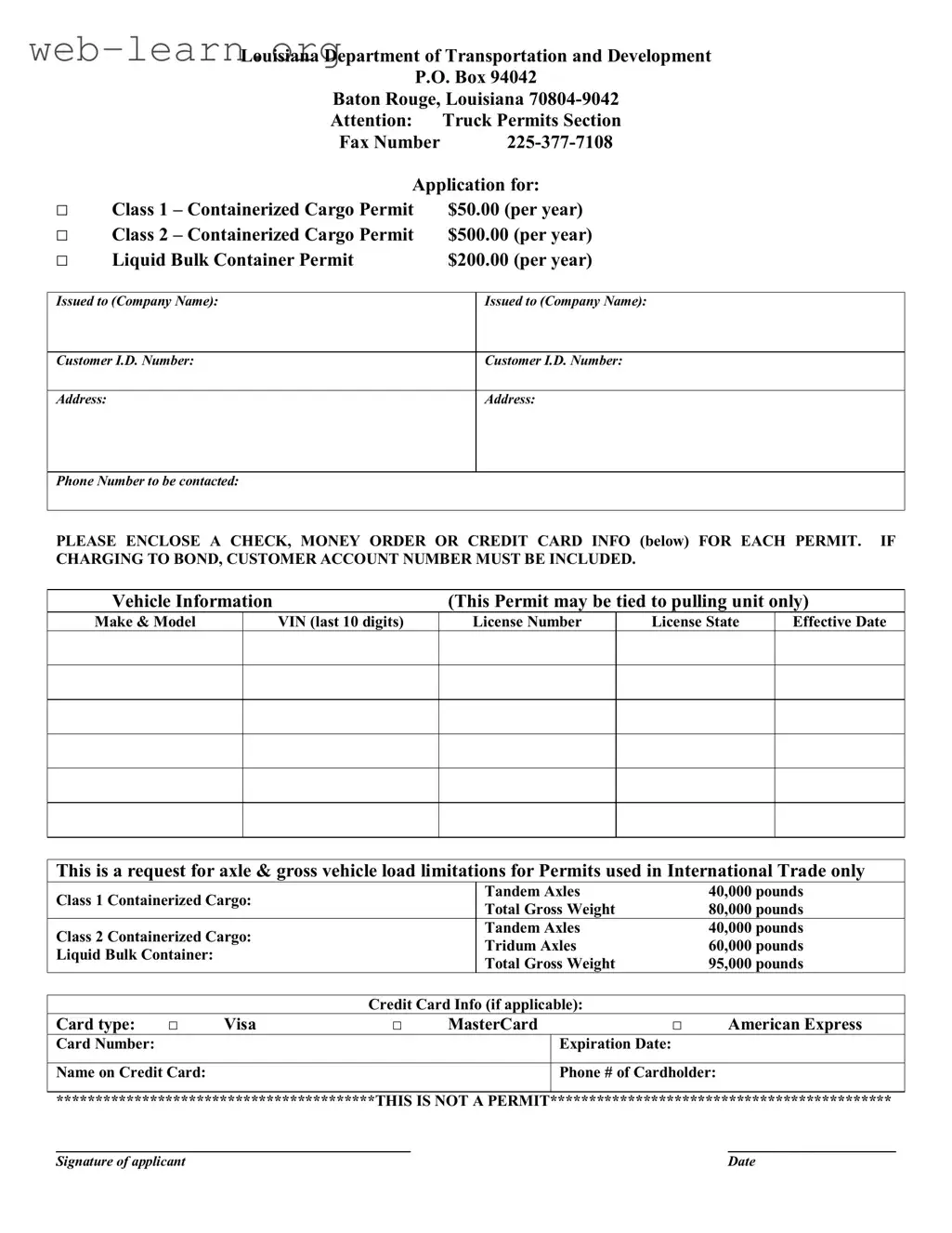
The Harvest Season Permit Louisiana form is a crucial document for businesses engaged in transporting specific types of cargo within the state. This form, issued by the Louisiana Department of Transportation and Development, serves as an application for various permits, including Class 1 and Class 2 Containerized Cargo Permits, as well as a Liquid Bulk Container Permit. Each permit comes with its own fee structure, with the Class 1 permit priced at $50 per year, the Class 2 permit at $500 per year, and the Liquid Bulk Container Permit at $200 per year. Applicants must provide essential information such as the company name, customer identification number, and contact details. Additionally, vehicle specifics, including make and model, VIN, and license information, must be included. The form also outlines axle and gross vehicle load limitations, particularly for those engaged in international trade, specifying weight allowances for different classes of cargo. Payment options include checks, money orders, or credit card information, which must be submitted alongside the application. Importantly, the form emphasizes that it is a request and not a permit itself, requiring the applicant's signature and date to validate the submission.
|
Louisiana Department of Transportation and Development |
||
|
P.O. Box 94042 |
||
|
Baton Rouge, Louisiana |
||
|
Attention: |
Truck Permits Section |
|
|
Fax Number |
||
□ |
Application for: |
||
Class 1 – Containerized Cargo Permit |
$50.00 (per year) |
||
□ |
Class 2 – Containerized Cargo Permit |
$500.00 (per year) |
|
□ |
Liquid Bulk Container Permit |
$200.00 (per year) |
|
|
|
|
|
Issued to (Company Name): |
|
Issued to (Company Name): |
|
|
|
|
|
Customer I.D. Number: |
|
Customer I.D. Number: |
|
|
|
|
|
Address: |
|
|
Address: |
|
|
|
|
Phone Number to be contacted:
PLEASE ENCLOSE A CHECK, MONEY ORDER OR CREDIT CARD INFO (below) FOR EACH PERMIT. IF CHARGING TO BOND, CUSTOMER ACCOUNT NUMBER MUST BE INCLUDED.
Vehicle Information |
(This Permit may be tied to pulling unit only) |
Make & Model
VIN (last 10 digits)
License Number
License State
Effective Date
This is a request for axle & gross vehicle load limitations for Permits used in International Trade only
Class 1 Containerized Cargo: |
|
|
Tandem Axles |
|
40,000 pounds |
||
|
|
Total Gross Weight |
|
80,000 pounds |
|||
|
|
|
|
|
|
||
Class 2 Containerized Cargo: |
|
|
Tandem Axles |
|
40,000 pounds |
||
|
|
Tridum Axles |
|
60,000 pounds |
|||
Liquid Bulk Container: |
|
|
|
|
|||
|
|
|
Total Gross Weight |
|
95,000 pounds |
||
|
|
|
|
|
|
||
|
|
|
|
|
|
||
|
|
|
Credit Card Info (if applicable): |
|
|
||
Card type: |
□ |
Visa |
□ |
MasterCard |
□ |
American Express |
|
Card Number:
Name on Credit Card:
Expiration Date:
Phone # of Cardholder:
*****************************************THIS IS NOT A PERMIT********************************************
______________________________________ |
__________________ |
Signature of applicant |
Date |
| Fact Name | Details |
|---|---|
| Governing Authority | The Harvest Season Permit is regulated by the Louisiana Department of Transportation and Development. |
| Application Types | Three types of permits are available: Class 1, Class 2, and Liquid Bulk Container Permits. |
| Permit Fees | Fees for the permits range from $50 to $500, depending on the type of permit requested. |
| Weight Limitations | Weight limitations vary by permit type, with maximum gross weights reaching up to 95,000 pounds. |
Completing the Harvest Season Permit form for Louisiana is a straightforward process. Once filled out, this form will allow you to apply for the necessary permits to operate within the state. Ensure that you have all required information handy before you start, as this will make the process smoother.
After submitting your application, it will be reviewed by the Truck Permits Section. Keep an eye on your phone for any communication regarding your application status. You will receive your permit once everything is processed and approved.
The Harvest Season Permit Louisiana form is used to apply for specific permits related to containerized cargo and liquid bulk transportation. These permits allow vehicles to exceed standard weight limits for certain types of cargo, facilitating international trade. There are three classes of permits available: Class 1 for containerized cargo, Class 2 for containerized cargo, and a Liquid Bulk Container Permit.
The cost of the permits varies based on the class:
Payment can be made via check, money order, or credit card. Ensure that you include the payment information along with your application.
The application requires several key pieces of information:
Make sure to fill out all sections completely to avoid delays in processing.
Yes, it is important to remember that this form is a request for a permit, not the permit itself. You must sign the application and date it before submission. Additionally, if you are paying by credit card, include the card type, number, name on the card, expiration date, and the phone number of the cardholder. Always double-check your information to ensure accuracy.
Filling out the Harvest Season Permit Louisiana form can be a straightforward process, but many applicants make common mistakes that can delay their permit approval. One frequent error is neglecting to provide the correct Company Name and Customer I.D. Number. These details are essential for the processing of the application. If these fields are left blank or filled out incorrectly, it can lead to confusion and may result in the application being returned or rejected.
Another mistake often seen is the failure to include the appropriate payment method. The form requires applicants to enclose a check, money order, or credit card information. Some people forget this step entirely, while others may not specify their payment method clearly. Without the payment, the application cannot be processed, leading to unnecessary delays.
Additionally, applicants sometimes overlook the importance of providing accurate vehicle information. This includes the Make & Model, VIN (last 10 digits), and License Number. Any inaccuracies in this section can result in the permit being issued for the wrong vehicle, which could cause legal issues down the line. Double-checking this information before submission is crucial to avoid complications.
Lastly, many applicants forget to sign and date the application. This might seem minor, but without a signature, the form is not valid. It’s a simple step that can easily be overlooked in the rush to submit the application. Ensuring that all required fields are completed, including the signature, can help expedite the approval process and get you on your way.
The Harvest Season Permit in Louisiana is often accompanied by several other forms and documents that facilitate the permitting process. Below is a list of these commonly used documents, each described briefly for clarity.
Having these documents prepared and submitted along with the Harvest Season Permit can help streamline the permitting process and ensure compliance with state regulations.
The Harvest Season Permit Louisiana form shares similarities with several other documents related to transportation and cargo permits. Here are ten documents that are comparable:
When filling out the Harvest Season Permit Louisiana form, keep these important dos and don’ts in mind:
This permit is not limited to agricultural producers. It is available to any company involved in containerized cargo or liquid bulk transport during the harvest season.
While it requires specific information, the application is straightforward. Clear instructions are provided to guide applicants through the necessary steps.
There are different classes of permits, each with its own fee structure. For example, a Class 1 permit costs $50, while a Class 2 permit costs $500.
Payment is required with the application. Applicants must enclose a check, money order, or credit card information to process their request.
Approval is not guaranteed. Each application is reviewed, and permits are issued based on compliance with regulations.
This permit is specific to the vehicle listed on the application. It is tied to the pulling unit only, ensuring proper tracking and regulation.
The Harvest Season Permit is intended for commercial use only. It is not valid for personal vehicles or non-commercial activities.
Each permit application must be submitted separately, along with the appropriate payment for each one. This ensures proper processing and record-keeping.
The Harvest Season Permit is not a license. It serves a specific purpose related to weight limitations and cargo types during harvest season, distinct from general vehicle licensing.
Here are some key takeaways about filling out and using the Harvest Season Permit Louisiana form: