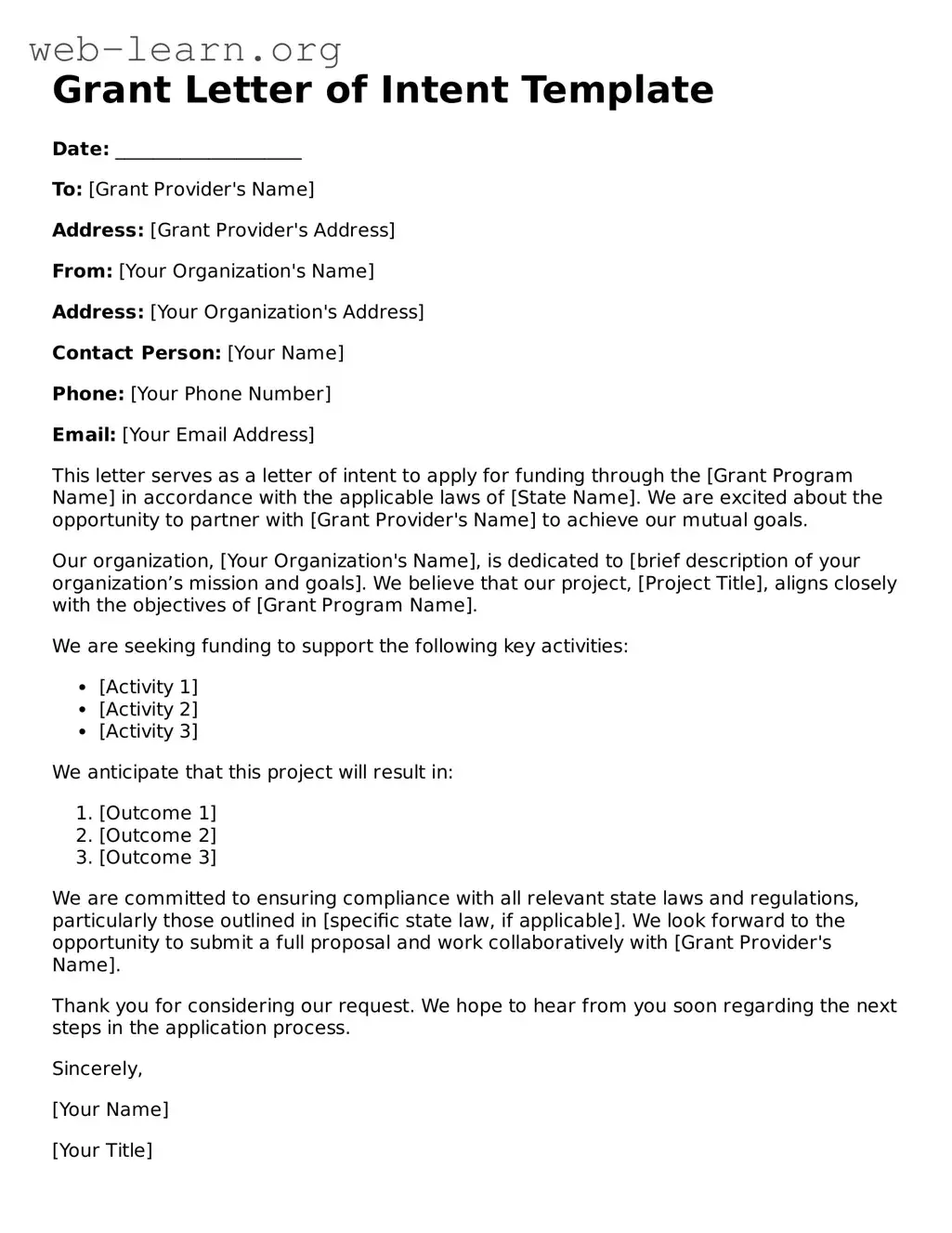
When seeking funding for a project or initiative, a Grant Letter of Intent (LOI) serves as a crucial first step in the application process. This document outlines your intention to apply for a grant, providing potential funders with a snapshot of your project. Typically, it includes key elements such as the project's purpose, objectives, and anticipated outcomes, along with a brief description of your organization and its qualifications. The LOI often highlights the significance of the project and how it aligns with the funder's mission and goals. By submitting this letter, you not only express your interest but also set the stage for a more detailed proposal, allowing funders to assess whether your project merits further consideration. A well-crafted LOI can pave the way for a successful funding application, making it essential to approach this task thoughtfully and strategically.
Grant Letter of Intent Template
Date: ____________________
To: [Grant Provider's Name]
Address: [Grant Provider's Address]
From: [Your Organization's Name]
Address: [Your Organization's Address]
Contact Person: [Your Name]
Phone: [Your Phone Number]
Email: [Your Email Address]
This letter serves as a letter of intent to apply for funding through the [Grant Program Name] in accordance with the applicable laws of [State Name]. We are excited about the opportunity to partner with [Grant Provider's Name] to achieve our mutual goals.
Our organization, [Your Organization's Name], is dedicated to [brief description of your organization’s mission and goals]. We believe that our project, [Project Title], aligns closely with the objectives of [Grant Program Name].
We are seeking funding to support the following key activities:
We anticipate that this project will result in:
We are committed to ensuring compliance with all relevant state laws and regulations, particularly those outlined in [specific state law, if applicable]. We look forward to the opportunity to submit a full proposal and work collaboratively with [Grant Provider's Name].
Thank you for considering our request. We hope to hear from you soon regarding the next steps in the application process.
Sincerely,
[Your Name]
[Your Title]
[Your Organization's Name]
| Fact Name | Description |
|---|---|
| Purpose | The Grant Letter of Intent form is used to express an organization's intention to apply for a grant. |
| Eligibility | Typically, non-profit organizations, educational institutions, and government entities are eligible to submit this form. |
| State-Specific Forms | Some states may have their own versions of the form, which must comply with local regulations. |
| Governing Laws | The form is governed by federal and state grant laws, which vary by jurisdiction. |
| Submission Deadline | Deadlines for submission are often set by the grantor and must be strictly adhered to. |
| Follow-Up | After submission, applicants may need to provide additional information or clarification as requested by the grantor. |
After completing the Grant Letter of Intent form, you will need to review it for accuracy and ensure all required sections are filled out. Once finalized, the form should be submitted according to the guidelines provided by the grant organization.
What is a Grant Letter of Intent (LOI)?
A Grant Letter of Intent is a preliminary proposal submitted to a funding organization. It outlines the intent to apply for a grant and provides a brief overview of the project or program for which funding is being sought. The LOI helps the funding agency determine if the proposed project aligns with their priorities and guidelines.
Why do I need to submit a Letter of Intent?
Submitting an LOI is often a required step in the grant application process. It allows the funding organization to assess the suitability of your project before you invest time and resources into a full proposal. Additionally, some grant programs may only accept applications from those who have submitted an LOI and received approval to proceed.
What information should be included in the LOI?
The LOI typically includes:
Be concise and clear, as most LOIs have a word limit or specific formatting requirements.
How long should the Letter of Intent be?
The length of a Grant Letter of Intent can vary depending on the specific requirements of the funding organization. Generally, LOIs are brief, ranging from one to three pages. Always check the guidelines provided by the funding agency to ensure compliance with their expectations.
When is the best time to submit my LOI?
It is advisable to submit your LOI well in advance of the grant application deadline. This allows time for any feedback or revisions that may be necessary. Review the funding agency's timeline and ensure you adhere to their submission dates.
What happens after I submit my LOI?
After submission, the funding organization will review your LOI to determine if your project aligns with their goals. You may receive feedback or a request for further information. If your LOI is accepted, you will typically be invited to submit a full grant proposal.
Filling out a Grant Letter of Intent (LOI) can be a crucial step in securing funding for a project. However, many applicants make common mistakes that can jeopardize their chances. One frequent error is failing to follow the specific guidelines set by the funding organization. Each grantor may have unique requirements regarding format, length, and content. Ignoring these guidelines can lead to an immediate rejection.
Another mistake involves not clearly articulating the project’s goals and objectives. Applicants often assume that reviewers will understand the significance of their project without sufficient explanation. A lack of clarity can create confusion and diminish the perceived value of the proposal. It is essential to present a well-defined purpose and measurable outcomes.
Inadequate research about the funding organization is another pitfall. Each grantor has its own mission and priorities. When applicants do not align their project with the funder’s interests, they risk appearing out of touch. A successful LOI should demonstrate an understanding of the grantor’s goals and how the proposed project complements them.
Many applicants also underestimate the importance of proofreading. Spelling and grammatical errors can detract from the professionalism of the LOI. Such mistakes may lead reviewers to question the applicant's attention to detail and overall commitment to the project. A well-edited document reflects seriousness and respect for the review process.
Lastly, neglecting to include a budget or financial plan can be detrimental. While the LOI is often a preliminary document, providing a clear outline of anticipated costs shows that the applicant has thought through the project’s feasibility. A detailed budget can enhance the credibility of the proposal and indicate preparedness.
The Grant Letter of Intent form is a crucial document in the grant application process. It serves as an initial proposal that outlines the intent to apply for funding. Several other forms and documents often accompany this form to provide additional information and support the application. Below are some commonly used documents that may be included in the grant application package.
Including these documents alongside the Grant Letter of Intent form can enhance the overall application, making it more comprehensive and persuasive. Each piece plays a vital role in conveying the project's significance and the organization's ability to execute it successfully.
The Grant Letter of Intent form is a key document in the grant application process, serving as a preliminary proposal to funders. Several other documents share similarities with this form in terms of purpose and content. Below is a list of seven documents that are comparable to the Grant Letter of Intent form:
Understanding these documents can help navigate the grant application landscape more effectively.
When filling out a Grant Letter of Intent form, it's essential to approach the task thoughtfully. Here are five things you should and shouldn't do:
By following these guidelines, you can enhance your chances of making a positive impression with your Grant Letter of Intent.
When it comes to the Grant Letter of Intent (LOI) form, there are several misconceptions that can lead to confusion. Understanding these common misunderstandings can help ensure a smoother application process.
Many people think that submitting a Letter of Intent is equivalent to submitting a full grant application. However, the LOI is typically a preliminary step that outlines your project idea and its significance. It helps funders decide if they want to see a full application.
Some believe that any individual or organization can submit an LOI. In reality, funders often have specific eligibility criteria. It’s important to ensure that your project aligns with the funder’s goals before submitting.
Submitting an LOI does not guarantee that you will receive funding. It is merely a way to express interest and provide a brief overview of your project. The funder will still review the full application and make decisions based on various factors.
Some may think that a longer LOI is better. However, most funders prefer concise letters that clearly convey the project’s purpose, goals, and potential impact. Keeping it brief and to the point is often more effective.
It’s a common belief that writing an LOI is simply about outlining your idea. In fact, conducting research is crucial. Understanding the funder’s priorities and tailoring your letter accordingly can significantly improve your chances of moving forward.
Some people think that once they submit their LOI, they cannot make any changes. In many cases, funders may allow you to revise your letter if they request additional information or clarification. Open communication can help clarify any uncertainties.
Filling out and using the Grant Letter of Intent form is a crucial step in the grant application process. Here are some key takeaways to keep in mind:
By keeping these takeaways in mind, you can enhance your chances of making a positive impression and advancing your grant application process.
Sample Letter of Intent for Promotion Within Company - The Letter of Intent can help the employee stand out among other candidates for promotion.
Commercial Lease Proposal Template - It can also address options for renewal or expansion of the lease in the future.
Letter of Intent Template Medical School - A chance to discuss your plans for professional development beyond medical school.