Applying to graduate school can be a daunting task, and one critical component of the application process is the Graduate School Recommendation Letter form. This form serves as a vital tool for applicants, allowing them to showcase their strengths and potential through the eyes of their recommenders. Typically, it includes sections for the recommender's contact information, their relationship to the applicant, and an evaluation of the applicant’s skills, achievements, and character. Additionally, it may prompt recommenders to provide specific examples that highlight the applicant's qualifications for the program. The form often requires a signature, affirming the authenticity of the recommendation, and may also include a deadline for submission to ensure timely processing. Understanding the nuances of this form can significantly enhance an applicant's chances of standing out in a competitive field.
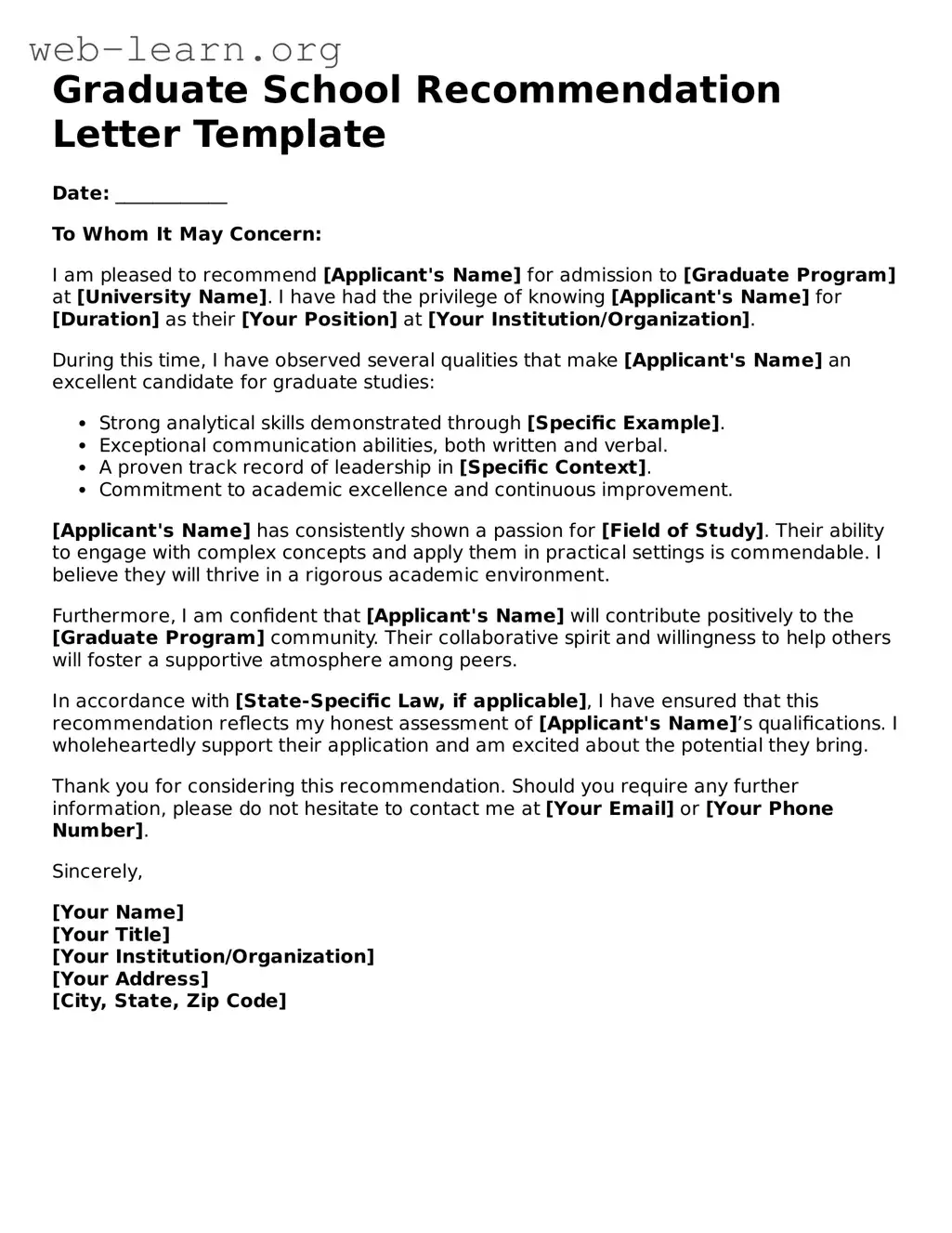
Graduate School Recommendation Letter Template
Date: ____________
To Whom It May Concern:
I am pleased to recommend [Applicant's Name] for admission to [Graduate Program] at [University Name]. I have had the privilege of knowing [Applicant's Name] for [Duration] as their [Your Position] at [Your Institution/Organization].
During this time, I have observed several qualities that make [Applicant's Name] an excellent candidate for graduate studies:
[Applicant's Name] has consistently shown a passion for [Field of Study]. Their ability to engage with complex concepts and apply them in practical settings is commendable. I believe they will thrive in a rigorous academic environment.
Furthermore, I am confident that [Applicant's Name] will contribute positively to the [Graduate Program] community. Their collaborative spirit and willingness to help others will foster a supportive atmosphere among peers.
In accordance with [State-Specific Law, if applicable], I have ensured that this recommendation reflects my honest assessment of [Applicant's Name]’s qualifications. I wholeheartedly support their application and am excited about the potential they bring.
Thank you for considering this recommendation. Should you require any further information, please do not hesitate to contact me at [Your Email] or [Your Phone Number].
Sincerely,
[Your Name]
[Your Title]
[Your Institution/Organization]
[Your Address]
[City, State, Zip Code]
| Fact Name | Description |
|---|---|
| Purpose | The Graduate School Recommendation Letter form is used to gather insights about a candidate's qualifications from a recommender. |
| Recommender Requirements | Recommenders should be familiar with the candidate's academic or professional abilities and can provide an honest assessment. |
| Submission Process | Recommenders typically submit the form directly to the graduate school, ensuring confidentiality and integrity of the recommendation. |
| State-Specific Forms | Some states may have specific forms or requirements; check local regulations for compliance. |
| Governing Laws | In states like California, the California Education Code governs the use of recommendation letters in educational institutions. |
| Content Guidelines | The form should include specific questions about the candidate’s skills, achievements, and potential for success in graduate studies. |
| Confidentiality | Many institutions encourage or require recommenders to keep their letters confidential to promote candid feedback. |
Once you have the Graduate School Recommendation Letter form, it's time to provide the necessary information. This process requires careful attention to detail. Follow these steps to complete the form accurately.
After completing the form, ensure that all information is accurate before submitting it to the recommender. This will help them provide a thoughtful and relevant recommendation letter.
A Graduate School Recommendation Letter serves as a testament to a candidate's qualifications, character, and potential for success in graduate studies. It provides admissions committees with insights into the applicant's skills, experiences, and academic abilities from the perspective of someone who has observed their work and growth. These letters can significantly influence the decision-making process by highlighting strengths that may not be evident from transcripts alone.
It is advisable to choose individuals who are familiar with your academic or professional achievements. Ideal recommenders include:
Consider selecting recommenders who can provide specific examples of your accomplishments and character, as these details can make the letter more impactful.
To facilitate a strong recommendation, it is helpful to provide your recommenders with the following:
Providing this information can help your recommenders craft a more personalized and compelling letter.
It is important to give your recommenders ample time to write and submit their letters. Generally, a timeline of at least 4-6 weeks before the application deadline is recommended. This allows them to reflect on your qualifications and write a thoughtful letter. Be sure to communicate the deadlines clearly and follow up politely as the date approaches, ensuring that they have everything they need to complete the letter on time.
Filling out a Graduate School Recommendation Letter form is a crucial step in the application process. Many applicants make common mistakes that can negatively impact their chances of admission. One significant error is providing vague or generic information. When recommenders fail to highlight specific skills or experiences, the letter lacks the personal touch that admissions committees seek. A strong recommendation should paint a clear picture of the applicant’s abilities and character.
Another frequent mistake is overlooking the deadline. Timeliness is essential in the application process. If a recommendation letter is submitted late, it may not be considered. Recommenders should be reminded of the deadline well in advance. This proactive approach ensures that the letter arrives on time and reflects positively on the applicant's organizational skills.
Some individuals also underestimate the importance of tailoring the recommendation. A one-size-fits-all letter does not serve the applicant well. Each program may have different criteria and values. A recommendation should address these specific aspects, demonstrating a clear understanding of the program and how the applicant fits into it. Without this customization, the letter may fail to resonate with the admissions committee.
Finally, failing to proofread the recommendation can lead to serious consequences. Spelling mistakes, grammatical errors, or unclear phrasing can undermine the credibility of the recommendation. A polished letter not only reflects well on the recommender but also enhances the applicant’s chances of success. Attention to detail is critical in creating a strong impression.
When applying to graduate school, candidates often need to submit various forms and documents alongside the Graduate School Recommendation Letter. Each of these documents plays a crucial role in providing a comprehensive view of the applicant's qualifications and potential for success in their chosen field. Below is a list of commonly required documents that complement the recommendation letter.
Each of these documents contributes to a holistic view of the applicant, enhancing the understanding of their qualifications and readiness for graduate study. Together, they create a comprehensive application package that supports the recommendation letter in presenting a strong case for admission.
The Graduate School Recommendation Letter form serves a specific purpose in the application process for graduate programs. However, it shares similarities with several other documents that also play a crucial role in evaluating a candidate’s qualifications. Here are four documents that are similar to the Graduate School Recommendation Letter form:
When it comes to filling out a Graduate School Recommendation Letter form, attention to detail can make a significant difference. Here’s a list of things to keep in mind, both what to embrace and what to avoid.
By following these guidelines, you can craft a recommendation that truly reflects the applicant's potential and supports their pursuit of advanced education.
When it comes to the Graduate School Recommendation Letter form, several misconceptions can lead to confusion for both applicants and recommenders. Understanding these myths can help streamline the application process and ensure that all parties are on the same page.
Many believe that the recommendation letter form is optional for every graduate program. In reality, most programs require it as part of the application process. It's essential to check specific program requirements to avoid any surprises.
Some applicants think that any letter from a professor or employer will meet the requirements. However, graduate programs often look for specific qualities and experiences that align with their criteria. A tailored recommendation that speaks to the applicant’s strengths is crucial.
While the form provides a structure, recommenders are encouraged to personalize their letters. Adding specific examples and anecdotes can significantly enhance the letter's impact, making it more memorable to admissions committees.
Another common belief is that submission deadlines for recommendation letters are flexible. In fact, most graduate programs have strict deadlines. Late submissions can jeopardize an applicant's chances, so it’s important to communicate clearly with recommenders about timelines.
Filling out and using a Graduate School Recommendation Letter form can be a critical step in the application process. Here are some key takeaways to keep in mind:
By considering these points, you can enhance the effectiveness of your recommendation letters and strengthen your graduate school application.