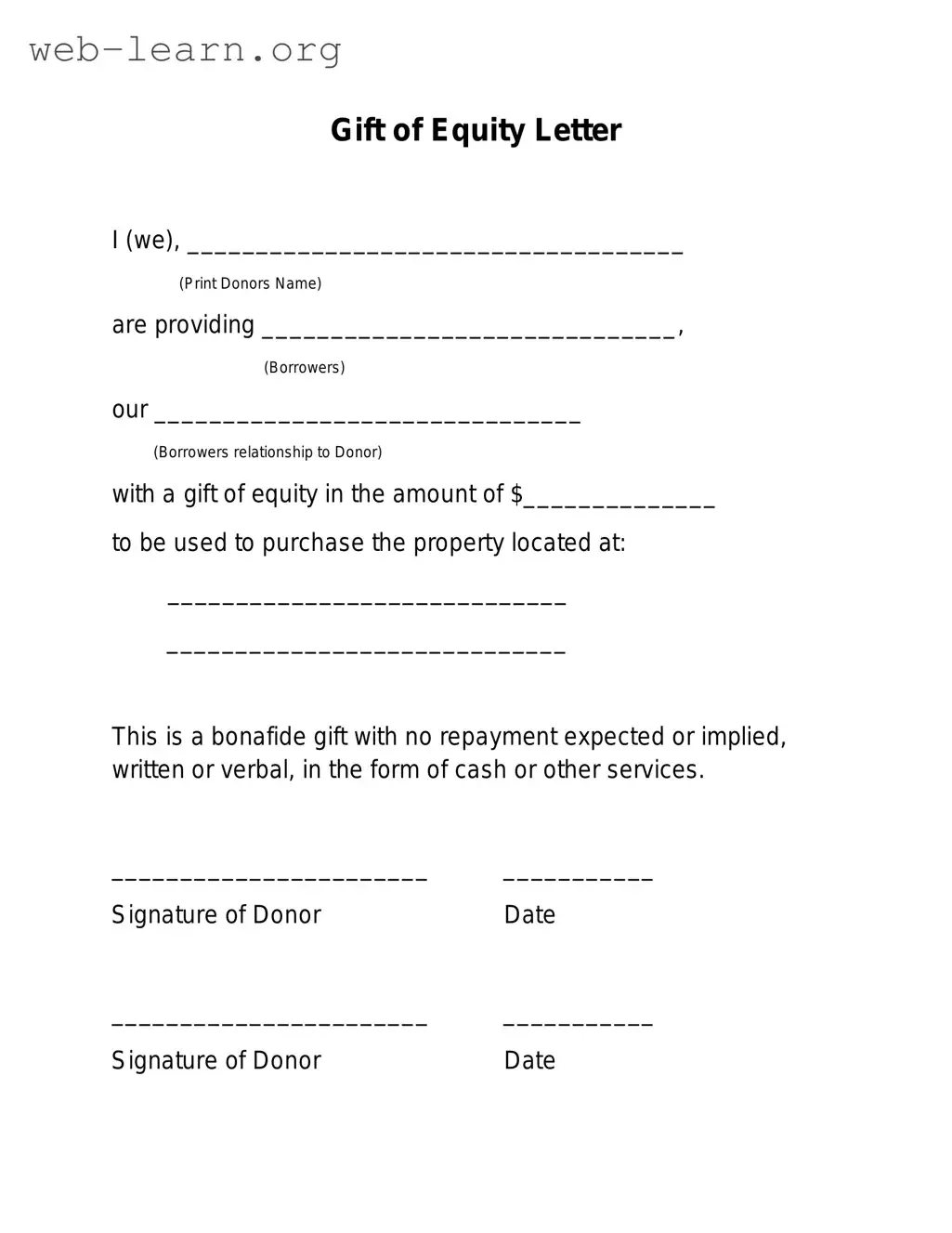
The Gift of Equity Letter serves as an important document in real estate transactions, particularly when a property is being transferred between family members or close friends. This letter outlines the specifics of a financial gift that allows the recipient to leverage the equity in a property for purchasing purposes. It begins with the names of the donors and the borrower, clearly establishing the relationship between the parties involved. The document specifies the amount of equity being gifted, which can significantly aid the borrower in securing financing for the property purchase. Importantly, the letter emphasizes that this is a genuine gift, with no expectation of repayment, whether in cash or through services. Signatures from the donors, along with the date, provide authenticity and clarity to the agreement, ensuring that all parties are on the same page regarding the terms of the gift. By formalizing this arrangement, the Gift of Equity Letter not only facilitates smoother transactions but also helps in maintaining transparency among family members and friends involved in the property transfer.
Gift of Equity Letter
I (we), ____________________________________
(Print Donors Name)
are providing ______________________________,
(Borrowers)
our _______________________________
(Borrowers relationship to Donor)
with a gift of equity in the amount of $______________
to be used to purchase the property located at:
_____________________________
_____________________________
This is a bonafide gift with no repayment expected or implied, written or verbal, in the form of cash or other services.
_______________________ |
___________ |
Signature of Donor |
Date |
_______________________ |
___________ |
Signature of Donor |
Date |
| Fact Name | Details |
|---|---|
| Purpose | The Gift of Equity Letter is used to document a gift of equity from a donor to a borrower for purchasing property. |
| Donor Information | The form requires the donor's name to be printed clearly to identify who is providing the gift. |
| Borrower Relationship | The relationship between the donor and the borrower must be specified, such as family member or friend. |
| Gift Amount | The exact dollar amount of the gift of equity must be included in the form. |
| Property Location | The address of the property being purchased with the gift must be clearly stated. |
| No Repayment Clause | The letter confirms that the gift is a bona fide gift with no expectation of repayment, either written or verbal. |
| Signatures | Both donors must sign and date the letter to validate the gift and confirm their intent. |
| State-Specific Forms | Some states may have specific requirements or forms related to gifts of equity; always check local laws. |
Once you have gathered the necessary information, you can proceed to fill out the Gift of Equity Letter form. This document is essential for establishing the terms of the gift and ensuring clarity between the donor and the borrower. Follow these steps to complete the form accurately.
After completing these steps, ensure that all information is accurate and legible. This form will serve as a formal record of the gift and can be presented during the loan application process. Keep a copy for your records as well.
What is a Gift of Equity Letter?
A Gift of Equity Letter is a document that outlines a financial gift given by a donor to a borrower. This gift is typically used to help the borrower purchase a property. The letter specifies the amount of equity being gifted and confirms that it is a genuine gift with no expectation of repayment.
Who typically uses a Gift of Equity Letter?
This letter is commonly used in family transactions, where a family member, such as a parent or grandparent, gifts equity to help a relative buy a home. It can also be used in other close relationships, such as between friends or partners.
What information is required in the Gift of Equity Letter?
The letter must include:
Is the Gift of Equity Letter legally binding?
While the letter serves as a formal acknowledgment of the gift, it is generally not a legally binding contract. However, it is important for the letter to clearly state that the gift is a bona fide gift, with no repayment expected, to avoid any misunderstandings in the future.
Do I need to have the Gift of Equity Letter notarized?
Notarization is not typically required for a Gift of Equity Letter. However, some lenders may request it as part of their documentation process. It's a good idea to check with your lender to see what their specific requirements are.
Can the Gift of Equity affect the borrower's mortgage application?
Yes, it can. Lenders often view a Gift of Equity as a positive factor, as it shows that the borrower has support from family or friends. However, it is essential to provide proper documentation, including the Gift of Equity Letter, to ensure that the lender understands the nature of the gift.
What if the donor changes their mind after signing the letter?
Once the Gift of Equity Letter is signed, it is generally understood to be a final decision. Since it is a gift, the donor cannot expect repayment. However, if there are significant changes in circumstances, open communication between the donor and borrower is crucial.
Are there any tax implications for the donor or borrower?
Gifts of equity may have tax implications. The donor may need to file a gift tax return if the amount exceeds the annual gift tax exclusion limit. Borrowers should consult a tax professional to understand how the gift may affect their tax situation.
Where can I find a template for a Gift of Equity Letter?
Templates for Gift of Equity Letters can be found online, or you may want to consult with a real estate attorney for assistance. It's important to ensure that any template used meets the specific requirements of your situation and lender.
Filling out a Gift of Equity Letter form is a straightforward process, but mistakes can lead to complications. One common error is failing to provide complete names. The form requires the full names of both the donor and the borrower. Omitting or misspelling these names can create confusion and may affect the validity of the gift.
Another frequent mistake is leaving out the relationship between the donor and the borrower. This section is crucial for establishing the context of the gift. If this information is missing, it could raise questions about the nature of the transaction.
People often forget to specify the exact amount of the gift. The form includes a blank for the dollar amount, and leaving this blank can render the document incomplete. A clearly stated amount is essential for clarity and legal purposes.
Some individuals neglect to include the property address where the equity gift will be applied. This detail is vital as it ties the gift to a specific transaction. Without it, the intent of the gift may be unclear.
Another mistake is not signing the form properly. Both donors must sign and date the document. Failing to include signatures can invalidate the gift, leading to potential disputes later.
In addition, people sometimes overlook the importance of stating that the gift is a "bonafide gift." This phrase clarifies that there are no expectations of repayment. Without this declaration, the transaction may be misinterpreted.
Some may also forget to mention whether the gift is in cash or other services. This detail is important for tax implications and for understanding the nature of the gift. Clarity here can prevent misunderstandings.
Individuals often fail to keep a copy of the completed form. Retaining a copy is essential for both the donor and the borrower. This serves as proof of the transaction and can be helpful for future reference.
Lastly, people may not consult with a legal or financial advisor before completing the form. Given the potential tax implications and legal considerations, seeking professional advice can help ensure that the gift is structured correctly and complies with all regulations.
The Gift of Equity Letter is a crucial document in real estate transactions where a property owner gifts equity to a buyer, often a family member. Several other forms and documents may accompany this letter to ensure clarity and compliance throughout the process. Below is a list of commonly used documents that may be required alongside the Gift of Equity Letter.
Each of these documents plays a significant role in the overall process of transferring property and ensuring that all parties involved are protected and informed. Properly preparing and submitting these forms can facilitate a smoother transaction and help avoid potential issues down the line.
The Gift of Equity Letter form shares similarities with several other documents used in real estate and financial transactions. Each serves a unique purpose but often conveys similar intentions regarding the transfer of value without expectation of repayment. Below are seven documents that align closely with the Gift of Equity Letter:
When filling out the Gift of Equity Letter form, it's essential to approach the task with care. Here are some key dos and don'ts to ensure that the process goes smoothly.
By following these guidelines, you can help ensure that your Gift of Equity Letter is complete and effective, facilitating a smoother transaction for everyone involved.
Understanding the Gift of Equity Letter form is crucial for both donors and borrowers. Here are five common misconceptions that need to be clarified:
Addressing these misconceptions is vital for a smooth transaction. Ensure all parties understand the terms and conditions involved in the Gift of Equity Letter.
When filling out and using the Gift of Equity Letter form, it is essential to understand its purpose and requirements. Below are key takeaways to consider: