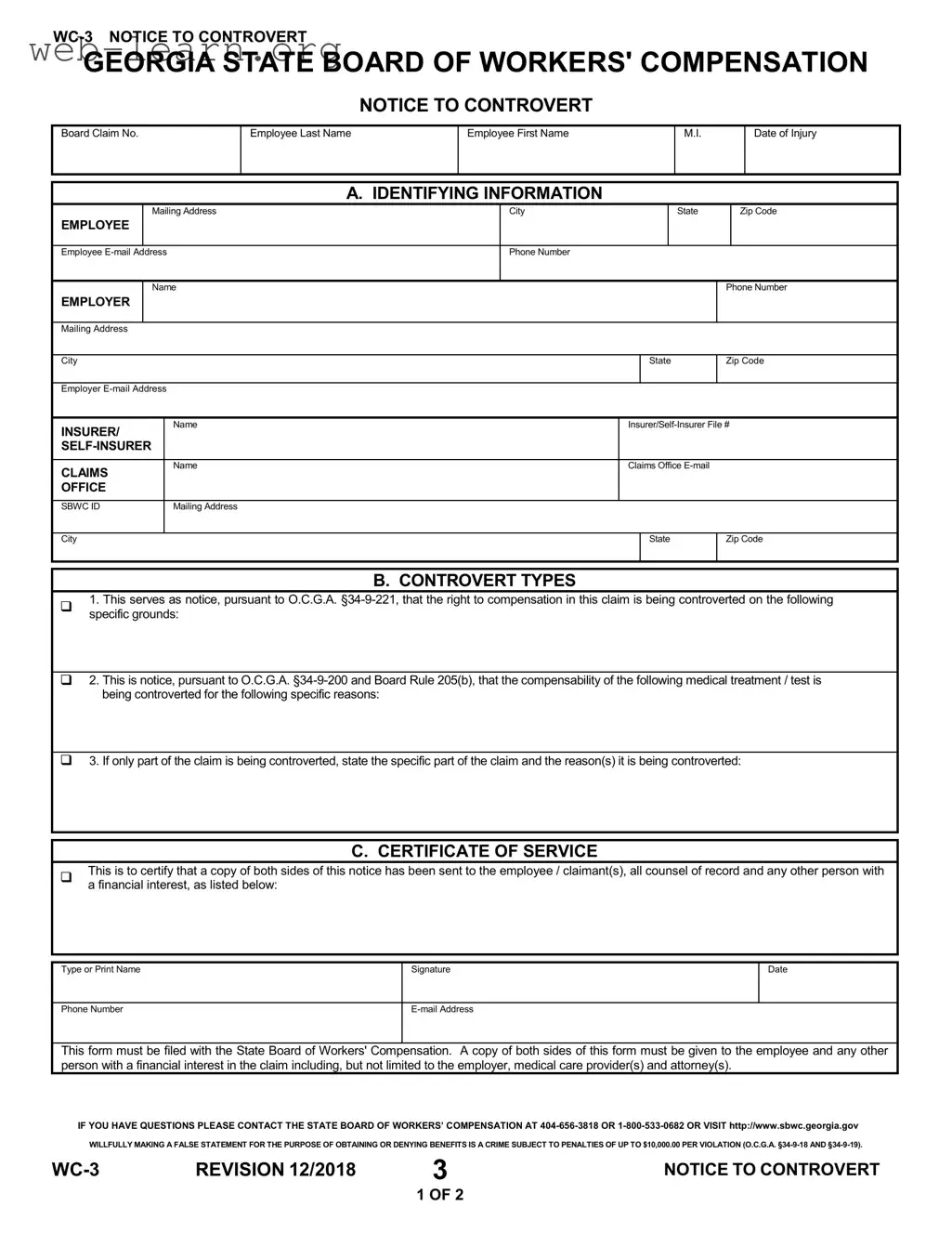
The Georgia WC-3 form, officially known as the Notice to Controvert, plays a crucial role in the workers' compensation process within the state. This form is utilized by employers or insurers to formally contest a worker's claim for compensation. It must be filed with the Georgia State Board of Workers' Compensation when there is a disagreement regarding the right to compensation or the compensability of specific medical treatments. The form includes essential identifying information about the employee, employer, and insurer, ensuring that all parties involved are clearly identified. Additionally, it outlines the specific grounds for the controversion, which can range from disputing the right to compensation altogether to questioning particular medical treatments. It is vital for the form to be completed accurately and submitted within a specified timeframe to avoid potential penalties, including attorney fees. Furthermore, a certificate of service is included, confirming that all relevant parties, such as the employee and their legal representatives, have been notified. Understanding the nuances of the WC-3 form is essential for both employers and employees navigating the complexities of workers' compensation claims in Georgia.

GEORGIA STATE BOARD OF WORKERS' COMPENSATION
NOTICE TO CONTROVERT
Board Claim No.
Employee Last Name
Employee First Name
M.I.
Date of Injury
|
|
|
|
A. IDENTIFYING INFORMATION |
|
|
|
|
|
|
EMPLOYEE |
|
Mailing Address |
|
City |
|
|
State |
|
Zip Code |
|
|
|
|
|
|
|
|
|
|
|
|
|
|
|
|
|
|
|
|
|
|
|
Employee |
|
Phone Number |
|
|
|
|
|
|||
|
|
|
|
|
|
|
|
|
|
|
EMPLOYER |
|
Name |
|
|
|
|
|
Phone Number |
||
|
|
|
|
|
|
|
|
|
|
|
|
|
|
|
|
|
|
|
|
|
|
Mailing Address |
|
|
|
|
|
|
|
|
|
|
|
|
|
|
|
|
|
|
|||
City |
|
|
|
|
|
State |
Zip Code |
|||
|
|
|
|
|
|
|
|
|
||
Employer |
|
|
|
|
|
|
|
|||
|
|
|
|
|
|
|
||||
INSURER/ |
|
Name |
|
|
||||||
|
|
|
|
|
|
|
|
|
||
|
|
|
|
|
|
|
|
|
||
|
|
|
|
|
|
|
|
|
||
CLAIMS |
|
Name |
|
|
Claims Office |
|
|
|||
|
|
|
|
|
|
|
|
|
||
OFFICE |
|
|
|
|
|
|
|
|
|
|
|
|
|
|
|
|
|
|
|
|
|
SBWC ID |
|
Mailing Address |
|
|
|
|
|
|
|
|
|
|
|
|
|
|
|
|
|||
City |
|
|
|
|
|
State |
Zip Code |
|||
|
|
|
|
|
|
|
|
|
|
|
|
|
B. CONTROVERT TYPES |
|
1. This serves as notice, pursuant to O.C.G.A. |
|
|
specific grounds: |
|
|
|
|
|
2. |
This is notice, pursuant to O.C.G.A. |
|
|
being controverted for the following specific reasons: |
|
|
|
|
3. |
If only part of the claim is being controverted, state the specific part of the claim and the reason(s) it is being controverted: |
|
|
|
|
|
C. CERTIFICATE OF SERVICE |
|
|
|
|
This is to certify that a copy of both sides of this notice has been sent to the employee / claimant(s), all counsel of record and any other person with |
||||
|
a financial interest, as listed below: |
|
|
|
|
|
|
|
|
|
|
|
|
|
|
|
|
Type or Print Name |
|
Signature |
|
Date |
|
|
|
|
|
|
|
Phone Number |
|
|
|
||
|
|
||||
This form must be filed with the State Board of Workers' Compensation. A copy of both sides of this form must be given to the employee and any other |
|||||
person with a financial interest in the claim including, but not limited to the employer, medical care provider(s) and attorney(s). |
|||||
|
IF YOU HAVE QUESTIONS PLEASE CONTACT THE STATE BOARD OF WORKERS’ COMPENSATION AT |
||||
|
WILLFULLY MAKING A FALSE STATEMENT FOR THE PURPOSE OF OBTAINING OR DENYING BENEFITS IS A CRIME SUBJECT TO PENALTIES OF UP TO $10,000.00 PER VIOLATION (O.C.G.A. |
||||
REVISION 12/2018 |
3 |
NOTICE TO CONTROVERT |
|||
|
|
|
1 OF 2 |
|
|
NOTICE TO CONTROVERT |
GEORGIA STATE BOARD OF WORKERS' COMPENSATION
INFORMATION FOR THE
Board Rule 61(b)(1): An insurer who receives a Form
Board Rule 61(b)(4): previously been filed.
Form
O.C.G.A.
Board Rule 221(d): To controvert in whole or in part the right to income benefits or other compensation use Form
O.C.G.A.
Board Rule 221(h)(1): A Form
O.C.G.A.
Board Rule 221(h)(2): If income benefits have been continued for more than 60 days after the due date of first payment of compensation, benefits may be suspended only on the grounds of a change in condition or newly discovered evidence. File Forms
O.C.G.A.
INFORMATION FOR THE EMPLOYEE:
This claim is being controverted for the reason(s) indicated on the front of this form. If you disagree, you should request a hearing by sending Form
STATE BOARD OF WORKERS' COMPENSATION
270 Peachtree Street, N.W. Atlanta, Georgia
or:
http://www.sbwc.georgia.gov
IF YOU HAVE QUESTIONS PLEASE CONTACT THE STATE BOARD OF WORKERS’ COMPENSATION AT
WILLFULLY MAKING A FALSE STATEMENT FOR THE PURPOSE OF OBTAINING OR DENYING BENEFITS IS A CRIME SUBJECT TO PENALTIES OF UP TO $10,000.00 PER VIOLATION (O.C.G.A.
REVISION 12/2018 |
3 |
NOTICE TO CONTROVERT |
|
|
|
2 OF 2 |
|
| Fact Name | Details |
|---|---|
| Form Purpose | The WC-3 form is used to notify the Georgia State Board of Workers' Compensation that a claim for workers' compensation is being contested. |
| Governing Laws | The form is governed by O.C.G.A. §34-9-221 and Board Rule 205(b). |
| Filing Deadline | The form must be filed within 21 days after the employer becomes aware of the alleged injury or death. |
| Certification Requirement | A certificate of service must be included, confirming that copies were sent to all relevant parties. |
| Controvert Types | The form allows for multiple grounds to contest a claim, including the right to compensation and specific medical treatments. |
| Employee Notification | A copy of the form must be provided to the employee and any other individuals with a financial interest in the claim. |
| False Statements | Willfully making a false statement on this form can result in penalties of up to $10,000. |
| Insurer Responsibilities | Insurers must complete the form and send it to the Board within the specified time frame after receiving a Form WC-1. |
| Related Forms | Form WC-1 and Form WC-2 are also relevant in the context of workers' compensation claims and their contestation. |
Filling out the Georgia WC-3 form is an important step in the workers' compensation process. This form notifies the State Board of Workers' Compensation that a claim is being disputed. It’s essential to complete the form accurately to ensure that all parties involved are properly informed.
What is the purpose of the Georgia WC-3 form?
The Georgia WC-3 form, also known as the Notice to Controvert, is used by employers or insurers to formally dispute a worker's compensation claim. This form notifies the State Board of Workers' Compensation that the right to compensation is being contested. It outlines the specific reasons for the dispute, which can include issues related to the claim's compensability or specific medical treatments.
When should the WC-3 form be filed?
The WC-3 form must be filed within 21 days after the employer or insurer becomes aware of the alleged injury or death. Failing to file the form on time may result in penalties, including the potential assessment of attorney's fees.
What information is required on the WC-3 form?
The form requires identifying information about the employee, employer, and insurer. This includes names, addresses, phone numbers, and email addresses. Additionally, it asks for details regarding the specific grounds for controverting the claim. This ensures that all parties are aware of the reasons for the dispute.
What happens after filing the WC-3 form?
Once the WC-3 form is filed, a copy must be provided to the employee and any other parties with a financial interest in the claim, such as medical providers or attorneys. The State Board of Workers' Compensation will then process the notice and may schedule a hearing if necessary.
Can the WC-3 form be used for all types of disputes?
No, the WC-3 form is specifically for controverting claims related to compensation rights. It cannot be used to suspend benefits if the only issue is the length of disability. In those cases, a different form (WC-2) should be filed. If there are grounds for disputing benefits due to a change in condition or newly discovered evidence, the WC-3 can be used alongside the appropriate forms.
What should I do if I disagree with a WC-3 filing?
If you, as an employee, disagree with the reasons stated in the WC-3 form, you have the right to request a hearing. To do this, you need to send a Form WC-14 to the State Board of Workers' Compensation. You can obtain this form by contacting the Board directly or visiting their website.
Filling out the Georgia WC-3 form correctly is crucial for ensuring that claims are processed efficiently. However, many individuals make common mistakes that can lead to delays or complications. One frequent error is failing to provide complete identifying information. It's essential to include all required details about both the employee and employer, such as names, addresses, and contact information. Missing any of this information can result in the form being rejected or returned for corrections.
Another common mistake is neglecting to specify the grounds for controverting the claim. The form has designated sections where specific reasons must be stated. Without this clarity, the Board may not understand the basis for the controversion, leading to confusion and potential legal complications. It's important to be as precise as possible when explaining the reasons for disputing the claim.
People often overlook the importance of the certificate of service section. This section certifies that the notice has been sent to all relevant parties, including the employee and any legal representatives. Failing to fill this out correctly can create issues down the line, as it may appear that proper notification was not given. Always ensure that this section is completed with accurate names and signatures.
Additionally, individuals sometimes forget to keep a copy of the submitted form. Retaining a copy is vital for personal records and may be needed for future reference. If there are disputes or questions later on, having documentation can be invaluable. Always make a copy before submitting the form to the Board.
Another mistake involves the timing of the submission. The WC-3 form must be filed within 21 days after the employer's knowledge of the alleged injury. Delays can result in penalties or the automatic approval of benefits. It's critical to be aware of this timeline and act promptly to avoid complications.
Some individuals also fail to follow up after submitting the form. After filing, it’s wise to check in with the State Board of Workers’ Compensation to confirm receipt and ensure that there are no issues with the submission. This proactive approach can help catch any potential problems early.
Finally, a significant mistake is providing false information on the form. Misrepresenting facts can lead to serious legal consequences, including fines. It’s essential to be truthful and transparent in all claims to avoid penalties and ensure fair treatment in the claims process.
When dealing with workers' compensation claims in Georgia, several forms and documents accompany the WC-3 form. Each serves a specific purpose in the claims process. Understanding these documents is crucial for both employees and employers to navigate the system effectively.
Filing these documents accurately and timely is essential to avoid complications in the workers' compensation process. Each form plays a vital role in ensuring that both employees and employers fulfill their obligations and rights under Georgia law.
When filling out the Georgia WC-3 form, it is crucial to adhere to specific guidelines to ensure accuracy and compliance. Below is a list of ten important dos and don'ts.
This is incorrect. The WC-3 form must be filed within 21 days of the employer's knowledge of the injury or death. Failing to adhere to this timeline may lead to penalties.
In reality, the WC-3 can be used to controvert specific parts of a claim. It is not limited to a blanket denial of all benefits.
This form requires input from both the employer and the insurer or self-insurer. Both parties have responsibilities in the filing process.
This is misleading. Filing the WC-3 is a legal requirement if the employer wishes to formally contest the claim.
Contrary to this belief, a copy must be provided to the employee and any other interested parties to ensure transparency and communication.
This is not true. Benefits can only be suspended on specific grounds, such as a change in condition or newly discovered evidence.
These forms serve different purposes. The WC-1 is used to report a claim, while the WC-3 is specifically for disputing a claim.
Filing the form does not guarantee a denial; it simply initiates a formal process to contest the claim.
Incorrectly filling out the form can lead to delays and potential penalties. Accuracy is crucial when completing the WC-3.
While filing a WC-3 initiates a formal dispute, employers may still reach a settlement or withdraw their contest depending on the circumstances.
Key Takeaways for Using the Georgia WC-3 Form: