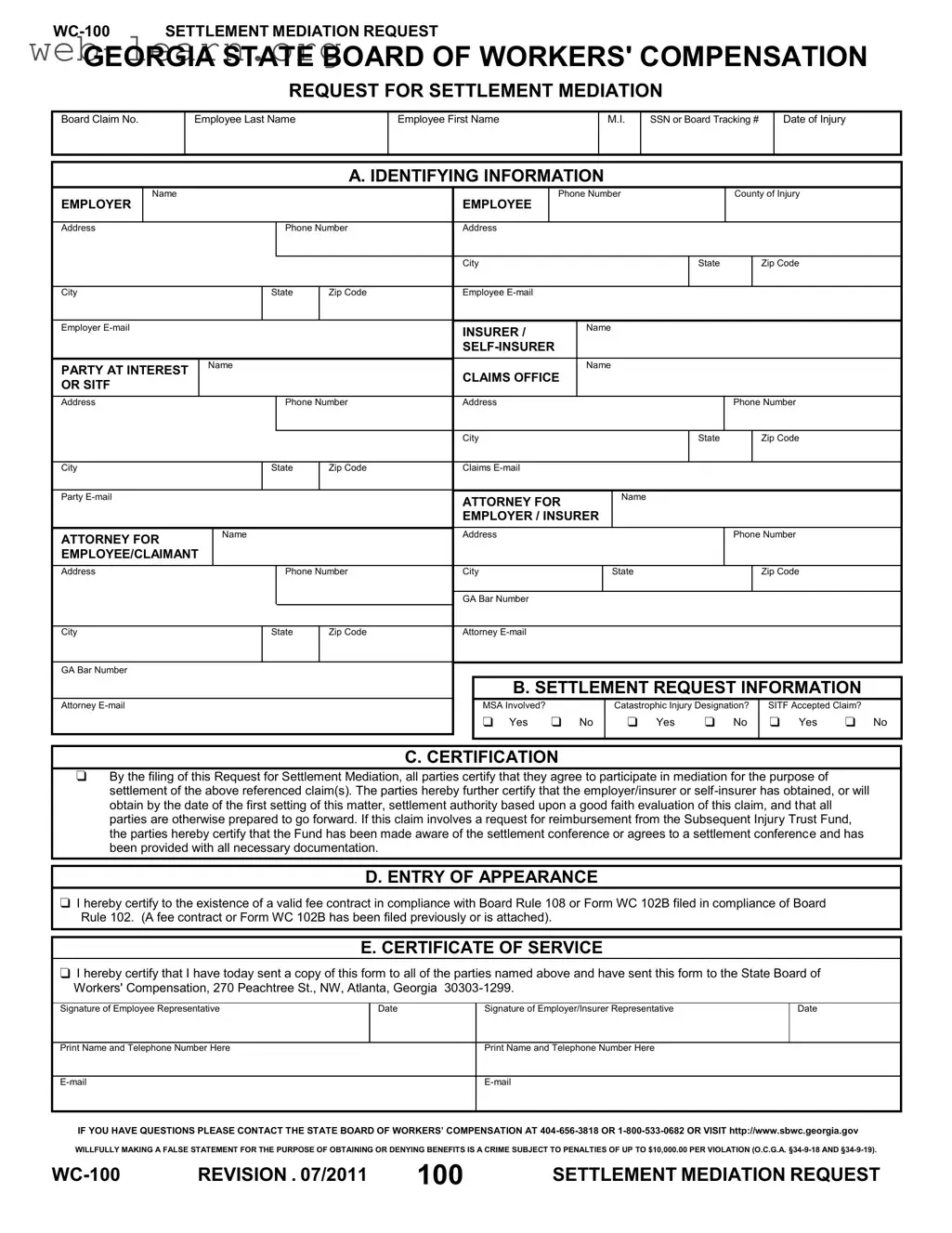
The Georgia WC-100 form serves as a critical tool for parties involved in workers' compensation claims, specifically when seeking settlement mediation. This form is essential for initiating the mediation process, allowing both employees and employers to formally request assistance from the Georgia State Board of Workers' Compensation. It requires detailed identifying information, such as the names and contact details of the employee, employer, and any involved insurers or attorneys. The form also includes sections to indicate whether the claim involves a catastrophic injury designation or if it has been accepted by the Subsequent Injury Trust Fund (SITF). Furthermore, all parties must certify their commitment to participate in mediation and confirm that the employer or insurer has obtained the necessary settlement authority. This ensures that everyone is prepared to engage in a good faith negotiation process. Lastly, the form mandates a certificate of service, confirming that all involved parties have received a copy, thereby promoting transparency and accountability throughout the mediation process.
GEORGIA STATE BOARD OF WORKERS' COMPENSATION
REQUEST FOR SETTLEMENT MEDIATION
Board Claim No.
Employee Last Name
Employee First Name
M.I.
SSN or Board Tracking #
Date of Injury
A. IDENTIFYING INFORMATION
|
|
Name |
|
|
|
|
|
|
Phone Number |
|
County of Injury |
|||
|
EMPLOYER |
|
|
|
|
|
EMPLOYEE |
|
|
|
|
|
|
|
|
|
|
|
|
|
|
|
|
|
|
|
|
|
|
|
Address |
|
|
Phone Number |
Address |
|
|
|
|
|
|
|||
|
|
|
|
|
|
|
|
|
|
|
|
|
|
|
|
|
|
|
|
|
|
City |
|
|
State |
|
Zip Code |
||
|
|
|
|
|
|
|
|
|
|
|
|
|||
|
City |
|
State |
Zip Code |
Employee |
|
|
|
|
|
|
|||
|
|
|
|
|
|
|
|
|
|
|
|
|
|
|
|
Employer |
|
|
|
|
INSURER / |
|
Name |
|
|
|
|
||
|
|
|
|
|
|
|
|
|
|
|
|
|
||
|
|
|
|
|
|
|
|
|
|
|
|
|
||
|
|
|
|
|
|
|
|
|
|
|
|
|
|
|
|
PARTY AT INTEREST |
Name |
|
|
|
|
|
|
Name |
|
|
|
|
|
|
|
|
|
|
CLAIMS OFFICE |
|
|
|
|
|
||||
|
OR SITF |
|
|
|
|
|
|
|
|
|
||||
|
|
|
|
|
|
|
|
|
|
|
|
|
||
|
|
|
|
|
|
|
|
|
|
|
|
|||
|
Address |
|
|
Phone Number |
Address |
|
|
|
Phone Number |
|||||
|
|
|
|
|
|
|
|
|
|
|
|
|
|
|
|
|
|
|
|
|
|
City |
|
|
State |
|
Zip Code |
||
|
|
|
|
|
|
|
|
|
|
|
|
|||
|
City |
|
State |
Zip Code |
Claims |
|
|
|
|
|
|
|||
|
|
|
|
|
|
|
|
|
|
|
|
|
|
|
Party
ATTORNEY FOR |
Name |
|
|
EMPLOYEE/CLAIMANT |
|
|
|
ATTORNEY FOR |
Name |
|
|
EMPLOYER / INSURER |
|
|
|
Address |
|
|
|
Phone Number
Address |
|
Phone Number |
City |
|
State |
|
|
Zip Code |
|
||
|
|
|
|
|
|
|
|
|
|
|
|
|
|
|
|
GA Bar Number |
|
|
|
|
|
|
|
|
|
|
|
|
|
|
|
|
|
|
|
City |
State |
Zip Code |
Attorney |
|
|
|
|
|
|
||
|
|
|
|
|
|
|
|
|
|
|
|
GA Bar Number |
|
|
|
|
|
|
|
|
|
|
|
|
|
|
|
|
B. SETTLEMENT REQUEST INFORMATION |
|
|||||
Attorney |
|
|
|
|
MSA Involved? |
|
Catastrophic Injury Designation? |
|
SITF Accepted Claim? |
|
|
|
|
|
|
|
Yes |
No |
Yes |
No |
|
Yes |
No |
|
|
|
|
|
|
|
|
|
|
|
|
|
|
|
|
|
|
|
|
|
|
|
|
C. CERTIFICATION
By the filing of this Request for Settlement Mediation, all parties certify that they agree to participate in mediation for the purpose of settlement of the above referenced claim(s). The parties hereby further certify that the employer/insurer or
D. ENTRY OF APPEARANCE
I hereby certify to the existence of a valid fee contract in compliance with Board Rule 108 or Form WC 102B filed in compliance of Board Rule 102. (A fee contract or Form WC 102B has been filed previously or is attached).
E. CERTIFICATE OF SERVICE
I hereby certify that I have today sent a copy of this form to all of the parties named above and have sent this form to the State Board of Workers' Compensation, 270 Peachtree St., NW, Atlanta, Georgia
Signature of Employee Representative
Date
Signature of Employer/Insurer Representative
Date
Print Name and Telephone Number Here
Print Name and Telephone Number Here
IF YOU HAVE QUESTIONS PLEASE CONTACT THE STATE BOARD OF WORKERS’ COMPENSATION AT
WILLFULLY MAKING A FALSE STATEMENT FOR THE PURPOSE OF OBTAINING OR DENYING BENEFITS IS A CRIME SUBJECT TO PENALTIES OF UP TO $10,000.00 PER VIOLATION (O.C.G.A.
REVISION . 07/2011 |
100 |
SETTLEMENT MEDIATION REQUEST |
| Fact Name | Details |
|---|---|
| Purpose of Form | The WC-100 form is used to request mediation for the settlement of a workers' compensation claim in Georgia. |
| Governing Law | This form is governed by the Georgia Workers' Compensation Act, specifically O.C.G.A. §34-9-1 et seq. |
| Certification Requirement | All parties must certify their agreement to participate in mediation and confirm that the employer/insurer has obtained settlement authority. |
| Submission Process | The completed form must be sent to all parties involved and submitted to the State Board of Workers' Compensation at their Atlanta office. |
Filling out the Georgia WC-100 form is an essential step for parties seeking mediation for a workers' compensation settlement. This form collects necessary information about the claim, the involved parties, and the settlement request. Properly completing this form is crucial to ensure that all relevant details are submitted for consideration.
Once the form is completed, it should be submitted to the State Board of Workers' Compensation. Ensure that all parties involved have received a copy of the form, as this is a critical step in the mediation process.
What is the purpose of the Georgia WC-100 form?
The Georgia WC-100 form is used to request mediation for the settlement of a workers' compensation claim. It is a formal document that outlines the details of the claim, including the parties involved, their contact information, and the nature of the injury. By filing this form, all parties agree to participate in mediation to reach a settlement.
Who needs to complete the WC-100 form?
Both the employee (claimant) and the employer (or their insurer) must complete the WC-100 form. Each party must provide their identifying information, including names, addresses, and contact details. Additionally, attorneys representing either party must also include their information on the form. This ensures that all relevant parties are notified and can participate in the mediation process.
What information is required on the WC-100 form?
The WC-100 form requires several key pieces of information:
This information is crucial for the mediation process and helps ensure that all parties are properly represented.
What happens after the WC-100 form is submitted?
Once the WC-100 form is submitted to the State Board of Workers' Compensation, the mediation process is initiated. All parties will be notified of the mediation date and location. It is important that all parties prepare for the mediation by gathering relevant documentation and formulating their positions regarding the settlement. The goal of mediation is to reach an agreement that satisfies all parties involved, thereby avoiding further litigation.
When filling out the Georgia WC 100 form, many individuals inadvertently make mistakes that can delay their claims or lead to complications. One common error is failing to provide complete identifying information. This includes not only the employee's name and Social Security number but also the employer's details. Incomplete information can cause confusion and hinder the processing of the mediation request.
Another frequent mistake is neglecting to check the appropriate boxes regarding the specifics of the claim. For instance, if the claim involves a catastrophic injury designation or a request for reimbursement from the Subsequent Injury Trust Fund, it is crucial to indicate this accurately. Missing these details can lead to misunderstandings during the mediation process and may require additional steps to rectify.
Some individuals also overlook the certification section, which is essential for validating the request. By not certifying that all parties agree to participate in mediation, the request may be considered incomplete. This certification is a commitment that all parties are prepared to move forward, and without it, the form may be rejected.
Additionally, failing to provide the correct attorney information can create significant problems. It’s important to ensure that the names, contact details, and Georgia Bar numbers of all attorneys involved are accurate. Incorrect information can lead to delays in communication and may even affect the mediation outcome.
Lastly, many people forget to include the certificate of service. This section confirms that all parties received a copy of the form. Omitting this can raise questions about whether everyone is on the same page, potentially complicating the mediation process. Ensuring that this step is completed is vital for a smooth experience.
The Georgia WC-100 form is a crucial document used in the workers' compensation system, particularly for requesting settlement mediation. Alongside this form, several other documents often play a significant role in the process. Each of these forms serves a specific purpose and helps streamline the mediation and settlement process.
Understanding these forms and their purposes can significantly enhance the mediation process. Each document contributes to a clearer picture of the claim, facilitating communication between all parties involved. This collaborative approach can lead to more effective resolutions in workers' compensation cases.
WC-102B: Fee Agreement - This document outlines the fee arrangement between the attorney and the client in a workers' compensation case. Like the WC-100, it requires signatures from both parties, ensuring that all involved understand the financial obligations tied to the legal representation. Both forms aim to facilitate clear communication and agreement on essential aspects of the workers' compensation process.
WC-104: Request for Hearing - The WC-104 is used when a party seeks a formal hearing regarding a workers' compensation claim. Similar to the WC-100, it serves as a formal request that initiates a specific legal process, ensuring that all parties are aware of their rights and obligations. Both forms require detailed information about the claim and the parties involved, promoting transparency.
WC-105: Settlement Agreement - This document is executed when parties agree on the terms of a settlement in a workers' compensation claim. Like the WC-100, the WC-105 formalizes an agreement between the employee and employer or insurer, outlining the terms under which the settlement will occur. Both documents focus on the resolution of claims and require the consent of all parties involved.
WC-110: Notice of Claim - The WC-110 serves as a formal notice to the employer or insurer that a claim has been filed. Similar to the WC-100, it requires essential identifying information about the employee and the nature of the claim. Both forms are critical in ensuring that all parties are informed and can take appropriate action regarding the workers' compensation process.
When filling out the Georgia WC 100 form, it's important to approach the process carefully. Here’s a list of things you should and shouldn't do:
Understanding the Georgia WC-100 form is crucial for all parties involved in workers' compensation claims. However, several misconceptions can lead to confusion. Here are eight common misunderstandings:
This form is meant for both employees and employers. It facilitates mediation for all parties involved in a workers' compensation claim.
Submitting the form does not ensure a settlement. It initiates mediation, which is a separate process aimed at reaching an agreement.
While having legal representation is advisable, any party involved in the claim can file the form as long as they meet the necessary requirements.
For claims that require mediation, filing the WC-100 is a mandatory step in the process.
Mediation is a structured process. All parties must prepare and participate seriously to reach a resolution.
There are specific timelines for filing the WC-100 form. It must be submitted in accordance with the guidelines set by the Georgia State Board of Workers' Compensation.
Signatures from both the employee representative and the employer/insurer representative are necessary to validate the request for mediation.
Additional documentation may be required, especially if the claim involves the Subsequent Injury Trust Fund or other specific circumstances.
Addressing these misconceptions is vital for ensuring a smoother mediation process. Be informed and prepared to navigate the complexities of workers' compensation claims effectively.
Filling out the Georgia WC-100 form can seem daunting, but understanding its key components can make the process smoother. Here are some essential takeaways to keep in mind:
By keeping these points in mind, you can navigate the WC-100 form more effectively and help facilitate a smoother mediation process.