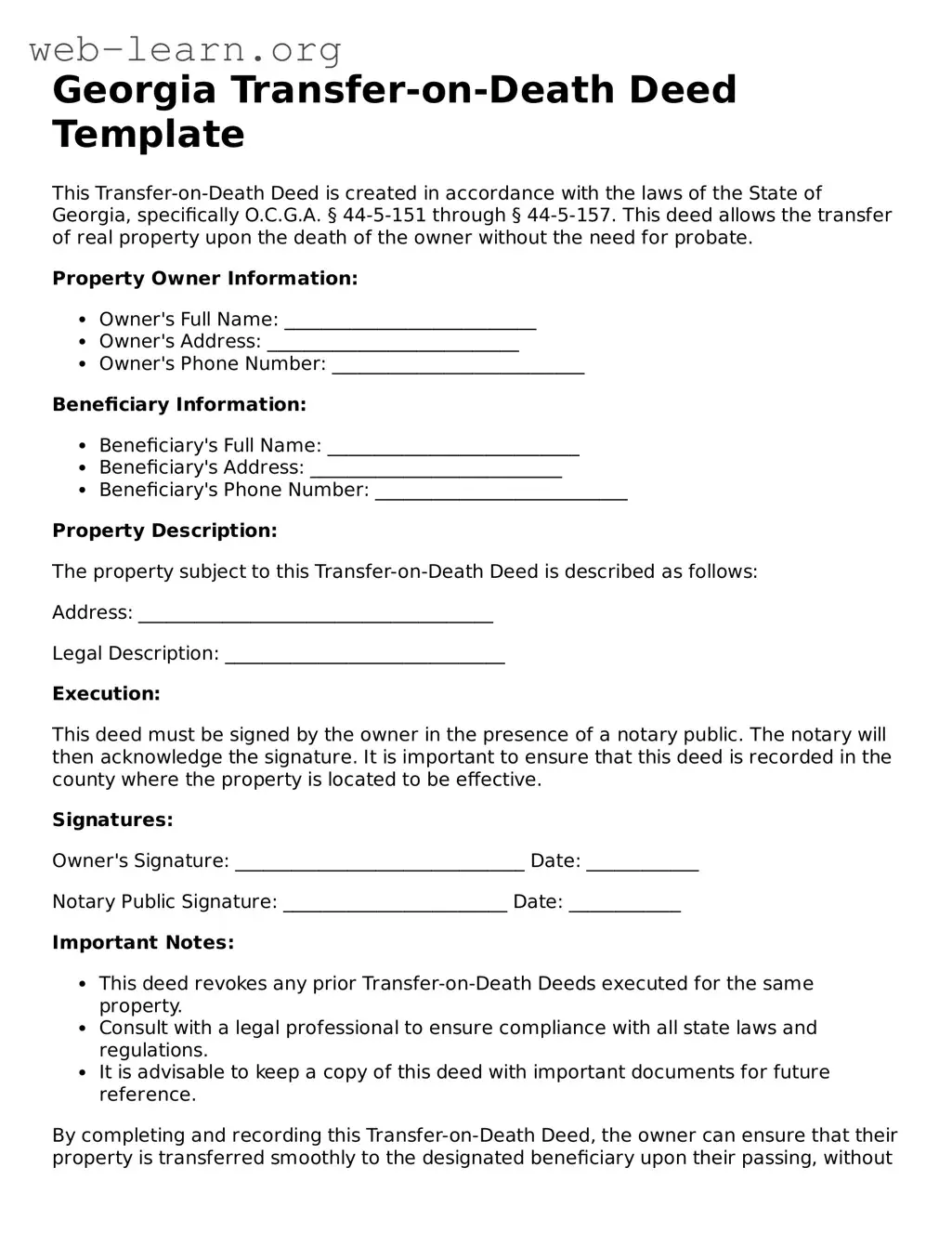
The Georgia Transfer-on-Death Deed form serves as a vital tool for property owners seeking to streamline the transfer of real estate upon their death. This legal instrument allows individuals to designate a beneficiary who will automatically inherit the property without the need for probate proceedings. By filling out this form, property owners can ensure that their wishes are honored, providing clarity and security for their loved ones. Importantly, the Transfer-on-Death Deed can be revoked or modified during the owner's lifetime, allowing for flexibility as circumstances change. Additionally, the form must be properly executed and recorded to be effective, ensuring that the transfer is recognized by the legal system. Understanding the nuances of this form is crucial for anyone considering estate planning in Georgia, as it not only simplifies the transfer process but also helps to avoid potential disputes among heirs.
Georgia Transfer-on-Death Deed Template
This Transfer-on-Death Deed is created in accordance with the laws of the State of Georgia, specifically O.C.G.A. § 44-5-151 through § 44-5-157. This deed allows the transfer of real property upon the death of the owner without the need for probate.
Property Owner Information:
Beneficiary Information:
Property Description:
The property subject to this Transfer-on-Death Deed is described as follows:
Address: ______________________________________
Legal Description: ______________________________
Execution:
This deed must be signed by the owner in the presence of a notary public. The notary will then acknowledge the signature. It is important to ensure that this deed is recorded in the county where the property is located to be effective.
Signatures:
Owner's Signature: _______________________________ Date: ____________
Notary Public Signature: ________________________ Date: ____________
Important Notes:
By completing and recording this Transfer-on-Death Deed, the owner can ensure that their property is transferred smoothly to the designated beneficiary upon their passing, without the need for probate proceedings.
| Fact Name | Description |
|---|---|
| Definition | A Transfer-on-Death (TOD) deed allows property owners in Georgia to transfer real estate to beneficiaries upon their death without going through probate. |
| Governing Law | The Georgia Transfer-on-Death Deed is governed by O.C.G.A. § 44-6-31 et seq. |
| Eligibility | Any individual who owns real property in Georgia can create a TOD deed, provided they are of sound mind and at least 18 years old. |
| Beneficiary Designation | Property owners can designate one or more beneficiaries on the TOD deed, allowing for flexibility in estate planning. |
| Revocation | The property owner can revoke or change the TOD deed at any time before their death, ensuring control over the asset. |
| No Immediate Transfer | The transfer of property occurs only upon the owner's death, meaning the beneficiary has no rights to the property during the owner's lifetime. |
| Filing Requirements | The TOD deed must be recorded in the county where the property is located to be valid and enforceable. |
| Tax Implications | Beneficiaries may face tax implications when they inherit the property, but the TOD deed itself does not trigger any immediate tax consequences. |
| Limitations | Transfer-on-Death deeds cannot be used for all types of property, such as personal property or jointly owned property, which may require different estate planning tools. |
After obtaining the Georgia Transfer-on-Death Deed form, it is essential to complete it accurately. This process will ensure that the property is transferred to the designated beneficiaries upon the owner’s passing. Follow the steps below to fill out the form correctly.
Once the form is filled out and submitted, it will be recorded by the county. This ensures that the transfer of property will occur seamlessly upon the owner's passing, according to the details specified in the deed.
What is a Transfer-on-Death Deed in Georgia?
A Transfer-on-Death Deed (TOD) is a legal document that allows an individual to transfer real property to a designated beneficiary upon the individual's death. This deed enables property owners to bypass the probate process, simplifying the transfer of ownership to heirs.
Who can use a Transfer-on-Death Deed in Georgia?
Any individual who owns real property in Georgia can utilize a Transfer-on-Death Deed. This includes homeowners and property investors. However, the property must be solely owned by the individual, as joint ownership situations may require different considerations.
How do I create a Transfer-on-Death Deed?
To create a Transfer-on-Death Deed, the property owner must fill out the appropriate form, which includes details such as the owner's name, the property description, and the beneficiary's name. After completing the form, the owner must sign it in front of a notary public and then record it with the county clerk's office where the property is located.
Can I change the beneficiary after I have created the deed?
Yes, the property owner can change the beneficiary at any time before their death. To do this, the owner must complete a new Transfer-on-Death Deed that names the new beneficiary and follow the same process of signing and recording it. It is important to ensure that the new deed is properly recorded to avoid confusion later.
What happens if the beneficiary predeceases the owner?
If the named beneficiary dies before the owner, the Transfer-on-Death Deed will become void unless an alternate beneficiary is named. It is advisable to include alternate beneficiaries in the deed to ensure that the property is transferred according to the owner's wishes, even if the primary beneficiary is no longer living.
Are there any tax implications associated with a Transfer-on-Death Deed?
Generally, the transfer of property via a Transfer-on-Death Deed does not trigger immediate tax consequences. However, the beneficiary may be subject to capital gains taxes when they sell the property. It is advisable for beneficiaries to consult with a tax professional to understand any potential tax liabilities.
Can creditors claim the property after the owner's death?
Yes, creditors may still claim the property after the owner's death. The property transferred through a Transfer-on-Death Deed may be subject to the deceased owner's debts. Beneficiaries should be aware that the property may need to be sold to satisfy any outstanding debts before they can fully inherit it.
Is legal assistance recommended when creating a Transfer-on-Death Deed?
While it is possible to create a Transfer-on-Death Deed without legal assistance, consulting with an attorney is recommended. An attorney can help ensure that the deed is properly completed and recorded, and they can provide guidance on the implications of the deed for estate planning purposes.
Filling out the Georgia Transfer-on-Death Deed form can be a straightforward process, but mistakes can lead to complications down the line. One common error is not providing accurate property descriptions. The form requires a clear and precise description of the property being transferred. Failing to include details such as the address or legal description can create confusion and might invalidate the deed.
Another frequent mistake involves not properly identifying the beneficiaries. It’s essential to list the full names of the individuals who will inherit the property. Omitting a middle name or using nicknames can lead to disputes or difficulties in transferring ownership later. Additionally, ensuring that the beneficiaries are legally able to receive the property is crucial.
Many people overlook the importance of signing the deed correctly. The form must be signed by the property owner in the presence of a notary public. If the signature is missing or the notarization is not done properly, the deed may not be valid. Always double-check that all required signatures are present.
Another mistake is neglecting to record the deed with the county. Once the form is filled out and signed, it must be filed with the appropriate county office where the property is located. Failing to do so means that the transfer will not be recognized, and the property may still be considered part of the owner's estate upon their death.
People often forget to review the form for accuracy before submitting it. Typos or incorrect information can lead to significant issues. Taking the time to proofread the document can save a lot of headaches later on.
Additionally, not understanding the implications of the Transfer-on-Death Deed can lead to problems. This type of deed allows for the transfer of property outside of probate, but it does not eliminate the need for a will or other estate planning documents. Failing to consider how this deed fits into the overall estate plan can create confusion and conflict among heirs.
Another common oversight is not discussing the deed with family members. Communication is key in estate planning. If beneficiaries are unaware of the deed or its implications, it can lead to misunderstandings and disputes after the property owner passes away.
Lastly, some individuals may not seek legal advice when filling out the form. While it may seem simple, having a professional review the deed can help identify potential issues and ensure that everything is in order. Consulting with an attorney can provide peace of mind and help avoid costly mistakes.
When considering the Georgia Transfer-on-Death Deed, it is essential to understand that several other forms and documents may accompany it. These documents help ensure a smooth transition of property ownership and clarify the intentions of the property owner. Below is a list of commonly used forms that often go hand-in-hand with the Transfer-on-Death Deed.
Understanding these documents can significantly aid in planning for the future. Each form serves a specific purpose and can work together with the Transfer-on-Death Deed to create a comprehensive estate plan. It is advisable to consult with a professional to ensure all documents align with your intentions and comply with applicable laws.
The Transfer-on-Death Deed (TOD) allows property owners to designate a beneficiary who will receive the property upon their death, avoiding probate. Here are five documents that share similarities with the TOD Deed:
When filling out the Georgia Transfer-on-Death Deed form, it’s important to approach the process with care. Here are some guidelines to help you navigate this important task.
By following these guidelines, you can help ensure that your Transfer-on-Death Deed is filled out correctly and serves its intended purpose.
When discussing the Georgia Transfer-on-Death Deed form, several misconceptions often arise. Understanding these can help individuals make informed decisions regarding property transfer. Below are four common misconceptions:
This is not true. The Transfer-on-Death Deed can be used by anyone who owns property in Georgia, regardless of their financial status. It is a useful tool for simplifying the transfer of property to heirs without the need for probate.
This misconception is misleading. The property owner can create a Transfer-on-Death Deed without needing approval from heirs. However, it is advisable to communicate intentions to avoid potential disputes later.
In reality, revoking a Transfer-on-Death Deed is straightforward. The property owner can revoke it at any time by executing a new deed or by following specific procedures outlined in Georgia law.
This is incorrect. The property owner retains full control over the property during their lifetime. They can sell, mortgage, or otherwise manage the property without any restrictions imposed by the Transfer-on-Death Deed.
Understanding the Georgia Transfer-on-Death Deed form is crucial for effective estate planning. Here are some key takeaways that can guide individuals through the process:
Where Can I Get a Tod Form - The deed does not affect the owner's ability to sell or mortgage the property while alive.
Arkansas Beneficiary Deed Pdf - It can help streamline the transition of property ownership during a difficult time.