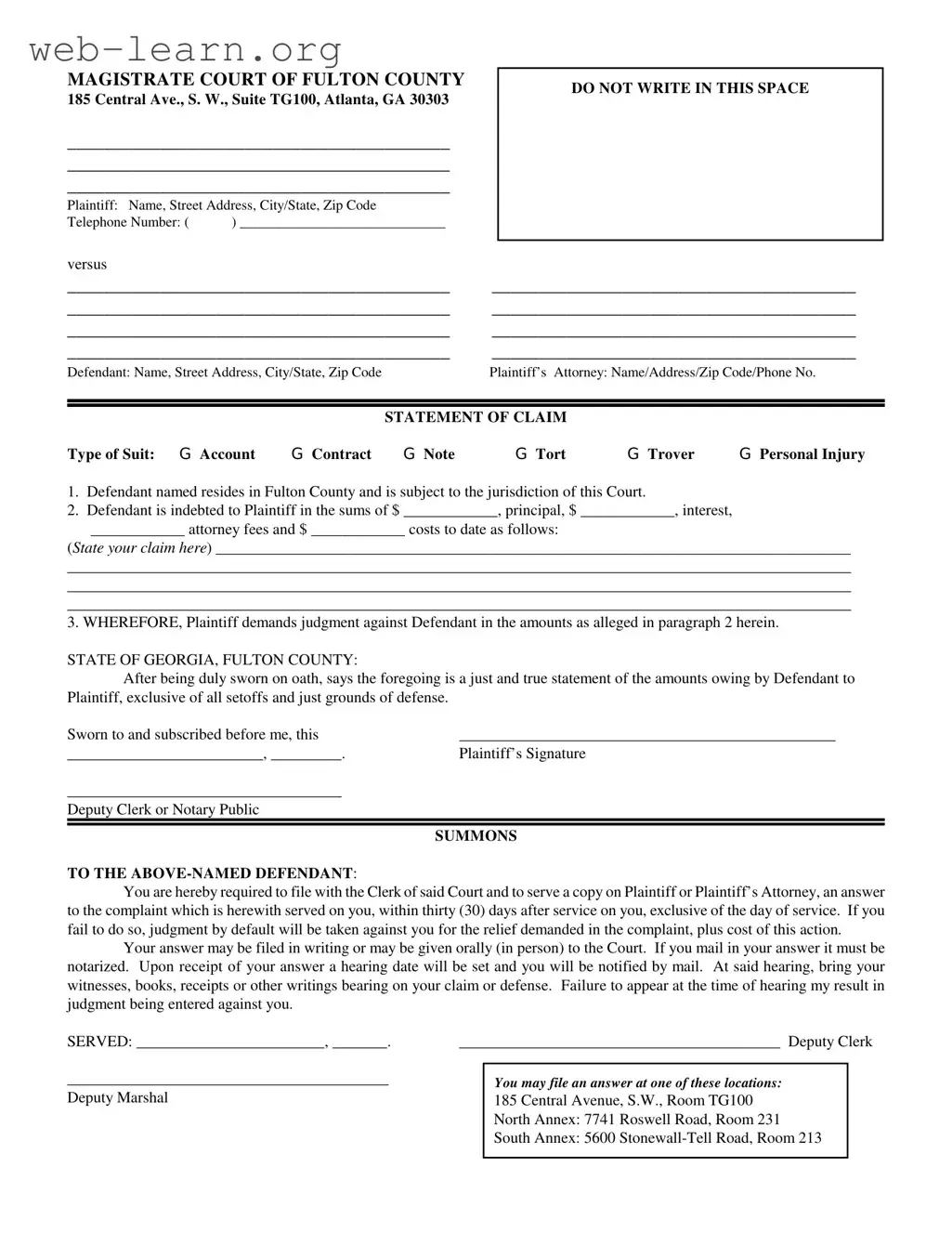
The Georgia Statement Claim Fulton form is an essential legal document used in the Magistrate Court of Fulton County for initiating civil claims. This form allows a plaintiff to outline their case against a defendant, specifying the nature of the claim, whether it is based on an account, contract, note, tort, trover, or personal injury. Key sections include the identification of both parties, detailing the plaintiff’s contact information and the defendant’s address. The form requires the plaintiff to state the amount owed, including principal, interest, attorney fees, and costs. It also includes a sworn statement affirming the accuracy of the claim. Additionally, the form outlines the defendant's obligations, including the requirement to respond within thirty days to avoid default judgment. Proper completion and submission of this form are crucial for ensuring that the court can effectively address the claims presented.

MAGISTRATE COURT OF FULTON COUNTY
185 Central Ave., S. W., Suite TG100, Atlanta, GA 30303
_________________________________________
_________________________________________
_________________________________________
Plaintiff: Name, Street Address, City/State, Zip Code
Telephone Number: ( |
) _____________________________ |
versus |
|
DO NOT WRITE IN THIS SPACE
_________________________________________ |
_______________________________________ |
||||
_________________________________________ |
_______________________________________ |
||||
_________________________________________ |
_______________________________________ |
||||
_________________________________________ |
_______________________________________ |
||||
Defendant: Name, Street Address, City/State, Zip Code |
|
Plaintiff’s Attorney: Name/Address/Zip Code/Phone No. |
|||
|
|
|
|
|
|
|
|
|
|
|
|
|
|
STATEMENT OF CLAIM |
|
|
|
Type of Suit: G Account |
G Contract |
G Note |
G Tort |
G Trover |
G Personal Injury |
1.Defendant named resides in Fulton County and is subject to the jurisdiction of this Court.
2.Defendant is indebted to Plaintiff in the sums of $ ____________, principal, $ ____________, interest,
____________ attorney fees and $ ____________ costs to date as follows:
(State your claim here) _________________________________________________________________________________
____________________________________________________________________________________________________
____________________________________________________________________________________________________
____________________________________________________________________________________________________
3. WHEREFORE, Plaintiff demands judgment against Defendant in the amounts as alleged in paragraph 2 herein.
STATE OF GEORGIA, FULTON COUNTY:
After being duly sworn on oath, says the foregoing is a just and true statement of the amounts owing by Defendant to Plaintiff, exclusive of all setoffs and just grounds of defense.
Sworn to and subscribed before me, this |
________________________________________________ |
_________________________, _________. |
Plaintiff’s Signature |
___________________________________ |
|
Deputy Clerk or Notary Public |
|
|
|
|
SUMMONS |
TO THE
You are hereby required to file with the Clerk of said Court and to serve a copy on Plaintiff or Plaintiff’s Attorney, an answer to the complaint which is herewith served on you, within thirty (30) days after service on you, exclusive of the day of service. If you fail to do so, judgment by default will be taken against you for the relief demanded in the complaint, plus cost of this action.
Your answer may be filed in writing or may be given orally (in person) to the Court. If you mail in your answer it must be notarized. Upon receipt of your answer a hearing date will be set and you will be notified by mail. At said hearing, bring your witnesses, books, receipts or other writings bearing on your claim or defense. Failure to appear at the time of hearing my result in judgment being entered against you.
SERVED: ________________________, _______. |
_________________________________________ Deputy Clerk |
||
_________________________________________ |
|
|
|
|
You may file an answer at one of these locations: |
|
|
|
|
|
|
Deputy Marshal |
|
185 Central Avenue, S.W., Room TG100 |
|
|
|
North Annex: 7741 Roswell Road, Room 231 |
|
|
|
South Annex: 5600 |
|
|
|
|
|
| Fact Name | Description |
|---|---|
| Jurisdiction | The Defendant must reside in Fulton County to fall under the jurisdiction of the Fulton County Magistrate Court. |
| Filing Requirements | The Defendant has 30 days to file an answer after being served with the complaint. This must be done either in writing or orally in person. |
| Judgment by Default | If the Defendant fails to respond within the specified time, a judgment by default may be entered against them, granting the Plaintiff the relief requested. |
| Governing Law | This form is governed by the laws of the State of Georgia, specifically under the jurisdiction of the Fulton County Magistrate Court. |
Filling out the Georgia Statement Claim Fulton form is an important step in initiating a legal claim. Once completed, this form will allow you to formally present your case in the Magistrate Court of Fulton County. Below are the steps to help you accurately fill out the form.
After submitting your claim, the court will process your paperwork. You will then receive further instructions regarding the next steps, including how the defendant can respond to your claim and any upcoming hearings.
What is the purpose of the Georgia Statement Claim Fulton form?
The Georgia Statement Claim Fulton form is used to initiate a civil lawsuit in the Magistrate Court of Fulton County. This form allows a plaintiff to formally state their claim against a defendant, detailing the nature of the dispute and the amount owed. It serves as the starting point for legal proceedings and ensures that both parties are aware of the claims being made.
Who can file a claim using this form?
Any individual or entity that believes they have a valid claim against another party can file this form. The defendant must reside in Fulton County or be subject to the jurisdiction of the court. This includes businesses, organizations, and individuals who have incurred debts or damages that they seek to recover.
What information is required on the form?
When completing the form, the plaintiff must provide:
This information is crucial for the court to understand the basis of the claim and to notify the defendant appropriately.
What happens after the form is submitted?
Once the form is submitted, the court will issue a summons to the defendant. This summons requires the defendant to file an answer to the complaint within thirty days. If the defendant fails to respond, the plaintiff may receive a judgment by default, meaning the court may rule in favor of the plaintiff without hearing the defendant's side.
Can the defendant respond verbally to the complaint?
Yes, the defendant has the option to respond either in writing or orally. If choosing to respond in writing, the answer must be notarized if mailed. An oral response can be given in person at the court. This flexibility allows defendants to choose the method that is most convenient for them.
What should I bring to the hearing?
If a hearing is scheduled, it is important to come prepared. Both parties should bring any relevant evidence, such as:
Failure to appear at the hearing may result in a judgment against the absent party, so preparation is key to ensuring a fair hearing.
Filling out the Georgia Statement Claim Fulton form can be a straightforward process, but several common mistakes can lead to complications. First and foremost, one of the most frequent errors is neglecting to provide complete and accurate information about the parties involved. The form requires the full names, addresses, and contact details of both the plaintiff and the defendant. Omitting any of this information can result in delays or even dismissal of the claim.
Another common mistake is failing to specify the type of suit. The form includes checkboxes for various types of claims, such as account, contract, or personal injury. Choosing the wrong type or leaving this section blank can create confusion and may hinder the processing of the claim. It is crucial to select the category that best represents the nature of the dispute.
Many individuals also struggle with the monetary amounts they need to list in the claim. It's essential to clearly state the principal amount owed, as well as any interest, attorney fees, and costs. Inaccurate calculations or vague descriptions can weaken the claim. Providing a detailed breakdown of the amounts can help clarify the situation for the court.
Additionally, some claimants forget to sign the form or fail to have their signature notarized when required. A signature is a critical component of the document, as it verifies that the claimant is attesting to the truth of the information provided. Without a proper signature, the court may not accept the filing.
Another mistake involves overlooking the requirement to serve the defendant properly. The summons section of the form outlines the necessity of delivering a copy of the complaint to the defendant within a specified timeframe. Failing to follow these instructions can result in the case being thrown out or delayed.
Furthermore, claimants often neglect to keep copies of the filed documents. It's important to retain a copy of the completed form for personal records. This can be helpful for future reference and ensures that the claimant has a record of what was submitted.
Lastly, many people underestimate the importance of attending the scheduled hearing. If the plaintiff fails to appear, the court may rule in favor of the defendant by default. Being present at the hearing allows the plaintiff to present their case effectively and increases the likelihood of a favorable outcome.
When filing a claim in Fulton County, Georgia, there are several other forms and documents that may be necessary to support your case. Each of these documents serves a specific purpose and can help streamline the legal process. Here’s a list of commonly used forms that you might encounter alongside the Georgia Statement Claim Fulton form.
Understanding these forms can help you navigate the legal landscape more effectively. Each document plays a crucial role in ensuring that your case is presented clearly and thoroughly in court. Being prepared with the right paperwork can significantly influence the outcome of your legal proceedings.
When filling out the Georgia Statement Claim Fulton form, it is essential to ensure accuracy and completeness. Here are eight important do's and don'ts to consider:
Understanding the Georgia Statement Claim Fulton form can be tricky, especially with the various misconceptions surrounding it. Let’s clear up some of the common misunderstandings:
Many believe this form can only be used for certain types of lawsuits, but it actually accommodates a variety of claims including accounts, contracts, torts, and personal injuries. This flexibility allows plaintiffs to use the same form for different legal situations.
While having an attorney can be beneficial, it’s not a requirement. Individuals can represent themselves in court and file the form without legal assistance. This is often referred to as "pro se" representation.
Filing the Georgia Statement Claim Fulton form does not guarantee a favorable outcome. It initiates the legal process, but the final decision will depend on the evidence presented and the court’s judgment.
Some people think they can simply ignore the summons if they disagree with the claim. However, failing to respond can lead to a default judgment against them, meaning the court may rule in favor of the plaintiff without hearing the defendant's side.
While the form itself may seem straightforward, the legal process can be lengthy and complex. After filing, there are specific timelines and procedures that must be followed, which can take time and effort to navigate.
By understanding these misconceptions, individuals can better prepare themselves for the legal process and make informed decisions about their claims.
Filling out the Georgia Statement Claim Fulton form can seem daunting, but understanding the key elements can make the process smoother. Here are some essential takeaways to keep in mind:
By keeping these points in mind, you can navigate the Fulton County Magistrate Court process more effectively. Always ensure that you are following the guidelines provided and seek assistance if needed.