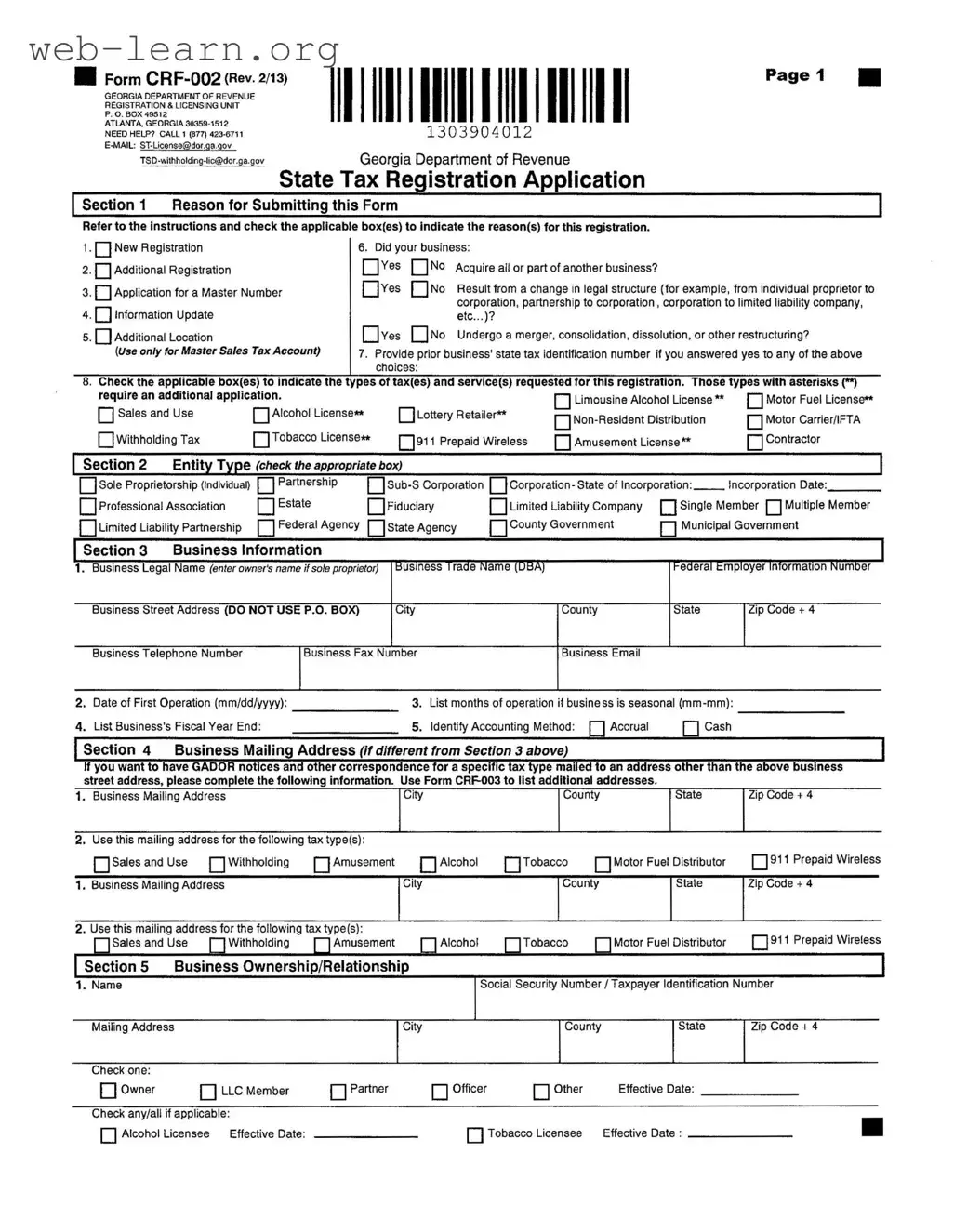
The Georgia State Tax Instruction form, officially known as Form CRF-002, serves as a crucial document for businesses looking to register for various state taxes. This form is essential for both new and existing businesses that may be undergoing changes such as acquiring another business, altering their legal structure, or expanding their operations to additional locations. It provides a structured way for businesses to indicate their reason for registration, whether it be a new registration, an update of information, or an application for a master number. The form requires businesses to specify the types of taxes they wish to register for, including sales and use tax, withholding tax, and various licenses. Additionally, it captures important details about the business entity, ownership, and activities, ensuring that the Georgia Department of Revenue has the necessary information to process the registration efficiently. Accurate completion of this form is vital, as it not only affects tax obligations but also compliance with state regulations. Understanding the nuances of this form can help business owners navigate the registration process with confidence.
■ Form |
1303904012 |
Page 1 |
GEORGIA DEPARTMENT OF REVENUE REGISTRATION & LICENSING UNIT
P. O. BOX 49512
ATLANTA, GEORGIA
ОЛППЛЛЛ1 n
l3039040l2
Georgia Department of Revenue
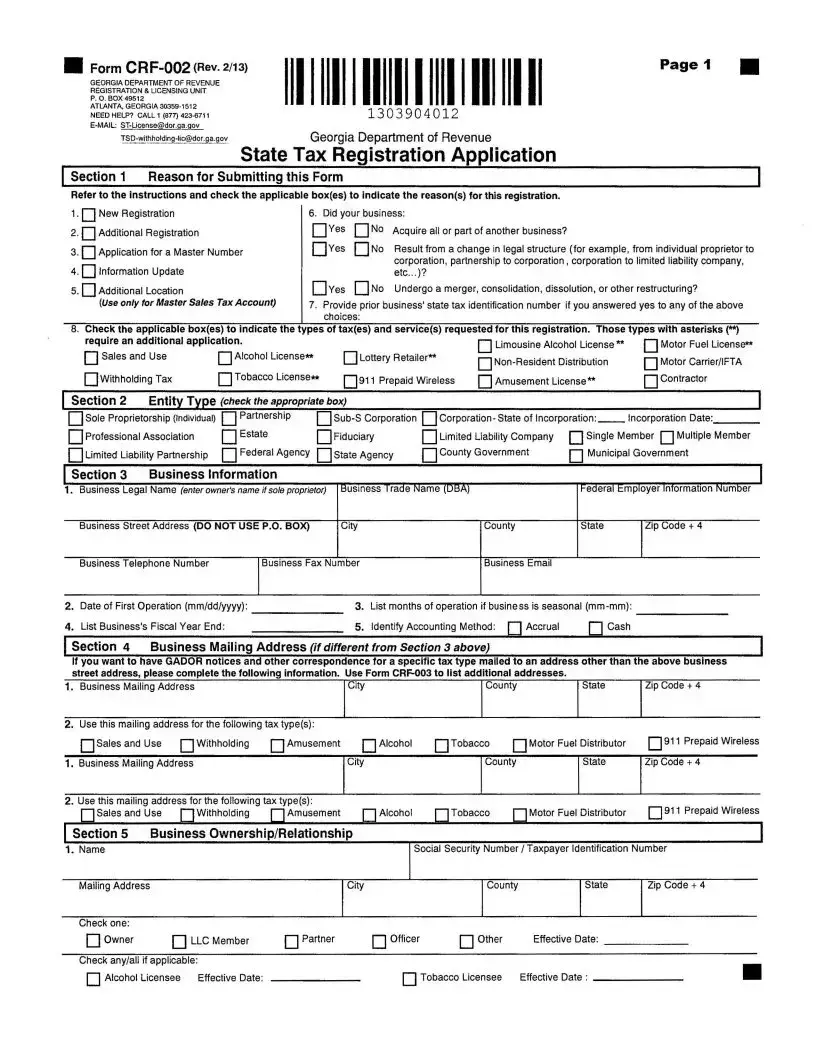
State Tax Registration Application
Section 1 Reason for Submitting this Form
Refer to the instructions and check the applicable box(es) to indicate the reason(s) for this registration.
1 • New Registration
2.Additional Registration
3.Application for a Master Number
4.Information Update
5.Additional Location
(Use only for Master Sales Tax Account)
6. Did your business:
Yes |
No |
Acquire all or part of another business? |
Yes |
No |
Result from a change in legal structure (for example, from individual proprietor to |
|
|
corporation, partnership to corporation, corporation to limited liability company, |
|
|
etc...)? |
Yes |
No |
Undergo a merger, consolidation, dissolution, or other restructuring? |
7.Provide prior business' state tax identification number if you answered yes to any of the above choices:
8. Check the applicable box(es) to indicate the types of tax(es) and service(s) requested for this registration. Those types with asterisks (**)
require an additional application. |
|
|
Limousine Alcohol License** |
Motor Fuel License** |
|||||
| | Sales and Use |
| |
| Alcohol License** |
Lottery Retailer** |
||||||
Motor Carrier/IFTA |
|||||||||
|
|
|
|
|
|
||||
Withholding Tax |
□Tobacco License** |
911 Prepaid Wireless |
Amusement License** |
| | Contractor |
|||||
| Section 2 |
Entity Type (check the appropriate box) |
|
|
|
] |
||||
Sole Proprietorship (Individual) |
| |
| Partnership |
| Corporation - State of Incorporation: |
Incorporation Date:. |
|||||
Professional Association |
| |
| Estate |
Fiduciary |
Limited Liability Company |
Single Member | | Multiple Member |
||||
Limited Liability Partnership |
|
Federal Agency |
State Agency |
County Government |
[ | Municipal Government |
||||
| Section 3 |
Business Information |
|
|
|
j |
||
1. |
Business Legal Name (enter owner's name if sole proprietor) |
Business Trade Name (DBA) |
Federal Employer Information Number |
||||
|
Business Street Address (DO NOT USE P.O. BOX) |
City |
County |
State |
Zip Code + 4 |
||
|
Business Telephone Number |
Business Fax Number |
Business Email |
|
|
||
2. |
Date of First Operation (mm/dd/yyyy): |
|
3. |
List months of operation if business is seasonal |
|
||
4. |
List Business's Fiscal Year End: |
|
5. |
Identify Accounting Method: □Accrual |
□Cash |
|
|
I Section 4 Business Mailing Address (if different from Section 3 above)
If you want to have GADOR notices and other correspondence for a specific tax type mailed to an address other than the above business street address, please complete the following information. Use Form
1. Business Mailing Address |
City |
County |
State |
Zip Code + 4 |
2. Use this mailing address for the following tax type(s):
Salesand Use | [Withholding □Amusement [ | Alcohol | |Tobacco | [Motor Fuel Distributor | |911 Prepaid Wireless
1. Business Mailing Address |
City |
County |
State |
Zip Code + 4 |
2. Use this mailing address for the following tax type(s):
[ [Sales and Use I [Withholding I [Amusement | | Alcohol | | Tobacco | | Motor Fuel Distributor 911 Prepaid Wireless
Section 5 |
Business Ownership/Relationship |
|
|
|
| |
||
1. Name |
|
|
|
Social Security Number/Taxpayer Identification Number |
|||
Mailing Address |
|
|
City |
|
County |
State |
Zip Code + 4 |
Check one: |
|
|
|
|
|
|
|
Owner |
|
LLC Member |
Partner |
Officer |
Other |
Effective Date: |
|
Check any/all if applicable: |
|
|
|
|
|
||
Alcohol Licensee |
Effective Date: |
|
|
Tobacco Licensee |
Effective Date : |
|
|
■ Form |
1303904022 |
Page 2 |
■ |
1303904022
| |
Section 5 |
|
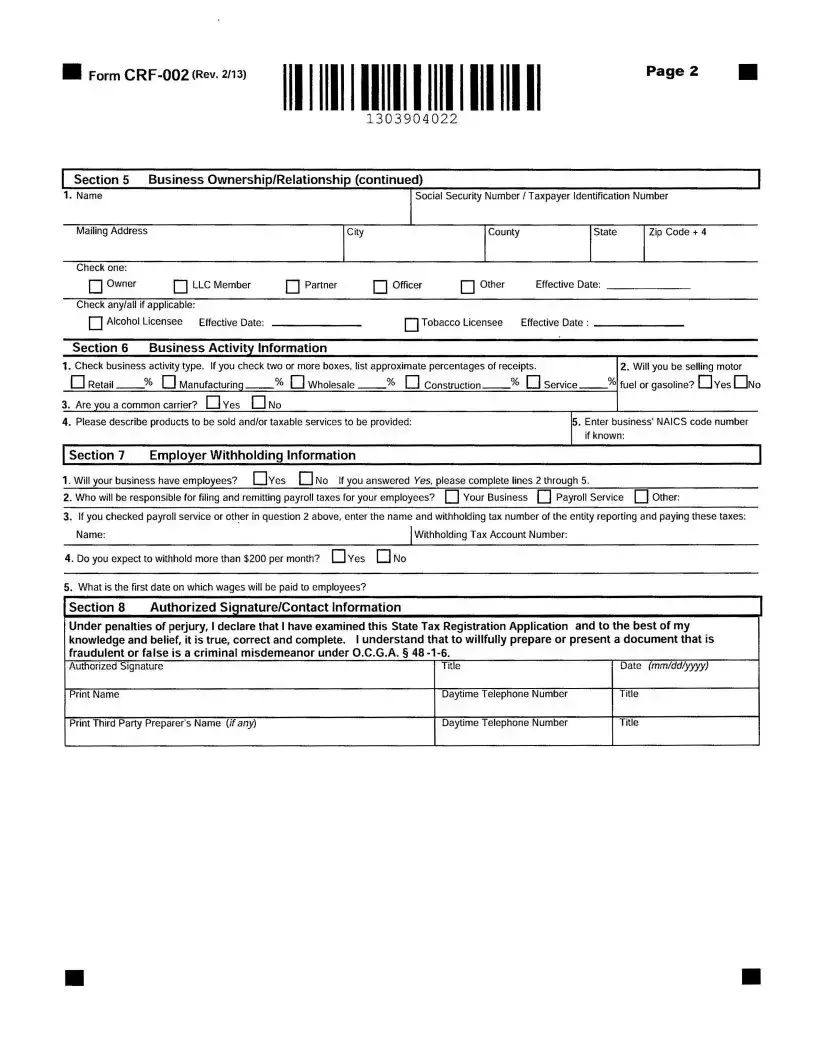
Business Ownership/Relationship (continued) |
|
|
|
|
| |
|||||
1. |
Name |
|
|
|
|
|
|
Social Security Number/Taxpayer Identification Number |
|||||
|
Mailing Address |
|
|
|
City |
|
|
County |
|
State |
Zip Code + 4 |
||
|
Check one: |
|
|
|
|
|
|
|
|
|
|
|
|
|
Owner |
|
I |
I LLC Member |
| |
| Partner |
| | Officer |
| | Other |
|
Effective Date: |
|
||
|
Check any/all if applicable: |
|
|
|
|
|
|
|
|
|
|||
|
I I Alcohol Licensee |
Effective Date: |
|
|
| |
| Tobacco Licensee |
|
Effective Date : |
|
||||
|
Section 6 |
|
Business Activity Information |
|
|
|
|
|
|
|
|||
1. Check business activity type. If you check two or more boxes, list approximate percentages of receipts. |
|
2. Will you be selling motor |
|||||||||||
1 |
1 Retail |
% П Manufacturing |
% 1 |
1 Wholesale |
% 1 |
1 |
Construction |
% П Service |
% fuel or gasoline? CH Yes CHNo |
||||
3. Are you a common carrier? П Yes П No |
|
|
|
|
|
|
|
|
|||||
4. |
Please describe products to be sold and/or taxable services to be provided: |
|
|
|
5. Enter business' NAICS code number |
||||||||
|
|
|
|
|
|
|
|
|
|
|
|
if known: |
|
Section 7 |
|
Employer Withholding Information |
|
|
|
|
|
|
| |
||||
1. Will your business have employees? □Yes Д No If you answered Yes, please complete lines 2 through 5.
2. Who will be responsible for filing and remitting payroll taxes for your employees? |
Your Business | | Payroll Service | | Other: |
3.If you checked payroll service or other in question 2 above, enter the name and withholding tax number of the entity reporting and paying these taxes: Name:_______________________________________________________ [withholding Tax Account Number:
4. Do you expect to withhold more than $200 per month? |
Yes EH No |
5.What is the first date on which wages will be paid to employees?
Section 8 |
Authorized Signature/Contact Information |
| |
Under penalties of perjury, 1 declare that 1 have examined this State Tax Registration Application and to the best of my knowledge and belief, it is true, correct and complete. 1 understand that to willfully prepare or present a document that is fraudulent or false is a criminal misdemeanor under O.C.G.A. § 48
Authorized Signature |
Title |
Date (mm/dd/yyyy) |
Print Name |
Daytime Telephone Number |
Title |
Print Third Party Preparer's Name {if any) |
Daytime Telephone Number |
Title |
И Form |
1303904032 |
Page 3 |
1303 904032
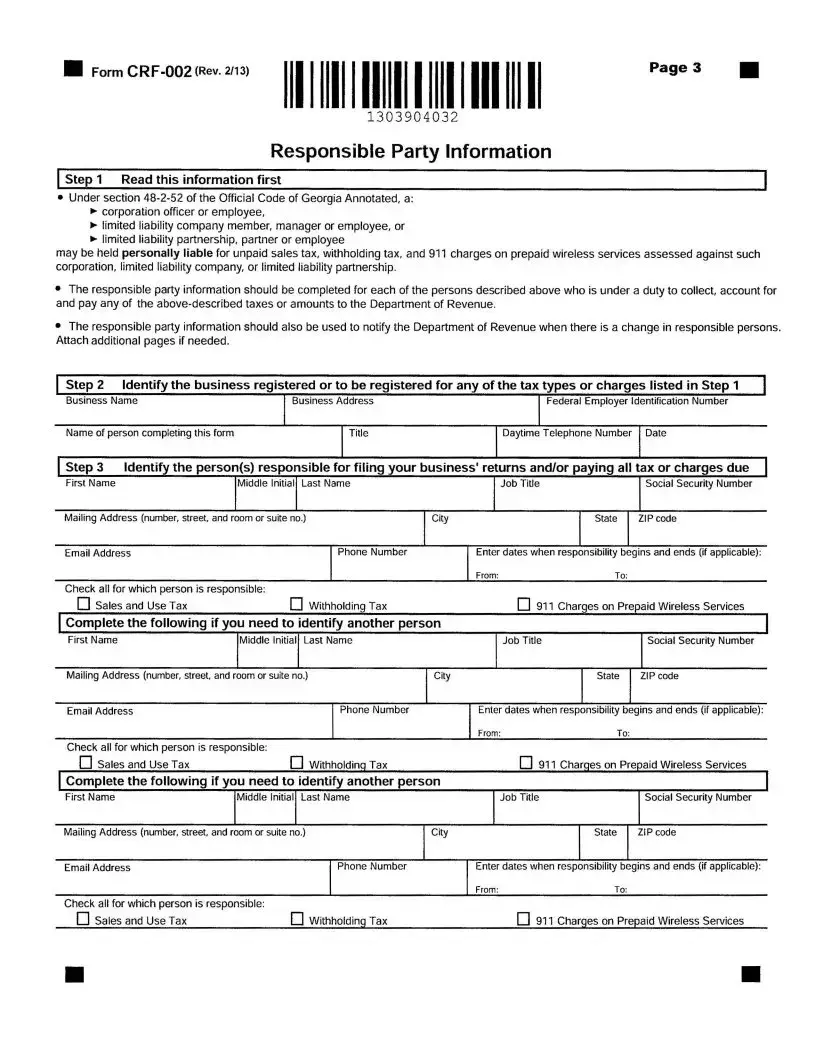
Responsible Party Information
Step 1 Read this information first |
| |
•Under section
►corporation officer or employee,
►limited liability company member, manager or employee, or
►limited liability partnership, partner or employee
may be held personally liable for unpaid sales tax, withholding tax, and 911 charges on prepaid wireless services assessed against such corporation, limited liability company, or limited liability partnership.
•The responsible party information should be completed for each of the persons described above who is under a duty to collect, account for and pay any of the
•The responsible party information should also be used to notify the Department of Revenue when there is a change in responsible persons. Attach additional pages if needed.
Check all for which person is responsible: |
|
|
□ Sales and Use Tax |
Д Withholding Tax |
□ 911 Charges on Prepaid Wireless Services |
| Fact Name | Details |
|---|---|
| Form Identification | This is the Georgia State Tax Registration Application, identified as Form CRF-002, revised in February 2013. |
| Purpose of the Form | The form is used for various reasons, including new registrations, updates, and changes in business structure. |
| Governing Law | The form is governed by the Official Code of Georgia Annotated (O.C.G.A.) § 48-1-6, which outlines the penalties for fraudulent submissions. |
| Business Information Required | Applicants must provide detailed business information, including legal name, trade name, address, and federal employer identification number. |
| Responsible Party Liability | Under O.C.G.A. § 48-2-52, certain individuals may be held personally liable for unpaid taxes related to the business. |
Filling out the Georgia State Tax Registration Application can seem daunting, but following these steps will help simplify the process. Be sure to have all necessary information at hand, including your business details and any relevant tax identification numbers. Once you complete the form, you'll be one step closer to ensuring your business is properly registered with the state.
What is the purpose of the Georgia State Tax Instruction form?
The Georgia State Tax Instruction form, specifically Form CRF-002, is designed to help businesses register for various state taxes. This form is essential for new businesses or existing ones undergoing changes, such as acquiring another business or altering their legal structure. By completing this form, businesses can ensure they are compliant with state tax regulations and can operate legally within Georgia.
Who needs to fill out this form?
Any business entity planning to operate in Georgia must fill out this form. This includes:
In essence, if your business needs to register for state taxes, this form is likely necessary.
What information do I need to provide on the form?
When completing the Georgia State Tax Instruction form, you will need to provide a variety of details, including:
Gathering this information beforehand can streamline the process and help avoid delays.
What happens after I submit the form?
Once you submit the Georgia State Tax Instruction form, the Georgia Department of Revenue will review your application. If everything is in order, you will receive a state tax identification number, which is crucial for your business operations. This number is necessary for filing taxes and conducting various business transactions. If there are any issues or additional information required, the Department will contact you directly.
Completing the Georgia State Tax Instruction form can be a straightforward process, but many individuals make common mistakes that can lead to delays or complications. One frequent error occurs in the selection of the reason for submitting the form. Applicants often fail to check all applicable boxes. For instance, if a business has undergone a change in legal structure and is also registering for a master number, both boxes should be checked. Neglecting to do so may result in incomplete processing.
Another common pitfall is related to providing inaccurate business information. This includes the business's legal name, trade name, and address. Many people mistakenly use a P.O. Box instead of a physical address. This can lead to issues with correspondence from the Georgia Department of Revenue, as they require a physical address for tax-related matters. Ensure that all information matches official documents to avoid discrepancies.
In Section 4, where business mailing addresses are specified, individuals sometimes forget to indicate the specific tax types for which the alternate mailing address should be used. This oversight can cause important tax documents to be sent to the wrong address, potentially resulting in missed deadlines or penalties. Always double-check that the correct tax types are selected next to the corresponding mailing address.
Additionally, many applicants struggle with the entity type selection. Misidentifying the business structure can have significant implications for tax obligations. For example, a sole proprietor should not select “Corporation” or “Partnership.” Taking a moment to review the definitions of each entity type can help ensure the right choice is made, aligning with the business’s actual structure.
Another mistake often made involves the accounting method choice. Some individuals overlook this section entirely or select the wrong method, such as choosing “Accrual” when they operate on a “Cash” basis. This choice affects how income and expenses are reported and can lead to complications with tax calculations. Understanding the difference between these methods is crucial for accurate reporting.
Moreover, failing to provide complete and accurate information about business ownership is a common issue. When listing owners or partners, individuals may omit vital details such as Social Security numbers or taxpayer identification numbers. This information is essential for the Department of Revenue to correctly associate tax obligations with the individuals responsible for the business.
Lastly, many applicants neglect to sign and date the form. A missing signature can halt the processing of the application, leading to delays in receiving necessary permits or licenses. It is important to remember that signing the form not only confirms the accuracy of the information provided but also acknowledges the legal responsibilities associated with operating a business in Georgia.
The Georgia State Tax Instruction form is essential for businesses registering for state taxes. However, several other forms and documents are often used in conjunction with it. These documents help ensure compliance with state regulations and facilitate the tax registration process.
Using these forms alongside the Georgia State Tax Instruction form can streamline the registration process and ensure that businesses meet all necessary requirements. Proper documentation helps avoid potential issues with state tax authorities.
The Georgia State Tax Instruction form shares similarities with several other legal documents related to business registration and taxation. Each document serves a specific purpose in the realm of tax compliance and business operations. Below is a list of six documents that are comparable to the Georgia State Tax Instruction form, along with explanations of their similarities.
When filling out the Georgia State Tax Instruction form, it is crucial to follow specific guidelines to ensure accuracy and compliance. Here’s a list of things to do and avoid:
Following these guidelines can help streamline the registration process and reduce the likelihood of delays or issues with your application.
This is not true. The Georgia State Tax Registration Application can be used for various reasons, including additional registrations, updates, and changes in business structure. Existing businesses may need to submit this form for reasons such as acquiring another business or changing their legal structure.
If your business has undergone changes like mergers or acquisitions, you must provide the prior business's state tax identification number. This information helps the Department of Revenue track tax obligations accurately.
In fact, the form allows you to check multiple boxes to indicate the types of taxes and services you wish to register for simultaneously. This includes sales and use tax, withholding tax, and various licenses.
A signature is mandatory. By signing the form, you declare that the information provided is accurate and complete. Failing to sign can result in delays or rejection of your application.
You can specify a different mailing address for correspondence. This is particularly useful if you want tax notices sent to a location that is not your business's physical address. Just ensure to fill out the relevant section of the form.
Filling out the Georgia State Tax Instruction form can be a straightforward process if you keep a few essential points in mind. Here are some key takeaways that may help you navigate the form effectively:
By keeping these takeaways in mind, you can approach the Georgia State Tax Instruction form with greater confidence and clarity. Ensuring accuracy and thoroughness in your submission can help facilitate a smoother registration process.