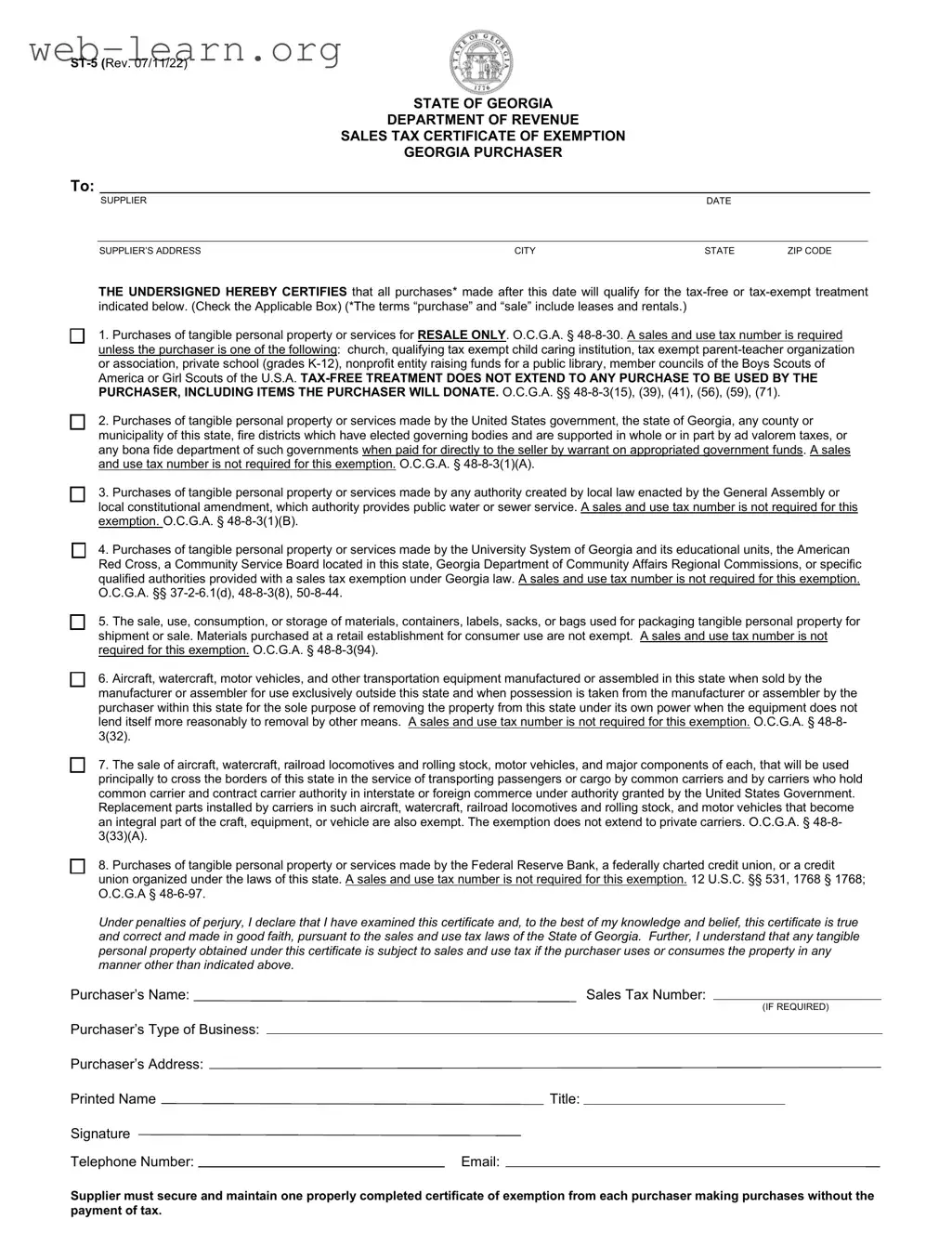
The Georgia ST-5 form serves as a crucial document for individuals and organizations seeking to make tax-exempt purchases within the state. It is designed to certify that the purchases made by the undersigned will qualify for tax-free treatment under specific conditions. The form outlines various categories of exemptions, including purchases for resale, those made by government entities, and transactions involving certain educational and nonprofit organizations. Additionally, it details exemptions related to packaging materials and specific transportation equipment. Importantly, the form stipulates that a sales tax number is required for some exemptions but not for others, such as those involving government purchases or certain nonprofit organizations. The undersigned must affirm the accuracy of the information provided, acknowledging that misuse of the exemption can lead to tax liabilities. By completing the ST-5 form, purchasers can navigate the complexities of Georgia's sales tax laws, ensuring compliance while benefiting from available exemptions.

STATE OF GEORGIA
DEPARTMENT OF REVENUE
SALES TAX CERTIFICATE OF EXEMPTION
GEORGIA PURCHASER
To:
|
SUPPLIER |
|
DATE |
|
|
|
|
|
|
|
|
SUPPLIER’S ADDRESS |
CITY |
STATE |
ZIP CODE |
||
THE UNDERSIGNED HEREBY CERTIFIES that all purchases* made after this date will qualify for the
1. Purchases of tangible personal property or services for RESALE ONLY. O.C.G.A. §
2. Purchases of tangible personal property or services made by the United States government, the state of Georgia, any county or municipality of this state, fire districts which have elected governing bodies and are supported in whole or in part by ad valorem taxes, or any bona fide department of such governments when paid for directly to the seller by warrant on appropriated government funds. A sales and use tax number is not required for this exemption. O.C.G.A. §
3. Purchases of tangible personal property or services made by any authority created by local law enacted by the General Assembly or local constitutional amendment, which authority provides public water or sewer service. A sales and use tax number is not required for this exemption. O.C.G.A. §
4. Purchases of tangible personal property or services made by the University System of Georgia and its educational units, the American Red Cross, a Community Service Board located in this state, Georgia Department of Community Affairs Regional Commissions, or specifi c qualified authorities provided with a sales tax exemption under Georgia law. A sales and use tax number is not required for this exemption. O.C.G.A. §§
5. The sale, use, consumption, or storage of materials, containers, labels, sacks, or bags used for packaging tangible personal property for shipment or sale. Materials purchased at a retail establishment for consumer use are not exempt. A sales and use tax number is not required for this exemption. O.C.G.A. §
6. Aircraft, watercraft, motor vehicles, and other transportation equipment manufactured or assembled in this state when sold by the manufacturer or assembler for use exclusively outside this state and when possession is taken from the manufacturer or assembler by the purchaser within this state for the sole purpose of removing the property from this state under its own power when the equipment does not lend itself more reasonably to removal by other means. A sales and use tax number is not required for this exemption. O.C.G.A. §
7. The sale of aircraft, watercraft, railroad locomotives and rolling stock, motor vehicles, and major components of each, that will be used principally to cross the borders of this state in the service of transporting passengers or cargo by common carriers and by carriers who hold common carrier and contract carrier authority in interstate or foreign commerce under authority granted by the United States Government. Replacement parts installed by carriers in such aircraft, watercraft, railroad locomotives and rolling stock, and motor vehicles that become an integral part of the craft, equipment, or vehicle are also exempt. The exemption does not extend to private carriers. O.C.G.A. §
8. Purchases of tangible personal property or services made by the Federal Reserve Bank, a federally charted credit union, or a credit union organized under the laws of this state. A sales and use tax number is not required for this exemption. 12 U.S.C. §§ 531, 1768 § 1768; O.C.G.A §
Under penalties of perjury, I declare that I have examined this certificate and, to the best of my knowledge and belief, this certificate is true and correct and made in good faith, pursuant to the sales and use tax laws of the State of Georgia. Further, I understand that any tangible personal property obtained under this certificate is subject to sales and use tax if the purchaser uses or consumes the property in any manner other than indicated above.
Purchaser’s Name: |
|
|
Sales Tax Number: |
|
|
|
|
|
|
|
|
(IF REQUIRED) |
|
Purchaser’s Type of Business: |
|
|
|
|
|
|
|
|
|
|
|
||
Purchaser’s Address: |
|
|
|
|
|
|
Printed Name |
|
Title: |
||||
Signature |
|
|
|
|
|
|
Telephone Number: |
|
|
Email: |
|||
Supplier must secure and maintain one properly completed certificate of exemption from each purchaser making purchases without the payment of tax.
| Fact Name | Description |
|---|---|
| Form Purpose | The Georgia ST-5 form serves as a Sales Tax Certificate of Exemption, allowing certain purchasers to claim tax-free status on eligible purchases. |
| Governing Law | This form is governed by the Official Code of Georgia Annotated (O.C.G.A.) § 48-8-30 and related sections, which outline the conditions for tax exemptions. |
| Eligible Purchasers | Purchasers eligible for exemption include churches, non-profit organizations, government entities, and specific educational institutions. |
| Tax Number Requirement | A sales and use tax number is typically required for most exemptions, except for certain governmental and educational purchases. |
| Types of Exempt Purchases | Exempt purchases can include tangible personal property for resale, government-related purchases, and specific services provided by local authorities. |
| Packaging Materials | Materials used for packaging tangible personal property for shipment or sale may be exempt, but consumer-use materials are not. |
| Penalties for Misuse | Purchasers must understand that any property obtained under this certificate is subject to tax if used in a manner not specified in the exemption. |
Completing the Georgia ST-5 form is essential for ensuring that purchases qualify for tax exemption. This process requires careful attention to detail to avoid any potential issues later. The following steps will guide you through the necessary information needed to fill out the form correctly.
Once you have completed the form, ensure that all information is accurate before submitting it to the supplier. This will help maintain compliance with Georgia's sales tax laws and facilitate a smooth transaction process.
The Georgia ST-5 form is a Sales Tax Certificate of Exemption issued by the Georgia Department of Revenue. It allows certain purchasers to make tax-exempt purchases of tangible personal property or services under specific conditions. This form is essential for businesses and organizations that qualify for tax exemptions, ensuring compliance with state tax laws.
Various entities can utilize the ST-5 form, including:
Each of these entities must meet specific criteria to qualify for tax-exempt purchases.
The ST-5 form covers several types of purchases, including:
However, it’s crucial to note that purchases intended for personal use or donation do not qualify for exemption.
In most cases, a sales tax number is required to use the ST-5 form, especially for businesses purchasing items for resale. However, certain exempt entities, such as government agencies and nonprofit organizations, do not need a sales tax number to qualify for exemptions.
When completing the ST-5 form, include the following information:
Accurate and complete information is essential to ensure the validity of the exemption.
Misuse of the ST-5 form can lead to serious consequences. If a purchaser uses or consumes the property in a manner not indicated on the form, they may be liable for sales and use tax. Additionally, penalties for perjury may apply if the information provided is found to be false or misleading.
The ST-5 form does not have a specific expiration date. However, it is recommended that purchasers keep the form updated and resubmit it if there are significant changes to their status or if they change suppliers. Maintaining accurate records is essential for compliance with tax regulations.
The Georgia ST-5 form can be downloaded from the Georgia Department of Revenue website. It is also available at various local government offices and tax offices throughout the state. Ensure that you are using the most current version of the form to avoid any issues with tax exemptions.
Filling out the Georgia ST-5 form can be straightforward, but many people make common mistakes that can lead to complications. One frequent error is failing to check the appropriate box for the type of exemption being claimed. Each box corresponds to a specific exemption category, and selecting the wrong one can result in the denial of tax-exempt status. It’s essential to read the descriptions carefully and choose the box that accurately reflects the nature of your purchase.
Another common mistake is neglecting to provide a sales tax number when required. For certain types of purchases, such as those made for resale, the form mandates that a sales tax number be included. Omitting this information can delay processing and may result in unexpected tax liabilities. Always double-check to see if your purchase qualifies for this requirement.
Many individuals also overlook the importance of providing complete and accurate contact information. Missing or incorrect details, such as the purchaser's name, address, or phone number, can create confusion and may lead to issues down the line. Ensure that all contact information is filled out clearly and correctly to avoid unnecessary complications.
Some people mistakenly think that the exemption applies to all purchases made by the organization or individual. However, the ST-5 form specifically states that the exemption only applies to certain types of purchases. Misunderstanding the scope of the exemption can lead to improper use of the certificate, which could result in penalties. It’s crucial to understand that the exemption does not extend to items for personal use or donations.
Another mistake is not signing or dating the form. The signature and date are essential components that validate the exemption claim. Failing to sign the form can render it invalid, leading to tax implications for the purchaser. Always ensure that the form is signed and dated before submitting it.
Some individuals may also forget to keep a copy of the completed form for their records. This is an important step, as having a copy can help resolve any future disputes or questions regarding the exemption. It’s advisable to maintain a well-organized file of all tax-related documents, including the ST-5 form.
In addition, people sometimes do not understand the specific language of the form, which can lead to misinterpretation. Terms like "tangible personal property" or "services for resale" may not be clear to everyone. If there’s any uncertainty about what qualifies for exemption, it’s wise to seek clarification before submitting the form.
Lastly, some individuals may rush through the process, leading to careless mistakes. Taking the time to carefully review the form and ensure all information is accurate can prevent headaches later on. A thorough review can help catch errors that might otherwise go unnoticed.
By being aware of these common mistakes, individuals can navigate the Georgia ST-5 form more effectively and ensure compliance with state tax laws. Taking a little extra time to review and understand the requirements can save a lot of trouble in the long run.
The Georgia ST-5 form is a Sales Tax Certificate of Exemption that allows certain purchasers to make tax-exempt purchases under specific conditions. In addition to the ST-5 form, there are several other forms and documents that are often used in conjunction with it. These documents help clarify the tax-exempt status and provide necessary information for compliance. Below is a list of related forms and documents.
Understanding these forms and documents is crucial for businesses and organizations looking to navigate Georgia's sales tax laws effectively. Proper use of the Georgia ST-5 form and its accompanying documents can help ensure compliance and avoid unnecessary tax liabilities.
The Georgia ST-5 form is a Sales Tax Certificate of Exemption. It serves as a declaration for purchasers who qualify for tax-exempt treatment under specific circumstances. Below are four documents that are similar to the Georgia ST-5 form, along with explanations of how they relate to it:
When filling out the Georgia ST-5 form, here are some important guidelines to follow:
Misconceptions about the Georgia ST-5 form can lead to confusion regarding tax-exempt purchases. Here are ten common misunderstandings:
Understanding these misconceptions can help ensure compliance with Georgia's sales tax laws and avoid potential penalties.
When filling out and using the Georgia ST-5 form, several important points should be considered to ensure compliance and proper usage.