When purchasing or selling a recreational vehicle (RV) in Georgia, having a properly executed RV Bill of Sale is crucial for both parties involved in the transaction. This document serves as a legal record that outlines the details of the sale, including the buyer's and seller's names, contact information, and the RV's identification details, such as the make, model, year, and Vehicle Identification Number (VIN). Additionally, the form typically includes the sale price and the date of the transaction, ensuring clarity and transparency. Not only does the RV Bill of Sale protect the interests of both the buyer and the seller, but it also provides essential information for future registration and titling of the vehicle. By having this document in place, both parties can feel secure in their agreement, knowing that they have a clear and enforceable record of the transaction. Understanding the importance of this form can help make the buying or selling process smoother and more efficient.
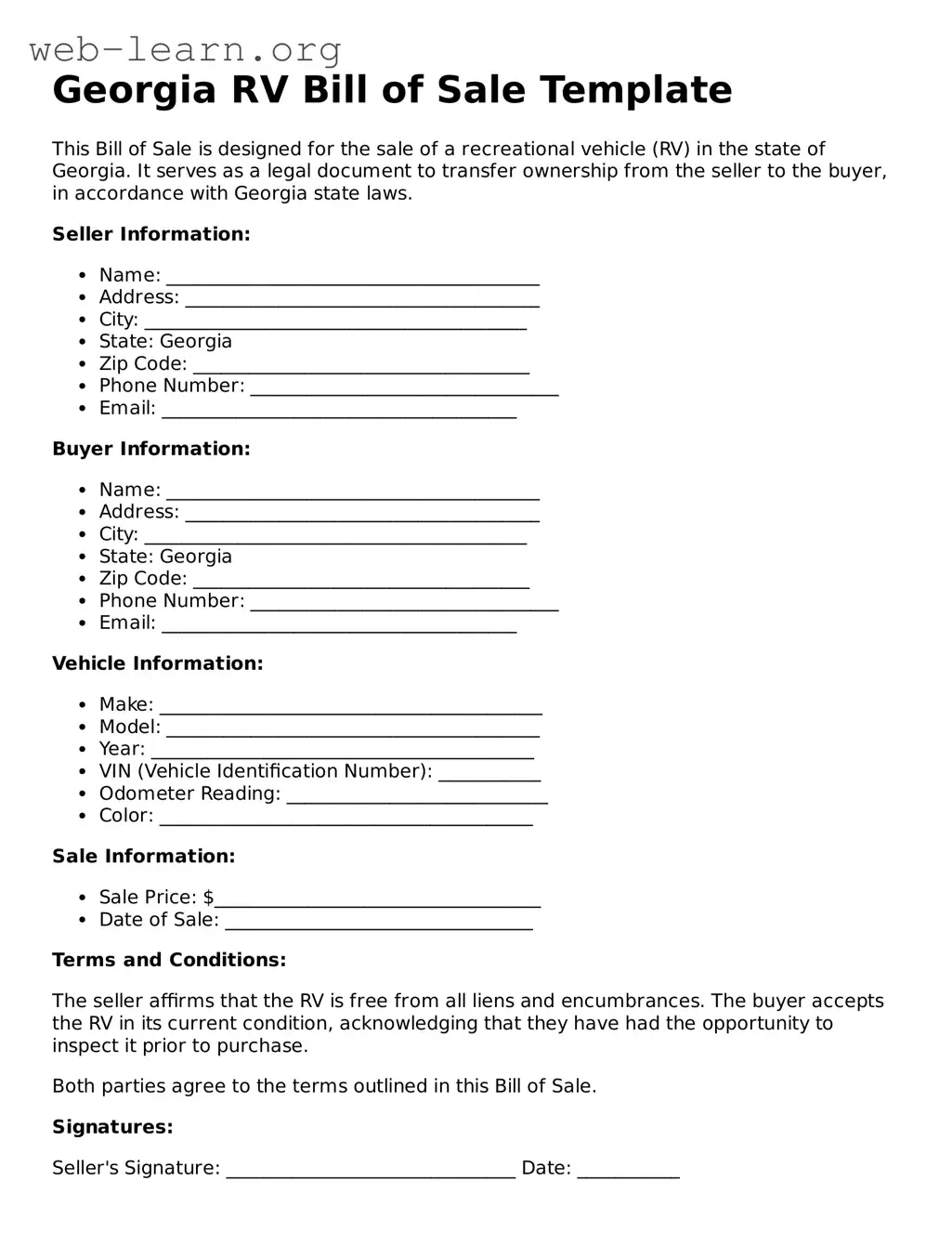
Georgia RV Bill of Sale Template
This Bill of Sale is designed for the sale of a recreational vehicle (RV) in the state of Georgia. It serves as a legal document to transfer ownership from the seller to the buyer, in accordance with Georgia state laws.
Seller Information:
Buyer Information:
Vehicle Information:
Sale Information:
Terms and Conditions:
The seller affirms that the RV is free from all liens and encumbrances. The buyer accepts the RV in its current condition, acknowledging that they have had the opportunity to inspect it prior to purchase.
Both parties agree to the terms outlined in this Bill of Sale.
Signatures:
Seller's Signature: _______________________________ Date: ___________
Buyer's Signature: _______________________________ Date: ___________
This document is effective as of the date signed by both parties.
| Fact Name | Details |
|---|---|
| Purpose | The Georgia RV Bill of Sale form is used to document the sale and transfer of ownership of a recreational vehicle in Georgia. |
| Governing Law | This form is governed by Georgia state law, specifically the Official Code of Georgia Annotated (O.C.G.A.) § 40-2-20. |
| Required Information | The form requires details such as the seller's and buyer's names, addresses, and the vehicle's identification number (VIN). |
| Signatures | Both the seller and buyer must sign the form to validate the transaction. |
| Notarization | While notarization is not mandatory, it is recommended to provide additional legal protection for both parties. |
| Usage | The completed form is essential for registering the RV in the new owner's name and for tax purposes. |
After obtaining the Georgia RV Bill of Sale form, you will need to accurately complete it to ensure a smooth transaction. This document serves as proof of the sale and provides essential information about the vehicle and the parties involved. Follow the steps below to fill out the form correctly.
A Georgia RV Bill of Sale is a legal document that records the sale of a recreational vehicle (RV) in the state of Georgia. It serves as proof of the transaction between the seller and the buyer. This document typically includes essential details such as the names and addresses of both parties, the RV's identification number, and the sale price.
The Bill of Sale is crucial for several reasons:
A complete Georgia RV Bill of Sale should include:
While it is not legally required for every RV sale, having a Bill of Sale is highly recommended. It provides a clear record of the transaction and can be beneficial for registration and title transfer processes.
Yes, you can create your own Bill of Sale. However, it is essential to ensure that all necessary information is included and that the document is signed by both parties. Using a standard form can help ensure that you cover all required details.
When filling out the Georgia RV Bill of Sale form, it’s easy to overlook certain details. One common mistake is not providing accurate vehicle information. Make sure to include the correct make, model, year, and Vehicle Identification Number (VIN). An incorrect VIN can lead to issues with registration and ownership transfer.
Another frequent error is failing to include the sale price. This detail is crucial for tax purposes and ensures that both parties agree on the transaction's value. Leaving this blank or writing an ambiguous amount can create confusion later on.
People often forget to sign the document. Both the seller and buyer must sign the Bill of Sale for it to be valid. Without signatures, the form is incomplete, and the transaction may not be recognized by the state.
Lastly, many individuals neglect to provide a date on the form. Including the date of the sale is important for record-keeping and helps establish when the ownership transfer occurred. Missing this detail can complicate future transactions or registrations.
When completing a transaction involving an RV in Georgia, several additional forms and documents may be necessary to ensure a smooth process. Each document serves a specific purpose, providing essential information for both the buyer and seller.
Gathering these documents can help facilitate a successful RV sale in Georgia. Each form plays a vital role in protecting the interests of both the buyer and seller, ensuring a clear and legal transfer of ownership.
The RV Bill of Sale form serves as an important document in the transaction of recreational vehicles. Similar documents can help facilitate various types of sales and transfers. Here are nine documents that share similarities with the RV Bill of Sale:
When filling out the Georgia RV Bill of Sale form, it is crucial to ensure accuracy and completeness. Here are some essential dos and don’ts to guide you through the process.
The Georgia RV Bill of Sale form is an important document for anyone buying or selling a recreational vehicle in the state of Georgia. However, several misconceptions can lead to confusion about its purpose and requirements. Below are four common misconceptions.
Some individuals believe that a bill of sale is optional when transferring ownership of an RV. In reality, a bill of sale serves as a legal record of the transaction and is crucial for both the buyer and seller. It provides proof of ownership and can be essential for registration purposes.
Many people think that the RV Bill of Sale must be notarized to be valid. In Georgia, notarization is not a requirement for the bill of sale. However, having it notarized can add an extra layer of security and authenticity to the document.
Some believe that a handwritten bill of sale is acceptable. While it is possible to create a handwritten document, using a standardized form is recommended. This ensures that all necessary information is included and reduces the risk of errors.
It is commonly assumed that only the seller is liable for any taxes associated with the sale of the RV. In Georgia, the buyer is typically responsible for paying sales tax upon registration of the vehicle. Understanding this responsibility is important for both parties involved in the transaction.
When filling out and using the Georgia RV Bill of Sale form, keep these key takeaways in mind:
Bill of Sale Michigan Vehicle - Helps to streamline the registration process with the Department of Motor Vehicles.
Where Do I Get a Bill of Sale - Ensures that both parties agree on the sale conditions.
Do You Need a Bill of Sale in Florida - Can be a vital document in case of future legal inquiries regarding the sale.