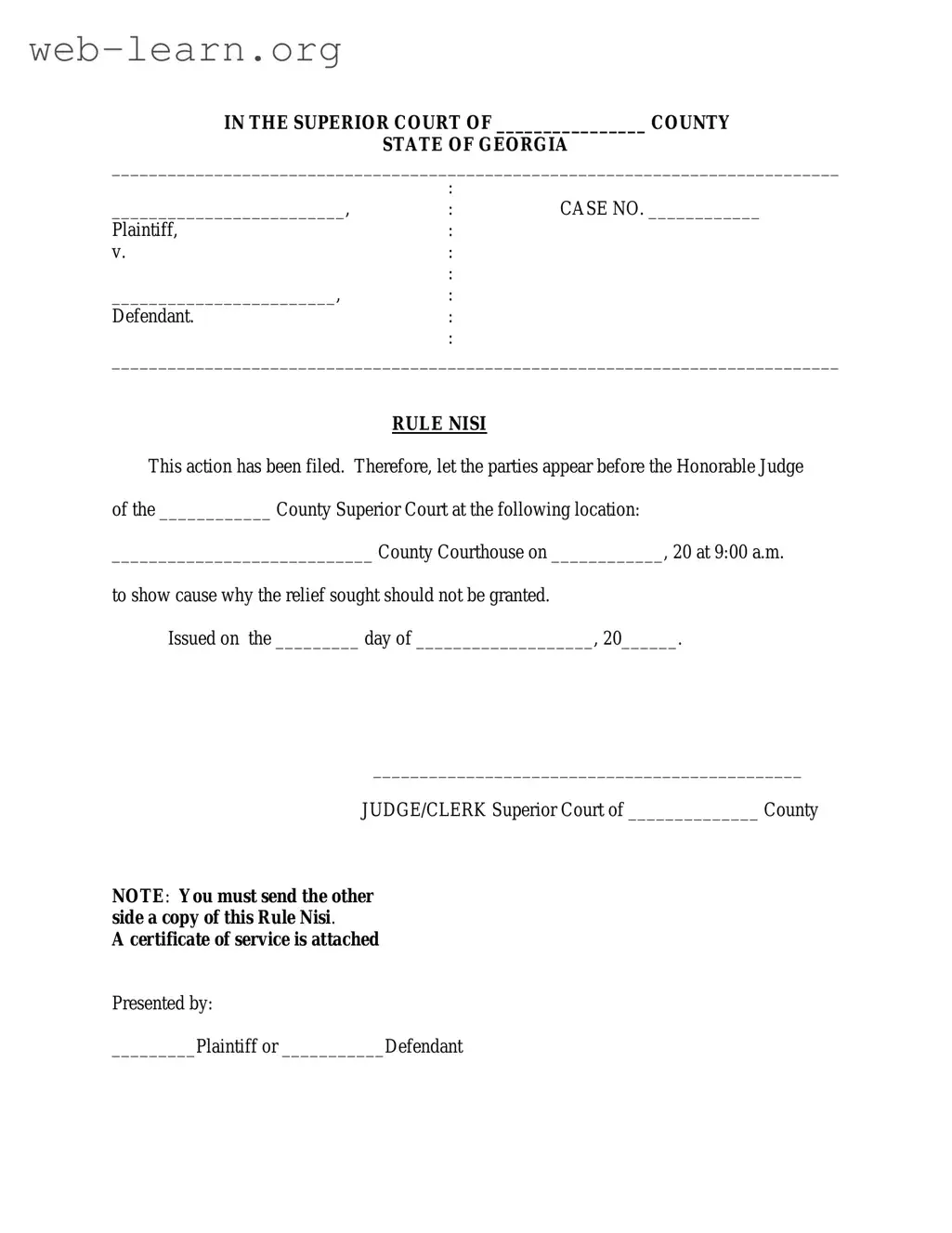
The Georgia Rule Nisi form is an essential document used within the Family Division of the Superior Court of Fulton County, particularly in cases involving legitimation. This form serves as a formal notice to a party, either the petitioner or the respondent, requiring them to appear before a judge to explain why certain requests outlined in a petition should or should not be granted. The form includes specific details such as the civil action file number, the date and time of the court appearance, and the courtroom number. It is critical for the involved parties to check the appropriate boxes indicating whether they are the petitioner or the respondent, as this clarifies their role in the proceedings. Additionally, the form must be signed by a deputy clerk, affirming its legitimacy and ensuring that all procedural requirements are met. Understanding the components and purpose of the Rule Nisi form is vital for anyone navigating the legal landscape in Georgia, as it helps facilitate communication and resolution in family law matters.
IN THE SUPERIOR COURT OF ________________ COUNTY
STATE OF GEORGIA
______________________________________________________________________________
|
: |
|
_________________________, |
: |
CASE NO. ____________ |
Plaintiff, |
: |
|
v. |
: |
|
|
: |
|
________________________, |
: |
|
Defendant. |
: |
|
|
: |
|
______________________________________________________________________________
RULE NISI
This action has been filed. Therefore, let the parties appear before the Honorable Judge of the ____________ County Superior Court at the following location:
____________________________ County Courthouse on ____________, 20 at 9:00 a.m.
to show cause why the relief sought should not be granted.
Issued on the _________ day of ___________________, 20______.
______________________________________________
JUDGE/CLERK Superior Court of ______________ County
NOTE: You must send the other side a copy of this Rule Nisi.
A certificate of service is attached
Presented by:
_________Plaintiff or ___________Defendant
IN THE SUPERIOR COURT OF ________________ COUNTY
STATE OF GEORGIA
______________________________________________________________________________
|
: |
|
_________________________, |
: |
CASE NO. ____________ |
Plaintiff, |
: |
|
v. |
: |
|
|
: |
|
________________________, |
: |
|
Defendant. |
: |
|
|
: |
|
______________________________________________________________________________
CERTIFICATE OF SERVICE
I hereby certify that I mailed a copy of the document entitled ________________ to the
following person:
Name of person to whom I mailed document: _______________________________
Address where I mailed document: |
_________________________________ |
|
_________________________________ |
Date I mailed document: |
_________________________________ |
_________________________________
Signature
________________________________
Printed Name
| Fact Name | Description |
|---|---|
| Governing Law | The Georgia Rule Nisi form is governed by the Georgia Code, specifically Title 19, which deals with domestic relations. |
| Purpose | This form is used to schedule a hearing for a petition for legitimation in family court. |
| Petitioner and Respondent | The form requires identification of both the Petitioner and Respondent, establishing the parties involved in the case. |
| Court Information | It specifies the Superior Court of Fulton County, Georgia, indicating the jurisdiction for the hearing. |
| Hearing Date | The form includes a section to fill in the date and time for the hearing, ensuring all parties are informed. |
| Clerk's Signature | A Deputy Clerk must sign the form, validating the order and confirming it has been officially filed. |
Filling out the Georgia Rule Nisi form is an important step in your legal process. Once completed, this form will be submitted to the court, initiating the next phase of your case. Follow these steps carefully to ensure accuracy and compliance.
What is the purpose of the Georgia Rule Nisi form?
The Georgia Rule Nisi form is a legal document used in family law cases, specifically in the context of legitimation. It serves as a notice to the parties involved that a hearing will take place, allowing one party to present their case to the court. The form outlines the details of the hearing, including the date, time, and courtroom.
Who files the Rule Nisi form?
The Rule Nisi form is typically filed by either the petitioner or the respondent in a legitimation case. This person is required to provide the necessary information to the court, including their name and the details of the hearing.
What information is required on the Rule Nisi form?
The form requires several key pieces of information:
What happens after the Rule Nisi form is filed?
Once the Rule Nisi form is filed, the court will schedule a hearing. Both parties will be notified of the date and time. It is essential for both parties to prepare their arguments and gather any necessary documentation to present at the hearing.
What is meant by "show cause" in the context of the Rule Nisi?
The term "show cause" means that the party must provide a valid reason or justification for their position in the case. During the hearing, the court will listen to both sides and determine whether to grant the requests made in the petition.
Can the hearing date be changed after the Rule Nisi is filed?
Yes, it is possible to request a change to the hearing date. However, this typically requires filing a motion with the court and providing a valid reason for the request. Both parties must agree to the new date, or the court must approve the change.
What should I do if I cannot attend the hearing?
If you are unable to attend the hearing, it is crucial to inform the court as soon as possible. You may need to file a motion to reschedule or provide a valid excuse for your absence. Failing to attend without proper notice may negatively impact your case.
What are the potential outcomes of the hearing?
The court may grant or deny the requests made in the petition. If granted, the court will issue an order reflecting its decision. If denied, the petitioner may have the option to appeal the decision, depending on the circumstances.
Where can I obtain a Georgia Rule Nisi form?
The Rule Nisi form can typically be obtained from the clerk's office at the Fulton County Superior Court Family Division or through their official website. It is essential to ensure that you are using the most current version of the form.
Filling out the Georgia Rule Nisi form can be straightforward, but many people make common mistakes that can delay their case. One frequent error is failing to provide complete information about the parties involved. Both the Petitioner and Respondent must be clearly identified, including their names and addresses. Omitting this information can lead to confusion and potential dismissal of the petition.
Another mistake involves not checking the appropriate boxes on the form. The instructions require you to indicate whether the Petitioner or Respondent is ordered to show cause. Neglecting to make this selection can result in a lack of clarity regarding who is responsible for appearing in court. Always double-check that you have marked the correct option.
Many individuals also overlook the importance of the date and time for the court appearance. It's essential to fill in the specific day, month, and year, as well as the time of the hearing. Leaving these fields blank or entering incorrect information can cause significant delays. Courts operate on strict schedules, and any inaccuracies can lead to rescheduling.
In addition, people often forget to sign the form. A signature is a crucial part of the document, indicating that the information provided is accurate and truthful. Without a signature, the court may not accept the form, leading to further complications in the legal process.
Lastly, failing to check for updates or revisions to the form can be a costly mistake. The Georgia Rule Nisi form has been revised periodically, and using an outdated version may result in the court rejecting your submission. Always ensure you are using the most current form available to avoid unnecessary setbacks.
The Georgia Rule Nisi form is an important document used in family law cases, particularly in matters involving legitimation. Alongside this form, there are several other documents that may be necessary to support the legal process. Below is a list of commonly used forms and documents that often accompany the Rule Nisi.
These documents play a crucial role in the legal process surrounding the Rule Nisi. Each form serves a specific purpose and contributes to ensuring that the proceedings are conducted fairly and efficiently. It is important to prepare these documents accurately to facilitate a smooth legal process.
The Georgia Rule Nisi form shares similarities with several other legal documents. Each serves a specific purpose in family law and civil proceedings. Below is a list of documents that are comparable to the Rule Nisi form:
When filling out the Georgia Rule Nisi form, it’s important to follow specific guidelines to ensure accuracy and completeness. Here are five things you should and shouldn't do:
Understanding the Georgia Rule Nisi form is essential for individuals navigating family law matters in Georgia. However, several misconceptions can lead to confusion. Here are six common misunderstandings about this form:
Clarifying these misconceptions can help individuals approach the Rule Nisi process with a better understanding and greater confidence.
Filling out and using the Georgia Rule Nisi form can be a straightforward process if you keep a few key points in mind. Here are some essential takeaways:
By following these guidelines, you can navigate the process more smoothly and ensure that your rights are protected throughout the legal proceedings.