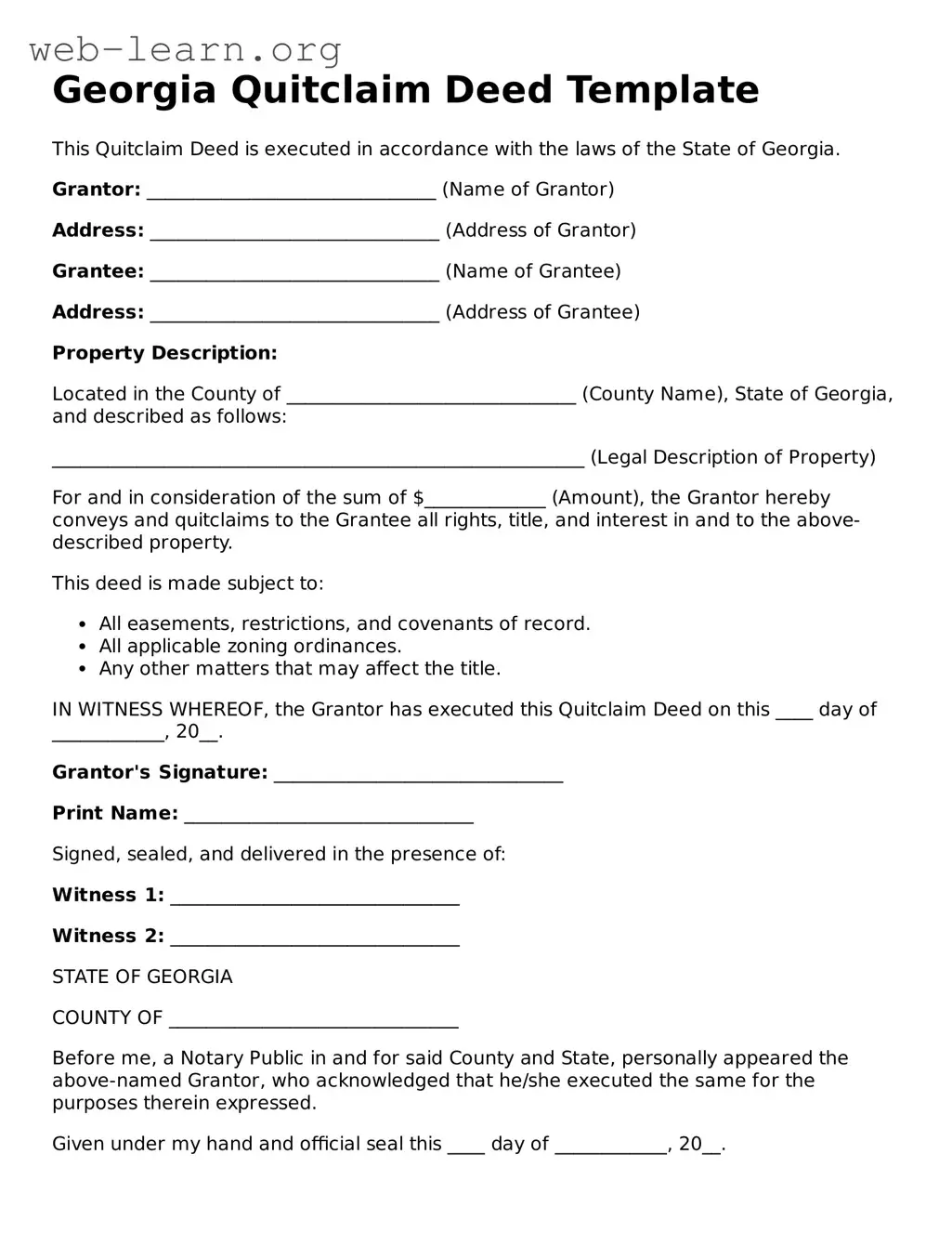
The Georgia Quitclaim Deed form serves as a vital instrument in the realm of property transactions, allowing property owners to transfer their interests in real estate to another party without guaranteeing the title's validity. This form is particularly useful in situations where the parties involved trust one another, such as between family members or friends. Unlike other types of deeds, a quitclaim deed does not provide any warranties or assurances regarding the property’s condition or title; it simply conveys whatever interest the grantor has at the time of the transfer. The form must include essential information, such as the names of the grantor and grantee, a legal description of the property, and the date of execution. Additionally, it requires the grantor's signature, which must be notarized to ensure the document's legality. Understanding the nuances of this form is crucial for anyone looking to navigate property transfers in Georgia effectively.
Georgia Quitclaim Deed Template
This Quitclaim Deed is executed in accordance with the laws of the State of Georgia.
Grantor: _______________________________ (Name of Grantor)
Address: _______________________________ (Address of Grantor)
Grantee: _______________________________ (Name of Grantee)
Address: _______________________________ (Address of Grantee)
Property Description:
Located in the County of _______________________________ (County Name), State of Georgia, and described as follows:
_________________________________________________________ (Legal Description of Property)
For and in consideration of the sum of $_____________ (Amount), the Grantor hereby conveys and quitclaims to the Grantee all rights, title, and interest in and to the above-described property.
This deed is made subject to:
IN WITNESS WHEREOF, the Grantor has executed this Quitclaim Deed on this ____ day of ____________, 20__.
Grantor's Signature: _______________________________
Print Name: _______________________________
Signed, sealed, and delivered in the presence of:
Witness 1: _______________________________
Witness 2: _______________________________
STATE OF GEORGIA
COUNTY OF _______________________________
Before me, a Notary Public in and for said County and State, personally appeared the above-named Grantor, who acknowledged that he/she executed the same for the purposes therein expressed.
Given under my hand and official seal this ____ day of ____________, 20__.
Notary Public: _______________________________
My Commission Expires: _______________________________
| Fact Name | Details |
|---|---|
| Definition | A quitclaim deed is a legal document used to transfer ownership of real estate from one party to another without any warranties regarding the title. |
| Governing Law | The Georgia Quitclaim Deed is governed by Georgia state law, specifically O.C.G.A. § 44-5-30 et seq. |
| Parties Involved | The form involves two parties: the grantor (seller) and the grantee (buyer). |
| Consideration | While a monetary exchange is common, a quitclaim deed can be executed with nominal or no consideration. |
| Title Transfer | The deed transfers whatever interest the grantor has in the property, but does not guarantee that the title is free of claims or encumbrances. |
| Usage | Quitclaim deeds are often used in situations like divorce settlements, property transfers between family members, or clearing up title issues. |
| Filing Requirements | After execution, the deed must be filed with the county clerk's office in the county where the property is located. |
| Notarization | The signature of the grantor must be notarized for the deed to be valid and enforceable. |
After you complete the Georgia Quitclaim Deed form, you will need to file it with the appropriate county office to ensure it is recorded. This step is crucial for establishing the legal transfer of property rights. Make sure to keep a copy for your records.
What is a Quitclaim Deed in Georgia?
A Quitclaim Deed is a legal document used to transfer ownership of real estate from one party to another. Unlike a warranty deed, which guarantees that the title is clear, a Quitclaim Deed offers no such assurances. It simply conveys whatever interest the grantor (the person transferring the property) has in the property, if any. This type of deed is often used between family members or in situations where the parties know each other well and trust the transaction.
When should I use a Quitclaim Deed?
Quitclaim Deeds are commonly used in specific situations, such as:
In these cases, a Quitclaim Deed can simplify the process and avoid the complexities of a warranty deed.
How do I complete a Quitclaim Deed in Georgia?
To complete a Quitclaim Deed in Georgia, follow these steps:
Are there any risks associated with using a Quitclaim Deed?
Yes, there are some risks to consider. Because a Quitclaim Deed does not guarantee that the grantor has a clear title, the grantee may inherit problems, such as liens or claims against the property. If the grantor does not actually own the property, the grantee may have no legal recourse. Therefore, it is advisable to conduct a title search or consult with a real estate attorney before proceeding with a Quitclaim Deed.
Can I revoke a Quitclaim Deed after it has been executed?
Once a Quitclaim Deed is executed and recorded, it cannot be unilaterally revoked. However, the parties involved can create a new deed to reverse the transaction. This would typically require the original grantee to transfer the property back to the original grantor. It's important to understand that any new deed must also be properly executed and recorded to be legally effective.
When completing a Georgia Quitclaim Deed form, individuals often encounter several common pitfalls. One significant mistake is failing to include the correct names of the grantor and grantee. The grantor is the person transferring the property, while the grantee is the person receiving it. If these names are misspelled or not listed correctly, it can lead to confusion and potential legal issues in the future.
Another frequent error is neglecting to provide a complete legal description of the property. A legal description is more than just the property address; it should include specific details that clearly identify the property boundaries. Without this information, the deed may be considered incomplete, which can complicate future transactions or ownership disputes.
People also often overlook the need for notarization. In Georgia, a Quitclaim Deed must be signed in front of a notary public to be considered valid. Failing to have the deed notarized can render it unenforceable, meaning the transfer of property may not be legally recognized.
Additionally, individuals sometimes forget to include the date of the transfer. While it may seem minor, the date is crucial for establishing the timeline of ownership. Without a date, it can be difficult to determine when the transfer took place, which can affect various legal aspects, including tax implications.
Finally, many individuals do not record the Quitclaim Deed with the county clerk's office after completion. Recording the deed is essential to protect the new owner's rights and to provide public notice of the property transfer. If the deed is not recorded, future buyers or creditors may not recognize the new ownership, leading to potential disputes.
The Georgia Quitclaim Deed is a legal document used to transfer ownership of real estate from one party to another without guaranteeing the title. When completing a property transfer, several other forms and documents may be required to ensure a smooth transaction. Below is a list of commonly used documents that often accompany the Quitclaim Deed in Georgia.
These documents play a crucial role in ensuring that the property transfer is executed properly and legally. It is advisable to review each document carefully and consult with a professional if needed to ensure compliance with all applicable laws and regulations.
The Quitclaim Deed is a specific legal document used to transfer ownership of property. However, several other documents serve similar purposes in property transactions. Here are six documents that share similarities with the Quitclaim Deed:
When filling out the Georgia Quitclaim Deed form, it's essential to follow specific guidelines to ensure accuracy and legality. Here are some key do's and don'ts:
When it comes to the Georgia Quitclaim Deed, many people hold misconceptions that can lead to confusion or mistakes. Understanding the truth behind these myths is crucial for anyone involved in property transactions. Here are eight common misconceptions:
By debunking these misconceptions, individuals can approach property transactions with a clearer understanding and make informed decisions. Always consider consulting with a legal professional to navigate the complexities of property deeds effectively.
Filling out and using a Georgia Quitclaim Deed form involves several important considerations. Here are some key takeaways to keep in mind:
Idaho Quit Claim Deed Form - This deed can facilitate the smooth transfer of property between business partners in a partnership dissolution.
How to Transfer Land Ownership - The grantee receives whatever interest the grantor has in the property.