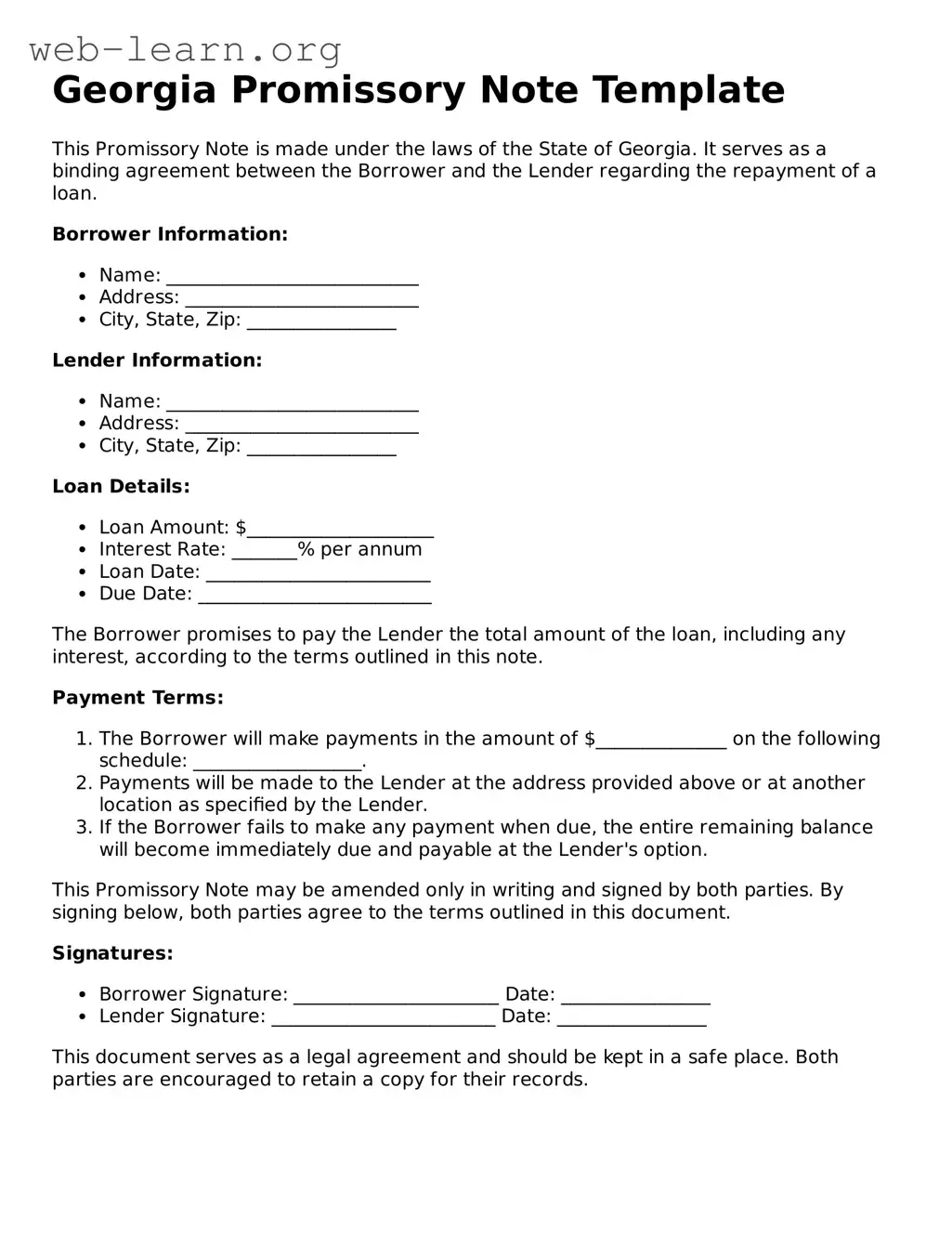
In Georgia, a Promissory Note serves as a crucial financial document that outlines the terms of a loan agreement between a borrower and a lender. This form typically includes essential details such as the amount borrowed, the interest rate, and the repayment schedule. It also specifies the consequences of default, ensuring both parties understand their rights and responsibilities. Often, the Promissory Note is secured by collateral, providing an added layer of protection for the lender. The simplicity and clarity of this document make it an essential tool for personal loans, business financing, and various other financial transactions. Understanding the components of a Georgia Promissory Note can help individuals navigate their financial commitments with confidence.
Georgia Promissory Note Template
This Promissory Note is made under the laws of the State of Georgia. It serves as a binding agreement between the Borrower and the Lender regarding the repayment of a loan.
Borrower Information:
Lender Information:
Loan Details:
The Borrower promises to pay the Lender the total amount of the loan, including any interest, according to the terms outlined in this note.
Payment Terms:
This Promissory Note may be amended only in writing and signed by both parties. By signing below, both parties agree to the terms outlined in this document.
Signatures:
This document serves as a legal agreement and should be kept in a safe place. Both parties are encouraged to retain a copy for their records.
| Fact Name | Description |
|---|---|
| Definition | A promissory note is a written promise to pay a specified amount of money to a designated party at a specified time. |
| Governing Law | The Georgia Promissory Note is governed by the Uniform Commercial Code (UCC) as adopted in Georgia. |
| Parties Involved | The note involves two primary parties: the maker (borrower) and the payee (lender). |
| Interest Rate | The interest rate on the note must be clearly stated. It can be fixed or variable. |
| Maturity Date | The maturity date indicates when the borrower must repay the principal amount and any interest due. |
| Payment Terms | Payment terms should specify how and when payments will be made, including any grace periods. |
| Default Clause | The note may include a default clause, outlining the consequences if the borrower fails to make payments. |
| Notarization | While notarization is not always required, it can enhance the enforceability of the note. |
| Transferability | Promissory notes can be transferred or assigned to another party unless otherwise restricted. |
After obtaining the Georgia Promissory Note form, you will need to carefully fill it out to ensure all necessary information is accurately recorded. This form serves as a written agreement between the borrower and the lender, outlining the terms of repayment. Follow the steps below to complete the form effectively.
Once you have completed the form, ensure that both parties retain a signed copy for their records. This will serve as a reference throughout the duration of the loan agreement.
What is a Georgia Promissory Note?
A Georgia Promissory Note is a legal document in which one party (the borrower) promises to pay a specific amount of money to another party (the lender) under agreed-upon terms. This document outlines the amount borrowed, the interest rate, payment schedule, and consequences for defaulting on the loan.
Who can use a Promissory Note in Georgia?
Any individual or business can use a Promissory Note in Georgia. It is commonly used for personal loans, business loans, and real estate transactions. Both parties should be of legal age and have the capacity to enter into a contract.
What are the key components of a Georgia Promissory Note?
Is a Promissory Note legally binding in Georgia?
Yes, a properly executed Promissory Note is legally binding in Georgia. Both parties must agree to the terms and sign the document. If the borrower fails to repay the loan, the lender can take legal action to recover the amount owed.
Does a Promissory Note need to be notarized in Georgia?
Notarization is not required for a Promissory Note to be valid in Georgia. However, having the document notarized can add an extra layer of authenticity and may be beneficial in case of disputes.
What happens if the borrower defaults on the Promissory Note?
If the borrower defaults, the lender has the right to pursue legal action to recover the owed amount. This may include filing a lawsuit or seeking a judgment against the borrower. The specific consequences should be outlined in the Promissory Note.
Can a Promissory Note be modified?
Yes, a Promissory Note can be modified if both parties agree to the changes. It is advisable to document any modifications in writing and have both parties sign the amended agreement to avoid future disputes.
Where can I obtain a Georgia Promissory Note template?
Templates for Georgia Promissory Notes can be found online through legal document websites or by consulting with a legal professional. Ensure that any template used complies with Georgia laws and is tailored to the specific loan agreement.
When filling out the Georgia Promissory Note form, individuals often make several common mistakes that can lead to complications later on. One frequent error is not including all necessary information. Essential details like the names of the borrower and lender, the loan amount, and the repayment terms must be clearly stated. Omitting any of this information can render the note invalid.
Another mistake is failing to specify the interest rate. The form requires a clear indication of whether the loan will accrue interest and, if so, what the rate will be. Leaving this section blank can lead to misunderstandings and disputes in the future.
Some people do not date the document correctly. A promissory note should include the date when the agreement is signed. Without a proper date, it may be difficult to enforce the terms of the loan or to establish a timeline for repayment.
Additionally, signatories sometimes forget to sign the document. Both the borrower and lender must provide their signatures for the note to be legally binding. A missing signature can invalidate the agreement and complicate any potential legal actions.
Another common oversight is not having the document notarized when required. While not all promissory notes need notarization, certain situations may call for it to ensure authenticity. Failing to notarize can lead to questions about the legitimacy of the agreement.
People also tend to overlook the importance of including a payment schedule. A clear repayment plan detailing when payments are due and how much is owed can prevent confusion. Without this, borrowers may not understand their obligations, leading to missed payments.
Some individuals mistakenly use vague language in the terms of the agreement. Clear and precise wording is crucial. Ambiguities can lead to different interpretations of the terms, which may result in disputes down the line.
Lastly, neglecting to keep a copy of the signed document is a significant error. Both parties should retain a copy of the promissory note for their records. This ensures that everyone has access to the agreed-upon terms and can refer back to them if necessary.
The Georgia Promissory Note is a crucial document for outlining the terms of a loan agreement between a borrower and a lender. To ensure a comprehensive understanding and protection for both parties, several additional forms and documents are often used in conjunction with the promissory note. Below is a list of these important documents.
Using these documents alongside the Georgia Promissory Note can help clarify the terms of the agreement and protect the interests of both parties involved. Proper documentation is essential for a smooth transaction and can prevent misunderstandings in the future.
When filling out the Georgia Promissory Note form, it's crucial to approach the task with care. A few simple guidelines can help ensure that the document is completed correctly and is legally binding.
Things You Should Do:
Things You Shouldn't Do:
Understanding the Georgia Promissory Note form can be tricky. Here are six common misconceptions that people often have:
By clearing up these misconceptions, individuals can better navigate the use of promissory notes in Georgia.
When filling out and using the Georgia Promissory Note form, there are several important points to keep in mind. These key takeaways will help ensure that the document serves its intended purpose effectively.
By paying attention to these key aspects, you can fill out the Georgia Promissory Note form accurately and ensure that it serves its purpose effectively.
Promissory Note Template Louisiana - They may include a grace period for late payments, depending on the agreement.
New York Promissory Note Requirements - The promissory note can be an effective way to document informal loans.
Promissory Note Friendly Loan Agreement Format - The enforceability of a promissory note depends on its compliance with state laws and regulations.
Promissory Note Friendly Loan Agreement Format - They are often used in business transactions to formalize lending arrangements.