In Georgia, a prenuptial agreement serves as a vital tool for couples preparing to marry, allowing them to outline their financial rights and responsibilities before entering into matrimony. This legally binding document addresses various aspects, including the division of assets and debts, spousal support, and the management of property acquired during the marriage. Couples can specify how their assets will be treated in the event of divorce or death, ensuring clarity and reducing potential conflicts in the future. The agreement must be in writing and signed by both parties to be enforceable, emphasizing the importance of transparency and mutual consent. Additionally, Georgia law requires that both individuals provide a fair disclosure of their financial situations prior to signing the agreement, fostering an environment of trust and understanding. By proactively addressing these matters, couples can create a solid foundation for their marriage while safeguarding their individual interests.
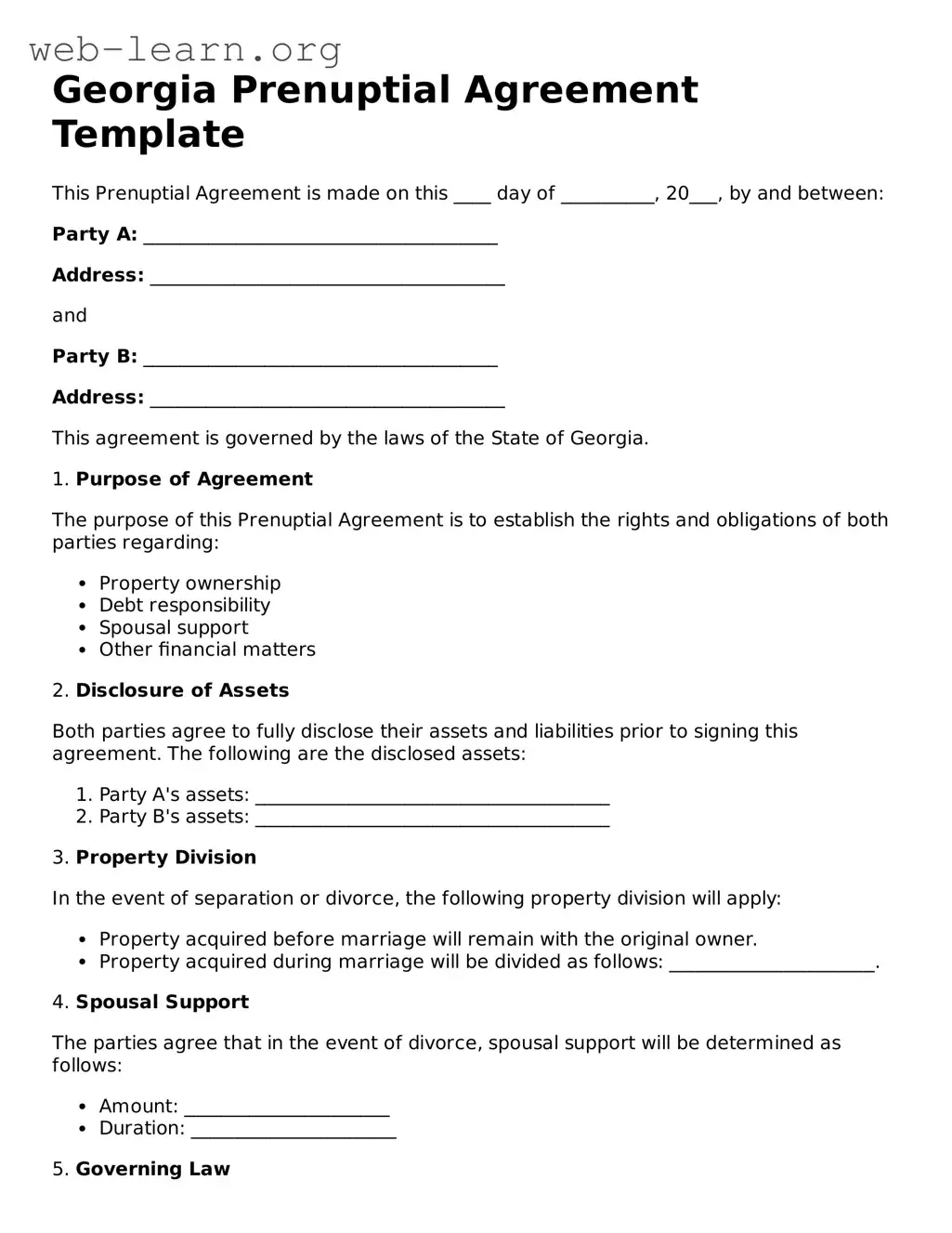
Georgia Prenuptial Agreement Template
This Prenuptial Agreement is made on this ____ day of __________, 20___, by and between:
Party A: ______________________________________
Address: ______________________________________
and
Party B: ______________________________________
Address: ______________________________________
This agreement is governed by the laws of the State of Georgia.
1. Purpose of Agreement
The purpose of this Prenuptial Agreement is to establish the rights and obligations of both parties regarding:
2. Disclosure of Assets
Both parties agree to fully disclose their assets and liabilities prior to signing this agreement. The following are the disclosed assets:
3. Property Division
In the event of separation or divorce, the following property division will apply:
4. Spousal Support
The parties agree that in the event of divorce, spousal support will be determined as follows:
5. Governing Law
This agreement will be governed by the laws of the State of Georgia. Any disputes arising from this agreement will be resolved in accordance with Georgia law.
6. Amendments
This agreement may be amended only by a written document signed by both parties.
7. Signatures
By signing below, both parties acknowledge that they have read and understood this Prenuptial Agreement and agree to its terms.
__________________________
Party A Signature
__________________________
Party B Signature
__________________________
Date
| Fact Name | Description |
|---|---|
| Governing Law | The Georgia Prenuptial Agreement is governed by the Georgia Uniform Premarital Agreement Act. |
| Purpose | This agreement outlines the financial and property rights of each spouse in the event of divorce or death. |
| Written Requirement | A prenuptial agreement must be in writing to be enforceable in Georgia. |
| Voluntary Execution | Both parties must enter into the agreement voluntarily, without coercion or undue influence. |
| Disclosure of Assets | Full and fair disclosure of assets and liabilities is required for the agreement to be valid. |
| Amendment and Revocation | Parties can amend or revoke the agreement at any time, provided it is in writing and signed by both parties. |
| Enforceability | The agreement may be challenged in court if it is found to be unconscionable or if there was a lack of disclosure. |
Filling out the Georgia Prenuptial Agreement form is an essential step for couples considering marriage. This document helps outline the financial rights and responsibilities of each partner in the event of a divorce or separation. It is important to approach this task thoughtfully to ensure that all necessary information is accurately recorded.
A prenuptial agreement, often referred to as a "prenup," is a legal document that a couple creates before getting married. It outlines how assets and debts will be divided in the event of a divorce or separation. In Georgia, this agreement can also address issues such as spousal support and property rights, providing clarity and protection for both parties.
Many couples opt for a prenuptial agreement to safeguard their individual assets and clarify financial responsibilities. It can be particularly beneficial for those entering a marriage with significant assets, business interests, or children from previous relationships. A prenup can help prevent disputes in the future and ensure that both parties have a clear understanding of their rights and obligations.
In Georgia, a prenuptial agreement must be in writing and signed by both parties. It is essential that both individuals fully disclose their assets and liabilities for the agreement to be enforceable. Additionally, both parties should have the opportunity to seek independent legal advice before signing to ensure that the agreement is fair and understood.
Yes, a prenuptial agreement can be modified or revoked at any time, provided that both parties agree to the changes. This must be done in writing and signed by both individuals. It is advisable to consult with a legal professional when making modifications to ensure that the changes are valid and enforceable.
If a couple does not have a prenuptial agreement in place, Georgia law will dictate how assets and debts are divided in the event of a divorce. This can lead to lengthy and potentially contentious legal battles, as courts will make decisions based on state laws rather than the couple's personal preferences.
Generally, prenuptial agreements are enforceable in Georgia as long as they meet the legal requirements. Courts will typically uphold these agreements unless they are found to be unconscionable or were signed under duress or without full disclosure of assets.
Creating a prenuptial agreement involves several steps. First, both parties should discuss their financial situations openly. Next, it is advisable to consult with legal professionals who specialize in family law to draft the agreement. After drafting, both parties should review the document, make any necessary changes, and sign it well before the wedding date.
While prenuptial agreements primarily focus on financial matters, couples can include certain non-financial aspects, such as responsibilities for household chores or guidelines for raising children. However, courts may not enforce these provisions if they are deemed contrary to public policy or if they interfere with child custody decisions.
Filling out a prenuptial agreement can be a daunting task, and many individuals make common mistakes that can lead to complications down the line. One prevalent error is failing to fully disclose all assets and debts. Transparency is crucial in a prenuptial agreement. If one party withholds information about their financial situation, it can lead to disputes later. Both parties should sit down together and list all their assets, liabilities, and income sources to ensure that nothing is overlooked.
Another frequent mistake is not having the agreement reviewed by a legal professional. While it may seem tempting to save money by filling out the form independently, the nuances of the law can be complex. A qualified attorney can provide valuable insights and ensure that the agreement complies with Georgia state laws. This step can prevent potential legal challenges in the future.
In addition, many people overlook the importance of including specific terms regarding spousal support or alimony. While it may feel uncomfortable to discuss these issues, addressing them upfront can save both parties from misunderstandings later. Clearly outlining expectations can lead to a smoother process if the marriage does not last as intended.
Another mistake involves using vague or ambiguous language. Clarity is key in a prenuptial agreement. Phrases that are open to interpretation can lead to disputes. It is advisable to use precise language and clearly define any terms used within the agreement. This will help both parties understand their rights and responsibilities.
Lastly, couples sometimes forget to sign the agreement in front of witnesses or a notary public. This step is essential to ensure the document is legally binding. Without proper signatures and notarization, the agreement may not hold up in court. Taking the time to complete this final step can provide peace of mind for both individuals.
When preparing for marriage, couples often consider a variety of legal documents to protect their interests and clarify their financial responsibilities. A prenuptial agreement is one such document, but it is frequently accompanied by other forms that serve complementary purposes. Below are several documents commonly used alongside the Georgia Prenuptial Agreement.
These documents, when used together, can provide a clearer understanding of each party's rights and responsibilities, fostering a sense of security and mutual respect in the marriage. Couples should consider consulting with a legal expert to ensure that all documents are properly drafted and tailored to their unique circumstances.
When filling out the Georgia Prenuptial Agreement form, it is essential to approach the process thoughtfully. A prenuptial agreement can help clarify financial responsibilities and protect individual assets. Here are some important dos and don'ts to consider:
By following these guidelines, you can create a prenuptial agreement that serves both parties' interests and fosters a sense of security as you enter into marriage.
Many people have misunderstandings about prenuptial agreements in Georgia. These misconceptions can lead to confusion and may affect decisions about marriage. Below are some common misconceptions explained clearly.
This is not true. Anyone can benefit from a prenuptial agreement, regardless of their financial status. It helps clarify expectations and protect both parties.
While discussing finances before marriage may feel awkward, it can actually strengthen a relationship. Open communication about financial matters is important for a healthy partnership.
This is a misconception. Prenuptial agreements are legally binding in Georgia if they meet certain requirements, such as being in writing and signed voluntarily by both parties.
Not everything can be included. Courts may not enforce provisions related to child custody or child support. These matters are determined based on the child's best interests.
While they are often thought of in the context of divorce, prenuptial agreements can also clarify financial responsibilities during the marriage.
This is incorrect. Both parties can agree to modify the agreement later. Changes must be documented in writing and signed by both individuals.
People in first marriages can also benefit from these agreements. They provide clarity and security for both partners, regardless of their marital history.
This is a misunderstanding. They can help couples discuss and manage financial expectations, which can lead to a more harmonious marriage.
This is not necessarily true. Many couples view prenuptial agreements as a way to protect their interests and ensure transparency, not as a sign of impending divorce.
Understanding these misconceptions can help couples make informed decisions about prenuptial agreements. Open discussions about finances can lead to a stronger foundation for marriage.
When considering a prenuptial agreement in Georgia, it’s important to understand the key aspects of the process. Here are some essential takeaways:
By keeping these points in mind, individuals can navigate the process of creating a prenuptial agreement more effectively and ensure that their interests are adequately protected.
Arizona Prenup - A prenuptial agreement can simplify the divorce process if needed.
Hawaii Prenup - It is important for both partners to fully disclose their financial situations when creating this document.
Alabama Prenup - This agreement can ensure that both parties are on the same page financially.